Have you ever read an argument that sounded like a pile of opinions dropped on the page? One sentence says school uniforms are good, the next gives a fact about bullying, then another suddenly mentions cost, and by the end you are not even sure what the writer believes. Strong argument writing does the opposite. It guides the reader step by step, showing exactly how each idea fits with the next. That smooth connection is called cohesion.
When writers make an argument, they want readers to understand not just what they think but why they think it. A clear argument moves like a bridge: each sentence connects to the next, and each part supports the whole. If those connections are weak, the reader may feel lost, confused, or unconvinced.
In argument writing, cohesion helps the reader follow the relationship among ideas. It shows how a reason supports a claim, how evidence proves a reason, how a counterclaim differs from the writer's main position, and how the writer answers that counterclaim. Cohesion is not just about adding transition words. It is about making the logic visible.
Cohesion is the smooth linking of ideas in writing so that readers can easily follow the relationships among them. In an argument, cohesion helps connect a claim, reasons, evidence, counterclaims, and rebuttals into one logical whole.
A cohesive argument sounds thoughtful and organized. It also sounds more formal. Instead of jumping from idea to idea, the writer explains the path. For example, a weak statement might say, "Later school start times are better. Teens are tired. Some schools changed their schedules." A more cohesive version says, "Later school start times are better because teenagers need more sleep. For example, some schools that changed their schedules reported better attendance." The second version makes the relationship clear.
An argument has several connected parts, as [Figure 1] shows. To write with cohesion, you need to understand what each part does and how each one links to the others.
A claim is the main point or position the writer wants the reader to accept. A claim answers a question or takes a side. For example: "Schools should start later in the morning."
A counterclaim is the opposing view. It shows that the writer understands another side of the issue. For example: "Some people argue that later start times would interfere with after-school sports."
A reason explains why the claim makes sense. It gives support for the writer's position. For example: "Teenagers learn better when they are well rested."
Evidence is the information that supports a reason. It may come from facts, statistics, examples, observations, or credible sources. For example: "According to sleep researchers, many middle school students do not get enough sleep on school nights."
A rebuttal answers the counterclaim. It explains why the opposing view is less convincing or why the writer's claim still stands. For example: "Although later start times may affect activities, schools can adjust practice schedules, while the benefit to student health is much more important."
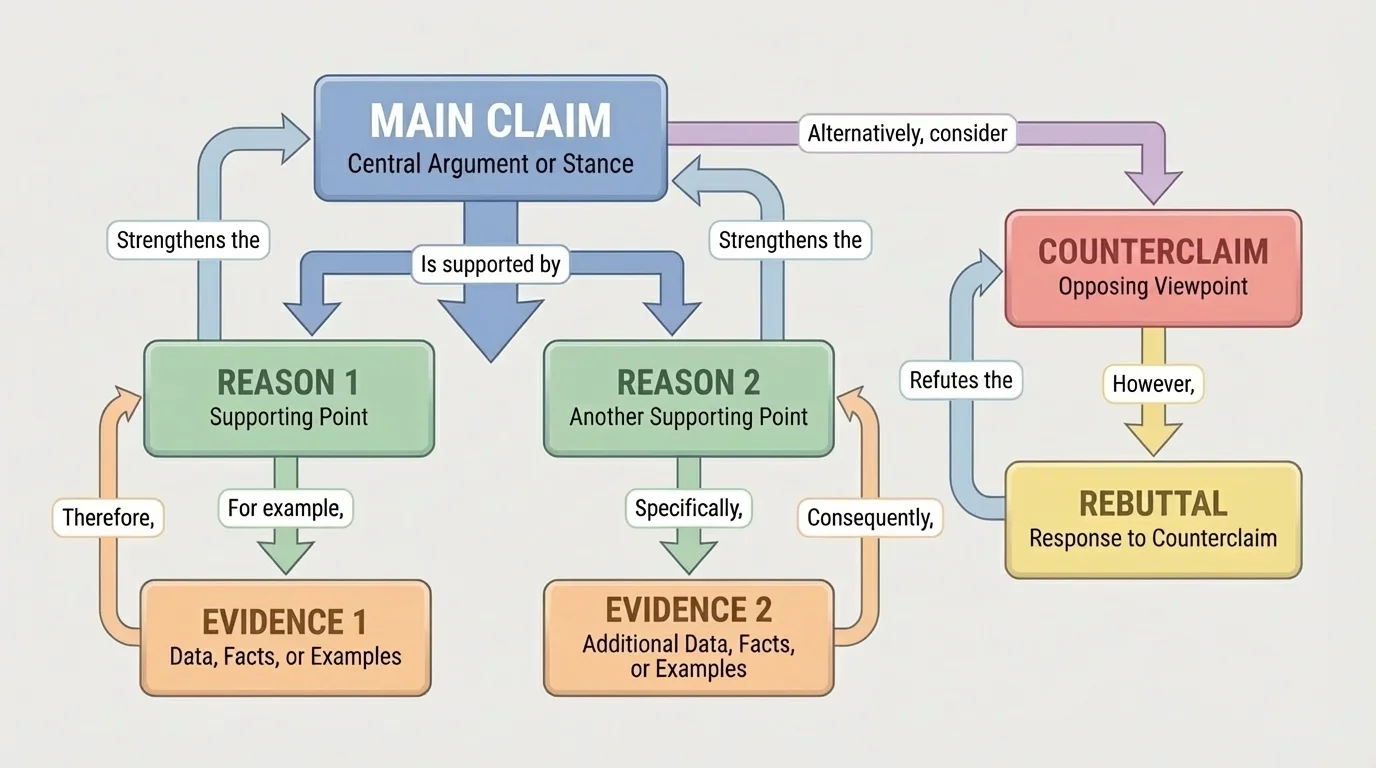
Notice that these parts should not appear as isolated pieces. They should connect like links in a chain. The claim leads to reasons. The reasons lead to evidence. The counterclaim introduces an opposing idea, and the rebuttal responds to it. If one link is missing or unclear, the reader may not understand the full argument.
Arguments are not just opinions. A strong argument includes a clear position, support for that position, and an explanation of how the support proves the point.
You can think of argument writing as building a case. A lawyer in court does not simply shout a conclusion. The lawyer presents reasons, shows evidence, considers the other side, and responds. Writers do the same thing with words on a page.
One major way to create cohesion is to use connecting words and phrases. These are often called transitions. Different transitions show different relationships, and [Figure 2] organizes them by purpose.
Some words and phrases show addition. These help when you are adding another reason or another piece of evidence. Common examples include also, in addition, furthermore, and another reason is. Example: "School gardens improve science learning. In addition, they teach students responsibility."
Some transitions show cause and effect. These help explain why one idea leads to another. Examples include because, since, therefore, as a result, and this means that. Example: "Students move more during the day; as a result, they may focus better in class."
Some transitions show examples or evidence. These make it clear that proof is coming. Examples include for example, for instance, according to, such as, and research shows. Example: "Many schools have seen improvements. For instance, one district reported fewer tardies after changing start times."
Some transitions show contrast or introduce a counterclaim. Examples include however, on the other hand, some people argue, although, and even though. Example: "Some people argue that uniforms limit self-expression. However, many schools report that uniforms reduce distractions."
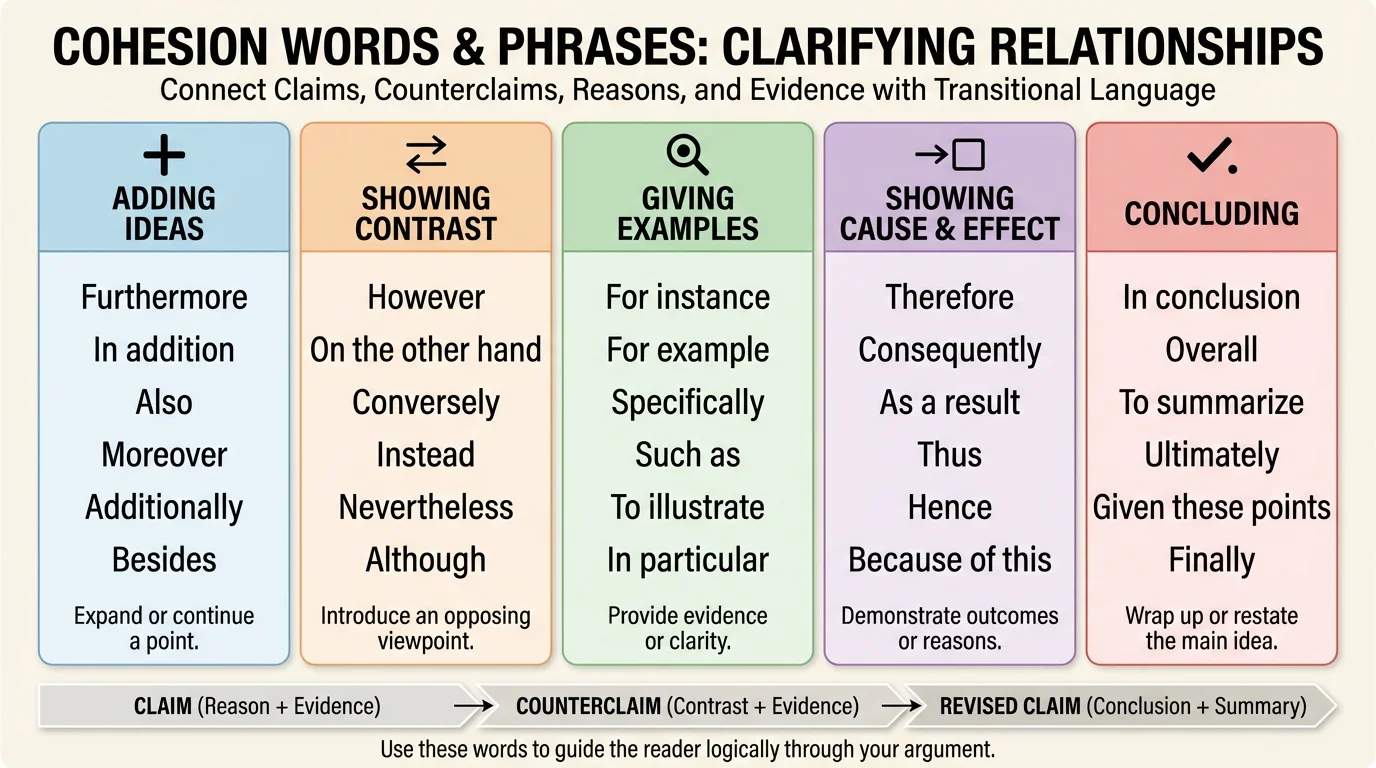
Some transitions show conclusion or importance. Examples include therefore, for these reasons, clearly, and this shows that. Example: "For these reasons, schools should provide more time for physical activity."
Good writers choose transitions that match the relationship they want to show. If you use however, readers expect a contrast. If you use for example, readers expect evidence. If the transition does not match the logic, the writing feels confusing.
| Purpose | Useful words and phrases | What they signal |
|---|---|---|
| Adding ideas | also, in addition, furthermore, another reason | A new supporting point is coming |
| Showing cause/effect | because, since, therefore, as a result | One idea leads to another |
| Giving evidence | for example, for instance, according to, research shows | Proof or support is coming |
| Showing contrast | however, although, on the other hand, yet | An opposing or different idea appears |
| Concluding | therefore, clearly, for these reasons, this shows that | The writer is wrapping up a point |
Table 1. Categories of words and phrases that create cohesion in argument writing.
Transitions work best when they are natural, not forced. Using too many can make writing sound mechanical: "First, also, furthermore, therefore, however..." Instead, choose the clearest transition only where you truly need it. Cohesion comes from logic as well as wording.
Professional writers often revise transitions several times. A single change from also to however can completely change the meaning of a paragraph.
Writers do not create cohesion only with single words. They also use clauses, which are groups of words containing a subject and a verb. Clauses help explain relationships in more complete and precise ways.
A clause can show cause: "Schools should serve healthier lunches because students need nutritious food to learn well." The clause beginning with because explains why the claim is reasonable.
A clause can show contrast: "Although some students dislike uniforms, uniforms can reduce peer pressure about clothing." The clause beginning with although introduces a counterclaim before the writer's response.
A clause can show condition: "If schools provide recycling bins in every classroom, more students will recycle regularly." This type of clause helps a writer explain what must happen for a result to occur.
A clause can show time or sequence: "When students have access to books at home, they often read more frequently." This pattern helps connect one situation to another result.
Clauses are useful because they let writers pack clear relationships into one sentence. Compare these two versions: "Video games can be educational. Some teach problem-solving." This is understandable, but the link is weak. Now read: "Video games can be educational because some games teach problem-solving skills." The second sentence is more cohesive because the clause explains the connection directly.
How clauses strengthen argument writing
Clauses help writers move beyond simple lists of facts. They show exactly how ideas fit together: one idea causes another, contrasts with another, or depends on another. This makes an argument sound more logical and more mature.
You can also combine clauses with evidence: "School gardens should be expanded because students learn science through hands-on observation, and according to one school report, science engagement increased after a garden program began." Here, the clauses and phrases work together to connect claim, reason, and evidence.
Strong argument paragraphs work like linked chains of thinking, and [Figure 3] highlights where those links appear. Each sentence should grow naturally from the one before it.
Here is a less cohesive paragraph:
"Schools should have longer lunch periods. Students feel rushed. Some students say longer lunch would reduce class time. Lunch is important. A survey showed many students do not finish eating."
This paragraph has useful ideas, but the relationships are not clear. Now read a more cohesive version:
"Schools should have longer lunch periods because students need enough time to eat and reset before returning to class. According to a student survey, many students report that they do not finish eating during short lunch periods. This evidence suggests that the current schedule does not meet students' needs. Some people argue that longer lunches would reduce learning time; however, students may focus better after eating properly, so the extra time can support learning rather than harm it."
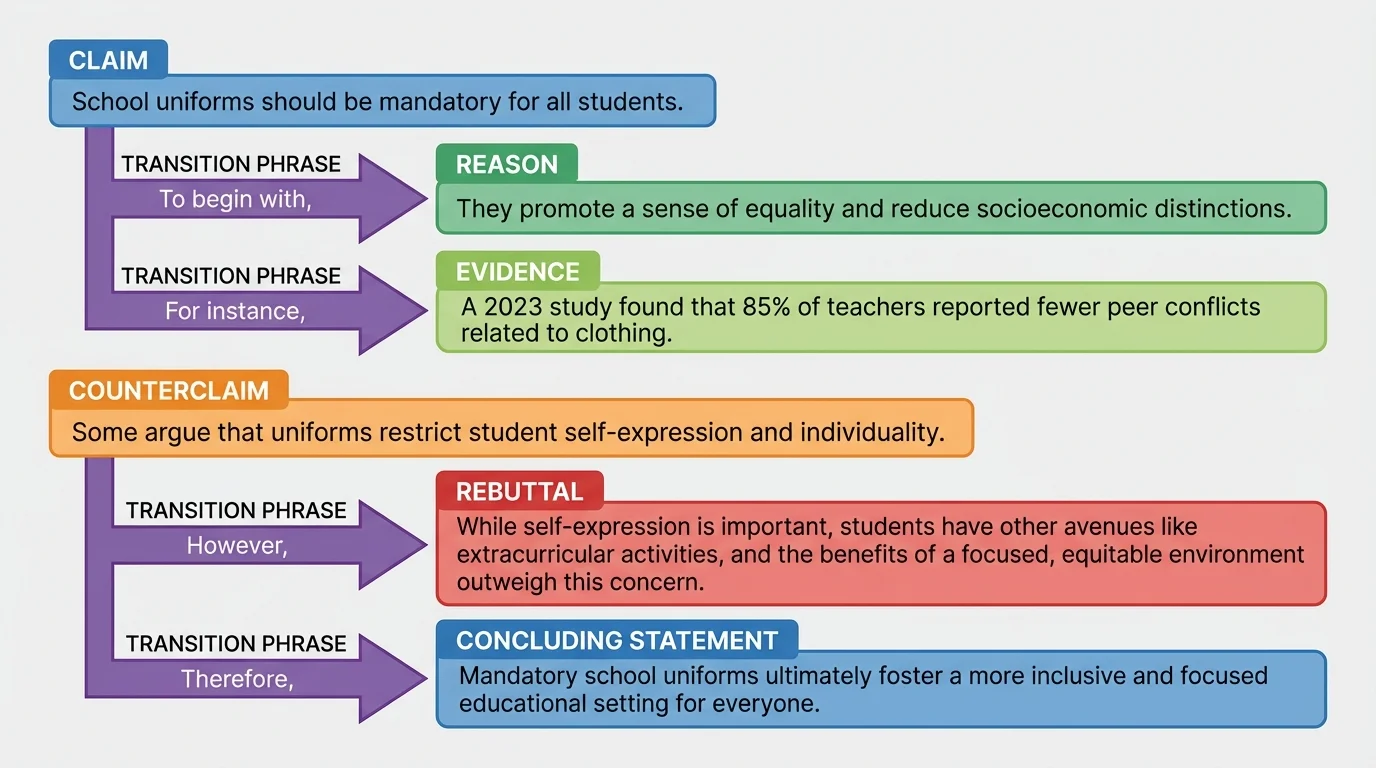
In the improved paragraph, every sentence has a job. The first sentence states the claim and gives a reason. The second brings in evidence. The third explains what the evidence means. The fourth presents a counterclaim, and the fifth rebuts it. The relationships are visible because of words, phrases, and clauses.
Example: Building cohesion in an argument paragraph
Topic: Should cities create more bike lanes?
Step 1: State the claim with a reason.
"Cities should create more bike lanes because they make travel safer for cyclists."
Step 2: Add evidence with a clear signal.
"For example, some cities have reported fewer bicycle accidents after protected lanes were added."
Step 3: Explain how the evidence supports the claim.
"This evidence shows that well-designed bike lanes can reduce danger on busy roads."
Step 4: Introduce a counterclaim and respond.
"Although some drivers worry that bike lanes take up space, safer streets benefit the whole community."
The paragraph feels unified because each sentence connects clearly to the one before it.
Notice the importance of explanation. Evidence alone is not enough. Writers must tell readers how the evidence supports the reason. Without that link, facts may seem dropped into the paragraph. As we saw earlier in [Figure 1], evidence is one part of a larger structure, not a separate piece.
One common mistake is writing a list of points instead of a connected argument. A student may include several facts, but if the writing does not explain how they relate, the paragraph feels scattered.
Another problem is using unclear pronouns. For example: "The school changed the rule, and this was unfair." What does this refer to exactly? The rule? The change? The result? A clearer sentence would say, "The new rule was unfair because students were not allowed to explain their concerns."
A third problem is adding evidence without naming the source or connection. Saying "Studies prove it" is vague. Better writing says, "According to a health study, students who sleep more often perform better in class." Then the writer should explain why that evidence matters.
Another mistake is using transitions that do not fit. For example: "Uniforms reduce distractions. However, students can focus better." The word however signals contrast, but the second sentence actually supports the first one. A better transition would be therefore or as a result.
Writers also weaken cohesion when they mention a counterclaim but never answer it. If you introduce another side, readers expect a response. Otherwise, the opposing view may seem stronger than your own. The structure in [Figure 3] reminds us that a counterclaim should connect to a rebuttal, not stand alone.
"Good writing is clear thinking made visible."
Revision is where cohesion often becomes strongest. First drafts usually contain the main ideas, but revision improves the links among them. When you revise, read your paragraph slowly and ask: How does each sentence connect to the one before it?
Look for places where you can add a word, phrase, or clause to make the relationship clearer. You might add because to explain a reason, for example to introduce evidence, however to present a counterclaim, or although to combine two related ideas into one clear sentence.
Also revise for formal style. Formal style means using clear, respectful language instead of slang or casual talk. For example, "Kids hate this rule because it's dumb" is too informal for an academic argument. A more formal version would be, "Many students oppose this rule because they consider it unfair." The second sentence sounds more credible and appropriate for school writing.
As you revise, check for repeated sentence openings. If every sentence starts with "This shows," "This shows," "This shows," the paragraph may sound repetitive. Vary your structure while keeping the logic clear. You can write, "This evidence suggests," "As a result," "According to the report," or "Although some people disagree." The transition chart in [Figure 2] helps you choose language that fits the job.
One useful revision method is to underline your claim in one color, your reasons in another, and your evidence in a third. Then ask whether the links between colors are clear. If a fact appears with no explanation, add a sentence that tells what it proves. If a counterclaim appears with no rebuttal, add a response. If a sentence seems out of place, move it or rewrite it.
Strong cohesion does not mean every sentence is long. Short sentences can be effective too, as long as the relationships are clear. For example: "Plastic waste harms oceans. As a result, many communities are limiting single-use bags." The link is direct and easy to follow.
When your writing is cohesive, readers can trace your thinking from beginning to end. They see the claim, understand the reasons, trust the evidence, recognize the counterclaim, and follow the rebuttal. That is what makes an argument not just organized, but convincing.
