A short piece of writing can sound finished even when it really says almost nothing. For example, a student might write, "Volcanoes are dangerous and interesting." That sentence is true, but it leaves a reader with questions: How are volcanoes dangerous? Why are they interesting? What facts, examples, or details help us understand them? Strong informative writing does more than name a topic. It opens the topic up so the reader can actually learn from it.
To develop a topic means to expand an idea with enough clear, relevant information that readers understand it well. In informative and explanatory writing, this usually begins with a central idea and then adds supporting material that teaches the reader something important.
Topic development is not the same as making writing longer. A paragraph can be long and still weak if it repeats itself or adds random facts. Good development happens when each sentence adds useful meaning. The writer selects information carefully, explains it, and connects it to the topic.
Topic development is the process of building an idea with relevant information so readers understand the subject clearly and completely. Strong development often includes facts, definitions, specific details, quotations, examples, and explanations that connect back to the main idea.
Think of a topic sentence as the frame of a house. The frame gives shape, but people cannot live in it yet. Facts, details, examples, and explanations are like walls, windows, wiring, and doors. Without them, the structure is incomplete.
Strong development uses several kinds of support because no single kind of information can do every job. As shown in [Figure 1], a definition may explain what something is, but an example helps the reader picture it. A fact may prove a point, while a quotation may add an expert voice.
One useful kind of support is a fact. A fact is information that can be checked for accuracy. If you are writing about the Amazon rainforest, a fact might be that it stretches across several South American countries. Facts make writing trustworthy because they are based on evidence.
Another important kind of support is a definition. Definitions explain what a word, process, or idea means. If a writer mentions renewable energy, readers may need a definition: renewable energy is energy from sources that are naturally replaced, such as sunlight or wind. Definitions are especially helpful when a topic includes unfamiliar vocabulary.
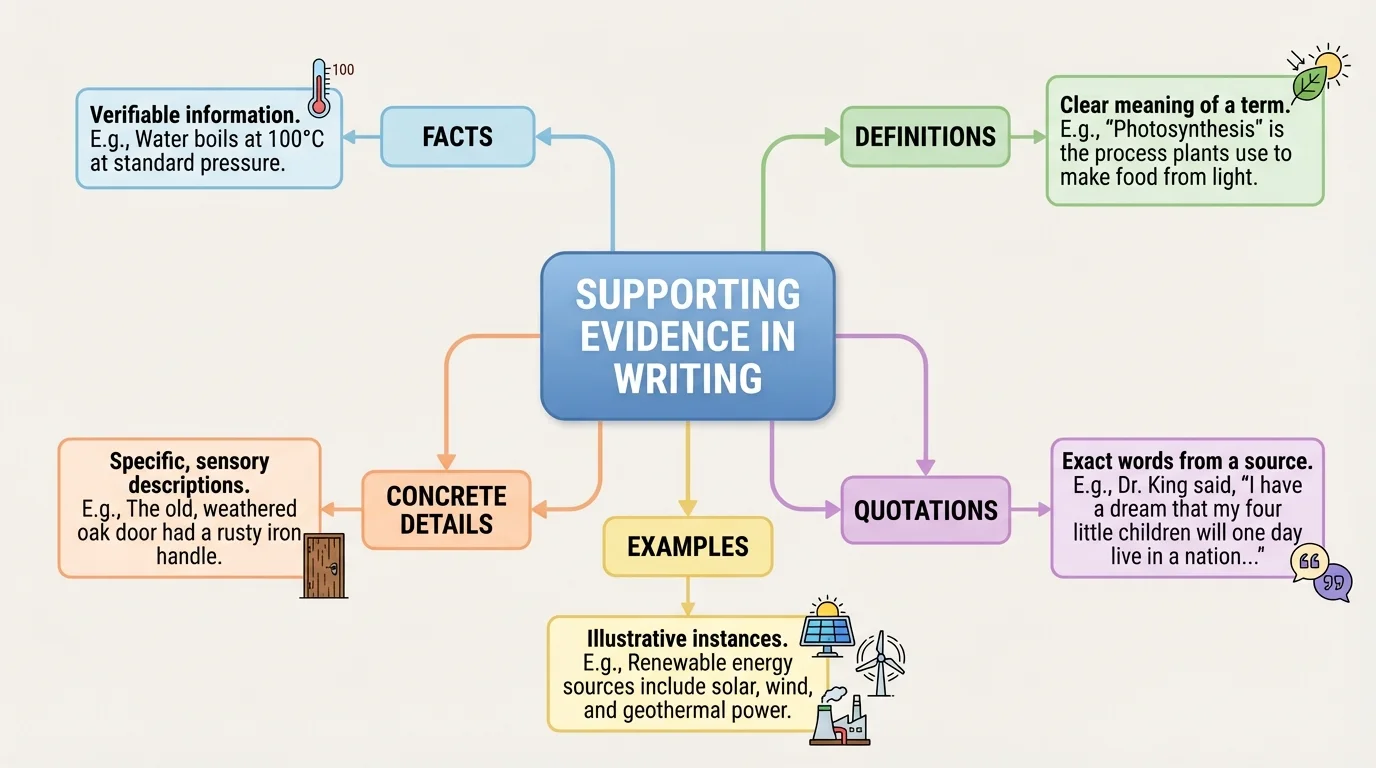
Concrete details are specific pieces of information that help readers see, hear, imagine, or understand the topic more clearly. Instead of saying, "The desert is hot," a writer could say, "Daytime temperatures in some deserts rise above 100°F." Specificity creates a sharper picture in the reader's mind.
A quotation includes the exact words of a speaker or writer. Quotations can add authority, emotion, or perspective. For example, in a report about perseverance, a writer might include Thomas Edison's statement, "I have not failed. I've just found 10,000 ways that won't work." A quotation becomes stronger when the writer explains why it matters.
An example shows an idea in action. If you write that communities are finding new ways to reduce waste, you might include the example of a city that banned certain single-use plastics. Examples move writing from general statements to real situations.
Writers may also use statistics, descriptions, comparisons, anecdotes, or observations. Even though these forms are different, they all serve the same purpose: they help readers understand the topic more completely. Effective writing often combines several kinds of support instead of relying on only one.
Professional writers in science, journalism, and history rarely depend on a single detail to explain something important. They often combine data, definitions, examples, and quotations because readers understand complex ideas better when information comes from more than one angle.
This is why the sentence "Recycling is good for the planet" is only a starting point. A developed explanation might define recycling, explain how it reduces landfill waste, give an example of materials that can be reused, and include a fact about resource conservation.
Not every interesting detail belongs in every piece of writing. Relevant information directly helps explain the topic. If you are writing about how earthquakes affect buildings, details about famous mountain climbers may be interesting, but they are not relevant.
Writers choose relevant information by asking three questions: What is my topic? What is my purpose? Who is my audience? A report for classmates should be clear and focused. The writer does not need every fact in the world; the writer needs the facts that help these readers understand this topic.
Suppose your topic is school gardens. If your purpose is to explain how school gardens help students learn, relevant details might include how students measure plant growth, observe insects, and learn about nutrition. A long discussion about the history of farming in ancient civilizations might be fascinating, but if it does not support your explanation, it may distract the reader.
Relevance depends on purpose. A detail is relevant when it helps the writer achieve a goal. The same fact may be useful in one piece and unhelpful in another. For example, the average size of a soccer field matters in an article about sports design, but not in an essay about teamwork on a soccer team.
Good writers are selective. They do not pour every note into the paragraph. They sort, choose, and keep only what strengthens the main idea.
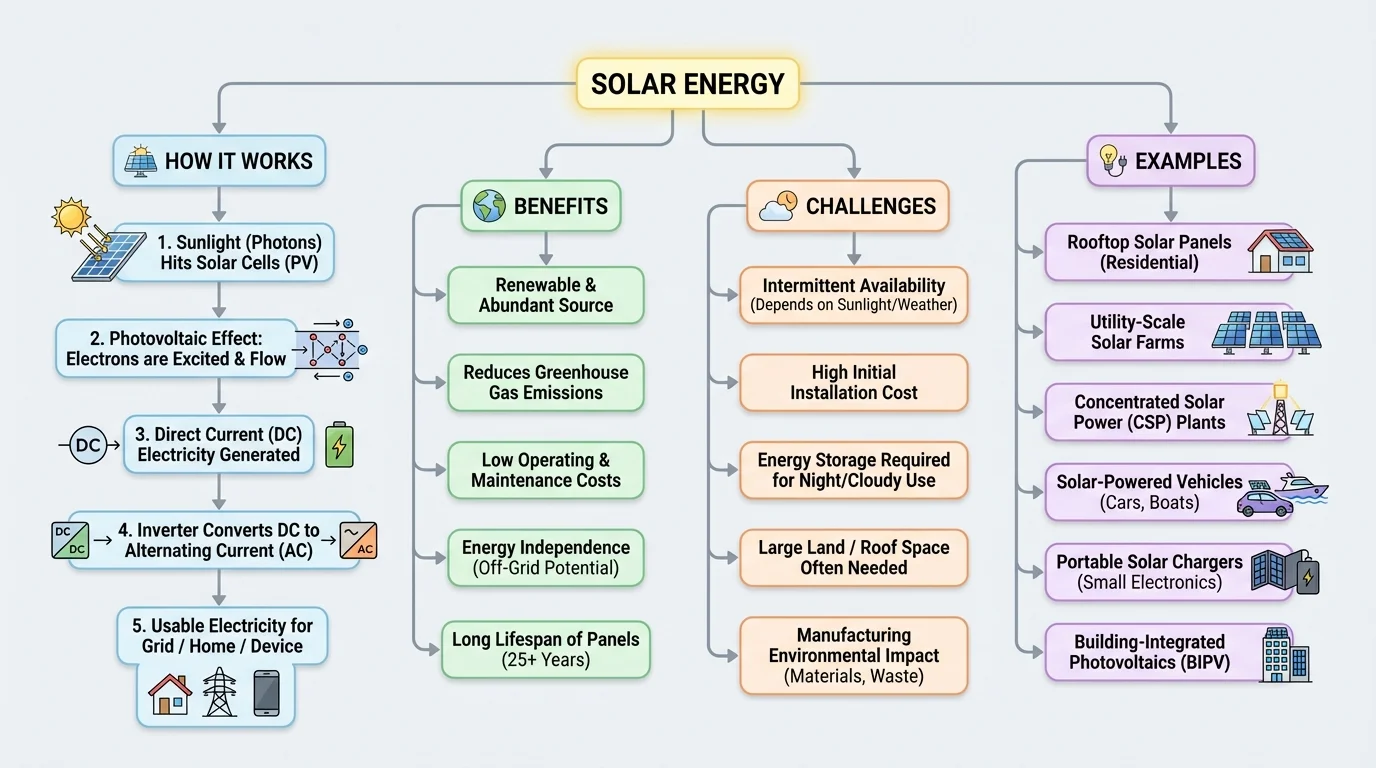
Readers understand information more easily when it is arranged in clear groups. As shown in [Figure 2], even strong facts can feel confusing if they are placed in a random order. Organization helps readers follow the writer's thinking.
One common way to organize information is by category. If you are writing about solar energy, you might group ideas into how solar panels work, benefits of solar energy, challenges, and real-world uses. Another structure is sequence, which works well when explaining steps or processes. Cause and effect, comparison and contrast, and problem and solution are also useful structures.
A useful test is this: if a reader shuffled your supporting details around, would the writing still make sense? In well-organized writing, the answer is no, because the order matters. The sequence guides understanding.
Transitions also help development. Words and phrases such as for example, in addition, as a result, because, and in contrast show how ideas connect. These words act like bridges. They make relationships visible instead of forcing readers to guess.
When a writer groups related points together, each section becomes easier to expand. That is one reason outlines help. A simple outline can turn a pile of notes into a logical explanation. Grouped ideas create a path for both writer and reader.
| Structure | Best Used For | Example Topic |
|---|---|---|
| Category | Explaining parts or aspects of a topic | Types of renewable energy |
| Sequence | Showing steps or stages | How a bill becomes a law |
| Cause and effect | Explaining reasons and results | Effects of drought |
| Compare and contrast | Showing similarities and differences | Public and private transportation |
| Problem and solution | Explaining an issue and responses | Reducing plastic waste |
Table 1. Common ways to organize information in informative writing.
Students can see the difference between an underdeveloped and well-developed paragraph. As shown in [Figure 3], a weak paragraph usually states an idea but does not teach much. A stronger paragraph adds layers of information.
Consider this weak paragraph: "Bees are important. They help plants. Without bees, nature would change." The idea is true, but it is too general. It needs facts, details, and explanation.
Building a stronger paragraph about bees
Step 1: Start with a clear topic sentence.
"Bees are important because they help many plants reproduce through pollination."
Step 2: Add a definition or explanation.
Pollination happens when pollen is moved from one flower to another, allowing plants to produce seeds and fruit.
Step 3: Add a fact or detail.
Many crops, including apples, almonds, and blueberries, depend on pollinators.
Step 4: Add an example.
If bees visit apple blossoms in an orchard, the trees are more likely to produce fruit.
Step 5: Explain why the information matters.
This means bees support both natural ecosystems and food production for people.
The paragraph is now more informative because each sentence adds a new and useful layer.
Notice what changed. The improved paragraph does not just repeat "bees are important" in different words. Instead, it explains how bees are important and why readers should care.
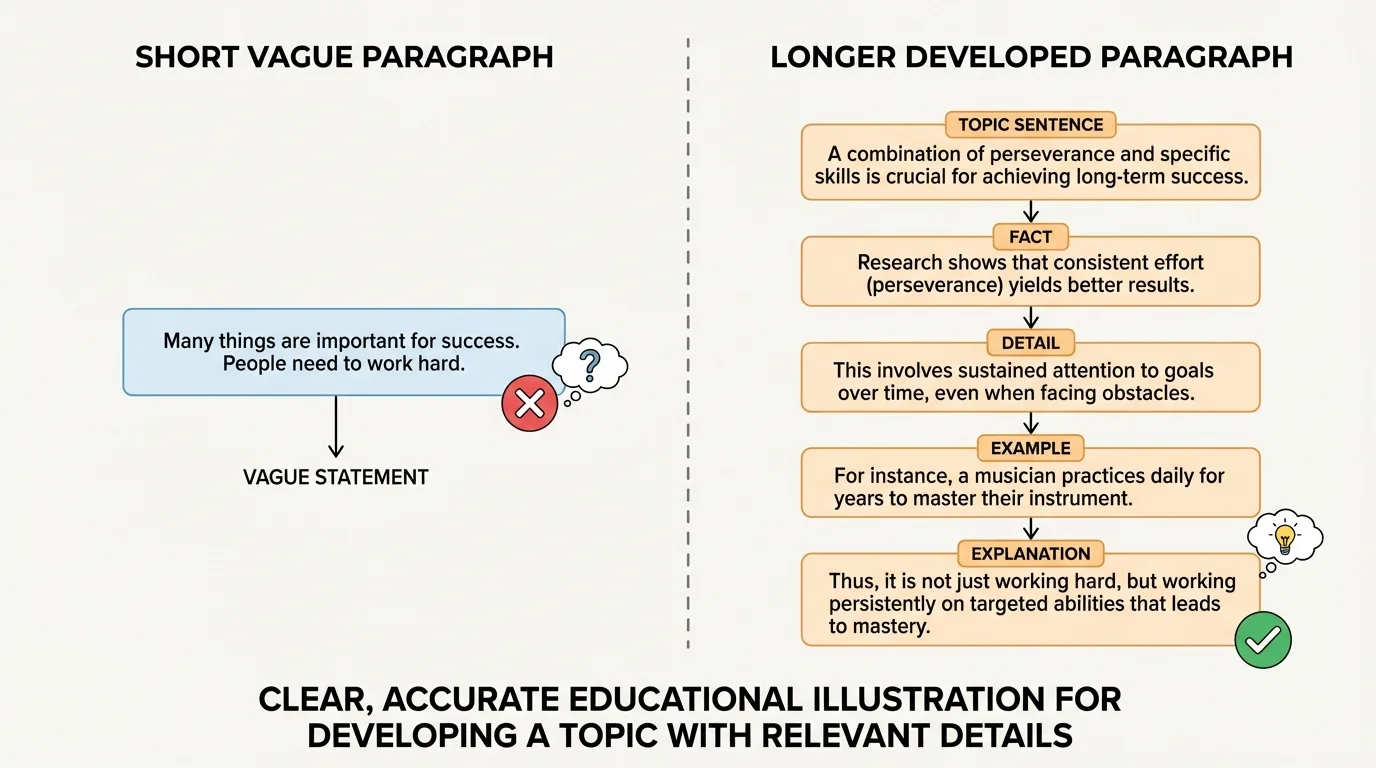
This same method works with almost any topic. If the topic is space exploration, the writer can define a rover, add facts about a mission, describe conditions on Mars, and explain what scientists learn. If the topic is exercise, the writer can define aerobic activity, give examples such as running or swimming, and explain how regular activity affects health. The pattern stays the same: state, support, explain.
When revising, ask yourself: Have I answered the reader's likely questions? If not, the paragraph probably needs more development. The diagram remains useful here because it highlights the parts that turn a simple statement into a meaningful explanation.
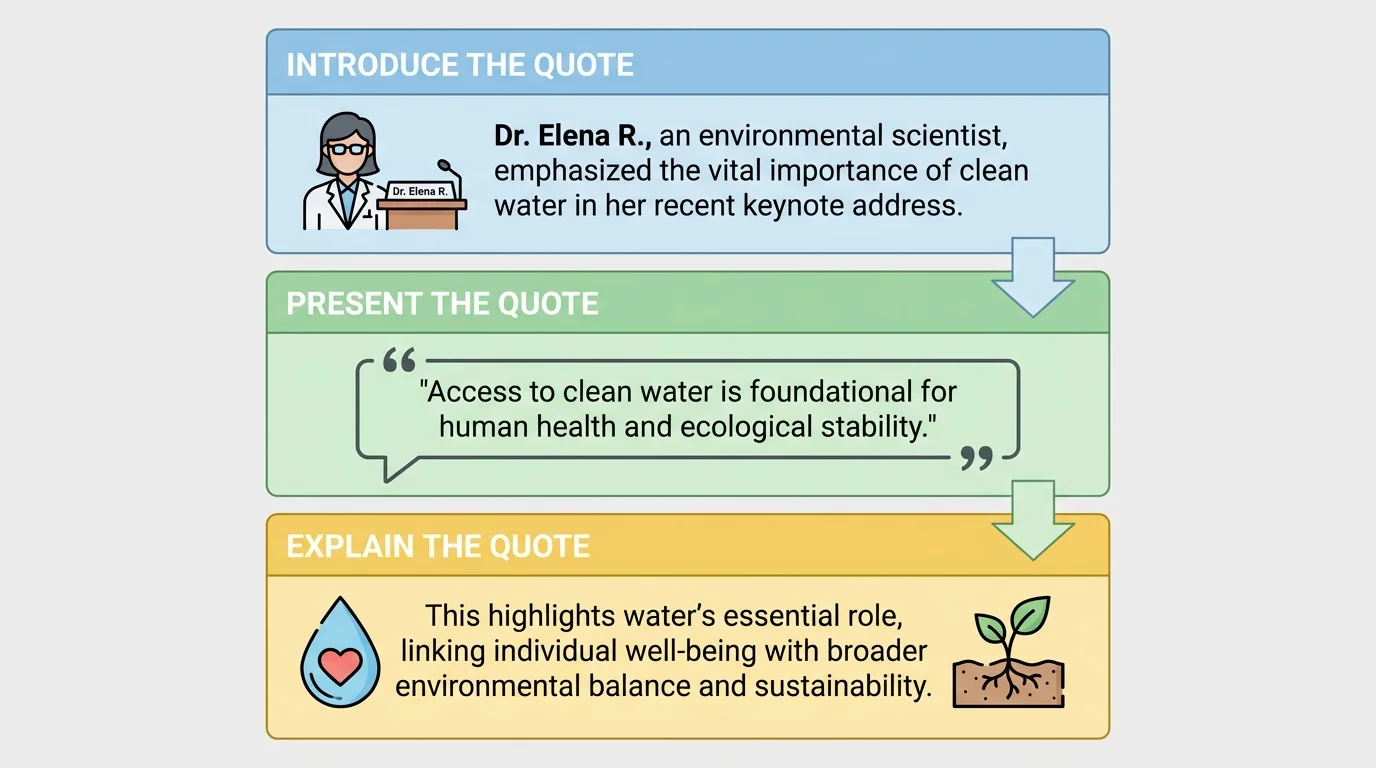
Quotations should be framed and interpreted rather than dropped into writing without context. As shown in [Figure 4], a quotation is strongest when the writer introduces it, presents it, and then explains it.
Suppose you are writing about access to clean water. You might introduce a quotation by naming the speaker and topic: A public health expert explains that clean water is one of the most important tools for preventing disease. Then you provide the quotation. After that, you explain what the quotation means and how it supports your point.
This approach is sometimes informally called a quote sandwich. The introduction is one piece of bread, the quotation is the filling, and the explanation is the other piece of bread. Without the explanation, the reader may not understand why the quotation is included.
Examples work in a similar way. They should not be thrown in without connection. If you mention that some cities are redesigning streets for safety, give a specific example and then explain what it proves. For instance, a city might add protected bike lanes and wider sidewalks. The writer should then explain that these changes can reduce traffic injuries and encourage more walking and biking.
A quotation or example does not speak for itself. The writer must do the work of interpretation. Later, when you review your draft, use the same idea: ask whether every quotation is introduced and explained, and whether every example clearly connects to the main idea.
"The art of writing is the art of discovering what you believe."
— Gustave Flaubert
That quotation reminds us that writing is not just repeating information. It is also thinking carefully about what information matters and how to present it clearly.
Good topic development depends not only on what information a writer chooses, but also on how that information is expressed. Precise language uses exact words instead of vague ones. Instead of saying "a lot of pollution," a writer might say "air pollution from vehicle exhaust and factory smoke." The second version is clearer and more informative.
Formal style means writing in a way that sounds respectful, clear, and appropriate for school or academic work. It does not mean using giant words to sound smart. It means avoiding slang, careless wording, and overly casual phrases such as "stuff," "things," or "kind of."
Compare these two sentences: "There are lots of things in the ocean that are bad for animals." "Plastic waste in the ocean harms marine animals when they swallow it or become tangled in it." The second sentence is stronger because it names the problem directly and explains the harm.
Earlier writing lessons often focus on topic sentences and supporting details. Those ideas still matter here. What changes now is depth: instead of adding just any detail, writers choose details that are accurate, specific, and clearly connected to the main idea.
Formal style also helps build trust. Readers are more likely to believe and learn from writing that sounds careful and informed. That is especially important in informative texts, where the goal is to explain rather than entertain alone.
One common problem is repetition. A writer may restate the same idea several times without adding anything new. For example: "Exercise is good for you. It helps your body. It is healthy." These sentences circle the topic but do not develop it. A better version would explain types of exercise, health benefits, and examples of how the body responds.
Another problem is irrelevant detail. If a piece about earthquakes spends half a paragraph describing a vacation at the beach, the writing loses focus unless the beach story somehow supports the main topic.
A third problem is making a claim without support. Saying "school uniforms improve learning" is only a claim unless the writer adds facts, examples, observations, or quotations that explain the statement.
Fixing an unsupported claim
Weak sentence: "Reading every day is important."
Step 1: Add a reason.
"Reading every day is important because it strengthens vocabulary and comprehension."
Step 2: Add a concrete detail.
Students who read often encounter new words in context, which helps them understand how those words are used.
Step 3: Add an example.
A student reading a science article may learn words such as habitat, climate, and adaptation while also learning the topic itself.
Step 4: Explain significance.
Because reading builds both knowledge and language, it supports success in many school subjects.
Writers can also overload a paragraph with facts but forget to explain them. A list of statistics may impress readers for a moment, but if the writer does not tell readers what the numbers mean, the paragraph still feels incomplete. Development requires both information and explanation.
Look at this model paragraph: "Community libraries remain important because they provide free access to information, technology, and learning spaces. Many libraries lend not only books but also computers, internet access, and digital materials. For students who do not have reliable internet at home, this access can make research and homework possible. Libraries also offer programs such as reading clubs, homework help, and workshops. According to the American Library Association, libraries help connect people with resources they might not otherwise have. This matters because equal access to information supports education, job skills, and community participation."
This paragraph works because it has a clear main idea and several kinds of support. It includes facts about what libraries offer, a concrete detail about internet access, a quotation-based reference to an organization, and an explanation of why the information matters. The sentences are connected, not random.
Now compare that with a weaker version: "Libraries are useful places. They have books and other things. People go there for different reasons. Libraries are still around today." The second paragraph is not wrong, but it is too thin. It leaves the reader with only a vague impression.
Development is explanation plus evidence. Evidence includes facts, definitions, examples, and quotations. Explanation tells readers how that evidence connects to the main idea. When writers include evidence without explanation, or explanation without evidence, the writing becomes weaker.
This principle matters in every subject. In science, students explain processes with facts and observations. In history, they support claims with dates, events, and sources. In technology writing, they define systems and describe how they work. In everyday life, people use the same skill when explaining a rule, giving directions, reviewing a product, or persuading someone with reasons.
Developing a topic well is really an act of respect for the reader. It says: I will not leave you with a half-built idea. I will give you the information you need, organize it clearly, and explain why it matters.
