A soccer field, a garden bed, a tablet screen, and a stained-glass window can all look very different, but they share one big math idea: area. Area tells how much flat space a shape covers. Some shapes are easy to measure, like rectangles. Others look trickier. The good news is that many hard-looking shapes become manageable when you cut them into familiar pieces or combine them into a shape you already know how to measure.
When workers install tile, they need to know how much floor space must be covered. When someone designs a park, they need to know how much grass, mulch, or pavement is needed. In geometry, area helps us compare shapes and solve problems about space. The unit for area is always a square unit, such as \(\textrm{cm}^2\), \(\textrm{m}^2\), or \(\textrm{ft}^2\).
Remember: A rectangle's area is found by multiplying its length by its width. If a rectangle is \(8\) units long and \(5\) units wide, then its area is \(8 \times 5 = 40\) square units.
This idea is the starting point for many other shapes. If you can find the area of a rectangle, you can often find the area of a triangle, a trapezoid, or even a many-sided polygon by cutting and rearranging parts.
Area is the amount of space inside a closed figure. For rectangles, the formula is
\[A = l \times w\]
where \(l\) is length and \(w\) is width. A square is a special rectangle with equal side lengths, so its area is side times side.
Suppose a rectangular notebook cover measures \(9\) inches by \(6\) inches. Its area is \(9 \times 6 = 54\) square inches. This simple rule becomes powerful because many shapes can be broken into rectangles or compared to rectangles.
Base is the side used with the height when finding area. Height is the perpendicular distance from the base to the opposite side or opposite vertex. Compose means put shapes together to make a larger shape. Decompose means break a shape into smaller, simpler parts.
One important detail is that the height must make a right angle with the base. A slanted side is not always the height.
[Figure 1] A right triangle is especially friendly because it can be seen as half of a rectangle with the same base and height. If you draw a diagonal across a rectangle, the rectangle splits into two congruent right triangles.
Because a rectangle has area \(b \times h\), one of those triangles has half that area. So the area formula for a triangle is
\[A = \frac{1}{2}bh\]
Here, \(b\) is the base and \(h\) is the height.
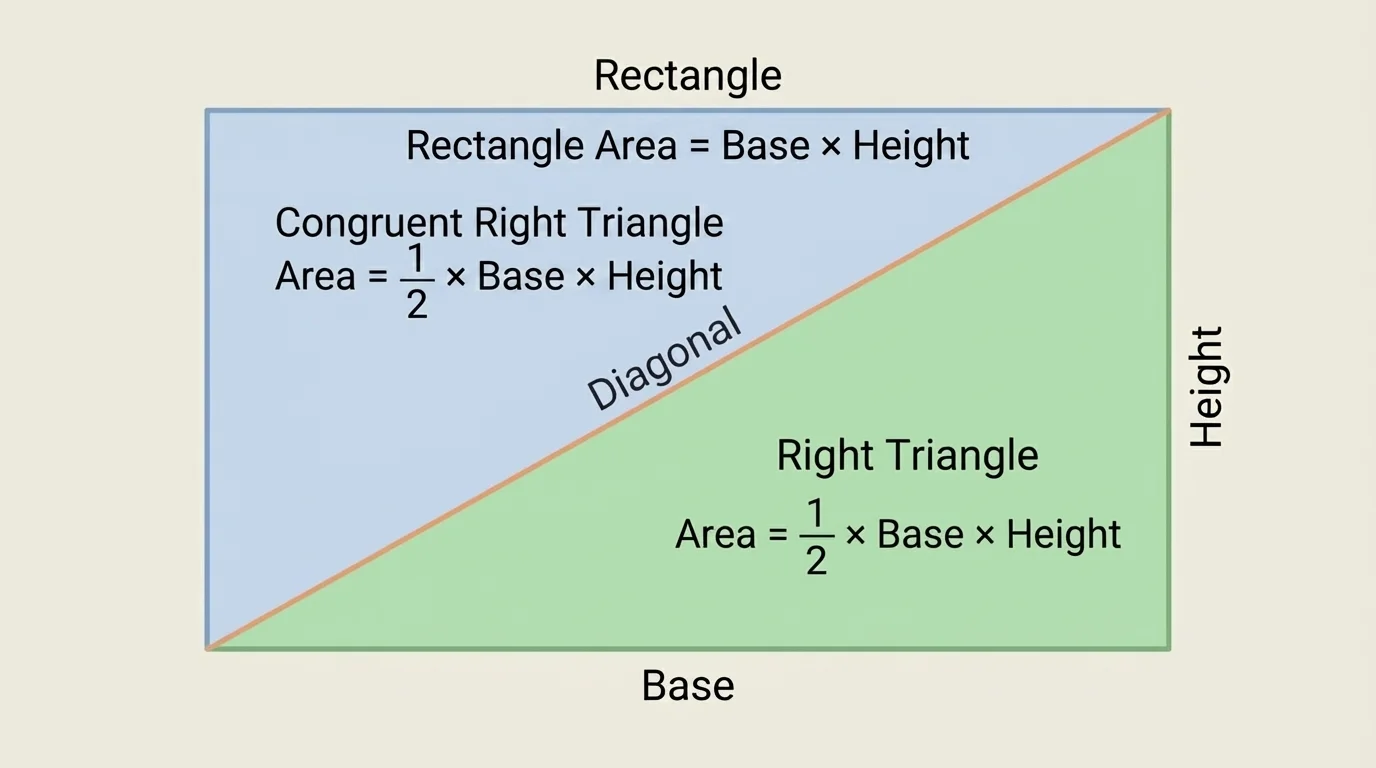
If a right triangle has base \(10\) units and height \(7\) units, then its area is \(\dfrac{1}{2} \cdot 10 \cdot 7 = 35\) square units. Notice that the legs of a right triangle often serve as the base and height because they meet at a right angle.
This rectangle connection helps you estimate and check your work. If a triangle fits exactly into half of a \(10\)-by-\(7\) rectangle, its area should be half of \(70\), which is \(35\). That is the same result we got with the formula.
[Figure 2] Not all triangles are right triangles. Some are slanted, but their area still depends on the same formula, \(A = \dfrac{1}{2}bh\). The important part is choosing a base and the matching height, with a perpendicular segment drawn to the base.
For a non-right triangle, the height may fall inside the triangle or even outside it. You may need to draw a line segment from a vertex straight down to the base, forming a right angle. That perpendicular segment is the height, not the slanted side.
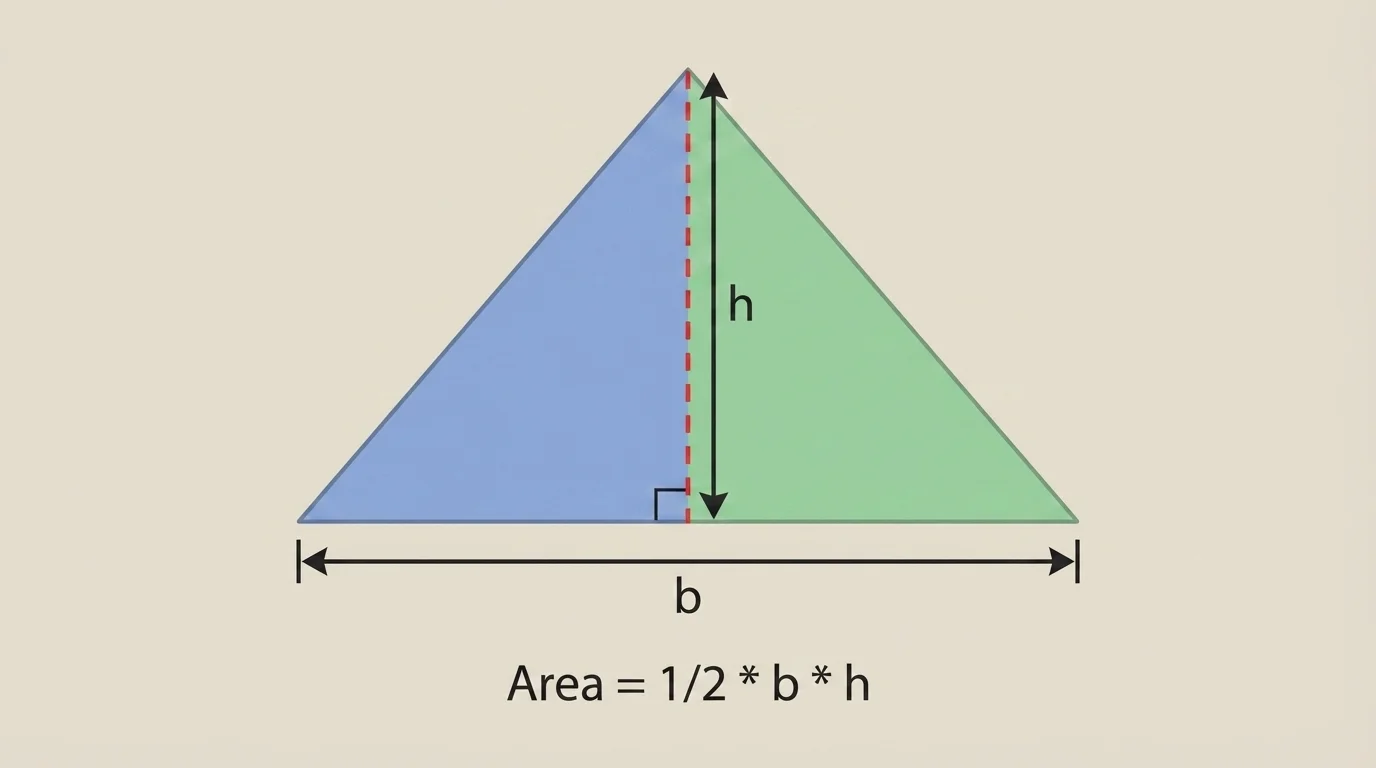
Another way to understand this is to copy the triangle and place the two copies together. They form a parallelogram, and one triangle is half of that larger shape. This is why the same formula works for every triangle.
Solved example 1: area of a right triangle
A triangular flag is a right triangle with base \(12\) inches and height \(9\) inches. Find its area.
Step 1: Write the triangle area formula.
\[A = \frac{1}{2}bh\]
Step 2: Substitute the known values.
\(A = \dfrac{1}{2} \cdot 12 \cdot 9\)
Step 3: Multiply.
\(12 \cdot 9 = 108\), so \(A = \dfrac{1}{2} \cdot 108 = 54\).
The area is \(54\) square inches.
When checking, think about the rectangle with side lengths \(12\) and \(9\). That rectangle would have area \(108\), so half is \(54\). The answer makes sense.
Solved example 2: area of a non-right triangle
A triangular road sign has a base of \(15\) centimeters and a height of \(8\) centimeters. Find its area.
Step 1: Use the triangle area formula.
\(A = \dfrac{1}{2}bh\)
Step 2: Substitute \(b = 15\) and \(h = 8\).
\(A = \dfrac{1}{2} \cdot 15 \cdot 8\)
Step 3: Compute.
\(15 \cdot 8 = 120\), and \(\dfrac{1}{2} \cdot 120 = 60\).
The area is \(60\) square centimeters.
Even though the triangle may look slanted, the formula works because area depends on the base and the perpendicular height, not on the slanted side lengths.
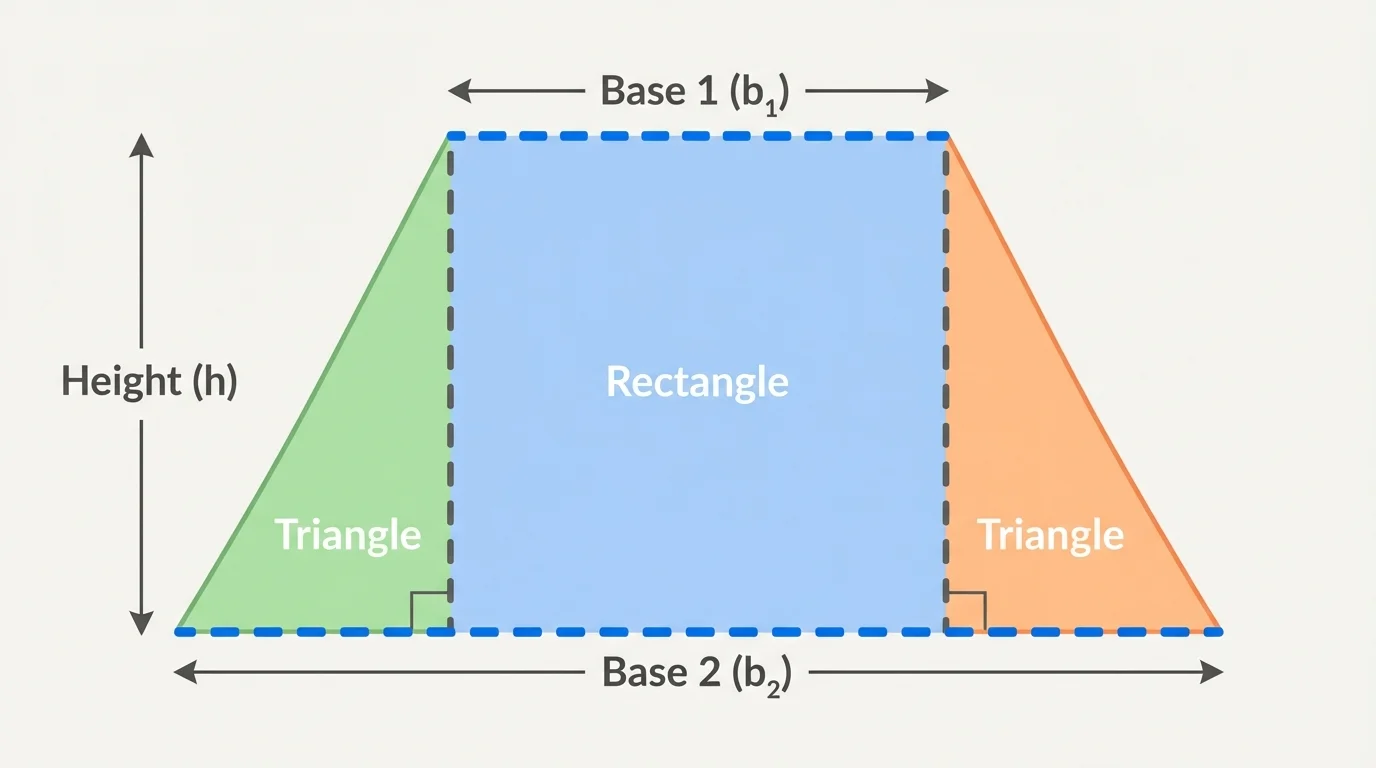
[Figure 3] A quadrilateral is a polygon with four sides. The areas of some special quadrilaterals can be found by decomposition. A parallelogram can be cut along one side and shifted to make a rectangle. A trapezoid can be split into simpler pieces, and this gives a helpful way to break a trapezoid into a rectangle and triangles.
For a parallelogram, one common formula is
\(A = bh\)
This works because a small triangle can be cut from one side and moved to the other side to form a rectangle with the same base and height.
A trapezoid has at least one pair of parallel sides. You can decompose it into a rectangle and one or two triangles. Another formula for a trapezoid is
\[A = \frac{1}{2}(b_1 + b_2)h\]
where \(b_1\) and \(b_2\) are the lengths of the parallel sides and \(h\) is the height.
A rhombus or kite can also be decomposed into triangles. If you know the diagonals of a rhombus or kite, you can use triangle ideas to find the total area, because the diagonals split the shape into triangles.
Some stained-glass artists plan complex window designs by splitting the full pattern into triangles and quadrilaterals first. That makes it easier to measure how much glass of each color they need.
Seeing a shape as several easier shapes is often better than trying to remember many separate formulas.
Solved example 3: area of a trapezoid by decomposition
A trapezoid has bases \(10\) meters and \(16\) meters and height \(5\) meters. Find its area.
Step 1: Use the trapezoid formula.
\[A = \frac{1}{2}(b_1 + b_2)h\]
Step 2: Substitute the values.
\(A = \dfrac{1}{2}(10 + 16) \cdot 5\)
Step 3: Add inside the parentheses.
\(10 + 16 = 26\), so \(A = \dfrac{1}{2} \cdot 26 \cdot 5\).
Step 4: Multiply.
\(\dfrac{1}{2} \cdot 26 = 13\), and \(13 \cdot 5 = 65\).
The area is \(65\) square meters.
You can also understand this answer by seeing the trapezoid as a rectangle plus two triangles, just as in [Figure 3]. The separate areas add to the same total.
A polygon with many sides can often be handled by decomposition. You can draw segments inside the shape to split it into triangles, rectangles, or other shapes whose areas you already know.
[Figure 4] This is especially useful for irregular polygons, shapes that do not have all sides and angles equal. Instead of searching for one special formula, look for hidden rectangles and triangles.
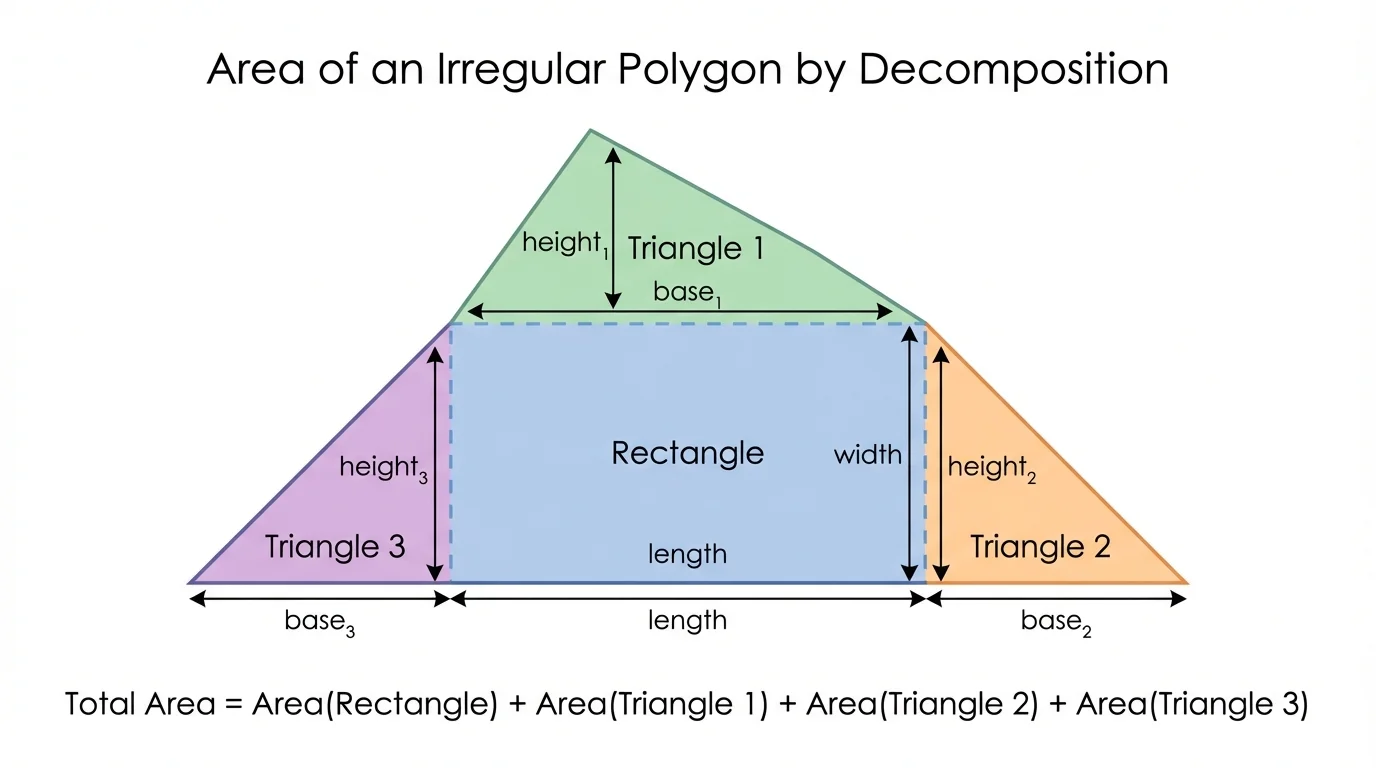
After splitting the polygon, find the area of each part and add them together. If a piece seems easier to subtract than add, you can also compose a larger rectangle around the shape, find the large area, and subtract the extra pieces.
Compose or decompose? If a shape almost looks like a rectangle with a corner cut off, composing a rectangle and subtracting may be easiest. If the shape naturally breaks into triangles and rectangles, decomposing directly may be best. Good problem solving often means choosing the simpler path.
This same idea works in reverse. If two smaller shapes fit together without overlapping, the area of the combined shape is the sum of their areas.
Solved example 4: area of a composite polygon
A playground region is made of a rectangle and a triangle. The rectangle measures \(14\) feet by \(8\) feet. On one side is a triangle with base \(14\) feet and height \(5\) feet. Find the total area.
Step 1: Find the area of the rectangle.
\(A_{\textrm{rect}} = 14 \cdot 8 = 112\)
Step 2: Find the area of the triangle.
\(A_{\textrm{tri}} = \dfrac{1}{2} \cdot 14 \cdot 5 = 35\)
Step 3: Add the areas.
\(112 + 35 = 147\)
The total area is \(147\) square feet.
If you had a map of the playground, a split like the one in [Figure 4] would help you see exactly where to separate the shape.
Area problems appear in everyday life more often than many people expect. A gardener may need to know how much soil or mulch covers a flower bed shaped like a trapezoid. A builder may calculate how much wood is needed for a triangular section of a roof. A school may estimate how much paint is needed for a mural made of several geometric shapes.
Suppose a garden is shaped like a rectangle attached to a right triangle. If the rectangle measures \(6\) meters by \(4\) meters, its area is \(24\) square meters. If the triangle has base \(6\) meters and height \(3\) meters, its area is \(\dfrac{1}{2} \cdot 6 \cdot 3 = 9\) square meters. The total garden area is \(24 + 9 = 33\) square meters.
Solved example 5: choosing materials for flooring
A room is shaped like a \(12\)-by-\(10\) foot rectangle with a triangular corner section added. The triangle has base \(4\) feet and height \(3\) feet. How much floor space is there in all?
Step 1: Find the rectangle's area.
\(12 \cdot 10 = 120\)
Step 2: Find the triangle's area.
\(\dfrac{1}{2} \cdot 4 \cdot 3 = 6\)
Step 3: Add the parts.
\(120 + 6 = 126\)
The room covers \(126\) square feet of floor space.
If flooring costs \(\$3\) per square foot, then the material cost would be \(\$378\) because \(126 \times 3 = 378\). This shows how geometry connects directly to planning and money decisions.
One common mistake is using a slanted side instead of the height. Remember, the height must be perpendicular to the base, as shown earlier in [Figure 2]. Another mistake is forgetting to divide by \(2\) when finding the area of a triangle.
Students also sometimes mix units. If one side is measured in centimeters and another in meters, convert so the units match before calculating. And always report area in square units, not just units.
When working with composite figures, be careful not to count any region twice. Draw the parts clearly and label what belongs to each shape.
| Shape | Helpful idea | Area formula |
|---|---|---|
| Rectangle | Multiply side lengths | \(A = lw\) |
| Triangle | Half of a rectangle or parallelogram | \(A = \dfrac{1}{2}bh\) |
| Parallelogram | Cut and shift to make a rectangle | \(A = bh\) |
| Trapezoid | Split into rectangle and triangles | \(A = \dfrac{1}{2}(b_1 + b_2)h\) |
| Composite polygon | Add or subtract simpler parts | No single formula; decompose or compose |
Table 1. Area strategies and formulas for common shapes in this lesson.
The big idea is not just memorizing formulas. It is understanding how shapes are related. Once you see a triangle as half of a rectangle, a parallelogram as a shifted rectangle, or a polygon as several smaller shapes, area becomes much more logical.
