A mountain may look solid and permanent, but it is really part of a giant recycling system. The rock in that mountain can break into sediment, wash into a river, settle on the seafloor, get buried, heat up, melt, and later return as new rock. At the same time, energy from sunlight and energy from deep inside Earth keep this huge system moving. Earth is not a still planet. It is a planet of cycles.
To understand Earth, it helps to think like a systems thinker. A system is a group of parts that interact. Earth's land, water, air, and living things are always affecting one another. Matter is not used up and gone forever. Instead, it moves from place to place and changes form. Energy is what drives many of these changes.
For example, rain falls on a hillside, water flows downhill, rock breaks apart, sediment is carried into a stream, and the stream deposits that sediment somewhere else. Later, deeper inside Earth, heat and pressure can change buried rock. Over very long times, Earth materials move through a cycle. Some parts happen quickly, such as a flood carrying mud. Other parts take millions of years, such as the formation of mountains.
Matter cycling means materials move through Earth's systems and are reused in new places or forms. Energy flow means energy enters a system, causes change, and is transferred from one part of the system to another. In Earth science, the two main energy sources are the Sun and Earth's interior.
When scientists build a model of Earth's changing systems, they often show two kinds of things: reservoirs, where matter is stored, and pathways, where matter moves. A river is a pathway. A glacier is a reservoir of frozen water. Sediment on the ocean floor is another reservoir. Models also include arrows to show where energy comes from and how it affects movement and change.
[Figure 1] Earth can be divided into four interacting parts: the geosphere, hydrosphere, atmosphere, and biosphere. These are not separate worlds. They constantly exchange matter and energy.
The geosphere includes rocks, soil, mountains, volcanoes, and the solid parts of Earth from the crust down toward the center. The hydrosphere includes all water: oceans, rivers, lakes, groundwater, glaciers, and water vapor. The atmosphere is the layer of gases around Earth. The biosphere includes all living things, from forests to tiny bacteria.
A single drop of water can move through all four systems. It can evaporate from the ocean, rise into the atmosphere, fall on land, seep into soil in the geosphere, and then be taken up by a plant in the biosphere. In the same way, carbon, sediment, and nutrients also move through multiple systems.
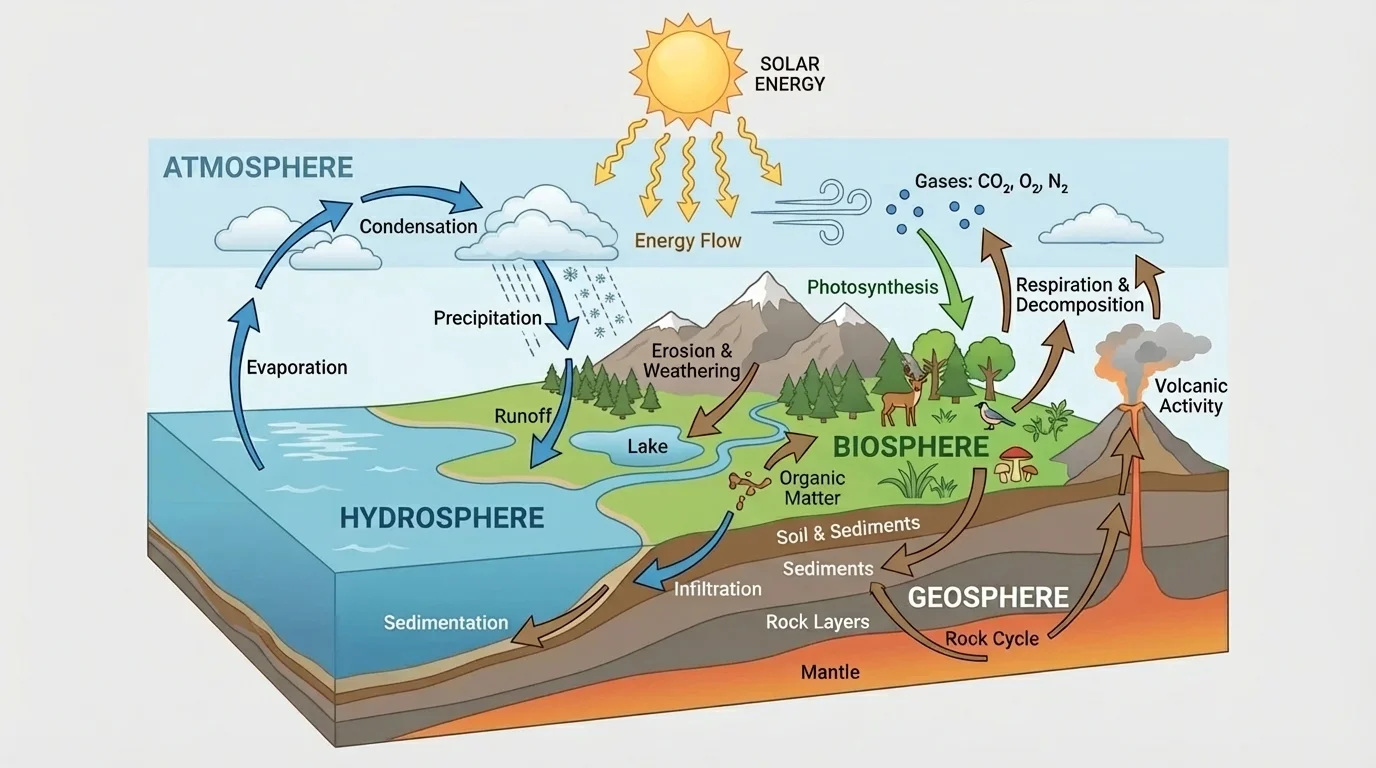
Thinking in systems helps explain why an event in one place can affect another. A volcanic eruption begins in the geosphere, sends gases and ash into the atmosphere, changes water chemistry in the hydrosphere, and can harm or help living things in the biosphere. Earth science is full of these connections.
You already know that water can change state between solid, liquid, and gas, and that heat can speed up many changes. Those ideas matter here because Earth materials often change as energy is added, removed, or transferred.
The four systems interact on every scale. A backyard puddle evaporating after rain and a continent moving over millions of years are both examples of matter moving and of energy driving change. The difference is mostly the scale of time and space.
The two major energy sources in this topic are the Sun and Earth's interior. The solar energy reaching Earth warms land, air, and water unevenly. That uneven heating drives winds, weather, ocean currents, and evaporation. These processes shape Earth's surface and move materials from place to place.
Earth's interior also contains thermal energy. Some of it is leftover heat from Earth's formation, and some comes from radioactive decay inside the planet. This internal heat drives movement in the mantle. That movement helps cause plate tectonics, volcanism, earthquakes, and the slow recycling of Earth's crust.
These two energy sources do different jobs. Sun-driven processes mostly reshape Earth's surface. Interior-driven processes mostly reshape Earth from below. But they are connected. For example, plate tectonics can build mountains, and then sun-driven weathering and erosion wear those mountains down.
"The present is the key to the past."
— A central idea in geology
This principle means that by studying processes we observe now, such as rivers carrying sediment or lava cooling into rock, we can understand how Earth changed long ago. The same cycling of matter has been happening for a very long time.
[Figure 2] The rock cycle is one of the clearest models for showing how Earth materials cycle. The rock cycle does not mean every rock follows one exact path. Instead, it shows several possible pathways by which rock material can change over time.
Igneous rock forms when molten rock cools and solidifies. If molten rock reaches the surface as lava and cools, it forms one kind of igneous rock. If it cools underground as magma, it forms another. What matters in this lesson is the process: cooling from a molten state into solid rock.
Sedimentary rock forms when pieces of older rock, plant remains, or other material are deposited in layers and then compacted and cemented together. This usually happens after weathering, erosion, transport, and deposition.
Metamorphic rock forms when existing rock is changed by heat and pressure without fully melting. The rock remains solid, but its structure changes. If heating continues long enough to melt it, the material becomes magma again.
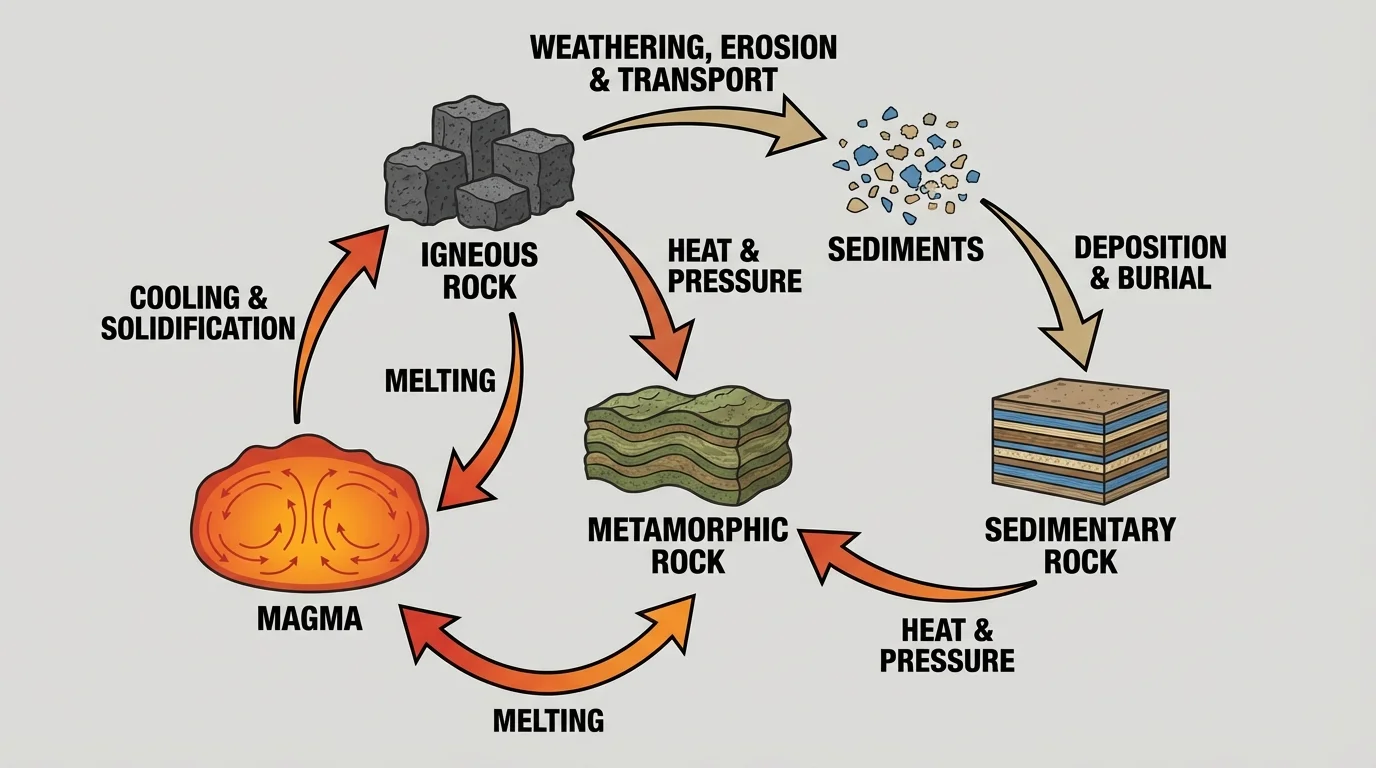
The important idea is that Earth material is recycled. A rock on a mountain can weather into sediment. That sediment can become sedimentary rock. Burial can turn it into metamorphic rock. Melting can produce magma. Cooling can produce igneous rock. The same atoms are still part of Earth, but they move through different forms and locations.
Notice that the rock cycle is powered by more than one energy source. Sun-driven weather and moving water help break down and transport rock at the surface. Earth's internal heat and pressure change rock underground. This is why the rock cycle is such a good model of both matter cycling and energy flow.
A model is a simplified picture of a complicated system. The rock cycle is not a strict circle with one starting point and one ending point. It is more like a network of pathways. In science, a model helps us explain patterns, make predictions, and understand processes we cannot watch from beginning to end.
As seen earlier in [Figure 1], rocks are not isolated from water, air, or living things. Plant roots can crack rock, rainwater can carry dissolved material, and oceans can collect sediments. The rock cycle connects to all Earth systems.
Several important surface processes move Earth materials. Weathering is the breaking down of rock into smaller pieces or changing it chemically. Weathering can happen when water freezes in cracks, when plant roots grow into rock, or when slightly acidic water reacts with certain materials in rock.
Erosion is the movement of weathered material from one place to another. Water, wind, ice, and gravity can all cause erosion. A stream carrying sand after a storm is a good example. So is wind blowing dust across dry land.
Deposition happens when transported material is dropped. Rivers deposit sediment where water slows down. Waves deposit sand on beaches. Glaciers leave behind piles of rock and soil. Deposition builds new landforms even while erosion wears others away.
Soil forms through a combination of weathered rock, decayed living matter, air, and water. Soil is part of the cycling of Earth materials too. It supports plants, stores water, and can be moved by erosion. Healthy soil takes a long time to form, but it can be lost quickly if land is not protected.
One strong storm can move more sediment in a single day than a small stream carries during many quiet days. Fast-moving water has much more energy to transport material.
These surface processes are mostly driven by solar energy because the Sun powers weather and the water cycle. Gravity also plays a major role by pulling water and sediment downhill.
[Figure 3] Water is more than something that cycles by itself. It is also a transporter of Earth materials. In the water cycle, water evaporates, condenses into clouds, falls as precipitation, flows over land as runoff, and can infiltrate into the ground. As it moves, it dissolves, carries, and deposits materials.
Rain can wear away soil and carry sediment into streams. Groundwater can slowly dissolve parts of rock and create caves. Ocean water can move sand along coastlines. Ice can freeze, expand, and help crack rock. Water connects the atmosphere, hydrosphere, and geosphere in powerful ways.
Plants and animals are part of this cycle too. Plants take in water from soil and release water vapor to the atmosphere. Living things also affect erosion and deposition. For example, plant roots can hold soil in place, while removing vegetation can increase erosion.
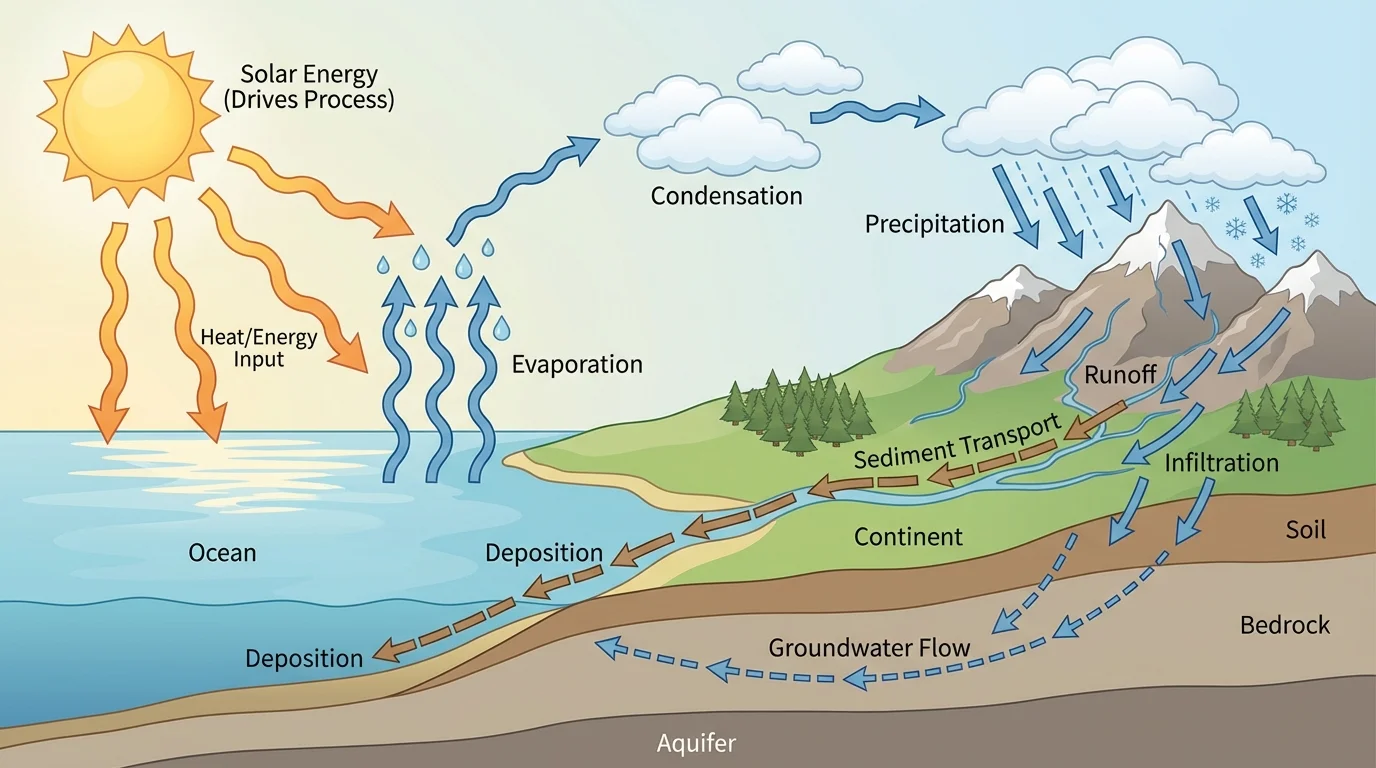
The water cycle depends mainly on the Sun. Solar heating causes evaporation. Gravity helps water fall as rain and flow downhill. Because water is constantly moving, it is one of the main ways matter gets transferred among Earth's systems.
Real-world example: A muddy river after heavy rain
A river often turns brown after a storm because water is carrying extra sediment.
Step 1: Sunlight warms oceans, lakes, and land water.
This energy helps water evaporate into the atmosphere.
Step 2: Water vapor condenses and later falls as precipitation.
Rain reaches the land surface.
Step 3: Moving water erodes soil and rock.
Runoff carries sediment into streams and rivers.
Step 4: The river transports the sediment.
When the river slows, some of that sediment is deposited downstream.
This single event shows both matter cycling and energy flow: solar energy drives the water cycle, and moving water transports Earth materials.
Later, the same sediment may become part of a floodplain, a delta, or even a future sedimentary rock layer. A storm is short, but its effects can last for years or much longer.
[Figure 4] Deep below the surface lies another major driver of material cycling: plate tectonics. Earth's outer shell is broken into large plates that move slowly over the softer asthenosphere below. Heat from Earth's interior causes convection in the mantle, and that movement helps drive the plates.
Plate tectonics explains why continents move, why earthquakes happen in belts, why volcanoes are common in some places, and how mountains form. When plates move apart, magma can rise and create new crust. When plates collide, one plate may sink beneath another in a process called subduction.
Subduction is especially important for material cycling. Old ocean crust is pushed down into the mantle, where it heats up and may melt. Some melted material rises again and feeds volcanoes. In this way, parts of Earth's crust are recycled back into the interior and later returned to the surface.
At convergent boundaries, compression can build mountain ranges. At divergent boundaries, new crust forms. At transform boundaries, plates slide past each other. These movements reshape Earth's surface and create pathways for matter to move from deep inside Earth to the outside and back again.
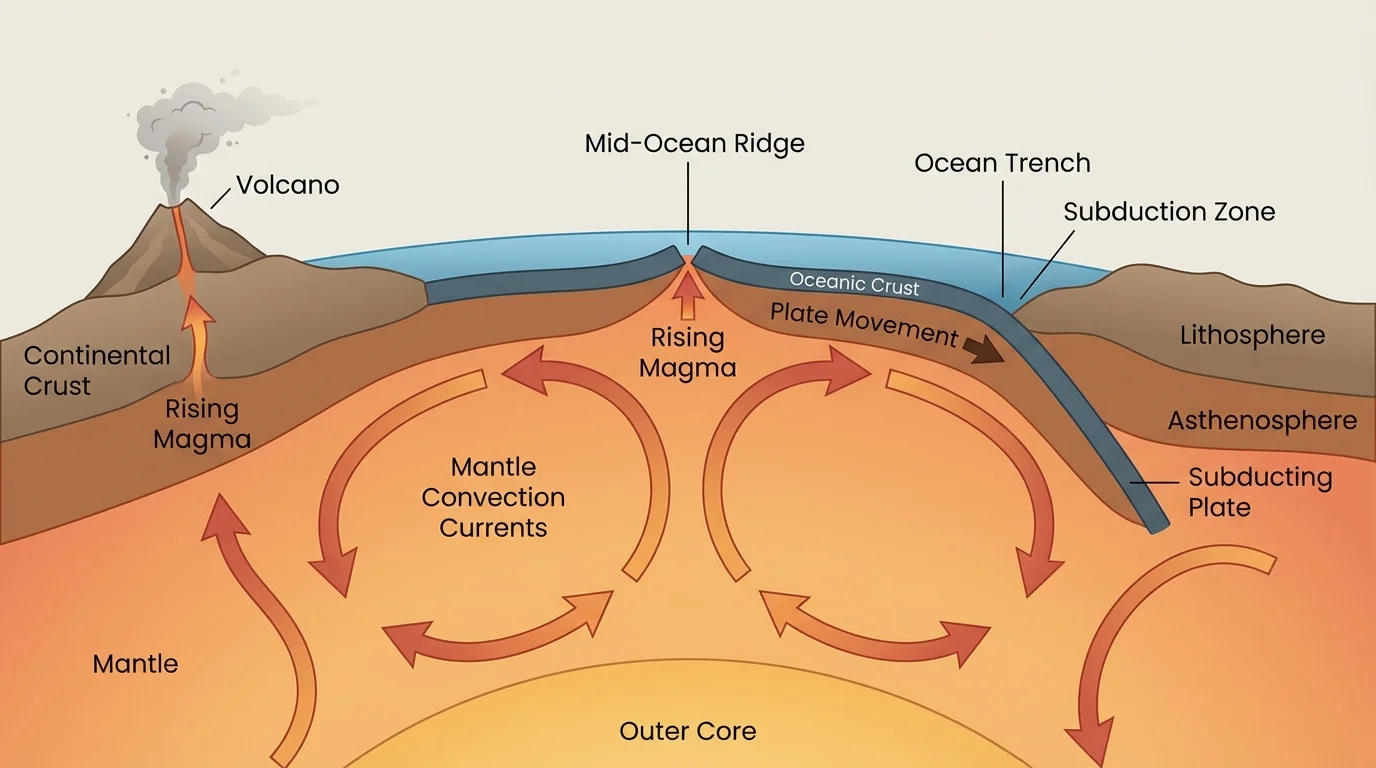
The movement is very slow, often only a few centimeters per year, but over millions of years the effects are enormous. A rate of about \(5 \textrm{ cm/year}\) may seem tiny, but in \(1{,}000{,}000 \textrm{ years}\) that becomes \(50{,}000 \textrm{ m} = 50 \textrm{ km}\). Slow processes can create major change when enough time passes.
The deep processes of plate tectonics connect directly to the rock cycle. Melting produces magma. Cooling forms igneous rock. Burial adds heat and pressure that can make metamorphic rock. Uplift can expose buried rock at the surface, where weathering begins again. The pathways in [Figure 2] depend heavily on the internal energy shown in [Figure 4].
It is tempting to study the water cycle, rock cycle, and plate tectonics as separate topics, but on Earth they overlap all the time. A volcanic island forms from internal energy. Rain falls on it because of the water cycle. Streams erode it. Sediment gathers along the coast. Layers build up. Burial, heat, and pressure change those layers over time. One system blends into another.
Mountain building is another example. Plate motion pushes crust upward to form mountains. Then wind, rain, ice, and rivers wear the mountains down. Sediment from the mountains may be carried to the ocean. Some of that material may later be buried and uplifted again. Earth's surface is like a giant construction-and-destruction zone running at the same time.
| Process | Main Energy Source | What Happens to Matter |
|---|---|---|
| Evaporation and weather | Sun | Water moves into the atmosphere and later returns as precipitation |
| Weathering and erosion | Sun and gravity | Rock and soil break down and are transported |
| Deposition | Gravity and slowing motion | Sediment settles in new places |
| Metamorphism | Earth's interior | Rock changes under heat and pressure |
| Melting and volcanism | Earth's interior | Rock melts and may return to the surface |
| Plate movement | Earth's interior | Crust is created, moved, and recycled |
Table 1. Major Earth processes, their main energy sources, and how they affect matter.
As we saw in [Figure 3], water often acts as the carrier that links systems at the surface. As shown in [Figure 4], mantle convection links the surface to the deep interior. A strong Earth system model includes both sets of connections.
Understanding Earth's material cycles helps people make safer and smarter decisions. Engineers need to know about erosion when designing roads, bridges, and buildings. Farmers need to protect soil from being washed away. City planners study floodplains because rivers deposit sediment and can change course over time.
Geologists study plate boundaries to better understand earthquake and volcanic hazards. They also examine rock layers and sediments to learn about Earth's history. Coastal communities track sand movement because waves and currents constantly reshape beaches.
Water quality is also connected to Earth systems. If too much sediment enters a river, it can harm fish habitats and make the water harder to treat. Land use, weather, and geology all matter. This is why Earth science is useful far beyond the classroom.
Case study: Why a landslide can happen after heavy rain
Step 1: Rain from the atmosphere enters the soil and rock on a slope.
Step 2: Extra water adds mass and reduces friction between particles.
Step 3: Gravity pulls the loosened material downhill.
Step 4: Sediment is deposited lower on the slope or in a stream.
This event involves the atmosphere, hydrosphere, geosphere, and sometimes the biosphere if plant cover has been removed.
Events like landslides remind us that Earth's cycles are not only slow. Some changes happen suddenly, even though they are part of long-term patterns of matter cycling.
When you build a model of Earth's changing materials, begin by identifying where matter is stored. These storage places may include mountains, rivers, glaciers, oceans, sediments, soils, magma, and the atmosphere. Then identify how matter moves: weathering, erosion, deposition, melting, cooling, uplift, evaporation, precipitation, and plate motion.
Next, add the energy sources. Draw arrows from the Sun to processes such as evaporation, wind, and weathering. Draw arrows from Earth's interior to processes such as mantle convection, volcanism, mountain building, and metamorphism. Gravity should also appear because it helps move water and sediment downhill.
A useful model also shows that cycles are connected. For example, a rock can be uplifted by tectonic forces, broken by weathering, moved by water, deposited in a basin, buried by more layers, changed by heat and pressure, and eventually melted. That is not a simple loop. It is a web of interacting pathways.
Good models do not need every tiny detail. They need the most important parts and arrows that correctly show cause and effect. In Earth science, a strong model answers two big questions: Where does the matter go? and What energy source drives the change?
