A single misunderstood word can distort an entire article, argument, or story. In a news piece, the word charged might refer to an accusation, a fee, or electrical energy. In a novel, cold might describe temperature, personality, or tone. Strong readers do not stop at their first guess. They make a careful inference, then they test it. That habit—verifying meaning instead of assuming it—is one of the clearest differences between shallow reading and expert reading.
When you meet an unfamiliar word or a familiar word used in an unfamiliar way, your first task is to make a preliminary determination of meaning. That means you form a best initial guess based on context. Your next task is just as important: verify that guess. Verification means checking whether the inferred meaning actually fits the sentence, the paragraph, the author's purpose, and, when needed, a reliable reference source.
This skill matters in every subject. In literature, it helps you understand tone, symbolism, and character motives. In science or history, it protects you from misreading technical terms. In argument writing, it keeps you from misunderstanding claims, evidence, and key distinctions. Verification is not a sign that you are confused. It is a sign that you are reading with precision.
Preliminary determination is an initial, evidence-based guess about what a word or phrase means in context.
Verification is the process of checking whether that guessed meaning is accurate by testing it against context, structure, and reference sources.
A context clue is a hint in the surrounding text that helps reveal meaning.
Readers often feel pressure to move quickly, especially when reading long assignments. That pressure can lead to a dangerous shortcut: selecting a meaning too early and never checking it. But language is flexible. Writers choose words that can carry multiple meanings, subtle connotations, or figurative force. A quick guess may be close, but "close" is not always enough.
Consider the sentence: "The committee found the proposal novel but impractical." A reader might first think of a long fictional book, because that is a common meaning of novel. In this sentence, however, novel means new, original, or unusual. If you fail to verify the meaning, the sentence becomes confusing. If you check the context, the meaning becomes clear.
Verification also matters because authors make purposeful choices. In an argumentative essay, a writer may use a word with a strong connotation to influence the audience. In a narrative, a phrase may reveal emotion indirectly. In an informational text, a technical word may have a narrower meaning than it has in casual conversation. Verification helps you read the author's actual meaning, not just the meaning you happened to think of first.
Verification begins only after you have made a thoughtful first inference. When you encounter an unknown or uncertain word, pause and ask: What seems most likely here? Look at nearby words, punctuation, sentence structure, and the topic being discussed. This gives you a starting point.
For example, in the sentence "After three weeks without rain, the fields looked parched," you may not know the word parched exactly, but the phrase "without rain" suggests dryness. Your preliminary determination might be "very dry." That is a reasonable beginning. Now you must test it.
Good readers do not expect the first inference to be perfect. They expect it to be useful. Think of it as a working hypothesis. You gather evidence, propose a likely meaning, and then check whether the evidence continues to support it.
Earlier reading skills still matter here: noticing prefixes and suffixes, recognizing parts of speech, and identifying a text's central idea all support accurate word meaning. Verification builds on those skills rather than replacing them.
The strongest first test is the surrounding context. Different kinds of context clues help readers confirm or revise meaning, as [Figure 1] illustrates. Sometimes the author directly defines the word. Sometimes the sentence gives an example, a contrast, a cause-and-effect relationship, or a tone that limits what the word can mean.
Definition clues are the most direct. In a sentence such as "Arboreal animals, those that live in trees, often have strong gripping limbs," the phrase "those that live in trees" verifies the meaning of arboreal. Example clues work similarly. If a text says, "Celestial bodies such as stars, planets, and moons fascinated early astronomers," the examples verify that celestial relates to objects in the sky or space.
Contrast clues can be especially powerful. If a sentence says, "Unlike his boisterous teammates, Marcus remained quiet and reserved," the contrast with "quiet and reserved" verifies that boisterous means noisy, energetic, or rowdy. Cause-and-effect clues can work too: "The medicine made her lethargic, so she struggled to stay awake" confirms that lethargic means sluggish or low in energy.
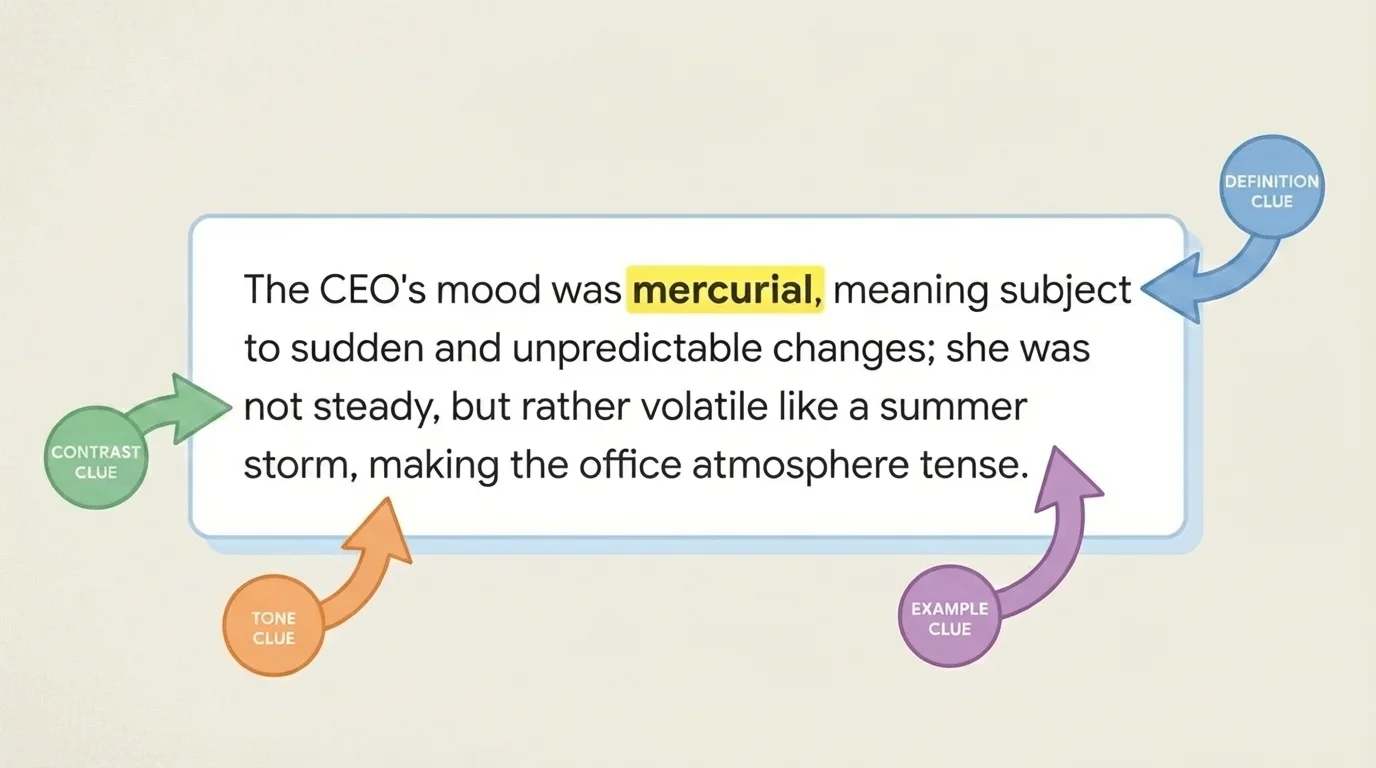
Tone and mood also help verify meaning. Suppose a narrator describes a mansion as "grand but ostentatious." If the surrounding tone sounds critical rather than admiring, the word likely carries a negative sense of excessive showiness, not simply beauty. This is why verification requires attention not only to denotation—the basic dictionary meaning—but also to attitude and effect.
Sentence structure can also guide you. Part of speech matters. In "They tempered their criticism with praise," tempered is a verb. In "She showed a calm temperament," the related noun points to self-control or balance. If your guessed meaning does not fit the grammar of the sentence, it is probably wrong.
Later, when you face more complex passages, the same clue types shown in [Figure 1] still apply. The difference is that the clues may be spread across several sentences instead of appearing immediately beside the word. Skilled readers gather evidence across the paragraph, not just within one line.
Meaning is tested, not merely noticed. Context clues are not decorations around a word. They are pieces of evidence. A reader forms a likely meaning, substitutes it into the sentence, and then asks whether the sentence still makes sense in tone, logic, and purpose. If the meaning weakens the sentence or creates contradiction, the reader revises it.
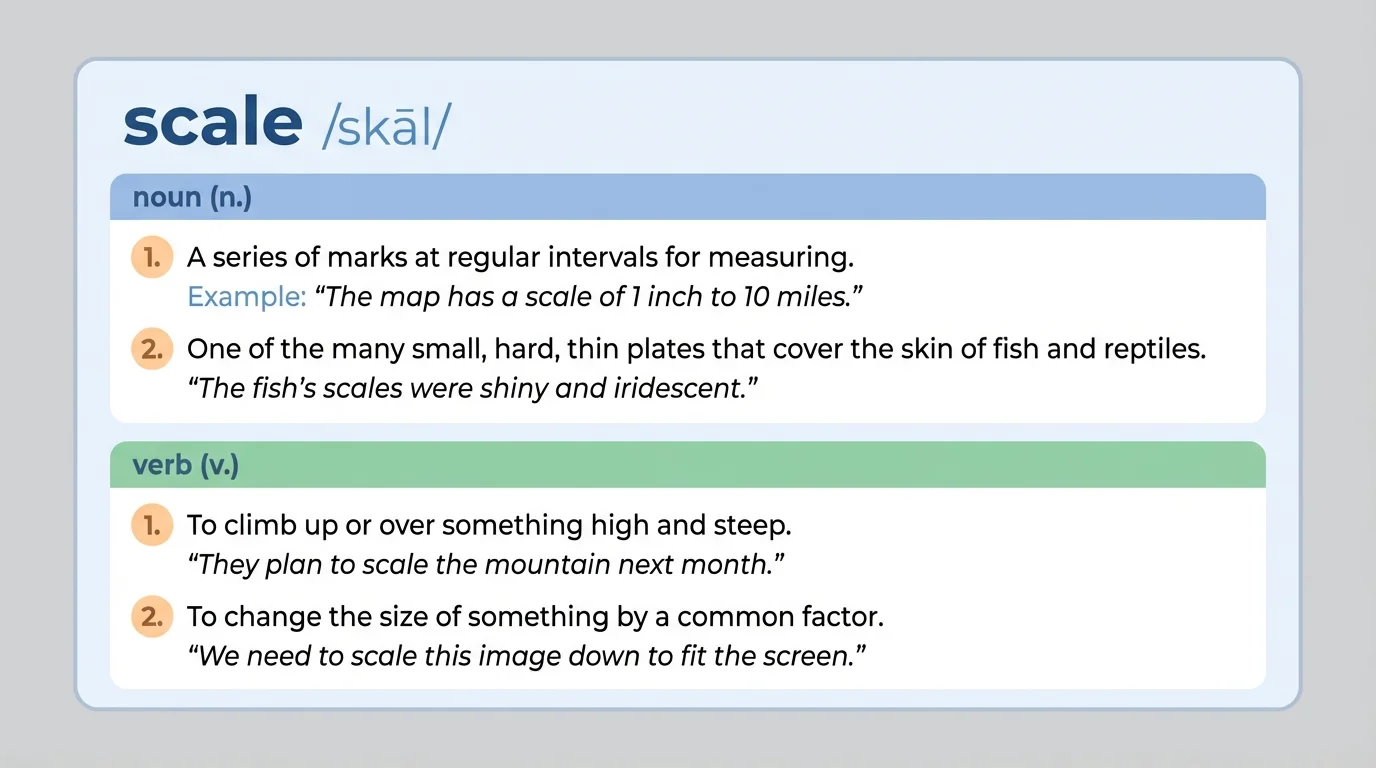
When context alone is not enough, readers turn to a dictionary entry or another reliable reference source. But using a dictionary well is a skill, not just a lookup action. Dictionary entries include several pieces of information: pronunciation, part of speech, numbered definitions, and often example sentences, as [Figure 2] shows. Choosing the first definition automatically is a common mistake.
Suppose you read, "The speaker addressed the gravity of the crisis." A dictionary might list meanings related to physical force and seriousness. The sentence is not about falling objects or planetary attraction. The definition must fit the context of a crisis, so the correct verified meaning is seriousness or importance. The dictionary helps only when you match the entry to the context.
Part of speech remains essential during dictionary use. In "The material contracted in the cold," the verb means shrank. In "She signed a contract," the noun refers to a legal agreement. Reference tools are useful only if you first identify whether the word functions as a noun, verb, adjective, or another part of speech in the sentence.
Digital tools can help, but they should be used critically. Online definitions, auto-generated translations, and quick search previews may oversimplify meaning. Reliable dictionaries, glossaries, and subject-specific references are better choices. In academic reading, a literature glossary, historical source note, or scientific reference may be more useful than a general dictionary because some words have discipline-specific meanings.
Etymology, or word origin, can also support verification, though it should not replace context. If you know that a prefix suggests "against" or a root suggests "speak," that can sharpen your guess. Still, the final test is always whether the meaning fits the text you are reading.
Some of the most frequent English words are also some of the most confusing because they have many meanings. Words like set, run, and charge can shift meaning dramatically depending on context, field, and grammar.
Verification is not complete the moment a definition looks plausible. You should reread the sentence by substituting the meaning you think is correct. Then reread the surrounding lines. Does the meaning fit both the immediate sentence and the larger point of the paragraph?
For example, in "Her remarks were candid, but not cruel," the meaning "honest and direct" fits well. It explains why the remarks might be sharp, but the phrase "not cruel" limits the interpretation. If you substituted "careless" or "random," the sentence would lose its logic. Verification means checking for coherence.
The whole text matters because authors develop ideas over time. In a historical essay, the word radical may mean extreme in one context, but in another it may mean fundamental or far-reaching in a political sense. In a chemistry chapter, radical may appear in a specialized scientific way, and the subject matter changes the correct interpretation. The broader topic helps confirm what local clues begin to suggest.
This is also where you check whether connotation fits. If an author is praising a scientist's "obsessive attention to detail," the word obsessive may carry a less negative force than it often does in casual conversation. Verification requires sensitivity to nuance, not just rough equivalence.
Verifying meaning in context
Sentence: "The mayor's response was measured, avoiding both panic and denial."
Step 1: Make a preliminary determination.
The surrounding idea suggests control and balance, so a first guess is "careful" or "calmly judged."
Step 2: Test the guess against nearby words.
The phrase "avoiding both panic and denial" supports moderation and self-control.
Step 3: Check for alternate meanings.
Measured can also mean physically counted or sized, but that meaning does not fit a response.
Step 4: Verify with the whole sentence.
The best meaning is "carefully controlled or judged." It fits the grammar, the tone, and the logic of the sentence.
Many words are not difficult because they are rare. They are difficult because they are flexible. A multiple-meaning word is a word with more than one accepted meaning. Verification becomes essential whenever a common word appears in an unfamiliar setting.
Take the word draft. In one text, it may mean a current of air. In another, a preliminary version of writing. In history, it may refer to compulsory military service. In sports, it may refer to the selection of players. A reader must use context, genre, and topic to verify which meaning is active.
Figurative language adds another layer. If a poem says, "Time is a thief," a literal dictionary definition of thief does not fully explain the phrase. The reader must verify that the phrase is metaphorical and understand the comparison: time takes things from us, such as youth, opportunity, or loved moments. Literal meanings are sometimes necessary, but they are not always sufficient.
Idioms work the same way. If a character says, "We're finally in the home stretch," no one is literally running a race unless the broader context says so. Verification means noticing when a phrase is figurative and testing whether a nonliteral meaning better fits the situation.
When evaluating figurative phrases, remember the clue patterns from [Figure 1]. Tone, surrounding images, and the author's purpose often matter more than dictionary definitions alone. Figurative language usually reveals its meaning through pattern and effect.
Readers do not verify meaning in exactly the same way in every genre. The process is consistent, but the strongest clues differ by text type, as [Figure 3] shows. In narrative writing, characterization, setting, and emotional tone often guide meaning. In argumentative writing, claim, evidence, and loaded connotation matter more. In informational writing, precise terminology and formal definitions are often the strongest guides.
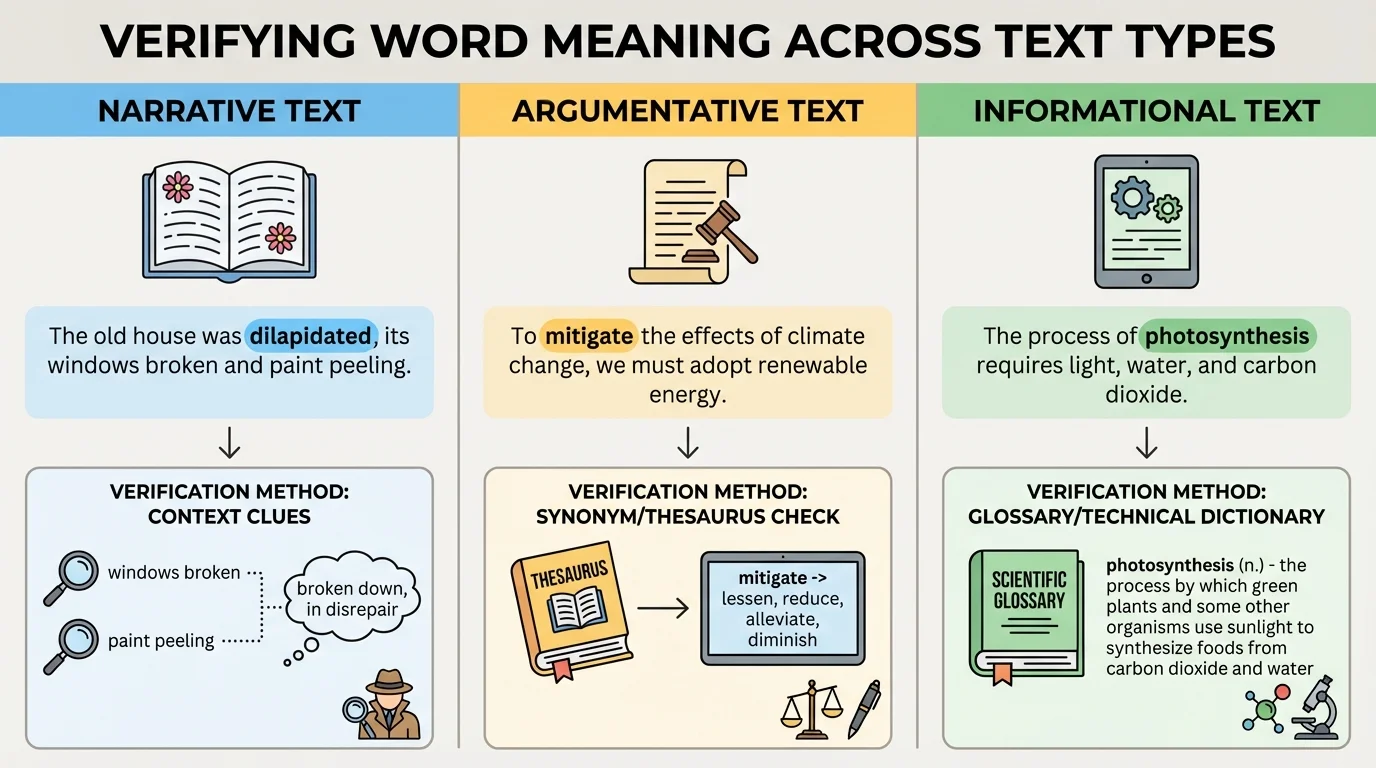
In a narrative, a sentence such as "He gave a brittle laugh and stared at the floor" uses the word brittle figuratively. The emotional context suggests fragility or strain, not a literal material property. In an argumentative essay, a phrase like "a superficial reform" depends on evaluating connotation. The writer is not simply describing a surface; the word suggests shallowness and insufficiency.
In informational texts, exactness matters even more. A biology article may use the word adaptation in a technical sense: an inherited trait that improves survival or reproduction. In everyday language, adaptation might mean adjustment or a new version of a book or film. The subject area verifies the intended meaning.
For this reason, students should always ask what kind of text they are reading. Genre shapes meaning. The comparison in [Figure 3] reminds us that the same strategy—guess, test, verify—works across genres, but the evidence you rely on may change.
| Text type | Most useful clues | What to watch for |
|---|---|---|
| Narrative | Character actions, dialogue, setting, tone | Figurative language, mood, implied emotion |
| Argumentative | Claim, evidence, word choice, connotation | Bias, persuasive tone, loaded language |
| Informational | Definitions, examples, headings, technical context | Domain-specific meanings, precision, formal usage |
Table 1. Comparison of the strongest verification clues in three major text types.
One common error is accepting a meaning that partly fits but not completely. Another is relying on only one clue when several are available. A third is choosing the first dictionary definition without checking part of speech or topic. Readers also go wrong when they ignore connotation and treat all meaning as neutral.
Strong readers build habits that prevent these mistakes. They pause at moments of uncertainty. They reread. They test a candidate meaning by substitution. They ask whether the meaning matches the author's tone and purpose. They consult references when needed, but they do not surrender judgment to the dictionary.
Another strong habit is flexibility. If a meaning does not fit after further reading, revise it. Skilled reading is not about being right immediately. It is about being willing to improve your interpretation when new evidence appears.
"The meaning of a word is its use in the language."
— Ludwig Wittgenstein
You can think of verification as a repeatable sequence. First, notice the unknown or uncertain word or phrase. Second, infer a likely meaning from local context. Third, identify part of speech and tone. Fourth, test the meaning by substitution in the sentence. Fifth, check the larger paragraph or text. Sixth, if uncertainty remains, consult a reliable reference and select the definition that matches the context. Finally, reread to confirm that the meaning works smoothly.
This process is especially useful on challenging grade-level texts because those texts often contain abstract language, nuanced claims, and words with layered meanings. Whether you are reading a Supreme Court opinion, a scientific article, a historical speech, or a complex short story, verified meaning leads to better understanding.
Language does not reward rushed reading. It rewards attentive reading. When you verify your preliminary determination, you move from guessing to knowing, from approximate understanding to precise comprehension.
