A calculator can evaluate \(9^{1/2}\), \(27^{1/3}\), and even \(32^{4/5}\) in seconds, but the deeper idea is more powerful: all of these expressions are built from the same exponent rules you already know. What first looks like two separate topics, radicals and exponents, turns out to be one connected system. Once you understand that connection, expressions that seem complicated become much easier to rewrite and simplify.
In algebra, you often see a radical such as \(\sqrt{x}\) or \(\sqrt[3]{8y^2}\). In another problem, the same idea might appear using a rational exponent, such as \(x^{1/2}\) or \((8y^2)^{1/3}\). These are not unrelated notations. They are equivalent ways to express roots and powers.
This matters because different forms are useful in different situations. Radical notation often makes the root easier to see. Exponent notation often makes algebraic manipulation easier because exponent rules can be applied directly. Mathematicians, scientists, and engineers switch between these forms depending on what they need to do.
You already know several exponent rules for integer exponents: \(a^m \cdot a^n = a^{m+n}\), \(\dfrac{a^m}{a^n} = a^{m-n}\) for \(a \neq 0\), \((a^m)^n = a^{mn}\), \((ab)^n = a^n b^n\), and \(a^{-n} = \dfrac{1}{a^n}\).
Those same properties extend naturally to rational exponents. The notation changes, but the structure stays consistent.
An exponent tells how many times a base is used as a factor. For example, \(2^4 = 2 \cdot 2 \cdot 2 \cdot 2 = 16\). Integer exponents include positive exponents, zero exponents, and negative exponents. For a nonzero base, \(a^0 = 1\), and \(a^{-3} = \dfrac{1}{a^3}\).
The important idea is that exponents follow patterns. For instance, \(x^5 \cdot x^2 = x^7\), so exponents add when multiplying like bases. Rational exponents continue these patterns rather than breaking them.
The key bridge between roots and exponents, as [Figure 1] illustrates, is that taking an \(n\)th root is the same operation as raising a number to the power \(\dfrac{1}{n}\). This means radical notation and rational exponent notation are two ways to describe the same quantity.
The basic definitions are
Rational exponent meaning
For a positive real number \(a\) and a positive integer \(n\),
\[a^{1/n} = \sqrt[n]{a}\]
More generally,
\[a^{m/n} = \left(\sqrt[n]{a}\right)^m = \sqrt[n]{a^m}\]
For example, \(16^{1/2} = \sqrt{16} = 4\), \(27^{1/3} = \sqrt[3]{27} = 3\), and \(81^{3/4} = \left(\sqrt[4]{81}\right)^3 = 3^3 = 27\).
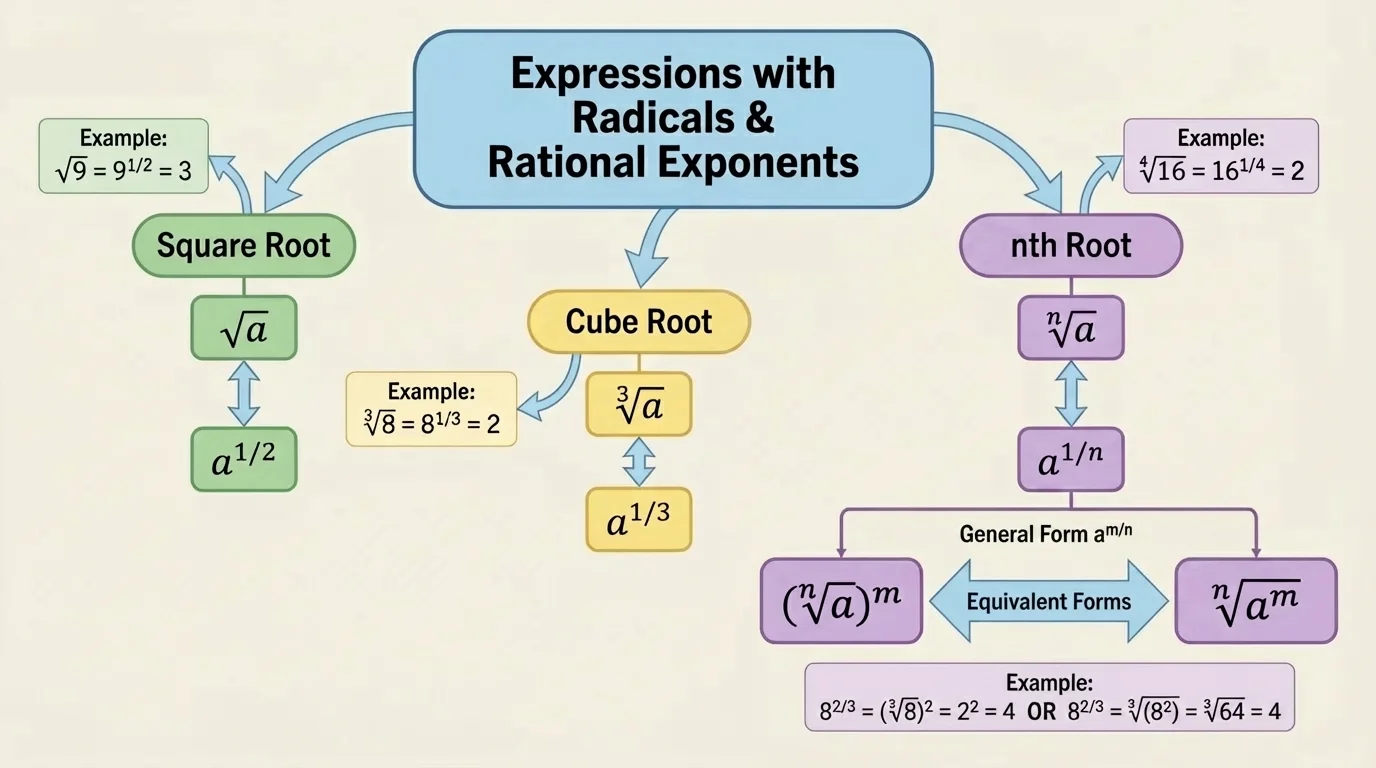
You can read \(a^{m/n}\) in two equivalent ways: first take the \(n\)th root and then raise to the \(m\)th power, or first raise to the \(m\)th power and then take the \(n\)th root. Both give the same result when the expression is defined in the real numbers.
This equivalence becomes useful later when one form is easier to compute than the other. As shown again by the relationships in [Figure 1], the denominator of the exponent tells the root, and the numerator tells the power.
Once rational exponents are understood as ordinary exponents, the standard properties apply. For suitable real values of the variables, the main rules are:
\[a^m \cdot a^n = a^{m+n}\]
\[\frac{a^m}{a^n} = a^{m-n} \quad (a \neq 0)\]
\[(a^m)^n = a^{mn}\]
\[(ab)^n = a^n b^n\]
\[\left(\frac{a}{b}\right)^n = \frac{a^n}{b^n} \quad (b \neq 0)\]
\[a^{-n} = \frac{1}{a^n}\]
These rules work with rational exponents too. For example, \(x^{1/2} \cdot x^{3/2} = x^2\), because \(\dfrac{1}{2} + \dfrac{3}{2} = 2\). Also, \((y^{2/3})^3 = y^2\), because \(\dfrac{2}{3} \cdot 3 = 2\).
Why the notation is powerful
Radical notation helps you recognize roots, but exponent notation helps you use algebraic rules more smoothly. For example, \(\sqrt{x} \cdot x^{3/2}\) is easier to combine if you rewrite \(\sqrt{x}\) as \(x^{1/2}\). Then the product becomes \(x^{1/2} \cdot x^{3/2} = x^2\).
That ability to move back and forth between forms is the core skill in this topic.
Not every radical expression represents a real number. The restrictions are easier to compare, as [Figure 2] shows, when you look at whether the root is even or odd.
If the denominator of a rational exponent is even, the radicand must be nonnegative in the real number system. For example, \(x^{1/2} = \sqrt{x}\) is real only when \(x \geq 0\). So \((-9)^{1/2}\) is not a real number.
If the denominator is odd, negative inputs are allowed. For example, \((-8)^{1/3} = \sqrt[3]{-8} = -2\), which is real. That means \(x^{1/3}\) is defined for all real \(x\).
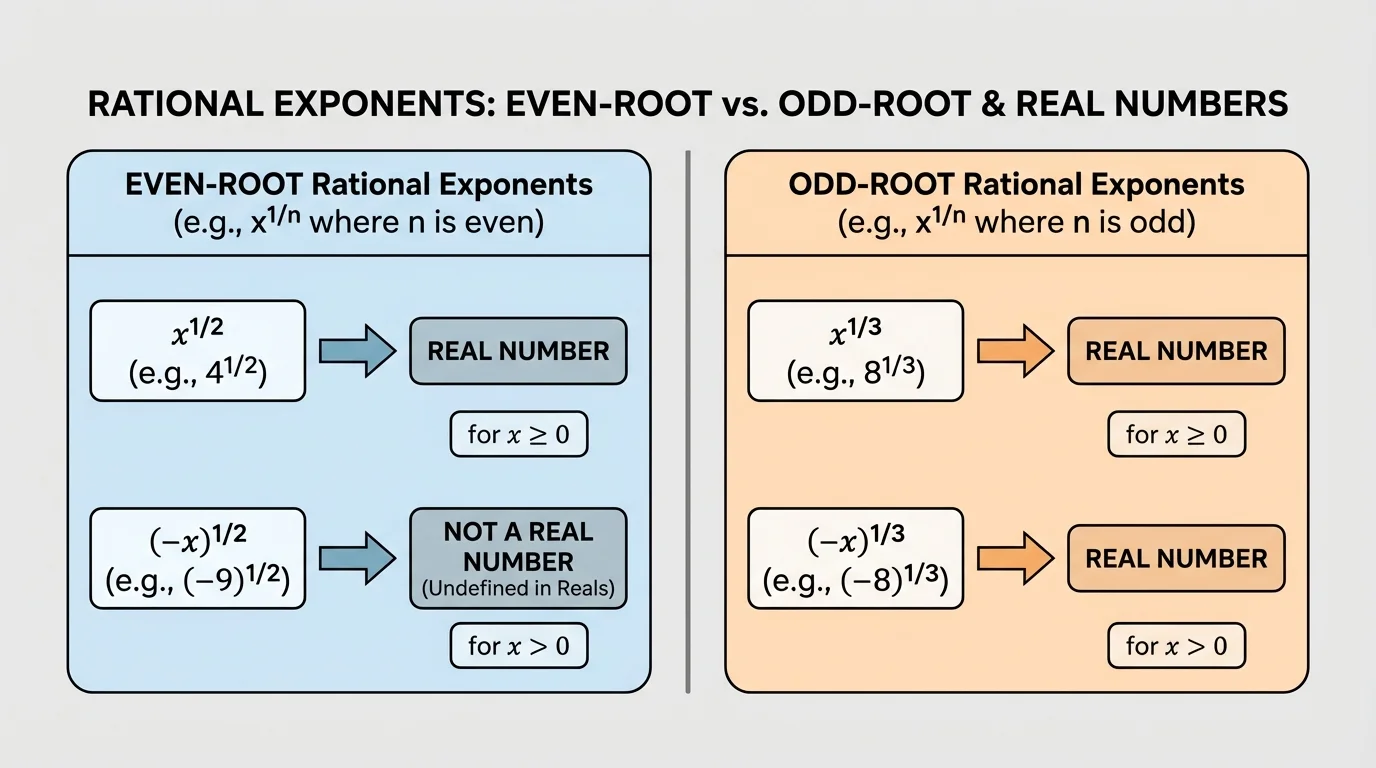
This difference is one reason you must pay attention to the denominator in a rational exponent. For instance, expressions such as \(a^{2/4}\) should be handled carefully when variables are involved, because rewriting the exponent can change the stated domain unless restrictions on \(a\) are made explicit.
When working only in the real numbers, always ask: does this root make sense for this input? The comparison in [Figure 2] helps explain why square roots and cube roots behave differently.
To rewrite a radical using exponents, use the index of the root as the denominator of the exponent.
Examples:
If a radical contains a power, that power becomes the numerator. For example, \(\sqrt[3]{y^7} = y^{7/3}\).
Sometimes rewriting helps simplify. For instance, \(\sqrt[3]{x} \cdot \sqrt[3]{x^2} = x^{1/3} \cdot x^{2/3} = x\).
An expression like \(a^{m/n}\) can be rewritten in two equivalent radical forms, and [Figure 3] makes those two routes easy to compare. This flexibility is useful because one route may simplify more quickly than the other.
The two equivalent forms are
\[a^{m/n} = \left(\sqrt[n]{a}\right)^m = \sqrt[n]{a^m}\]
Examples:
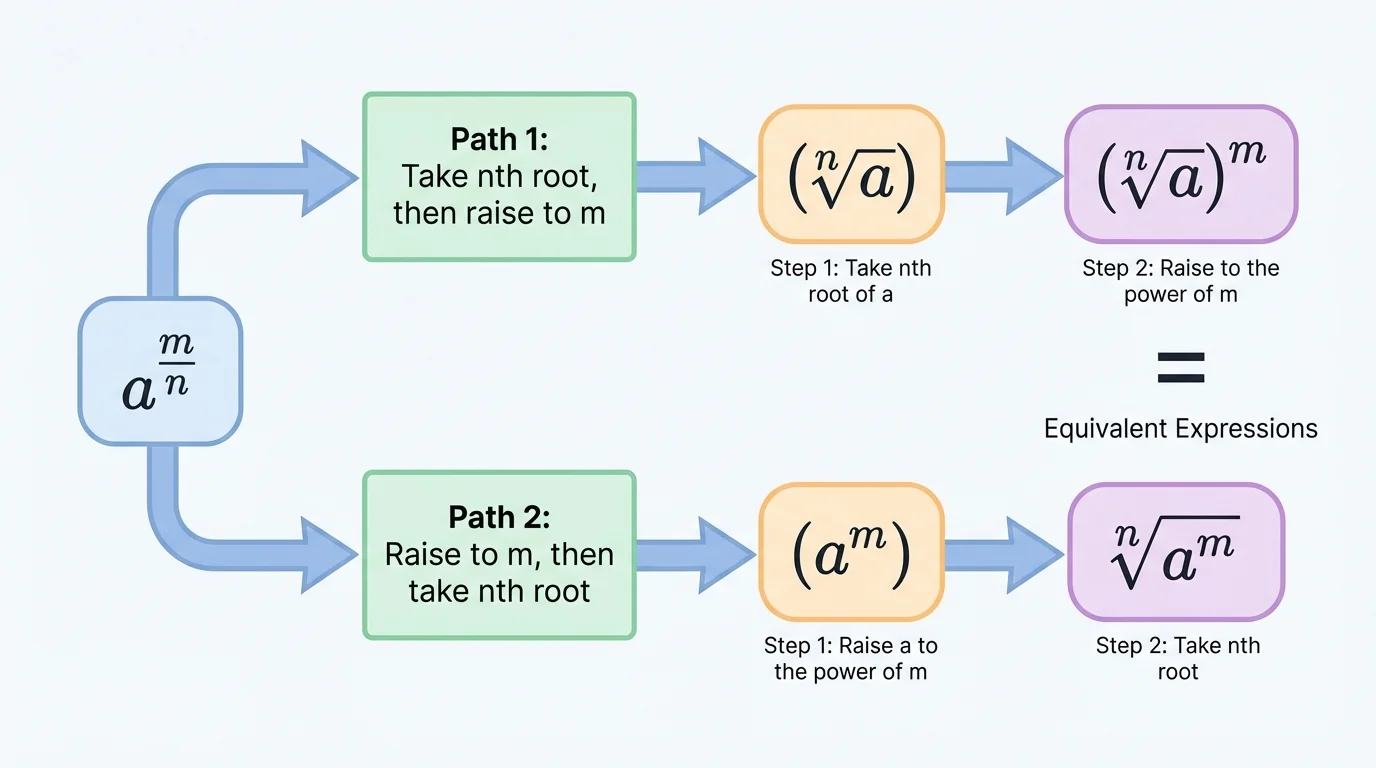
For numerical expressions, choosing the easier path matters. With \(64^{2/3}\), taking the cube root first gives \((\sqrt[3]{64})^2 = 4^2 = 16\), which is much simpler than computing \(64^2\) first.
As in [Figure 3], both methods are valid when the expression is defined; good algebra often means choosing the cleaner route.
When simplifying, first decide whether to keep the expression in radical form or exponent form. If you need exponent rules, rational exponents are often more convenient. If you need to present an exact root, radical form may be clearer.
Consider \(x^{5/2} \div x^{1/2}\). Using the quotient rule, \(x^{5/2 - 1/2} = x^2\).
Consider \((a^{2/3}b^{1/3})^3\). Multiply exponents: \(a^2b\).
Consider \(32^{4/5}\). Since \(32 = 2^5\), we have \((2^5)^{4/5} = 2^4 = 16\).
Prime factorization can also help. For example, \(81^{3/4}\) works well because \(81 = 3^4\), so \((3^4)^{3/4} = 3^3 = 27\).
Many scientific models use exponents less than \(1\). For example, scaling laws in biology and physics often involve fractional powers, which is one reason rational exponents matter beyond algebra class.
Negative rational exponents combine two ideas at once: roots and reciprocals. For example, \(x^{-1/2} = \dfrac{1}{x^{1/2}} = \dfrac{1}{\sqrt{x}}\), provided \(x > 0\) in the real numbers.
Careful step-by-step work is the best way to see these ideas in action.
Worked example 1
Rewrite \(\sqrt[3]{x^5}\) using rational exponents, then simplify if possible.
Step 1: Identify the root and the power.
The cube root means denominator \(3\), and the power on \(x\) is numerator \(5\).
Step 2: Rewrite using a rational exponent.
\(\sqrt[3]{x^5} = x^{5/3}\).
Step 3: Decide whether more simplification is possible.
As a single power, \(x^{5/3}\) is already simplified. It can also be written as \(x \cdot x^{2/3}\) because \(\dfrac{5}{3} = 1 + \dfrac{2}{3}\).
The rewritten form is \(x^{5/3}\)
This example shows that radicals can often be compressed into exponent notation, making later algebra easier.
Worked example 2
Simplify \(27^{2/3}\).
Step 1: Rewrite using a radical.
\(27^{2/3} = (\sqrt[3]{27})^2\).
Step 2: Evaluate the root.
\(\sqrt[3]{27} = 3\).
Step 3: Square the result.
\(3^2 = 9\).
So, \[27^{2/3} = 9\]
Notice how taking the root first is faster than computing \(27^2\) and then taking the cube root.
Worked example 3
Rewrite and simplify \(\dfrac{\sqrt{x} \cdot x^{3/2}}{x^{1/2}}\), assuming \(x > 0\).
Step 1: Rewrite the radical as a rational exponent.
\(\sqrt{x} = x^{1/2}\).
Step 2: Substitute into the expression.
\(\dfrac{x^{1/2} \cdot x^{3/2}}{x^{1/2}}\).
Step 3: Combine exponents in the numerator.
\(x^{1/2} \cdot x^{3/2} = x^{4/2} = x^2\).
Step 4: Divide like bases.
\(\dfrac{x^2}{x^{1/2}} = x^{2 - 1/2} = x^{3/2}\).
The simplified result is \(x^{3/2}\)
Because the expression was rewritten entirely with exponents, the simplification became straightforward.
Worked example 4
Simplify \((16a^8)^{1/4}\), assuming \(a \geq 0\).
Step 1: Apply the exponent to each factor.
\((16a^8)^{1/4} = 16^{1/4} \cdot (a^8)^{1/4}\).
Step 2: Evaluate each part.
\(16^{1/4} = 2\), and \((a^8)^{1/4} = a^{8/4} = a^2\).
Step 3: Multiply the simplified factors.
\(2 \cdot a^2 = 2a^2\).
The simplified result is \(2a^2\)
This example also shows why assumptions matter: real-number restrictions must be respected when even roots are involved.
One common mistake is adding exponents across addition instead of multiplication. For example, \(x^{1/2} + x^{1/2} = 2x^{1/2}\), not \(x^1\). Exponent rules apply to multiplication and division of like bases, not to addition.
Another common error is confusing \(a^{m/n}\) with \(\dfrac{a^m}{n}\). The denominator in a rational exponent does not mean divide by \(n\); it indicates an \(n\)th root.
A third mistake is ignoring domain restrictions. From the comparison in [Figure 2], remember that \((-16)^{1/2}\) and \((-16)^{1/4}\) are not real, while \((-16)^{1/3}\) is real because the denominator is odd.
Students also sometimes think \((a+b)^{1/2} = a^{1/2} + b^{1/2}\), but that is not generally true. For example, \(\sqrt{9+16} = \sqrt{25} = 5\), while \(\sqrt{9} + \sqrt{16} = 3 + 4 = 7\).
Rational exponents appear whenever quantities scale by area, volume, or repeated growth. If the area of a square is \(A\), then its side length is \(A^{1/2}\). If the volume of a cube is \(V\), then its edge length is \(V^{1/3}\). These are direct uses of square roots and cube roots.
In engineering and design, changing a measurement does not always change other quantities linearly. If a solid object's volume is multiplied by \(8\), its linear dimensions scale by \(8^{1/3} = 2\). That cube root tells how much each length changes.
In science, formulas often involve powers such as \(x^{1/2}\), \(x^{3/2}\), or \(x^{-1/2}\). Understanding how to rewrite expressions lets you interpret formulas, simplify models, and use technology more accurately. The two-path idea shown earlier in [Figure 3] is especially useful when evaluating numerical expressions efficiently.
| Expression | Equivalent form | Meaning |
|---|---|---|
| \(A^{1/2}\) | \(\sqrt{A}\) | Side length from square area |
| \(V^{1/3}\) | \(\sqrt[3]{V}\) | Edge length from cube volume |
| \(x^{-1/2}\) | \(\dfrac{1}{\sqrt{x}}\) | Reciprocal of a square root |
| \(k^{3/2}\) | \((\sqrt{k})^3\) | Root followed by repeated multiplication |
Table 1. Examples of how rational exponents appear in geometry, algebra, and applied contexts.
When you can rewrite expressions fluently, you gain more than a procedure. You gain a way to see structure: roots are exponents, exponents can represent roots, and the properties of exponents tie the whole system together.
