A surprising number of strong essays lose power in the last few lines. The writer builds a careful claim, uses evidence well, and then ends with something vague like That is why this topic is important or something dramatic that the essay never actually proved. A conclusion is not just the place where writing stops. It is the place where the writer shows control. A strong ending leaves the reader thinking, Yes, that follows. Yes, that matters.
In academic writing, a conclusion has a serious job. It gives the reader a sense of completion, but it also does more than close the paper. It shows how the ideas fit together and why the discussion deserves attention. In an argument, the ending helps the reader understand the full force of the claim. In an explanation, it helps the reader understand the larger meaning of the information.
A weak conclusion can create several problems. It can sound repetitive, as if the writer simply copied the introduction. It can feel abrupt, as if the paper ran out of energy. It can even damage credibility by making claims that are broader than the evidence supports. Because of that, strong writers treat the conclusion as part of the argument itself, not as an afterthought.
Concluding statement is the final part of a piece of writing that follows logically from what came before and gives the reader a clear sense of closure. In analytical and argumentative writing, it often reinforces the claim, synthesizes the main points, and explains the implications or significance of the topic.
A good conclusion does not merely repeat. It provides closure. That means it helps the reader see the meaning of the discussion more clearly at the end than at the beginning.
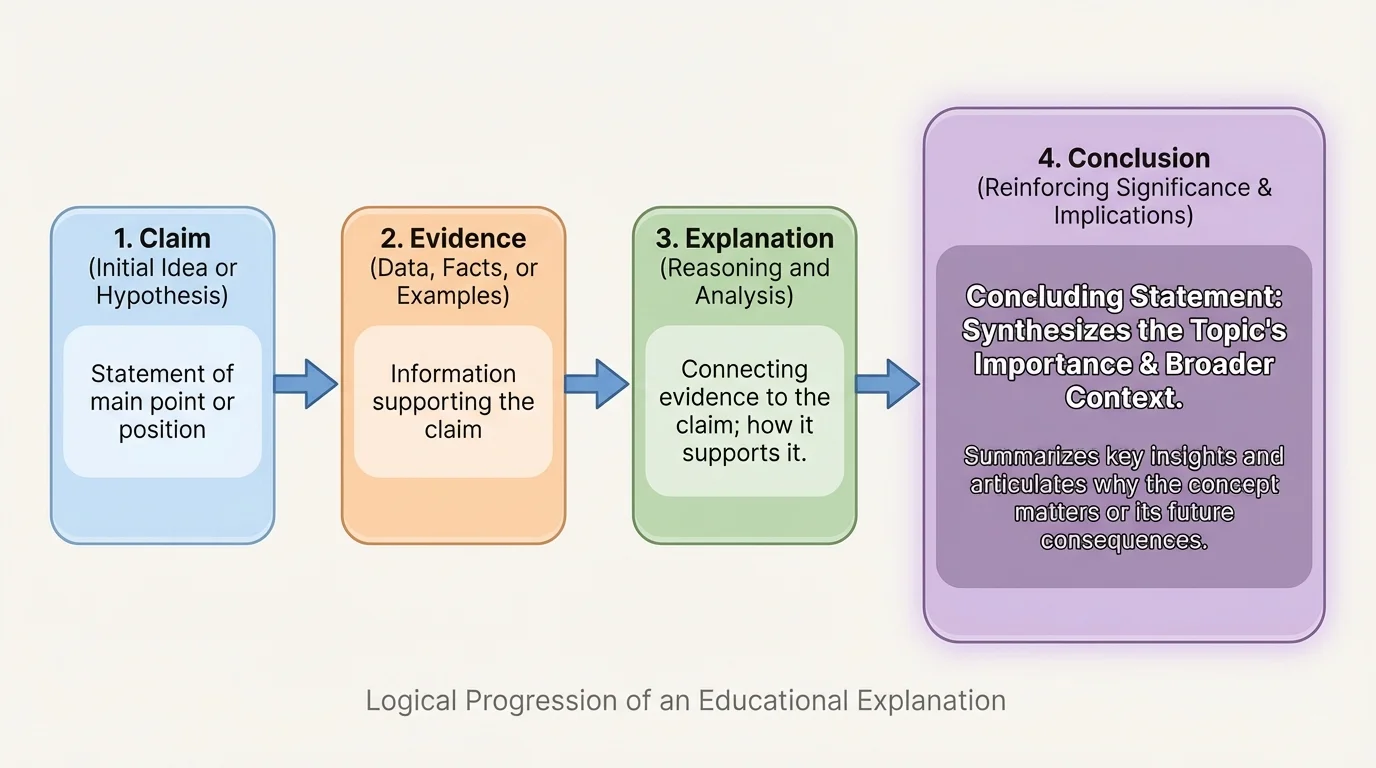
A conclusion works best when it grows naturally from the body of the writing, as [Figure 1] illustrates. The writer begins with a claim or central idea, supports it with reasons and evidence, explains that evidence, and then arrives at a conclusion that feels earned. The ending should not seem disconnected from what came before. Instead, it should feel like the logical final step.
Most effective conclusions do four things. First, they synthesize the main ideas rather than list them again. Second, they reinforce the central claim or explanation. Third, they show why the topic matters by addressing its consequences, implications, or significance. Fourth, they provide a sense of finality, so the reader does not feel abandoned in the middle of the discussion.
Think of the conclusion as the moment when a camera pulls back. During the body paragraphs, the camera focuses closely on individual pieces of evidence. In the conclusion, the camera widens to show what those details mean together.
This is why a conclusion is different from a summary. A summary mainly compresses information. A conclusion may include a brief summary, but its real work is interpretive. It answers questions such as: What should the reader understand now? What larger issue does this point toward? Why does this argument matter beyond the page?
The difference between repeating and concluding
Repeating gives the reader the same words or ideas again. Concluding reshapes earlier ideas into a final insight. For example, repeating might say, School start times should be later because students need sleep. A stronger conclusion might say, Because adolescent sleep needs are biologically real, later start times are not simply a convenience; they are a policy choice that affects learning, health, and safety. The second sentence grows from the argument and shows its broader importance.
Notice that the stronger ending does not wander away from the essay's evidence. It remains grounded in the same topic while clarifying why the issue deserves attention.
One of the most important qualities of a conclusion is that it must follow logically from the writing that came before it. If an essay argues that social media can spread misinformation quickly, the conclusion should not suddenly claim that all technology is harmful. That larger claim may be arguable, but it was not established by the essay. Conclusions must be supported by what has already been explained.
Writers sometimes weaken their endings by adding brand-new evidence in the final paragraph. This is usually a mistake. New evidence belongs in the body, where it can be explained and connected to the claim. The conclusion should build on what the reader already knows from the essay. In other words, the conclusion is where the writer draws meaning from the evidence, not where the writer begins a new line of proof.
Suppose a paper argues that public libraries remain essential because they provide internet access, educational programming, and community space. A conclusion that follows logically might say that libraries are not outdated institutions but vital public resources in a digital society. That statement grows directly from the reasons already presented. A conclusion that suddenly argues for increasing federal spending on all forms of cultural programming would go beyond the essay unless the body had developed that idea.
Writers should ask a simple question while revising: Can my reader point to the earlier parts of the essay that support this final statement? If the answer is no, the conclusion needs adjustment.
Professional writers often revise the conclusion after revising the body because the strongest ending depends on the exact ideas and evidence that finally remain in the piece.
This is one reason conclusions are often easier to write late in the drafting process. Once the writer knows exactly what the essay has proved, the final paragraph can be more precise and more convincing.
A conclusion should not only follow from the essay; it should also support the argument by strengthening the reader's understanding of it. One common way to do this is by explaining the significance of the topic. Significance means why the issue matters in a larger context.
For example, an essay about renewable energy might end by showing that the transition to cleaner power is not only an environmental issue but also an economic and public health issue. That concluding move supports the essay because it helps the reader understand the broader reach of the topic. It does not change the claim; it deepens the reader's understanding of it.
Another powerful move is to discuss implications. An implication is a likely consequence or meaning that follows from the argument. If a literary analysis argues that a novel portrays silence as a form of resistance, the conclusion might explain that this interpretation changes how readers understand the character's apparent passivity. If a historical argument shows that a reform movement succeeded because of local organizing, the conclusion might suggest that political change often depends less on speeches from national leaders than on sustained work by ordinary citizens.
These moves support the writing because they push the reader toward a clearer understanding of what is at stake. As we saw earlier in [Figure 1], the conclusion is not separate from the claim-and-evidence structure. It is the point where the argument's meaning becomes fully visible.
There is no single correct formula for a conclusion, but several moves appear often in effective writing.
Restate the claim with greater precision. This does not mean copying the thesis word for word. It means returning to the central point in a way that reflects the deeper understanding produced by the body paragraphs.
Synthesize key reasons. Instead of listing every body paragraph, connect the most important ideas. A synthesis shows relationships. For instance, a writer might show how economic, ethical, and scientific reasons all support the same claim.
Extend to a broader context. A conclusion may connect the argument to a larger issue, such as justice, technology, public policy, education, or human behavior. The broader context should still emerge naturally from the essay.
Address consequences. What happens if the argument is ignored? What changes if it is accepted? This move is especially useful in persuasive and policy writing.
End with a purposeful final sentence. The last line should sound deliberate. It might sharpen the claim, point to a meaningful consequence, or leave the reader with a strong final insight.
Example: From repetition to synthesis
Weak conclusion: School uniforms should be required because they reduce distractions, save money, and create unity. These are the reasons school uniforms are good.
Step 1: Identify the problem.
The ending simply repeats earlier points and adds no new understanding. It sounds flat because it does not explain why those reasons matter together.
Step 2: Revise by combining the points into a broader idea.
Stronger conclusion: Because uniforms reduce visible status competition, lower some family clothing costs, and create a shared school identity, they can help shift students' attention from appearance to participation. The debate over uniforms is really a debate over what schools should prioritize: display or learning.
The revised version still reflects the original argument, but it gives the reader a more meaningful final thought.
The strongest conclusions often sound inevitable in the best sense. They do not feel forced. They feel earned.
Just as some strategies strengthen a conclusion, others weaken it.
Avoid exact repetition. If the conclusion simply copies the introduction, it feels mechanical.
Avoid new major claims. A conclusion is not the place to introduce ideas that the essay has not developed.
Avoid unsupported emotional language. Statements like This proves once and for all that everyone must agree usually reduce credibility because they overstate the case.
Avoid vague importance. Sentences such as This topic is important in today's society sound empty unless the writer explains how and why it is important.
Avoid abrupt stopping. Ending immediately after the final piece of evidence can make the essay feel unfinished. Readers need a moment in which the writer interprets what the evidence means.
"The end of a piece of writing should feel discovered, not attached."
— Writing principle
That principle matters because readers notice when a final paragraph has no real connection to the rest of the essay. They also notice when a writer has shaped the conclusion to fit the argument carefully.
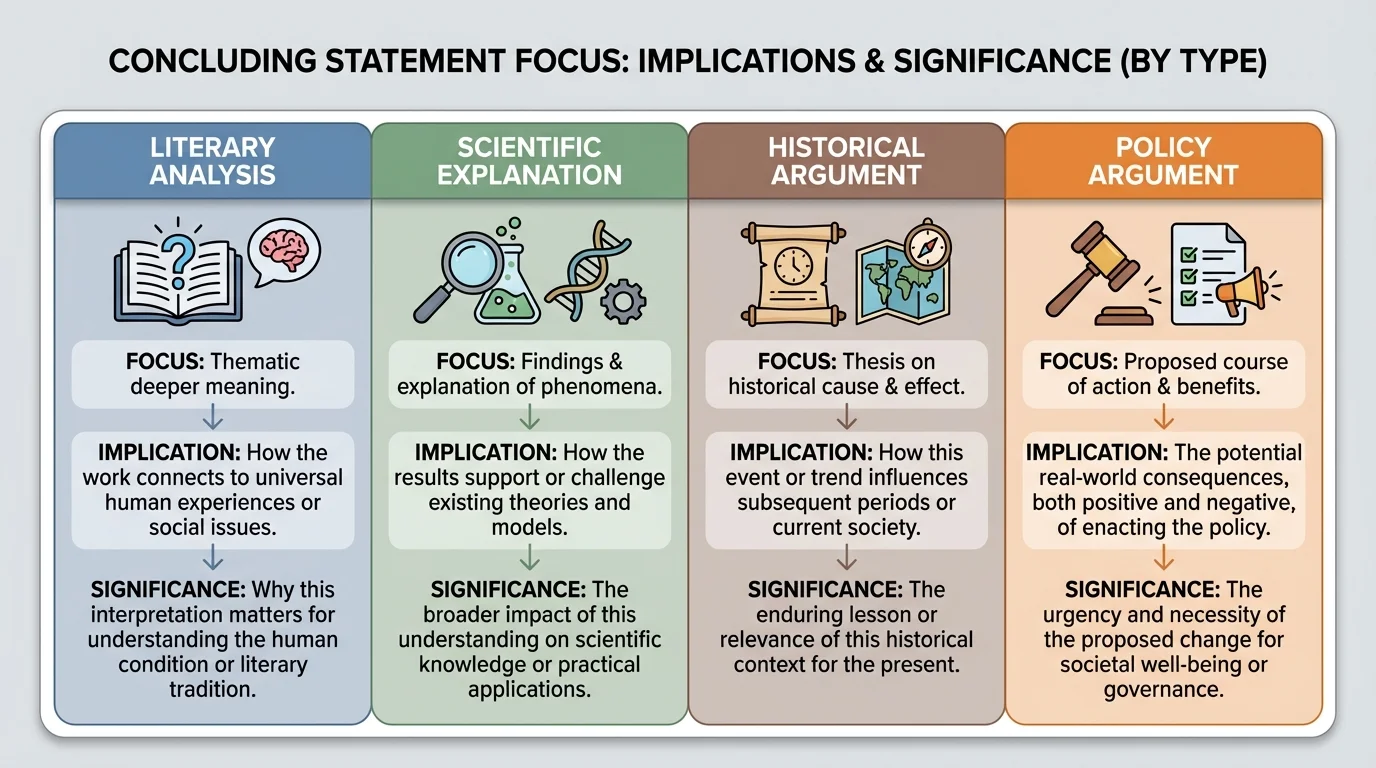
Conclusions vary depending on the kind of writing, as [Figure 2] shows. A literary analysis, a scientific explanation, a historical argument, and a policy essay all need closure, but they do not all end in exactly the same way. The writer's purpose determines what kind of ending works best.
In literary analysis, the conclusion often returns to the interpretation of the text and explains what that interpretation reveals about theme, character, or authorial purpose. In scientific or informational explanation, the ending often clarifies the meaning of the information or points to its practical consequences. In historical argument, the conclusion may highlight the causes, effects, or lasting importance of an event. In a policy argument, the conclusion may emphasize the stakes of action or inaction.
| Writing situation | What the conclusion often emphasizes |
|---|---|
| Literary analysis | The larger meaning of the interpretation |
| Scientific explanation | The practical meaning or application of the information |
| Historical argument | The event's causes, effects, or long-term significance |
| Policy argument | The consequences of choices and the need for action |
Table 1. Common emphases in conclusions across different types of academic writing.
Even with these differences, all strong conclusions have one quality in common: they are faithful to the body of the writing. They do not drift away from the central reasoning.
Later, when comparing conclusion types, it helps to remember [Figure 2]: the genre changes the emphasis, but not the need for logic, support, and closure.
Argumentative writing is never addressed to a blank wall. It is directed toward readers who bring beliefs, experiences, and assumptions. That is why effective conclusions often take the audience into account. A writer who understands the audience can frame the significance of the argument in a way that connects to the reader's values without sacrificing honesty.
Suppose a writer argues for investing in public transit. For an audience concerned mainly with the environment, the conclusion might stress lower emissions and cleaner air. For an audience focused on economics, the conclusion might emphasize reduced traffic costs and stronger access to jobs. For an audience worried about fairness, the writer might highlight transportation access for people who cannot afford cars. The evidence may be the same, but the conclusion can emphasize different implications.
This does not mean manipulating the reader. It means recognizing that arguments become more persuasive when they show why the issue matters to the people reading. Strong writers also anticipate bias, or the tendencies readers may have to favor certain perspectives. A thoughtful conclusion may respond by reinforcing shared values such as safety, fairness, responsibility, or opportunity.
Earlier lessons on argument likely emphasized claim, evidence, reasoning, and counterclaim. A conclusion depends on all four. If the earlier reasoning is weak, the conclusion cannot magically fix it. If the reasoning is strong, the conclusion can highlight that strength and leave the reader with a clear sense of purpose.
A conclusion can therefore be both logical and strategic. It remains grounded in the essay while also recognizing what the reader is likely to care about most.
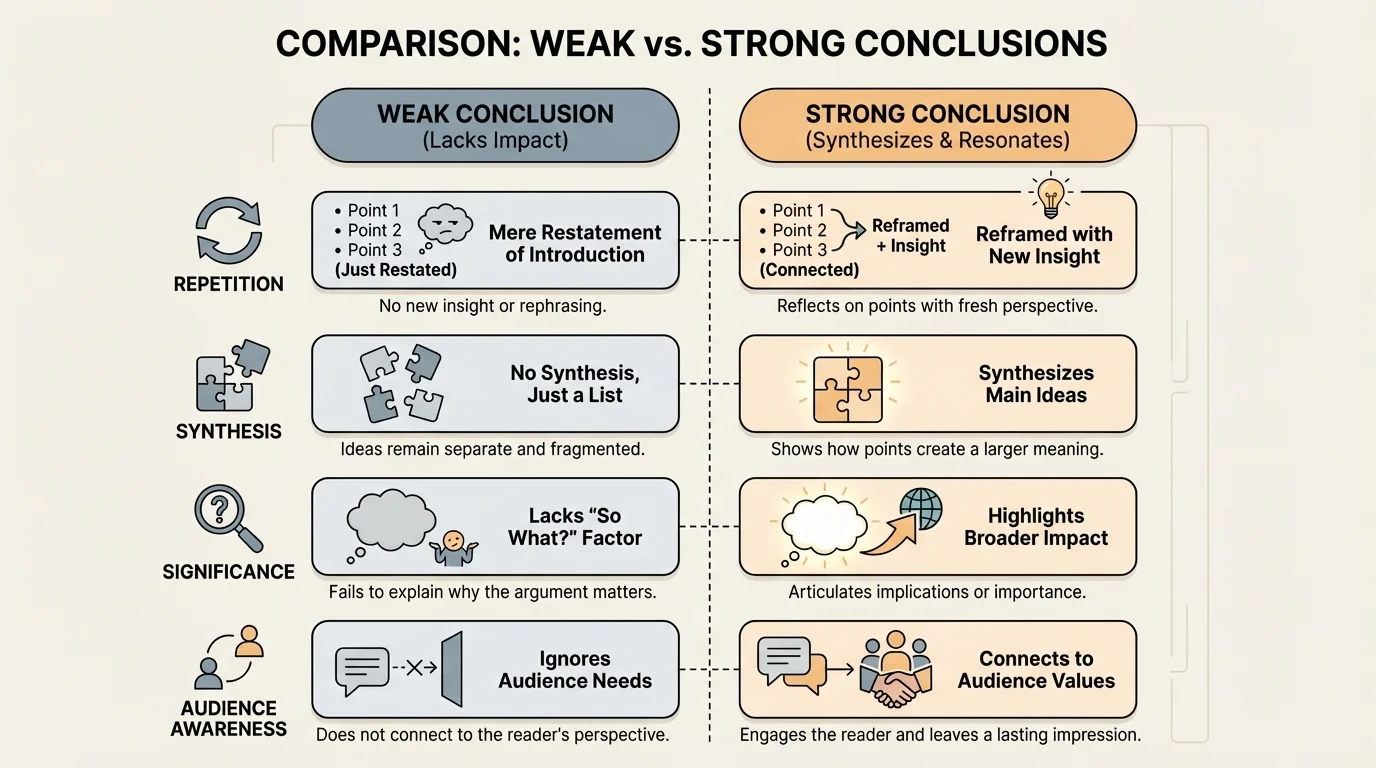
The difference between a weak ending and a strong one becomes clearer when you compare them directly. The strongest revisions usually do not add drama. They add precision, synthesis, and significance.
[Figure 3] Consider an argument about later school start times.
Weak conclusion: In conclusion, school should start later because teens are tired and need more sleep. This topic is important, and schools should think about it.
This ending is weak because it is obvious, generic, and underdeveloped. It does not show what the evidence means or why the issue matters beyond a basic statement.
Stronger conclusion: Because adolescents' sleep patterns are shaped by biology as well as habit, early start times create a conflict between school schedules and students' ability to function well. The evidence suggests that later starts are not a minor scheduling preference but a decision that can influence learning, mental health, and even traffic safety. When schools choose a start time, they are also choosing what kind of conditions they expect students to learn under.
This version follows from the evidence in the argument, adds a broader perspective, and leaves the reader with a purposeful final idea.
Now consider a literary analysis arguing that a character's silence represents resistance.
Weak conclusion: Therefore, the character is silent many times in the story, and this shows that silence is important.
Stronger conclusion: The character's silence is not an empty absence of speech; it is the novel's way of showing resistance in a world that expects submission. Reading those quiet moments as deliberate rather than passive changes the meaning of the character's role and reveals how the text links power to the control of voice.
Again, the stronger ending does more than repeat. It interprets. It clarifies significance. It leaves the reader with a sharper understanding of the claim.
When revising your own conclusions, the comparison in [Figure 3] is useful: strong endings move beyond simple repetition toward a final insight that is still fully supported by the essay.
Revision checklist in action
Suppose a paragraph currently ends with: This proves recycling is good for the planet.
Step 1: Test whether it follows from the body.
If the essay discussed landfill reduction, resource conservation, and energy savings, the conclusion should reflect those ideas specifically.
Step 2: Replace vagueness with significance.
A revised ending might say: By reducing landfill waste, preserving raw materials, and lowering energy use in manufacturing, recycling programs show how everyday systems can shape environmental outcomes on a large scale.
Step 3: Consider audience and stakes.
If the audience is a local community, the writer might add: For cities deciding where to invest limited funds, recycling is not only an environmental gesture but a practical policy choice with long-term consequences.
The revision remains grounded in evidence while becoming more specific and more persuasive.
These examples reveal an important pattern: strong conclusions often sound more thoughtful not because they are longer, but because they are more exact.
Good conclusions are rarely accidental. Writers usually improve them by revising with intention. One useful method is to draft the body first, then write the conclusion after asking three questions: What have I actually shown? Why does it matter? What final understanding should the reader leave with?
Another useful method is to look at the thesis and ask how it has changed through the essay. At the start, the thesis introduces the claim. At the end, the conclusion should return to that claim with the fuller understanding created by the evidence and reasoning.
It also helps to read the final paragraph alone. Does it sound connected to the paper, or could it belong to almost any essay on the topic? Generic conclusions are often a sign that the writer has not yet made the ending specific enough. The best conclusions could only belong to that particular essay because they grow directly from that essay's exact evidence and reasoning.
When writers learn to close with purpose, they do more than finish neatly. They show readers that the argument has direction, discipline, and meaning.
