If you lifted a small handful of sand, the number of grains might still be less than the number of stars in our galaxy. That comparison is not just poetic; it points to a real scientific challenge: the universe is so vast that human intuition struggles to grasp it. Yet by studying light, motion, and matter, astronomers have built a detailed picture of where Earth fits in space and how the universe has changed over time.
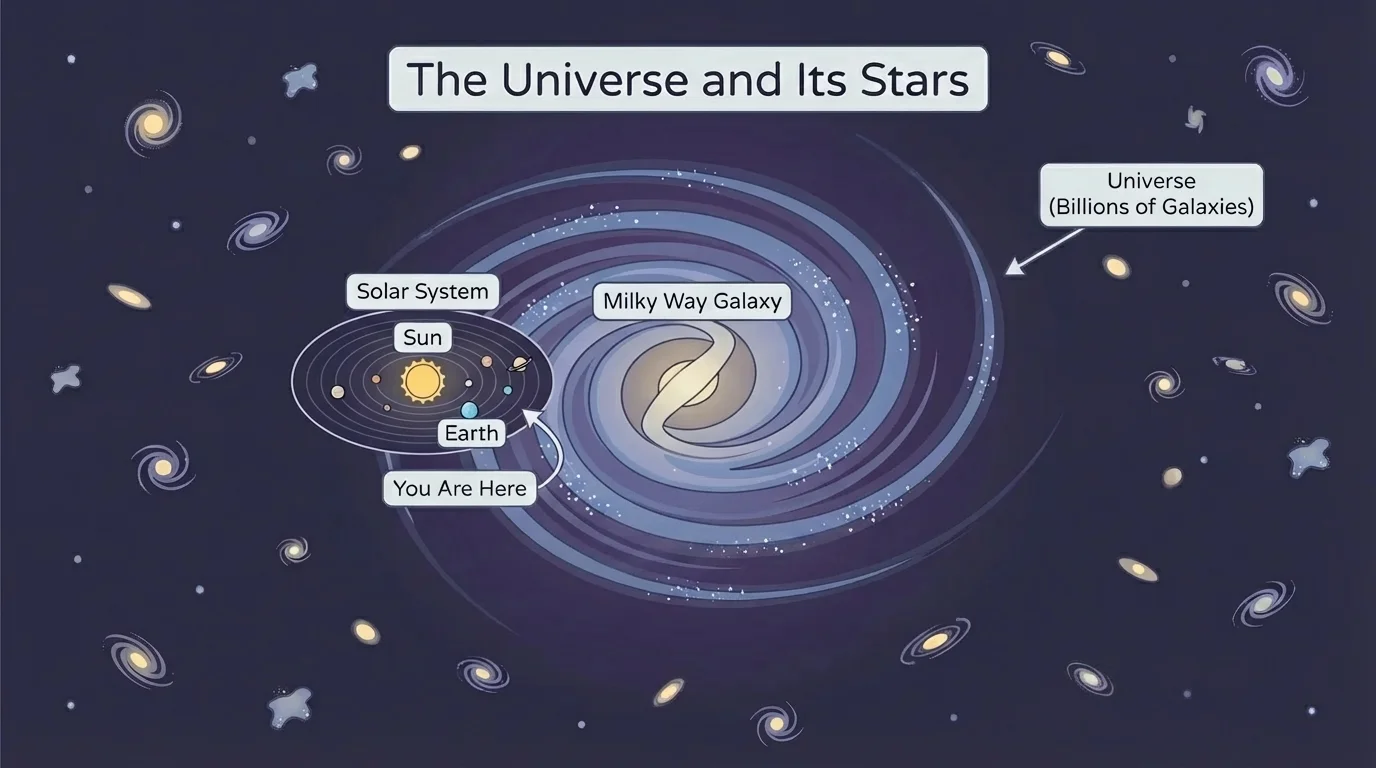
Earth is part of a solar system centered on the Sun, but the Sun is not unusual in the larger cosmic sense. As [Figure 1] shows, it is one star among more than 200 billion in the Milky Way, and the Milky Way itself is one galaxy among hundreds of billions in the observable universe. Understanding this scale changes how we think about Earth: our planet is physically tiny, but it sits inside a universe whose history can be investigated using evidence.
The galaxy we live in, the Milky Way, contains stars, gas, dust, and dark matter bound together by gravity. Our solar system is just a small part of one spiral arm region within this enormous system, and beyond the Milky Way lie countless other galaxies, each with its own stars and structure.
A star is a massive sphere of hot gas, mostly hydrogen and helium, held together by gravity and powered by nuclear reactions in its core. Some galaxies are spirals like the Milky Way, some are elliptical, and some are irregular in shape. Their differences tell astronomers about their histories, collisions, and rates of star formation.
Distances in space are so large that ordinary units such as kilometers become inconvenient. Astronomers often use the light-year, the distance light travels in one year. Because light moves at about \(300{,}000 \textrm{ km/s}\), one light-year is about \(9.46 \times 10^{12} \textrm{ km}\). This means when we observe distant objects, we are also looking into the past. A star seen from \(100\) light-years away appears as it was \(100\) years ago.
This idea is one of the most powerful in astronomy. Telescopes are not just tools for seeing far away; they are also time machines in a scientific sense. When astronomers observe very distant galaxies, they are seeing the universe as it was billions of years earlier.
The Andromeda Galaxy, the Milky Way's large neighboring galaxy, is so far away that the light reaching Earth tonight left Andromeda about 2.5 million years ago, when early human ancestors still lived on Earth.
The scale of the universe also helps explain why astronomy depends so heavily on patterns and indirect evidence. No one can travel to a star to collect a rock sample from its surface, but scientists can still determine what stars are made of, how they move, and how they evolve by carefully analyzing the light they emit.
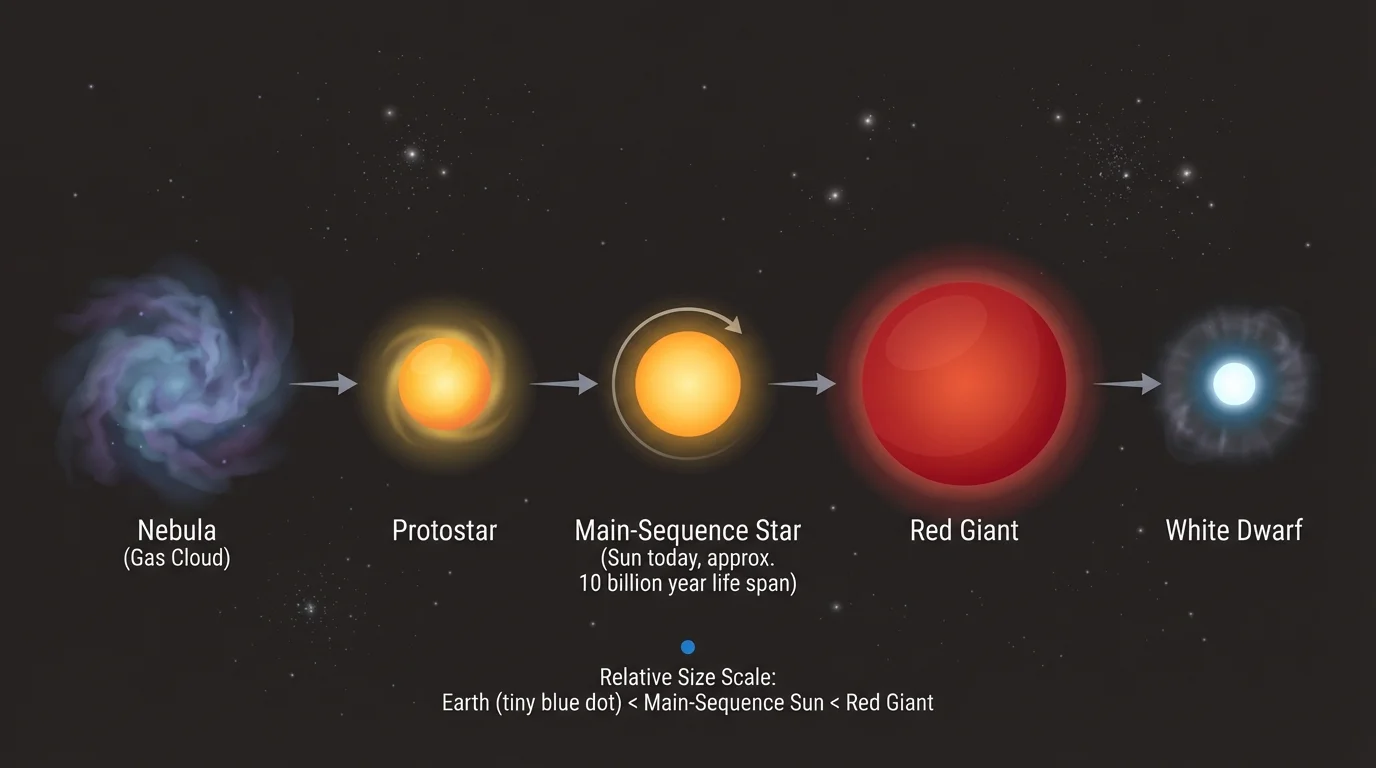
The Sun may seem permanent from a human point of view, but it is a changing star with a life cycle, as [Figure 2] illustrates. It formed from a collapsing cloud of gas and dust about \(4.6\) billion years ago and is currently in the long, stable stage of its life known as the main sequence.
In the Sun's core, extreme temperature and pressure allow hydrogen nuclei to fuse into helium. This process is called nuclear fusion. A simplified net reaction can be represented as \[4\textrm{H} \rightarrow \textrm{He} + \textrm{energy}\]. The energy released in fusion eventually reaches the Sun's surface and is radiated into space as electromagnetic energy, including visible light, infrared radiation, and ultraviolet radiation.
The Sun's total main-sequence lifespan is approximately \(10\) billion years. Since it is about \(4.6\) billion years old, it is roughly halfway through this stage. That does not mean it will suddenly switch off. Instead, stars evolve gradually as the conditions in their cores change.
When most of the hydrogen in the Sun's core has been converted to helium, the balance between outward pressure and inward gravity will shift. The core will contract and heat up, while the outer layers expand greatly. The Sun will become a red giant. In that future stage, it will be much larger and more luminous than it is now.
Eventually, the Sun will shed its outer layers and leave behind a hot, dense remnant called a white dwarf. It will no longer support fusion in the same way it does today. This is what scientists mean when they say the Sun will "burn out." It will not explode like a massive star in a supernova; instead, it will end as a cooling stellar remnant.
The Sun matters for much more than astronomy. Nearly all energy used by living things on Earth traces back to it, either directly through photosynthesis or indirectly through food chains and fossil fuels. Solar energy technologies also depend on understanding radiation from our star. The physics of the Sun is therefore both a cosmic topic and a practical one.
Numerical example: estimating how far sunlight travels to Earth
Light from the Sun takes about \(8.3\) minutes to reach Earth.
Step 1: Convert time to seconds
\(8.3 \textrm{ min} \times 60 \textrm{ s/min} = 498 \textrm{ s}\)
Step 2: Use distance equals speed times time
With the speed of light \(c \approx 300{,}000 \textrm{ km/s}\), the distance is \(d = ct = 300{,}000 \times 498\).
Step 3: Calculate
\[d \approx 149{,}400{,}000 \textrm{ km}\]
This is about \(1.49 \times 10^8 \textrm{ km}\), which matches the average Earth-Sun distance very closely.
The Sun's future also reminds us that stars are not fixed forever. The same physical laws that describe our star apply across the universe, but different stars live different kinds of lives depending mainly on their mass.
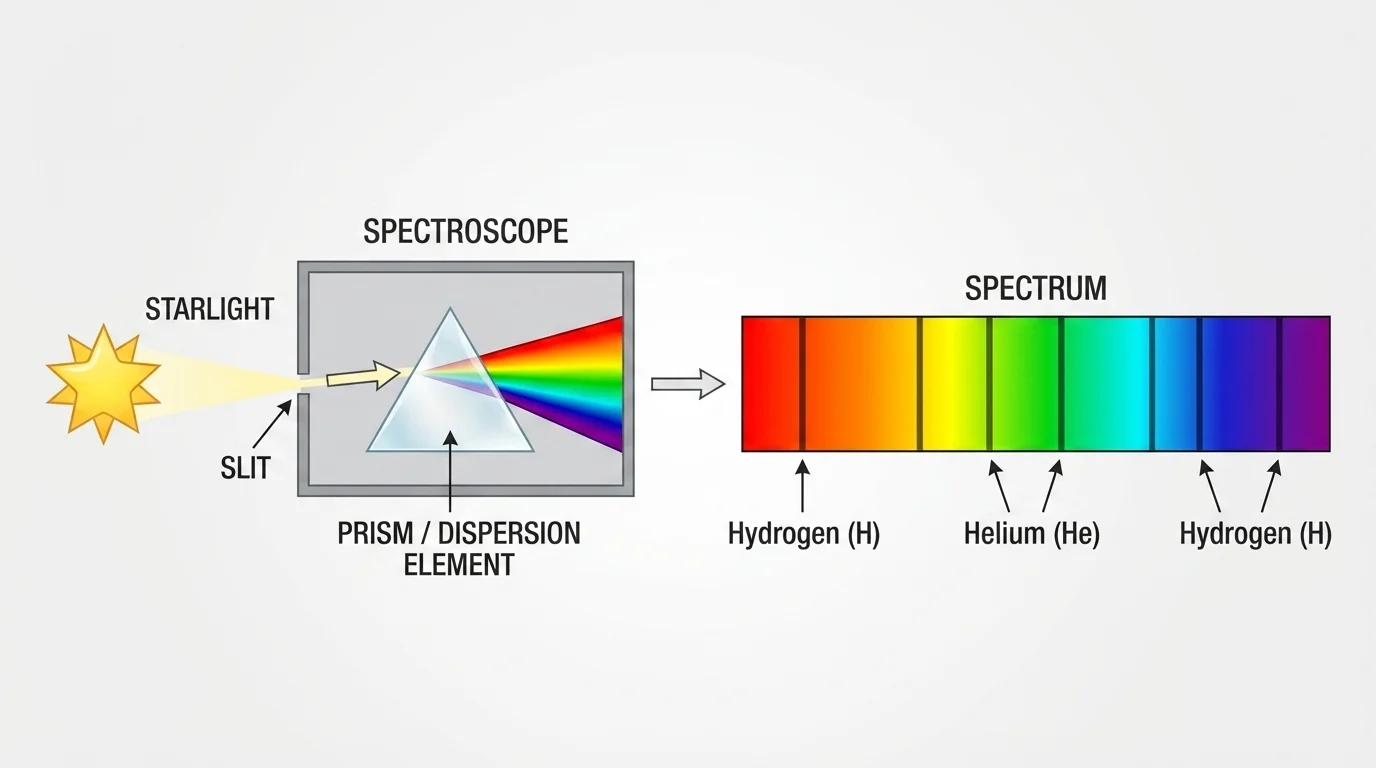
Astronomy is often called a science of light because nearly everything we know about distant stars comes from electromagnetic radiation. The spectrum of a star, as shown in [Figure 3], carries information about the star's composition, temperature, and motion.
When light from a hot object is spread out by a prism or diffraction grating, it forms a spectrum. If certain wavelengths are missing, dark lines appear. These are called absorption lines, and they act like fingerprints for elements. Hydrogen, helium, sodium, calcium, and iron all produce distinctive patterns of lines. By matching a star's spectrum to laboratory measurements, astronomers can identify which elements are present.
This method is known as spectroscopy. It is one of the most important tools in modern astronomy because it reveals the chemistry of objects far beyond direct reach. For example, if the spectrum of a star shows strong hydrogen lines and helium lines, scientists can conclude that those elements are abundant in the star's outer layers.
Brightness provides another important clue. A star's apparent brightness is how bright it looks from Earth, while its luminosity is the total energy it emits. A nearby dim star can appear brighter than a very luminous but distant one, so astronomers must separate true energy output from distance effects.
One useful relationship is the inverse-square law for light. If distance doubles, brightness becomes \(\dfrac{1}{4}\) as strong; if distance triples, brightness becomes \(\dfrac{1}{9}\) as strong. This can be written as \[B \propto \frac{1}{d^2}\] where \(B\) is brightness and \(d\) is distance.
Numerical example: how distance changes brightness
Suppose one star is observed from a distance of \(10\) units and then from \(20\) units.
Step 1: Compare the distances
The new distance is \(2\) times larger.
Step 2: Apply the inverse-square relationship
Brightness changes by \(\dfrac{1}{2^2} = \dfrac{1}{4}\).
Step 3: State the result
\[B_{new} = \frac{1}{4} B_{old}\]
The star appears only one-fourth as bright when the distance doubles.
Astronomers also measure how stars move by studying shifts in spectral lines. If a star is moving away, its spectral lines shift toward longer wavelengths, called a redshift. If it is moving closer, the lines shift toward shorter wavelengths, called blueshift. This is a version of the Doppler effect, the same basic phenomenon that changes the pitch of a passing siren.
Distance can be estimated in several ways. For nearby stars, astronomers use parallax, the apparent shift in a star's position against distant background stars as Earth moves around the Sun. For more distant stars, brightness comparisons with known standard candles are used. Together, spectra and brightness allow astronomers to study stars on a huge scale.
The same techniques are used in practical science beyond astronomy. Spectroscopy helps identify chemicals in laboratories, monitor air pollution, and even analyze the composition of distant planets' atmospheres. A method developed for stars turns out to be useful in chemistry, environmental science, and space exploration.
The Big Bang theory is the leading scientific explanation for the universe's origin and early development. It does not claim that an explosion happened in empty space. Instead, it says that the universe itself began in an extremely hot, dense state and has been expanding over time. One major line of evidence is that distant galaxies are receding from our own.
As [Figure 4] illustrates, when astronomers observe galaxies far away, they find that most of their spectra are redshifted. This means the galaxies are moving away from us. More importantly, the farther away a galaxy is, the faster it tends to recede. This pattern is consistent with an expanding universe. It is often compared to dots on the surface of an inflating balloon: as the balloon expands, every dot moves farther from every other dot.
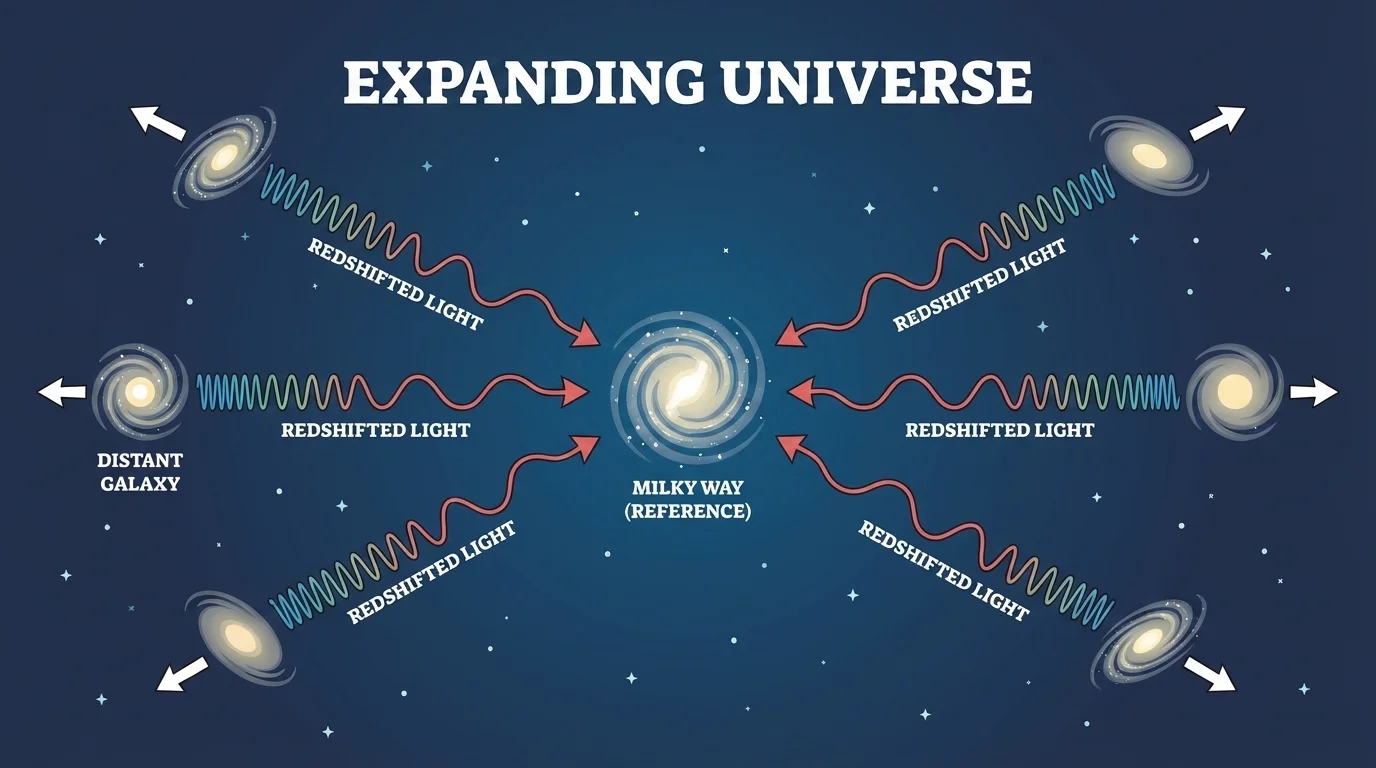
This relationship is summarized by Hubble's law: \(v = H_0 d\), where \(v\) is recessional speed, \(d\) is distance, and \(H_0\) is the Hubble constant. If \(H_0\) is taken as about \(70 \textrm{ km/s/Mpc}\), then a galaxy \(100\) megaparsecs away would have a recessional speed of about \(7{,}000 \textrm{ km/s}\).
A second line of evidence comes from the composition of matter in the universe. Models of the early universe correctly predict that ordinary matter should have formed mostly hydrogen and helium, with only tiny amounts of lithium. Observations of stars and non-stellar gases match this prediction remarkably well. The abundance of hydrogen and helium is therefore not random; it is a clue to conditions in the early universe.
A third major line of evidence is the cosmic microwave background, often abbreviated as the CMB. This is faint microwave radiation that fills all of space. It is the cooled remnant of radiation released when the early universe became transparent. Precise maps of the CMB show tiny variations in temperature that reflect the structure of the young universe.
Why the cosmic microwave background matters
The cosmic microwave background is powerful evidence because it is not just a general glow. Its spectrum matches what scientists expect from a hot early universe that expanded and cooled. Its tiny temperature differences also help explain how matter later gathered into galaxies and galaxy clusters.
Together, galaxy recession, element abundances, and the CMB form a strong, connected case for the Big Bang. Each line of evidence comes from a different kind of observation, and all of them point toward the same general history: the universe has changed over time from a hotter, denser beginning to its present large-scale structure.
As we saw earlier in [Figure 3], spectra reveal composition and motion, so the evidence for cosmic expansion depends directly on the same tools astronomers use to study stars. The universe's history is read through light.
The atoms in your blood, bones, electronics, and food have a cosmic history. The process of forming atomic nuclei is called nucleosynthesis, and [Figure 5] traces the major stages by which the universe produced different elements.
Shortly after the Big Bang, conditions allowed the formation of the lightest elements. Most of the ordinary matter produced then was hydrogen, with much helium and a very small amount of lithium. Heavier elements were not produced in large amounts during this stage because the universe cooled too quickly for extended fusion chains.
Later, stars became the factories of new elements. Inside stars, nuclear fusion combines lighter nuclei into heavier ones. In stars like the Sun, hydrogen fuses into helium. In more advanced stages of stellar evolution, especially in larger stars, helium and other nuclei can fuse into carbon, oxygen, neon, silicon, and eventually iron.
Fusion releases energy when it builds nuclei up to iron because those reactions lead to more stable configurations. But producing elements heavier than iron by fusion does not release energy in the same way. That is why iron is a major turning point in stellar evolution.
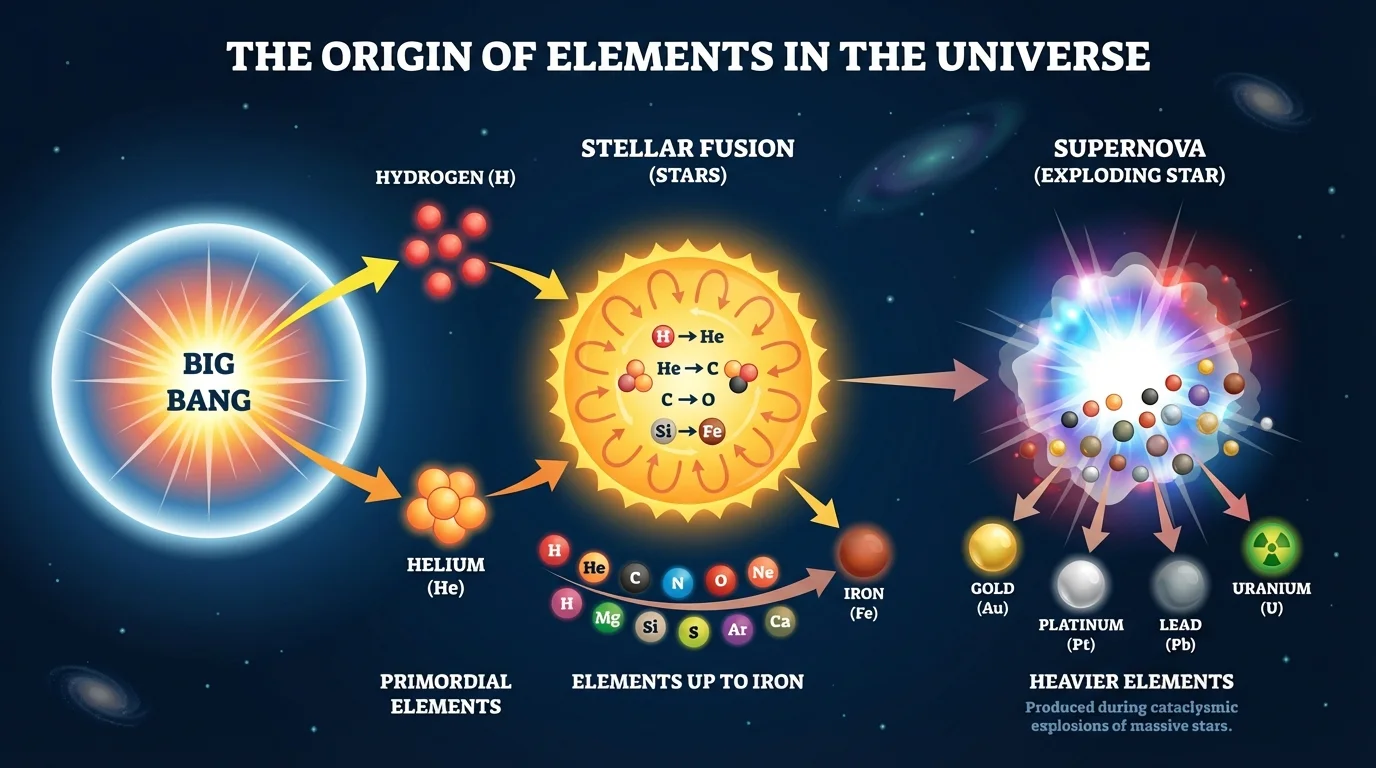
When certain very massive stars reach the end of their lives, their cores collapse and the stars explode as a supernova. In these extreme conditions, many elements heavier than iron are formed, including atoms such as gold, uranium, and much of the iron later incorporated into planets. These explosions also scatter material into space, where it can become part of new stars, planets, and eventually living things.
This means the chemistry of Earth depends on several stages of cosmic history. Hydrogen in water connects to the Big Bang. Carbon in living tissue connects to fusion inside stars. Gold in jewelry and many heavy elements in technology connect to ancient stellar explosions. The phrase "we are made of star stuff" is scientifically meaningful.
Numerical example: estimating the Sun's progress through its life span
If the Sun's approximate life span is \(10\) billion years and its current age is about \(4.6\) billion years, what fraction of that span has passed?
Step 1: Write the fraction
\(\dfrac{4.6}{10}\)
Step 2: Convert to decimal
\(\dfrac{4.6}{10} = 0.46\)
Step 3: Interpret the value
\(0.46 = 46\%\)
The Sun has completed about \(46\%\) of its approximate \(10\)-billion-year life span.
The origin of elements is not just an abstract astronomy topic. Medical imaging relies on elements forged in earlier generations of stars. Semiconductor technology depends on materials such as silicon. Even the calcium in bones and the iron in hemoglobin are part of the universe's long chemical story.
Space science often seems distant, but it changes life on Earth in direct ways. Telescopes drive advances in detectors, imaging, and computing. Spectroscopy supports chemistry and environmental monitoring. Models of the Sun improve predictions of space weather, which can affect satellites, power grids, and communication systems.
The universe also provides a deeper scientific perspective. As shown earlier in [Figure 1], Earth occupies a tiny place in one galaxy among countless others, yet humans can still uncover the structure and history of the cosmos. That is one of science's most impressive achievements: using evidence gathered on one planet to explain events billions of light-years away.
Gravity shapes structures on many scales. It keeps planets in orbit, holds stars together, gathers stars into galaxies, and helps drive the collapse of gas clouds that form new stars.
Modern astronomy combines physics, chemistry, mathematics, and engineering. It shows that the Sun is not eternal, that stars are chemical factories, that light can reveal the nature of distant objects, and that the universe itself has a history. These ideas connect Earth to the rest of space in a precise scientific way.
