A hurricane can begin over warm ocean water, pull moisture from the sea, gain energy from the Sun, reshape coastlines, flood rivers, and change the lives of millions of organisms, including humans. That is a powerful clue about our planet: Earth is not a collection of separate parts. It is a connected system where energy moves and matter cycles from one place to another, causing constant change.
Everything from clouds to volcanoes to forests depends on two big ideas. First, energy flows through Earth's systems. Second, matter is reused again and again. Water, carbon, oxygen, minerals, and rock materials do not simply disappear. They move, change form, and take part in new processes. Together, energy flow and matter cycling explain why Earth is active rather than still.
Earth can be understood as four major parts working together: the geosphere, which includes rocks, soil, landforms, and Earth's interior; the hydrosphere, which includes all water in oceans, rivers, lakes, glaciers, groundwater, and water vapor; the atmosphere, the layer of gases around Earth; and the biosphere, all living things.
As [Figure 1] shows, these systems interact constantly. Rain falls from the atmosphere into the hydrosphere and geosphere. Plant roots in the biosphere break rock and help form soil in the geosphere. Volcanoes in the geosphere release gases into the atmosphere. Oceans in the hydrosphere absorb carbon dioxide from the atmosphere. No system works alone for long.
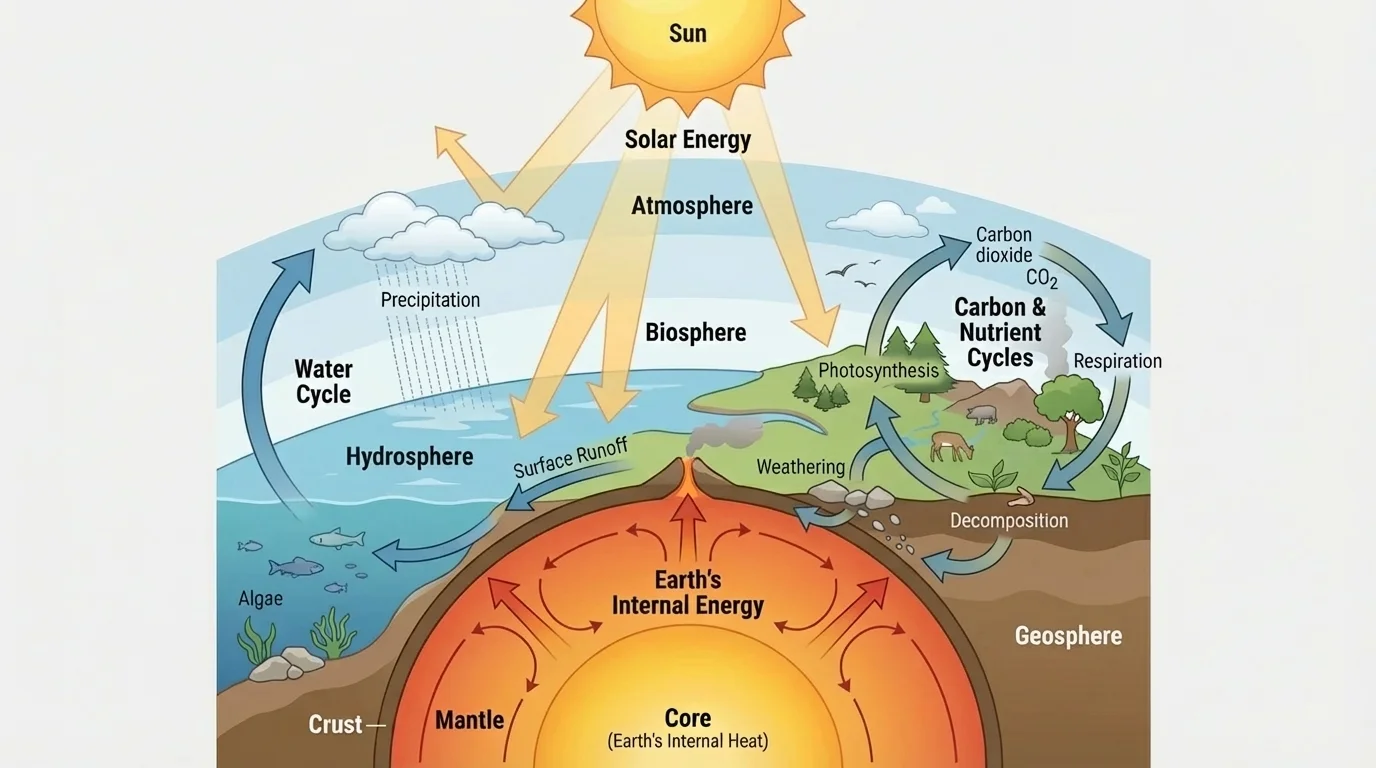
Energy flow is the transfer of energy from one place or form to another.
Matter cycling is the repeated movement and reuse of substances such as water, carbon, and rock materials through Earth's systems.
One important pattern is that energy usually moves in a direction and eventually spreads out, often as heat. Matter behaves differently. The same atoms can be used over and over. For example, a water molecule such as \(\textrm{H}_2\textrm{O}\) in a cloud today may later become snow on a mountain, water in a stream, and then vapor in the air again.
Earth's processes are powered mainly by two sources. The first is the Sun. Solar energy heats Earth's surface unevenly, and that unequal heating drives winds, weather patterns, ocean currents, and evaporation. It also supports most life through photosynthesis.
The second source is Earth's internal heat. Deep inside Earth, heat remains from the planet's formation, and more heat is produced by radioactive decay. This energy moves upward from the hot interior and helps drive plate motion, volcanic activity, and mountain building.
A useful way to think about this is that the Sun mostly powers surface processes, while Earth's hot interior mostly powers internal processes. Both sources are active at the same time, and both influence the planet we live on.
Matter is anything that has mass and takes up space. Energy is the ability to cause change. Earth science depends on both ideas because processes involve materials changing while energy is transferred or transformed.
Sunlight is the main driver of weather and the water cycle. When solar energy reaches Earth, land and water do not heat at the same rate. Dark pavement may become very hot on a summer day, while nearby water warms more slowly. These temperature differences cause air to move, forming winds.
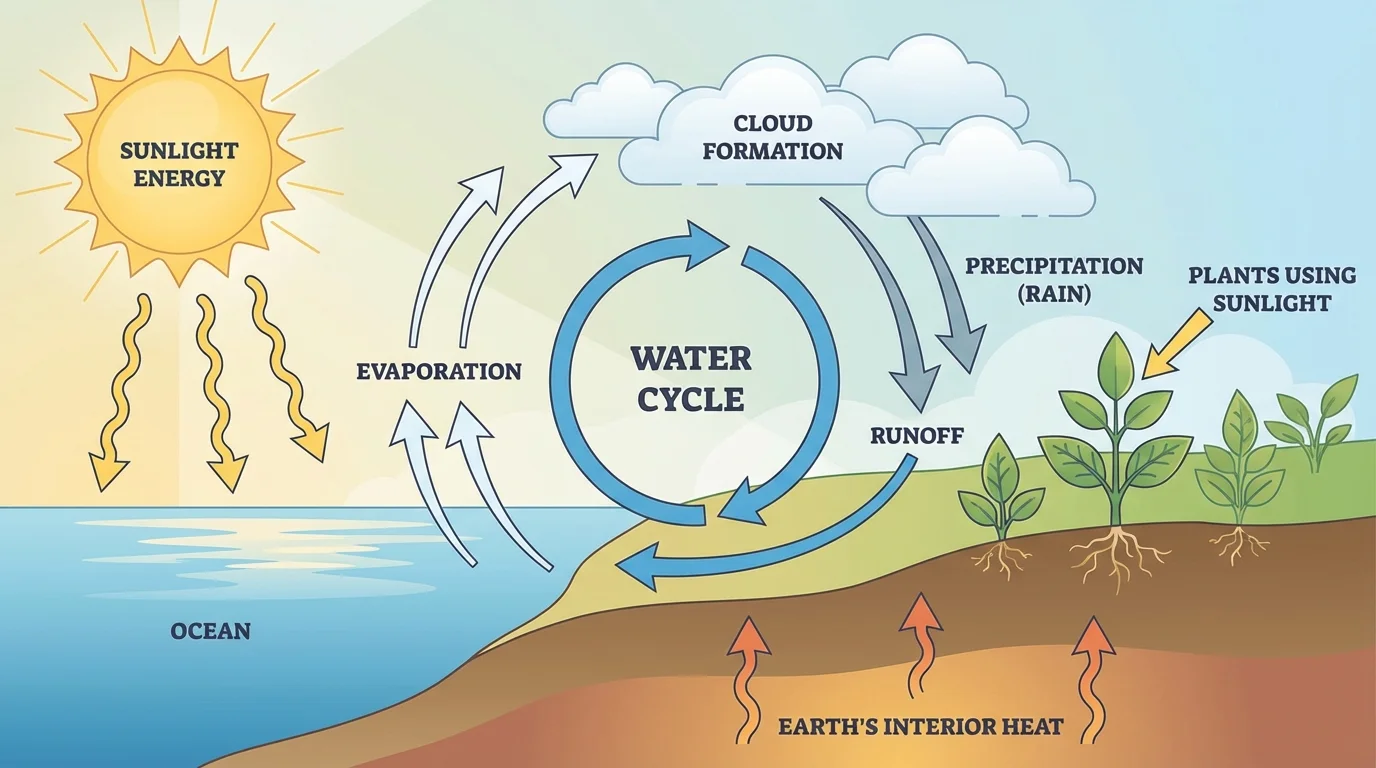
As [Figure 2] illustrates, solar energy also causes evaporation. In evaporation, liquid water gains enough energy to become water vapor. This is a physical change because the substance is still \(\textrm{H}_2\textrm{O}\), just in a different state. When water vapor cools, it can condense into tiny droplets that form clouds, and later it may fall as rain or snow.
The water cycle is a perfect example of matter cycling. Water moves between oceans, atmosphere, land, ice, and living things. The Sun supplies much of the energy that keeps this cycling going. A simple way to describe heating is with the relationship \(Q = mc\Delta T\), where \(Q\) is heat energy, \(m\) is mass, \(c\) is specific heat, and \(\Delta T\) is change in temperature. If \(m = 2\), \(c = 4\), and \(\Delta T = 3\), then \(Q = 2 \cdot 4 \cdot 3 = 24\). This shows that adding energy can change temperature, which helps explain warming of water and air at Earth's surface.
Sunlight also supports life. Green plants, algae, and some bacteria use photosynthesis to capture solar energy and store it in chemical form. One simplified equation is \(6\textrm{CO}_2 + 6\textrm{H}_2\textrm{O} \rightarrow \textrm{C}_6\textrm{H}_{12}\textrm{O}_6 + 6\textrm{O}_2\). Here, carbon dioxide and water are changed into sugar and oxygen using energy from sunlight. This is a chemical change because new substances form.
The energy stored by photosynthesis moves through food webs. Animals eat plants or other animals, and decomposers break down dead material. In this way, solar energy enters the biosphere, while matter such as carbon, oxygen, and water cycles through living and nonliving parts of Earth.
We can see these ideas in everyday life. Drying wet clothes outside depends on solar energy causing evaporation. Sea breezes happen because land heats faster than water. Crops grow because sunlight powers photosynthesis. Even the food you eat is linked to the Sun, directly or indirectly.
The oxygen in Earth's atmosphere was not always abundant. Over a very long time, photosynthetic organisms added large amounts of \(\textrm{O}_2\) to the air, changing Earth's atmosphere and making many modern life forms possible.
Earth's interior heat moves material inside the mantle and helps drive plate tectonics. The outer solid shell of Earth is broken into large plates. These plates move slowly, often only a few centimeters each year, but over millions of years that movement changes the planet dramatically.
As [Figure 3] shows, hot material deep in the mantle rises, cooler material sinks, and this slow movement is called convection. Convection transfers thermal energy and can help move tectonic plates. Where plates separate, new crust can form. Where plates collide, one plate may sink beneath another, causing earthquakes and volcanoes.
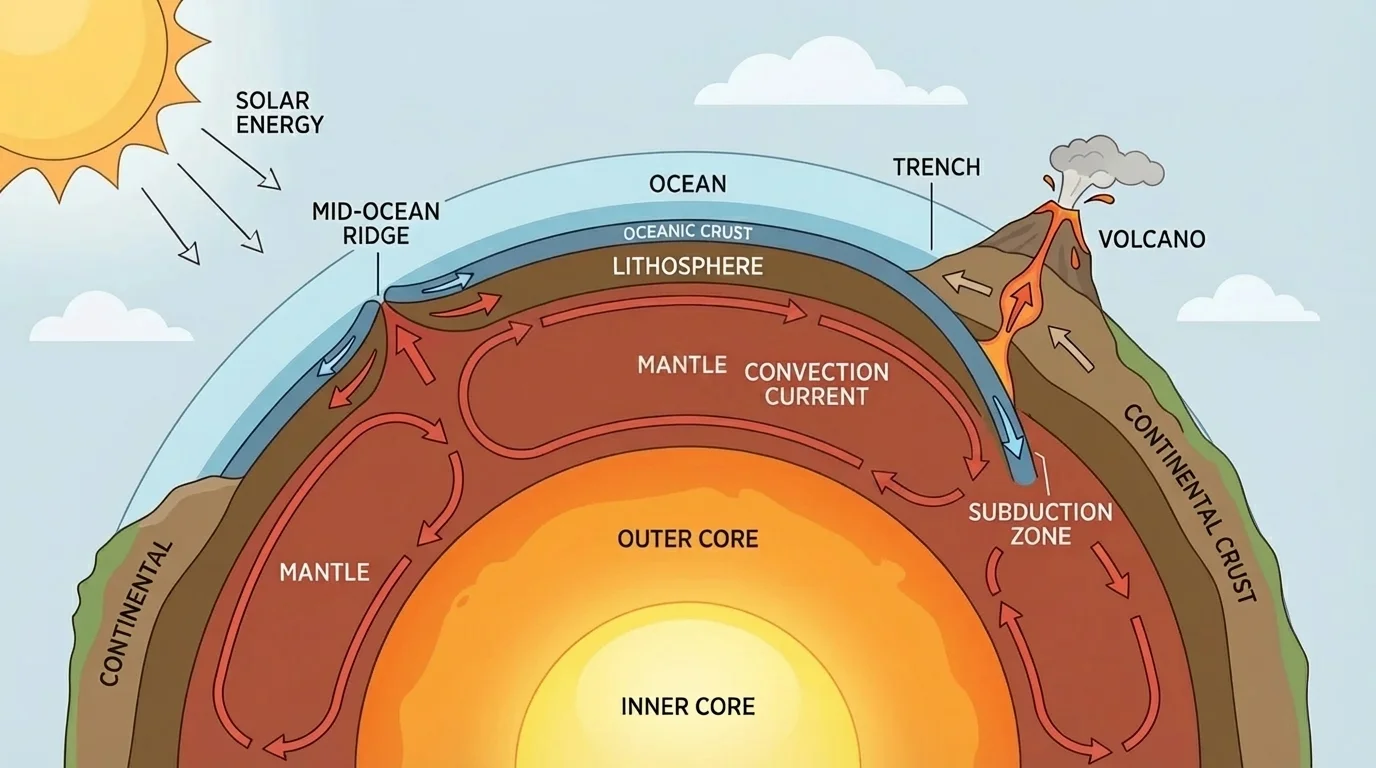
Volcanoes show both energy flow and matter cycling. Melted rock, called magma, rises because of heat and pressure. When a volcano erupts, matter from inside Earth enters the geosphere and atmosphere as lava, ash, and gases. Those materials later cool, weather, and become part of new rocks or soils.
Earthquakes are another result of internal energy. Rocks along faults store elastic energy as plates push or pull. When the rocks suddenly slip, that energy is released as seismic waves. The process happens underground, but its effects can reach buildings, roads, and entire cities.
The formation of mountain ranges is also tied to internal energy. When plates collide, crust can crumple and rise. The Himalayas, for example, continue to rise because the Indian Plate pushes into the Eurasian Plate. At the same time, weathering and erosion wear mountains down. This means internal and surface processes often work against each other at the same place.
Matter moves again and again through Earth's systems. Unlike energy, which tends to flow through a system, matter is reused. The atoms in your body may once have been in ocean water, volcanic gas, soil, or a dinosaur bone.
As [Figure 4] helps show with carbon, the water cycle includes evaporation, condensation, precipitation, runoff, infiltration, freezing, and melting. Water can be stored in oceans, lakes, glaciers, groundwater, clouds, and living things. The amount of water on Earth stays nearly the same, but its location and state keep changing.
The rock cycle describes how rocks form, break down, and change. Igneous rocks form from cooled magma or lava. Sedimentary rocks form from compacted sediments. Metamorphic rocks form when existing rocks are changed by heat and pressure. Matter moves through the geosphere, but water, wind, and living things also play roles in breaking rocks apart and transporting sediments.
The carbon cycle moves carbon through the atmosphere, biosphere, hydrosphere, and geosphere. Carbon dioxide, written as \(\textrm{CO}_2\), can be taken in by plants during photosynthesis. Carbon then moves into animals through feeding. Respiration and decomposition return carbon to the air and soil. Some carbon becomes trapped in ocean sediments or fossil fuels for millions of years.
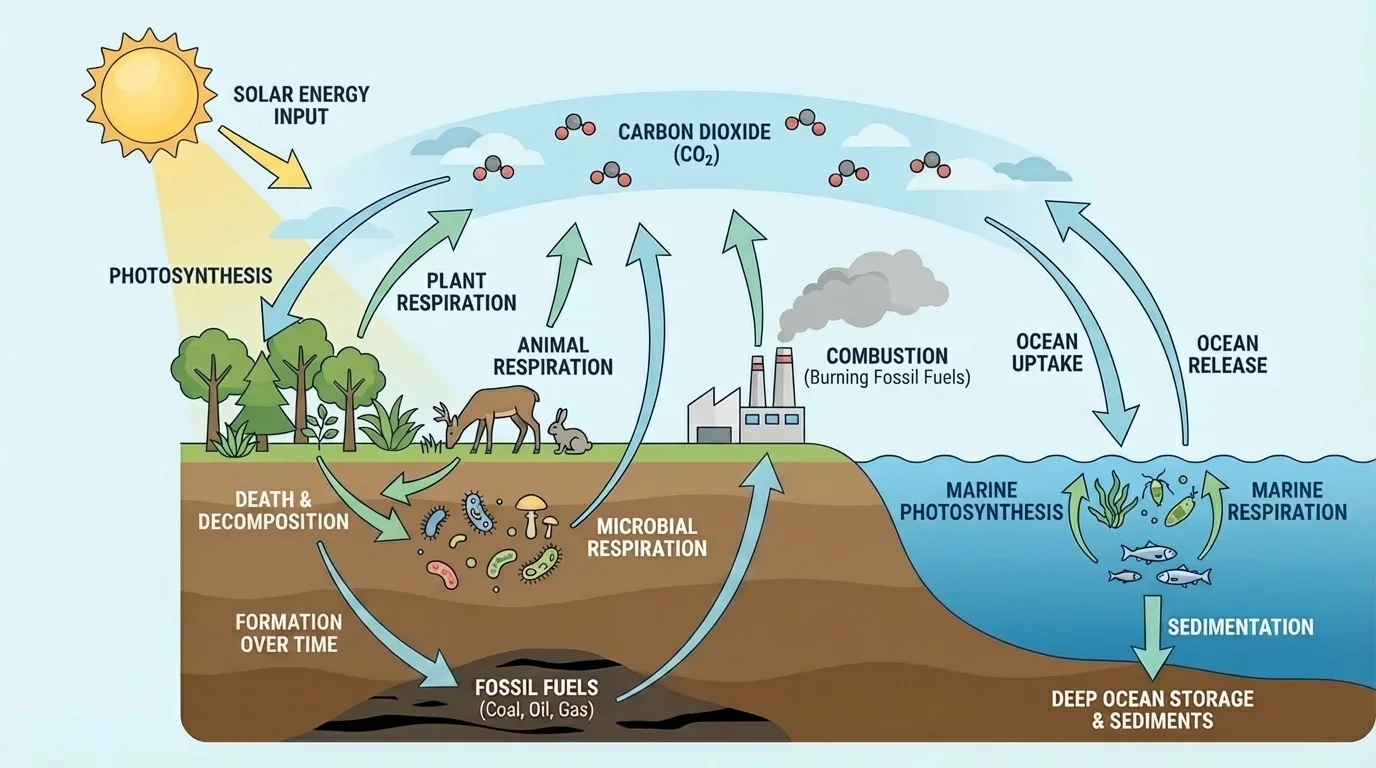
Burning fossil fuels moves carbon from long-term storage in the geosphere into the atmosphere as \(\textrm{CO}_2\). That change can affect climate because carbon dioxide traps heat in the atmosphere. This is one way human activity can change the balance of matter cycling.
| Cycle | Main Matter Moving | Key Processes | Systems Involved |
|---|---|---|---|
| Water cycle | \(\textrm{H}_2\textrm{O}\) | Evaporation, condensation, precipitation, runoff | Hydrosphere, atmosphere, geosphere, biosphere |
| Rock cycle | Minerals and rock materials | Melting, cooling, weathering, erosion, pressure | Mostly geosphere, with help from other systems |
| Carbon cycle | Carbon in \(\textrm{CO}_2\), living tissue, sediments, fuels | Photosynthesis, respiration, decomposition, combustion | Atmosphere, biosphere, hydrosphere, geosphere |
Table 1. Comparison of three major Earth cycles and the systems involved in each one.
Earth processes cause both physical changes and chemical changes. In a physical change, matter changes form, size, shape, or state, but its basic chemical identity stays the same. In a chemical change, atoms are rearranged and new substances form.
Examples of physical changes include ice melting, water freezing, rocks breaking into smaller pieces, and sediments being carried by rivers. If ice turns to liquid water, it is still \(\textrm{H}_2\textrm{O}\). The appearance changes, but the substance remains the same.
Examples of chemical changes include minerals reacting with oxygen, acids dissolving some rocks, and photosynthesis forming sugar. Rusting is a familiar chemical change. When iron reacts with oxygen, new iron oxides form. In nature, similar reactions help weather rocks and change soil chemistry.
Weathering is not just one process. Physical weathering breaks rock into smaller pieces without changing what the rock is made of. Chemical weathering changes the minerals themselves. For example, water freezing in cracks causes physical weathering, while slightly acidic rainwater reacting with limestone causes chemical weathering.
Living things are involved in both kinds of change. Tree roots can physically crack rock. Lichens can release chemicals that slowly dissolve minerals. Decomposers chemically break down dead organisms, returning nutrients to soil and water.
Real-world example: Why warm ocean water can strengthen a storm
A storm over the ocean can gain strength because energy and matter are both involved.
Step 1: Sunlight warms surface ocean water.
More thermal energy is stored in the water.
Step 2: Warm water increases evaporation.
Liquid \(\textrm{H}_2\textrm{O}\) becomes water vapor and enters the atmosphere.
Step 3: Water vapor condenses into clouds.
As condensation happens, energy is released into the storm system.
Step 4: The storm can grow stronger.
Energy flow and matter cycling work together to increase wind and rainfall.
This is why very warm ocean regions can be linked to powerful hurricanes.
Life does not just respond to Earth systems; it also changes them. As we saw earlier in [Figure 2], plants use sunlight, water, and carbon dioxide to build biomass. That process removes carbon dioxide from the atmosphere and adds oxygen.
Organisms also affect the geosphere. Plants help hold soil in place, reducing erosion. Burrowing animals mix soil. Coral organisms build reefs that change coastlines and create habitats. Tiny marine organisms can leave behind shells that eventually become limestone.
Through respiration, organisms release carbon dioxide. Through decomposition, bacteria and fungi break down dead matter and recycle nutrients. Without decomposers, dead material would pile up and important matter would stay locked away instead of returning to ecosystems.
Humans are part of the biosphere too, and our actions affect every Earth system. Building dams changes water flow. Farming changes soil. Mining moves geosphere materials. Burning fossil fuels changes the atmosphere. Understanding Earth systems helps us predict the effects of these changes.
A volcanic island is a dramatic example of Earth systems interacting. Internal heat drives magma upward, creating new land. Rain and waves then wear that land down. Plants arrive and begin soil formation. Birds and insects may colonize the island. Over time, the geosphere, atmosphere, hydrosphere, and biosphere all shape its future.
Soil formation is slower but just as important. Rock weathers physically and chemically. Water carries dissolved substances and small particles. Dead organisms add organic matter. Worms and roots mix materials. Good soil is the product of energy flow, matter cycling, and living activity working together over long periods.
Climate is another important case. The atmosphere receives energy from the Sun, but gases such as \(\textrm{CO}_2\) affect how much heat is retained. Oceans store and move heat around the planet. Ice reflects sunlight. Forests exchange water and carbon with the air. Climate is not controlled by one system alone.
The idea from [Figure 3] also helps explain why some places have many earthquakes and volcanoes. These hazards often happen near plate boundaries, where internal energy is being released through tectonic activity. Scientists use this understanding to map risk and improve safety planning.
"The Earth is what we all have in common."
— Wendell Berry
Nearly every Earth process can be traced to energy flowing and matter cycling. Rivers carve valleys because gravity moves water and sediment. Clouds form because solar energy drives evaporation and cooling causes condensation. Mountains rise because internal energy moves plates. Forests grow because sunlight becomes chemical energy through photosynthesis.
When scientists study droughts, landslides, coral reefs, climate change, earthquakes, or soil fertility, they are really asking versions of the same question: What energy is driving this process, and how is matter moving through the system? That question is powerful because it connects many topics into one big picture.
Earth is dynamic, not static. Its materials are always moving, changing form, and interacting with life. The same planet that powers a thunderstorm also grows a forest, forms a canyon, and builds a mountain range. Energy and matter make all of that possible.
