People argue every day about real issues: whether schools should start later, whether homework should be limited, whether plastic water bottles should be banned, or whether students should wear uniforms. But not all arguments are equally strong. A loud opinion may get attention, yet a well-supported argument earns respect because it gives readers a reason to believe it.
When you write an argument, your job is not just to say what you think. Your job is to convince readers by showing that your claim makes sense. That means using clear reasons, strong evidence, and trustworthy sources. It also means understanding the topic well enough to explain why your evidence proves your point.
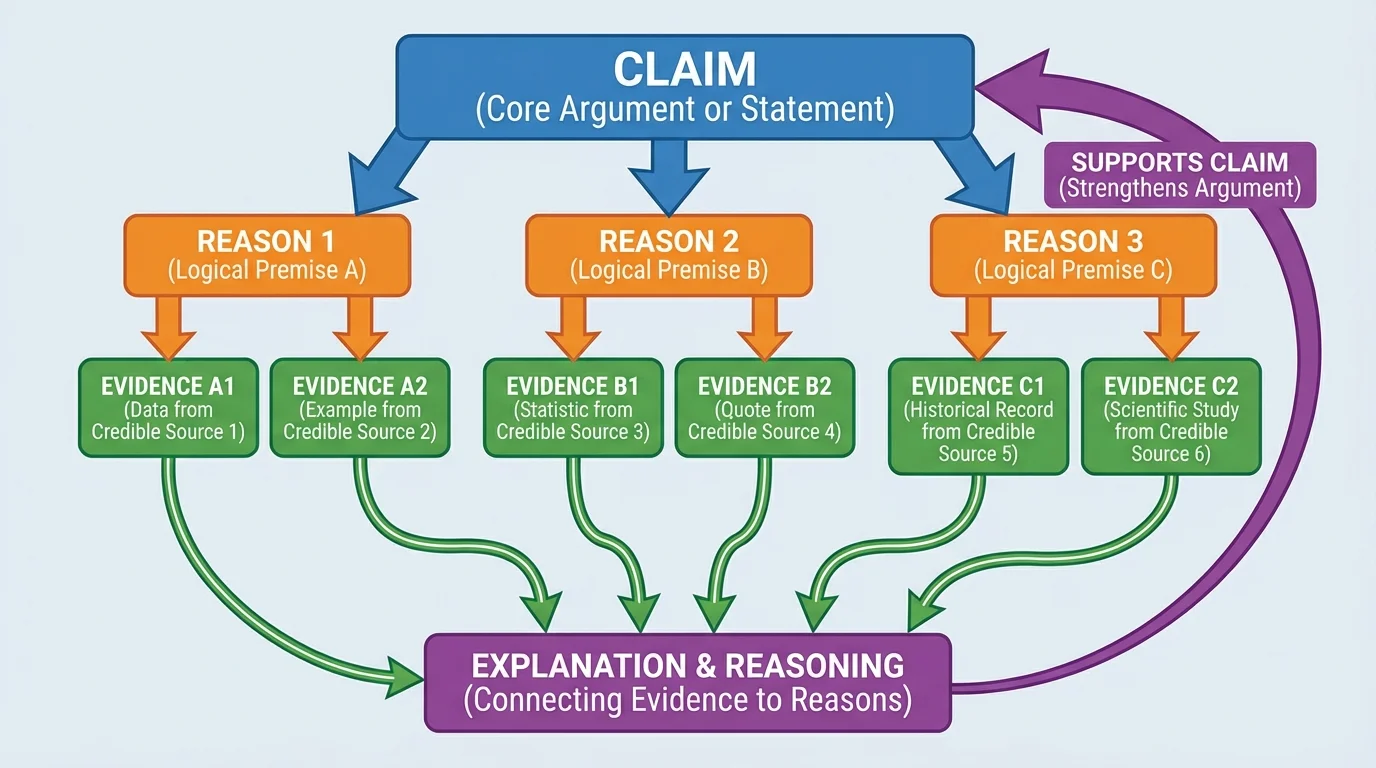
[Figure 1] A strong argument has connected parts: a claim, reasons that support the claim, evidence for those reasons, and explanation that ties everything together. If one part is weak or missing, the whole argument becomes less convincing.
The first part is the claim. A claim is the position or opinion you are trying to prove. Next come the reasons, which tell why your claim is true or sensible. Then comes the evidence: facts, examples, quotations, statistics, or details from sources. Finally, the writer explains how that evidence supports the claim.
Claim is the main point a writer wants the reader to accept. Reasoning is the logical explanation that shows how the evidence supports the claim. Evidence is the information used to support a reason, such as facts, examples, quotations, or data. Credible sources are sources that are trustworthy because they are accurate, informed, and reliable.
Think of argument writing like building a bridge. The claim is one side of the river, and the reader is on the other side. Reasons and evidence are the beams and supports that let the reader cross safely. If your evidence is weak, unrelated, or unreliable, the bridge does not hold.
A strong claim is clear, focused, and debatable. If everyone already agrees with the statement, it is not much of an argument. If the statement is too broad, it becomes hard to support well.
For example, "School exists to help students learn" is not a useful claim for an argument essay because it is too obvious. "Schools should start no earlier than 8:30 a.m." is much stronger because someone could agree or disagree, and it is specific enough to support with evidence.
A weak claim often sounds like this: "Homework is bad." That is too general. A stronger version is: "Middle school homework should be limited on weekends because students need time for rest, family responsibilities, and activities that support learning in other ways." This claim gives a clear position and hints at possible reasons.
Professional writers, scientists, and lawyers also build arguments from claims. They may use more advanced language, but the basic structure is the same: make a claim, support it, and explain it.
Notice that a clear claim does not simply announce a topic. "This essay is about recycling" is a topic, not a claim. "Cities should expand recycling programs because they reduce landfill waste and save reusable materials" is a claim because it takes a position.
Reasoning is what connects your evidence to your claim. Without reasoning, evidence can sit in a paragraph like a pile of bricks that no one used to build anything. Readers need to understand not only what the evidence is, but also why it matters.
Suppose your claim is that school start times should be later. One reason might be that later start times help students focus better in class. Your evidence might come from a sleep research organization or a medical group that reports that teens need more sleep than many of them get. Your reasoning explains the connection: if students are more rested, they are more alert, and alert students can learn more effectively.
Logical reasoning should avoid jumps. If a writer says, "Some students are tired in the morning, so schools should cancel first period forever," the leap is too large. Strong reasoning moves step by step. It asks, "What does this evidence show?" and then, "How does that support my claim?"
How reasoning works
Reasoning often follows a pattern: evidence shows a fact, the writer interprets that fact, and then the writer connects it to the claim. For example, if a survey shows many students use reusable water bottles when refill stations are available, the writer can reason that adding refill stations encourages less plastic waste. The evidence is the survey result; the reasoning is the explanation of what that result means.
Reasoning also helps readers trust that you understand the topic. If you use evidence without explaining it, readers may wonder whether you just copied information without thinking carefully about it.
Relevant evidence directly relates to your claim. It answers the question, "Does this information actually help prove my point?" If the answer is no, leave it out even if it sounds interesting.
Imagine you are arguing that schools should plant more trees on campus. Relevant evidence might include how trees provide shade, cool outdoor spaces, improve air quality, or create habitats for birds and insects. Irrelevant evidence would be something like the history of treehouses in movies. That information may be fun, but it does not support the claim.
Writers can use different kinds of evidence. Facts and statistics are useful when they come from strong sources. Quotations from experts can show informed opinions. Examples and case studies can show what happened in real situations. Details from a text can support arguments about literature or informational reading. Observation can help too, especially when the writer describes it carefully and honestly.
Good evidence is not just related; it is also enough. One tiny example may not be enough to prove a big claim. If you argue that a school rule should change, you may need several pieces of evidence from different angles rather than one opinion from one person.
| Type of evidence | What it does | Example |
|---|---|---|
| Fact | Gives verifiable information | A district report shows attendance improved after a schedule change. |
| Statistic | Shows patterns in numbers | A survey reports that many students prefer access to refill stations over bottled water purchases. |
| Expert quotation | Adds informed opinion | A pediatric sleep specialist explains why teens need more rest. |
| Example or case | Shows a real situation | One school reduced cafeteria waste by switching to reusable trays. |
| Text evidence | Supports literary or informational analysis | A passage from an article reveals the author's position on conservation. |
Table 1. Common types of evidence and how they support an argument.
As shown in [Figure 1], evidence works best when it is attached to a reason. Evidence without a reason can confuse readers, and a reason without evidence can sound like an unsupported opinion.
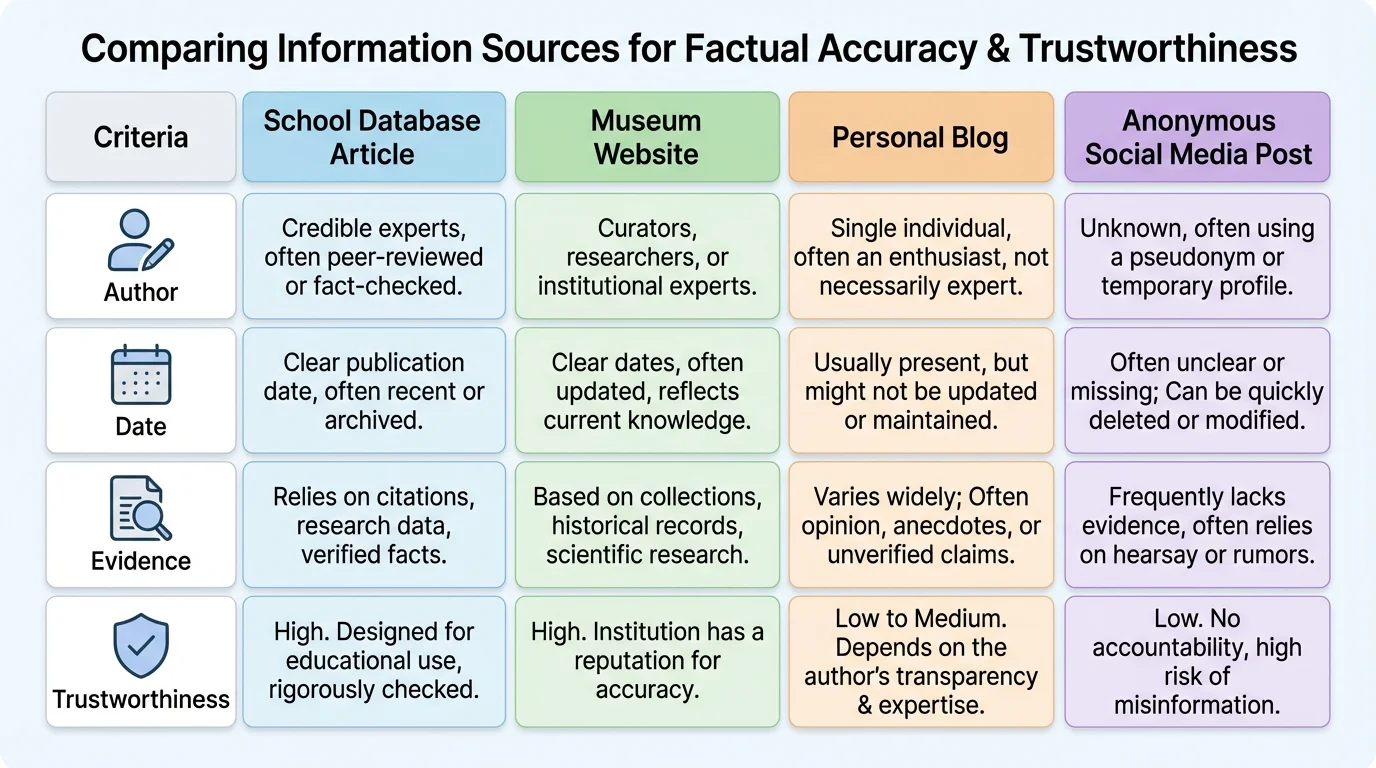
Not every source deserves equal trust. Source evaluation matters because an argument is only as strong as the information behind it. A source checklist helps writers compare sources by considering where the information comes from and whether it is trustworthy.
As [Figure 2] suggests, start by asking who created the source. Is the author named? Does that person or organization have knowledge about the topic? A children's hospital, a science museum, a university, or a government agency may be more reliable than an anonymous post online. That does not mean every official-looking source is perfect, but it gives you a stronger starting point.
Next, check whether the information is current enough. For some topics, an older source may still be useful, especially in history. But for topics like health, technology, or environmental data, a newer source may be more accurate. Also ask whether the source gives evidence for its claims. A trustworthy source usually explains where its information comes from.
Another question is bias. Bias means a source may favor one side strongly and present information unfairly. All writers have points of view, but some sources are far more balanced than others. If a company sells a product, its website may not be the best source for proving that the product is excellent. A more independent source may be better.
A smart writer checks more than one source. If several credible sources agree on a fact, that fact becomes more trustworthy. If one source says something surprising and no other reliable source supports it, be cautious.
Source check example
A student wants evidence about whether later school start times help middle school students.
Step 1: Compare possible sources.
Source A is a social media post with no author. Source B is an article from a children's health organization that names researchers and gives study findings.
Step 2: Ask which source is more trustworthy.
Source B is more credible because it names the organization, identifies experts, and provides evidence.
Step 3: Decide how to use it.
The student can quote or paraphrase Source B and explain how the health information supports the claim about start times.
When you use a source, stay accurate. Do not twist the meaning of a quotation or use a statistic out of context. Honest writers represent sources fairly, even when they strongly support a claim.
One common mistake in argument writing is called "evidence dumping." That happens when a writer inserts facts or quotations but does not explain them. The reader is left to do the thinking alone.
For example, a weak sentence might say, "According to a health organization, teenagers need more sleep." Then the writer moves on. A stronger version adds explanation: "According to a health organization, teenagers need more sleep than many currently get. This matters because students who are under-rested may struggle to focus, remember information, and participate actively in class."
The second version does more than report information. It interprets the evidence. That interpretation is a major part of argument writing.
When you wrote responses using details from a text, you may have learned to cite a quotation and then explain it. Argument writing uses the same habit, but now the explanation must also show how the detail supports a claim.
A useful pattern is this: state a reason, present evidence, and explain the evidence. Some writers think of this as "point, evidence, explain." That pattern can help organize body paragraphs clearly.
Strong arguments do not pretend that the other side does not exist. Instead, they recognize another view and respond to it. This is called a counterclaim.
If you are arguing that students should have limited homework on weekends, a counterclaim might be that homework helps students practice important skills. That is a reasonable point. Ignoring it would weaken your argument because readers may think you have not considered the whole issue.
After presenting the counterclaim fairly, you can respond with a rebuttal. For example, you might argue that practice is important, but too much weekend homework can interfere with sleep, family responsibilities, and outside reading or projects. A rebuttal should answer the other side with logic and evidence, not insults.
Fairness strengthens arguments
When writers treat opposing views honestly, they sound more thoughtful and more trustworthy. Readers are more likely to listen to a writer who understands both sides than to one who oversimplifies the issue.
This is especially important on topics where good people may disagree. A strong writer does not say, "Anyone who disagrees is wrong." A strong writer says, "Some people argue this, but the evidence suggests that another conclusion is stronger."
Argument writing should sound serious, clear, and respectful. That does not mean using complicated words just to impress people. It means choosing words that fit the topic and avoiding slang, exaggeration, and rude language.
Informal language might sound like this: "School lunch is gross and everybody knows it." A more formal version is: "School lunch menus should include more fresh options because nutritious meals support student health and concentration." The second sentence is more precise and more respectful.
Formal style also avoids overstatements such as "always," "never," or "everyone" unless they are truly accurate. If you write, "Everyone hates homework," readers can easily reject your claim because it is clearly not true. A better sentence is, "Many students report that excessive homework causes stress and reduces time for other responsibilities."
Transitions help formal writing sound organized. Words and phrases such as for example, in addition, however, as a result, and therefore guide readers through your thinking.
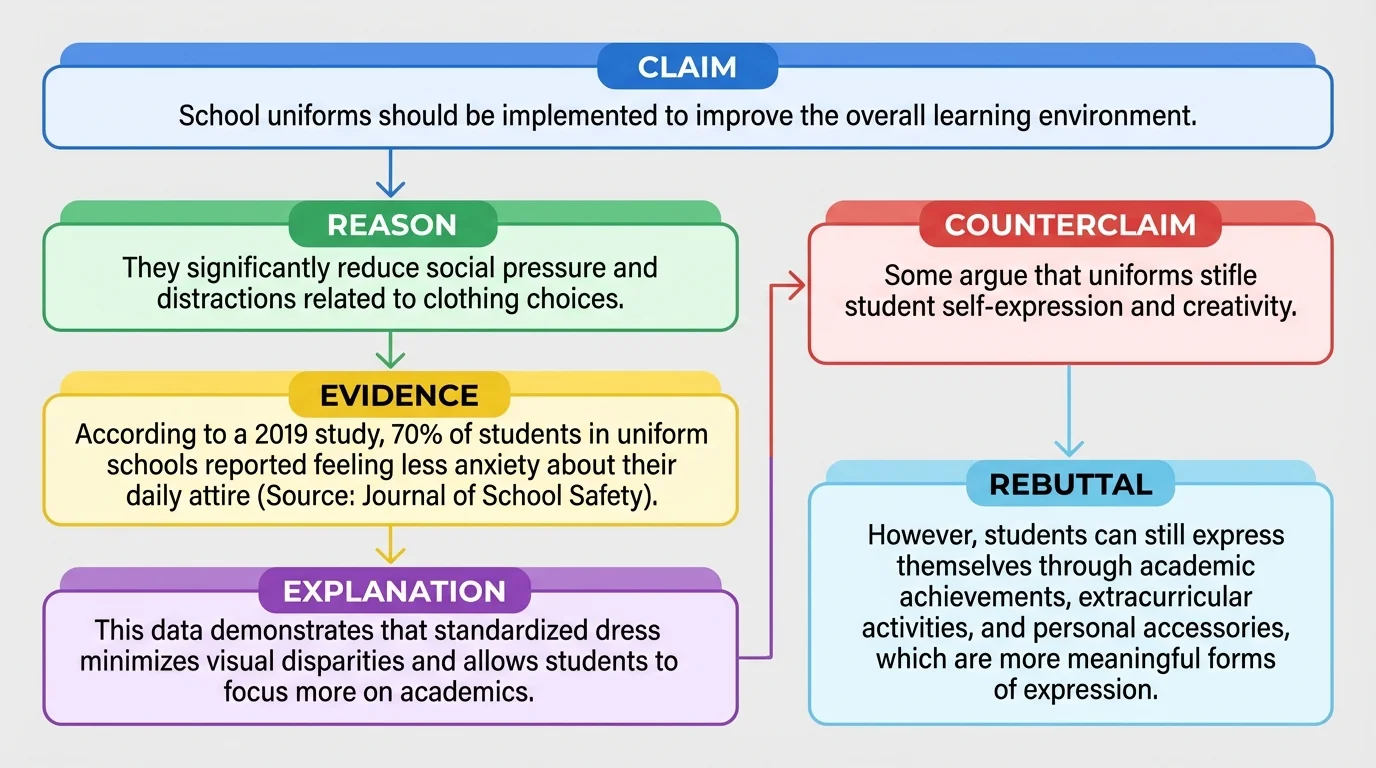
A complete argument paragraph combines all the parts we have studied. The writer begins with a claim or reason, supports it with evidence, explains the evidence, and may also address another viewpoint.
[Figure 3] Consider this example claim: schools should add more water refill stations. One reason is that refill stations can reduce single-use plastic waste. Evidence might include a report from a city or school district showing that students use fewer disposable bottles when refill stations are easy to find. The reasoning would explain that when reusable bottles are easier to refill, fewer disposable bottles are purchased and thrown away.
Sample argument paragraph
Schools should install more water refill stations because they help reduce plastic waste. A district sustainability report explains that when refill stations were added in several schools, students used reusable bottles more often and fewer disposable bottles were thrown away. This evidence supports the claim because it shows a clear connection between easy access to water and lower plastic use. Some people may argue that refill stations are too expensive to install. However, reducing waste and encouraging reusable bottles can save money over time by lowering trash volume and supporting long-term environmental goals.
This paragraph works because it does not stop at the evidence. It tells the reader what the evidence means. It also considers another view and responds to it respectfully.
Later, when you build a longer essay, you can use this same pattern across multiple body paragraphs. Each paragraph should support the main claim with a different reason. As shown earlier in [Figure 1], each reason should have matching evidence and explanation so the full argument stays organized.
One mistake is using evidence that does not match the claim. If your claim is about student health, evidence about school mascot popularity will not help. Always ask whether each detail serves a purpose.
Another mistake is relying on weak or doubtful sources. If your best support comes from an anonymous comment online, your argument will probably not convince careful readers. Use stronger sources whenever possible, and compare information across sources, just as the source chart in [Figure 2] demonstrates.
A third mistake is confusing opinion with proof. Your thoughts matter, but readers need more than "I think" or "I feel." They need facts, examples, quotations, and explanations that make your point believable.
Some writers also forget to explain their evidence. They may include a good quotation and assume the job is done. But the quotation does not speak for itself. The writer must explain how it supports the claim.
Finally, some arguments become weak because the tone is too emotional or disrespectful. Passion is not a problem by itself; in fact, caring about an issue can improve writing. But strong argument depends on logic, fairness, and evidence, not on anger alone.
"The best arguments are not the loudest ones. They are the ones that make the clearest case."
When you support claims well, you show more than opinion. You show careful thinking. You prove that you can examine a topic, choose trustworthy information, connect evidence to ideas, and communicate in a way that readers can follow and respect.
