A striking fact about Earth is that our planet's climate depends on only a tiny fraction of the Sun's total energy output. Yet that energy is enough to power winds, ocean currents, storms, evaporation, and life itself. The same sunlight that warms a sidewalk after school also drives hurricanes over tropical oceans and influences whether glaciers grow or melt. To understand climate, we have to follow energy: where it comes from, where it goes, and what happens when that flow is changed.
Weather is the short-term state of the atmosphere, including temperature, precipitation, wind, humidity, and cloud cover over hours or days. Climate is the long-term pattern of weather in a region, usually measured over decades. A rainy afternoon is weather; a desert's long-term dryness is climate.
This difference matters because climate is not judged by one cold day or one hot week. Climate scientists look for long-term trends, averages, ranges, and repeating patterns. For example, a city may still experience snowstorms even in a warming world, because climate change shifts probabilities and averages rather than eliminating all short-term variation.
Electromagnetic radiation is energy that travels in waves, including visible light, ultraviolet radiation, and infrared radiation. The Sun sends most of its energy to Earth as shortwave radiation, and Earth sends energy back toward space mainly as infrared radiation.
The climate system includes the atmosphere, oceans, land, ice, and living things. These parts are connected. A change in one part, such as less sea ice or more carbon dioxide \(\textrm{CO}_2\) in the atmosphere, can affect the entire system.
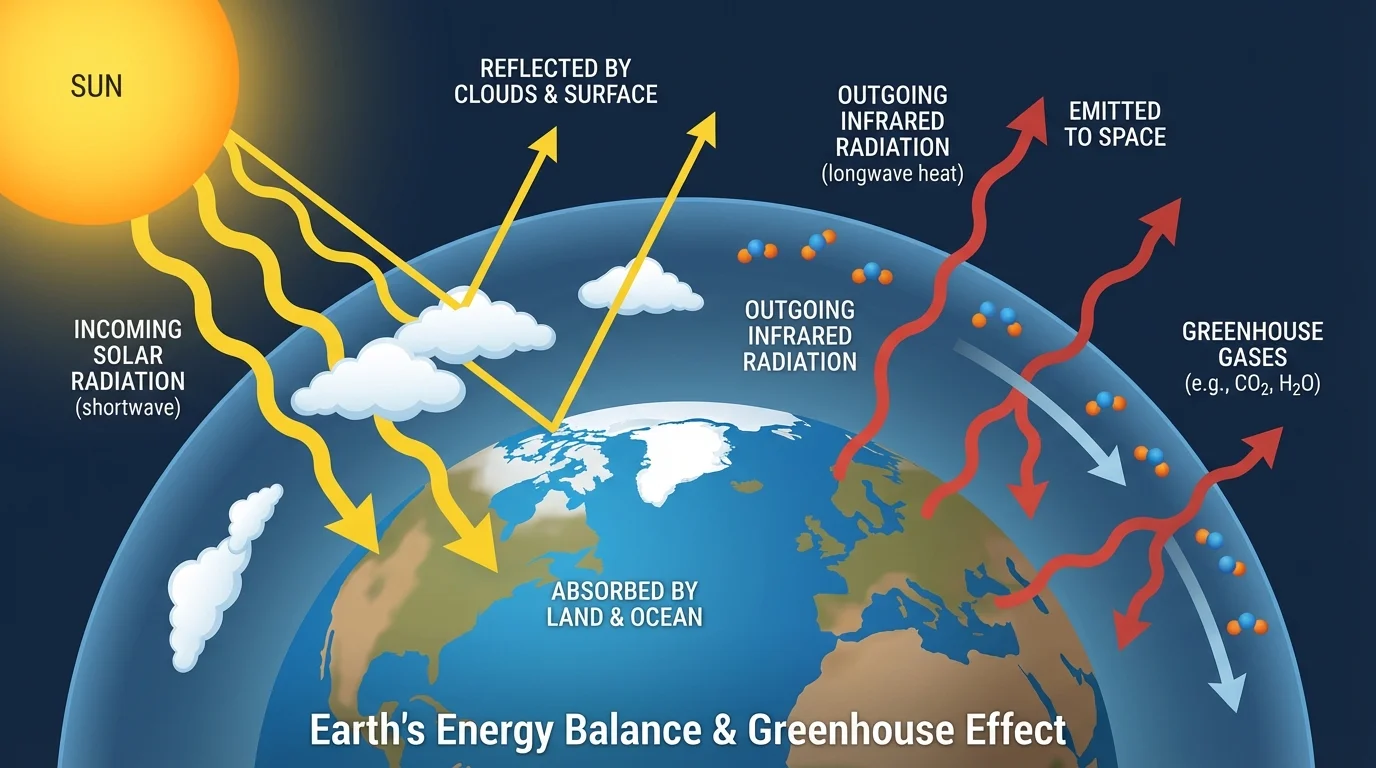
The foundation of Earth's global climate systems is electromagnetic radiation from the Sun. That incoming energy controls Earth's average temperature because climate depends on the balance between energy entering the Earth system and energy leaving it, as [Figure 1] shows. If more energy enters than leaves, Earth warms. If more leaves than enters, Earth cools.
The Sun does not heat Earth evenly. Because Earth is curved, sunlight strikes near the equator more directly and is spread over a smaller area. Near the poles, sunlight arrives at a lower angle and is spread over a larger area, so less energy reaches each square meter. This uneven heating is one major reason why tropical regions are generally warmer than polar regions.
Earth's rotation and tilt add more complexity. Rotation causes day and night, changing heating over each 24-hour period. Earth's axis is tilted by about \(23.5^\circ\), which changes the angle and duration of sunlight during the year. That tilt produces seasons. When a hemisphere is tilted toward the Sun, it receives more direct sunlight and longer days, so it becomes warmer.
A useful way to describe climate is through Earth's energy budget, the overall accounting of incoming and outgoing energy. In simplified form, if incoming solar energy is represented as 100 units, some is reflected back to space and the rest is absorbed by the atmosphere, land, and oceans. Over long time periods, a stable climate requires that absorbed energy be balanced by energy radiated back into space.
Numeric example: energy balance
Step 1: Start with incoming solar energy
Suppose Earth receives 100 energy units from the Sun.
Step 2: Account for reflection
If 30 units are reflected by clouds, ice, and bright surfaces, then absorbed energy is \(100 - 30 = 70\) units.
Step 3: Compare with outgoing energy
If Earth radiates 68 units back to space, then the imbalance is \(70 - 68 = 2\) units.
An imbalance of 2 units means the Earth system gains energy and tends to warm.
Even a small long-term imbalance matters because the climate system is enormous. Extra energy can accumulate in the oceans, melt ice, warm the atmosphere, and shift circulation patterns. Most of the added heat from recent global warming has gone into the ocean rather than the air.
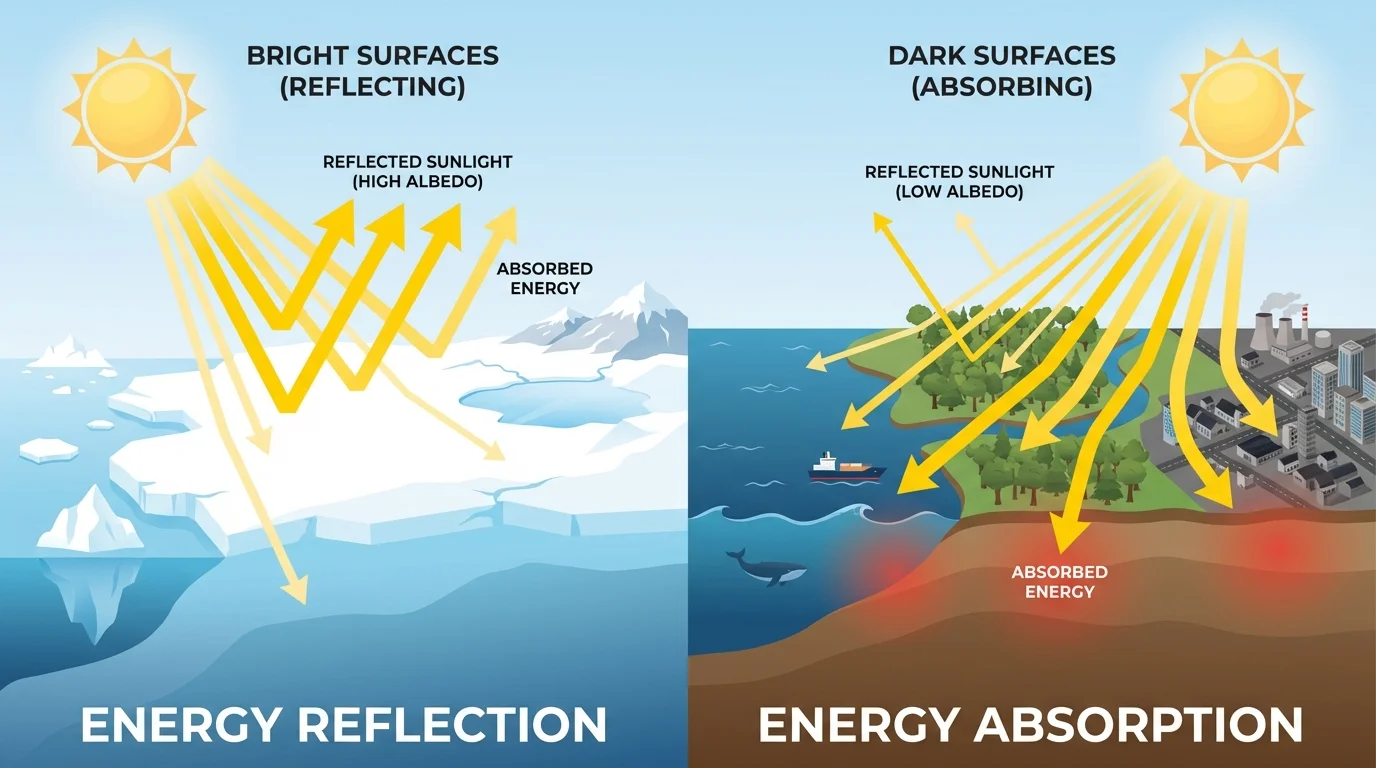
Not all incoming sunlight behaves in the same way. Some is reflected, some is absorbed immediately, some is stored for long periods, and some is later re-radiated as heat. Surface reflectivity is called albedo, and [Figure 2] illustrates why it matters so much for climate. Bright surfaces such as snow and ice have high albedo and reflect more solar energy. Darker surfaces such as forests or oceans have lower albedo and absorb more energy.
This helps explain an important feedback. If ice melts, the newly exposed darker water or land absorbs more solar energy than the ice reflected. That extra absorption can lead to further warming and more melting. This is one reason the Arctic is warming faster than the global average.
Absorbed energy does not always produce an immediate temperature rise in the same place. Some energy is stored, especially in water. The ocean has a high heat capacity, meaning it can absorb large amounts of energy with a smaller temperature change than land. That is why coastal climates are often more moderate than inland climates.
After Earth absorbs solar energy, it re-emits energy toward space as infrared radiation. Certain gases in the atmosphere absorb and re-emit some of this outgoing infrared energy. This natural process is the greenhouse effect. Without it, Earth's average temperature would be much lower and life as we know it would be difficult.
The greenhouse effect as an energy process
Sunlight, mostly shortwave radiation, passes through the atmosphere and warms Earth's surface. The surface then emits infrared radiation. Greenhouse gases such as water vapor, carbon dioxide \(\textrm{CO}_2\), methane \(\textrm{CH}_4\), and nitrous oxide \(\textrm{N}_2\textrm{O}\) absorb some of that infrared energy and re-emit it in different directions. Some of it continues to space, and some returns toward the surface, warming the lower atmosphere and surface.
A simple way to think about this is that greenhouse gases do not create energy. Instead, they slow the rate at which some energy escapes to space. If incoming energy stays the same while outgoing energy is reduced, the system warms until a new balance is reached. We saw this balancing idea earlier in [Figure 1], where outgoing heat is just as important as incoming sunlight.
Numeric example: albedo and absorbed energy
Step 1: Compare two surfaces receiving the same sunlight
Suppose both snow and ocean receive 200 energy units.
Step 2: Use different reflectivities
If snow reflects 80%, it reflects \(0.80 \times 200 = 160\) units and absorbs \(200 - 160 = 40\) units.
If ocean reflects 10%, it reflects \(0.10 \times 200 = 20\) units and absorbs \(200 - 20 = 180\) units.
Step 3: Interpret the difference
The ocean absorbs \(180 - 40 = 140\) more energy units than the snow surface.
This large difference helps explain why changing surface cover can strongly affect climate.
Energy does not stay where it is absorbed. The atmosphere and oceans move it around the planet through a process called redistribution, as [Figure 3] illustrates. Without this movement, the equator would be much hotter and the poles much colder than they already are.
In the atmosphere, warm air tends to rise and cool air tends to sink. Large-scale circulation cells, along with Earth's rotation, help produce trade winds, westerlies, and jet streams. These winds transport heat and moisture. They also steer storm systems, influence rainfall patterns, and connect distant regions. For instance, warm tropical oceans can add moisture to the air, which later falls as precipitation far from the original source.
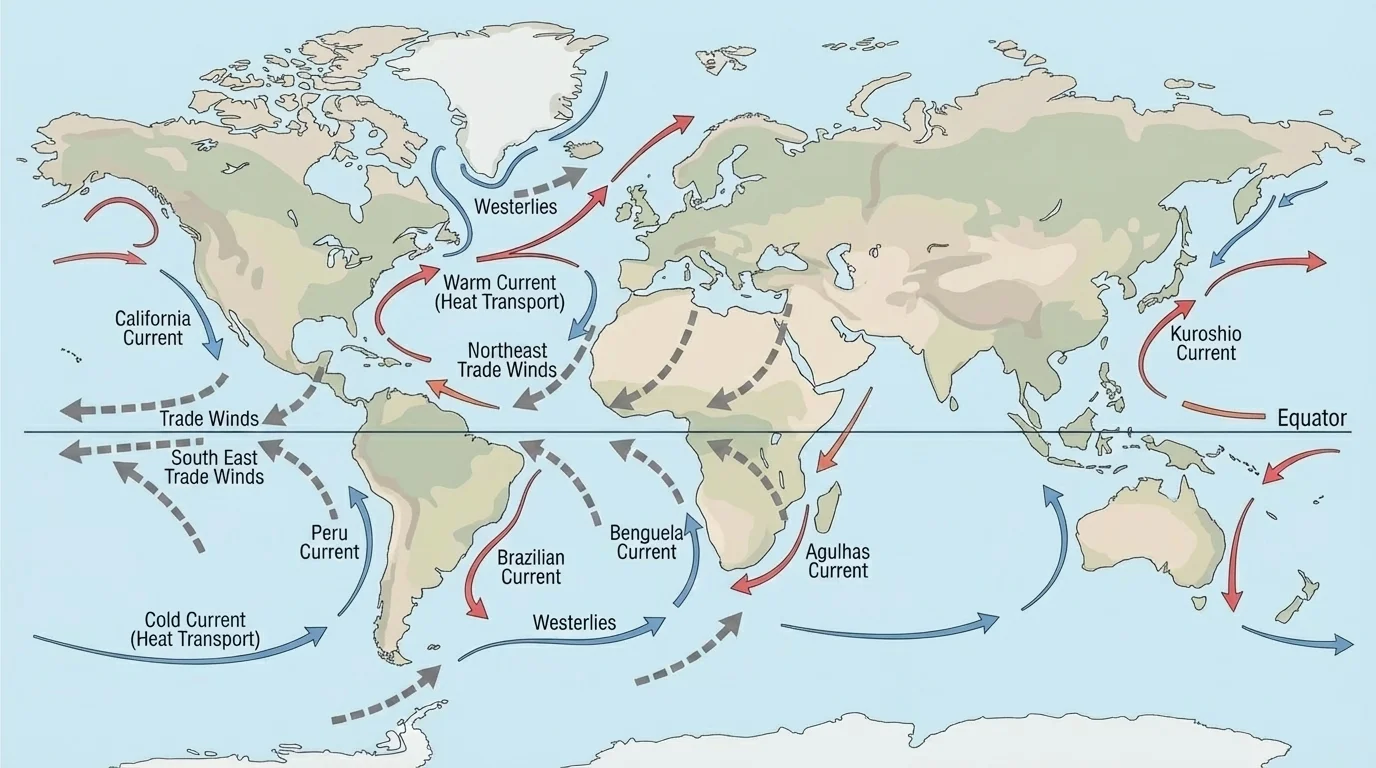
Oceans are equally important. Surface currents move warm water from the tropics toward higher latitudes and return cooler water toward lower latitudes. Deep ocean circulation also stores and transports heat over long timescales. This is why changes in ocean circulation can affect regional climates for decades or longer.
The water cycle is part of this redistribution. Solar energy causes evaporation of \(\textrm{H}_2\textrm{O}\) from oceans, lakes, soils, and plants. When water vapor condenses into clouds, latent heat is released into the atmosphere. This transfer of energy powers storms and helps move heat vertically and horizontally through the climate system.
Land also matters. Mountains can force air upward, cooling it and causing rain on one side and dry conditions on the other. Cities often create urban heat islands because dark pavement and buildings absorb more energy than vegetation does. Agriculture can also alter climate locally by changing surface color, moisture, and roughness.
The same ocean that helps keep many coastal cities from extreme temperature swings is also absorbing most of the excess heat added to the climate system. That buffering effect slows atmospheric warming somewhat, but it also leads to warmer oceans, coral bleaching, and sea level rise from thermal expansion.
Earth's atmosphere has not always had the same composition. Early in Earth's history, oxygen levels were much lower than they are today. Over long periods, plants, algae, and certain microorganisms changed the atmosphere by removing carbon dioxide \(\textrm{CO}_2\) and releasing oxygen \(\textrm{O}_2\) through photosynthesis.
In photosynthesis, organisms use sunlight to convert carbon dioxide and water into sugars and oxygen. A simplified chemical equation is \(6\textrm{CO}_2 + 6\textrm{H}_2\textrm{O} \rightarrow \textrm{C}_6\textrm{H}_{12}\textrm{O}_6 + 6\textrm{O}_2\). This process helped transform Earth's atmosphere and made aerobic life possible.
Carbon moves among the atmosphere, biosphere, hydrosphere, and geosphere. This long-term carbon cycle includes photosynthesis, respiration, decomposition, ocean uptake, sediment formation, and volcanic release.
Not all captured carbon immediately returns to the atmosphere. Some becomes stored in soils, sediments, forests, peat, and eventually fossil fuels over millions of years. In that sense, life has been one of the most powerful forces shaping atmospheric chemistry. The atmosphere we depend on today is partly a biological product.
This connection between life and climate is still active. Forests absorb carbon dioxide, phytoplankton in the oceans participate in carbon cycling, and soils can either store carbon or release it depending on temperature, moisture, and land use. The biosphere is therefore both influenced by climate and involved in regulating it.
During the last two centuries, humans have changed atmospheric composition rapidly by burning coal, oil, and natural gas; producing cement; and clearing forests. These actions increase the concentration of greenhouse gases, especially carbon dioxide \(\textrm{CO}_2\). Because greenhouse gases affect how efficiently Earth loses infrared radiation to space, increasing them strengthens the greenhouse effect.
This modern change is different from many natural climate changes because it is occurring very quickly on a geological timescale. Ice cores, direct atmospheric measurements, ocean observations, and satellite data all provide evidence that greenhouse gas concentrations are rising and that the climate system is responding.
Carbon dioxide is not the only human-influenced greenhouse gas. Methane \(\textrm{CH}_4\) comes from sources such as fossil fuel production, livestock, landfills, and wetlands. Nitrous oxide \(\textrm{N}_2\textrm{O}\) is linked partly to agriculture and fertilizer use. Different gases have different warming effects and atmospheric lifetimes, but all contribute to climate change.
Numeric example: concentration change
Step 1: Compare past and present carbon dioxide levels
Suppose atmospheric carbon dioxide rose from about 280 parts per million to 420 parts per million.
Step 2: Find the increase
The increase is \(420 - 280 = 140\) parts per million.
Step 3: Find the percent increase
\(\dfrac{140}{280} = 0.5\), so the increase is 50%.
A rise of about 50% in such an important greenhouse gas is large enough to alter Earth's energy balance significantly.
Deforestation matters in two ways: it releases stored carbon and removes trees that would otherwise absorb carbon dioxide. Land-use changes can also change albedo and local moisture conditions. Human influence on climate therefore involves both atmospheric chemistry and physical changes at Earth's surface.
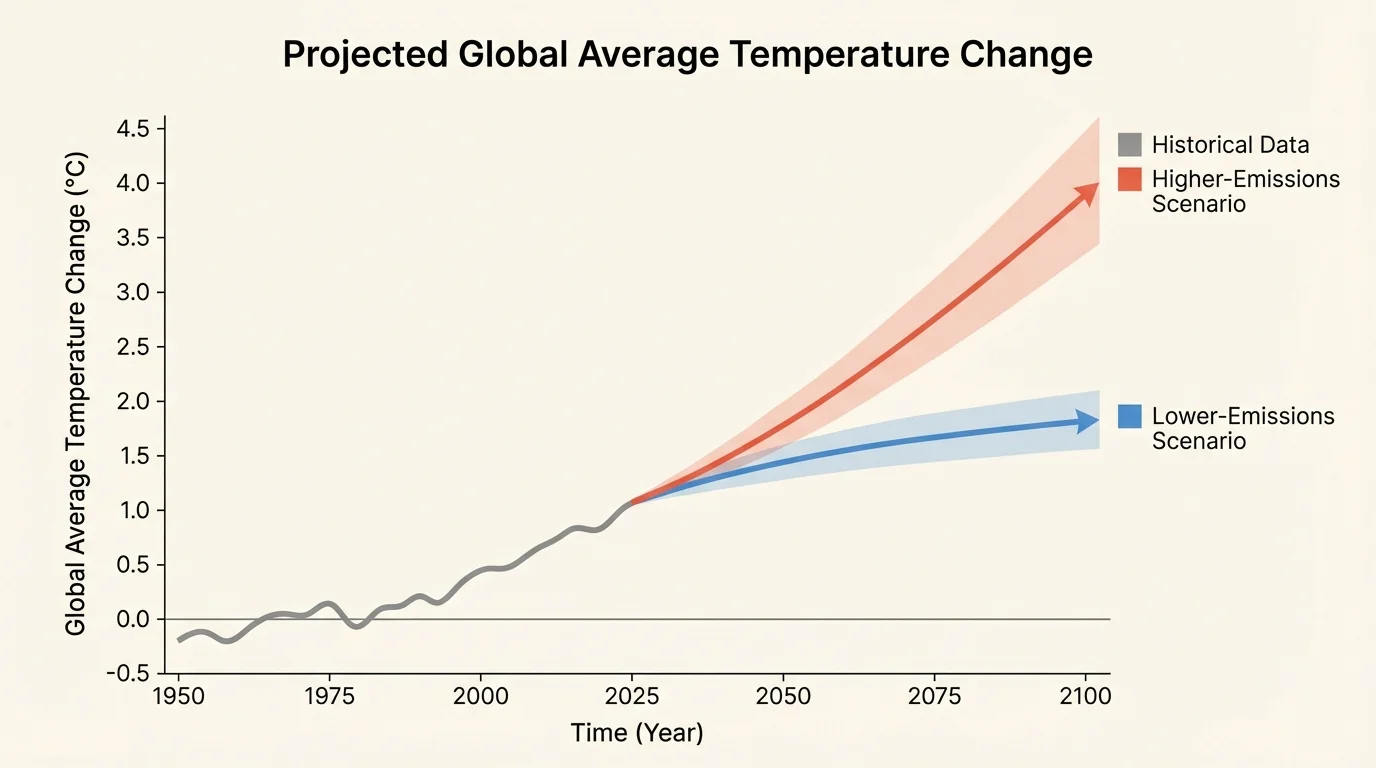
Because climate is a complex system with many interacting parts, scientists use climate models to test ideas and project future conditions. These models use physical laws about energy, motion, radiation, chemistry, and fluid flow. As [Figure 4] shows, models consistently project that average global temperature will continue to rise if greenhouse gas concentrations keep increasing.
Climate models are not simple guesses. They are based on observations and well-tested science. Scientists check how well models reproduce past climate patterns, seasonal cycles, volcanic cooling events, and recent warming trends. No model is perfect, but models are powerful because they combine many processes into one system.
One reason future regional climate change is difficult to predict in detail is that local climate depends on many factors: topography, land use, ocean currents, atmospheric circulation, ice cover, and feedback loops. That is why one region may become wetter while another becomes drier, even though the global average temperature rises overall.
Model outcomes depend strongly on the amounts of human-generated greenhouse gases added to the atmosphere each year. They also depend on how much of those gases are absorbed by the ocean and biosphere. If emissions are reduced, warming is limited compared with high-emission pathways. In [Figure 4], the gap between scenarios widens over time, showing that decisions made now affect climate decades into the future.
| Factor | Why it matters in models | Example effect |
|---|---|---|
| Greenhouse gas emissions | Controls how much extra heat is trapped | Higher emissions lead to greater warming |
| Ocean uptake | Oceans absorb heat and some \(\textrm{CO}_2\) | Can delay some atmospheric warming but increases ocean change |
| Biosphere uptake | Plants and soils can absorb carbon | Reforestation can increase carbon storage |
| Ice and snow cover | Affects albedo | Less ice means more absorption of solar energy |
| Regional circulation | Shapes local precipitation and temperature patterns | Shifts in jet streams can alter storm tracks |
Table 1. Major factors that influence climate model projections and climate outcomes.
Scientists express future possibilities as scenarios, not single guaranteed outcomes. That does not mean uncertainty is ignorance. It means the exact amount of future warming depends partly on human choices. The overall direction is clear: more greenhouse gases lead to more warming.
Climate change affects systems people depend on every day. Heat waves become more likely and more intense in many regions. A warmer atmosphere can hold more water vapor, which can increase the potential for intense rainfall in some places. At the same time, changing circulation and evaporation can worsen drought in others.
Oceans are experiencing multiple stresses. They warm as they absorb excess heat, and they become more acidic when they absorb carbon dioxide. This can harm marine organisms, especially those that build shells or skeletons from calcium carbonate. Coral reefs are especially vulnerable to prolonged warming.
Sea level rises for two main reasons: warming water expands, and land ice melts. Even small increases in sea level can greatly increase coastal flooding during storms. Ports, roads, freshwater supplies, and low-lying communities are all affected.
Why global average temperature still matters
Regional climate change may be complex and varied, but the global average temperature is a crucial indicator because it reflects the overall energy state of the planet. A rising global average means Earth is retaining extra energy, and that added energy influences ice melt, ocean heat content, extreme events, and ecosystems worldwide.
Agriculture also feels climate shifts. Growing seasons can change, heat stress can reduce crop yields, and altered precipitation affects irrigation needs. Some regions may temporarily benefit from longer warm seasons, but those gains are often offset by heat extremes, pests, water stress, or soil loss.
Reducing future risk depends largely on two linked ideas: lowering emissions and protecting or increasing natural carbon sinks. Cleaner energy systems, improved efficiency, reduced deforestation, and reforestation can all change the future path of warming. Since model projections depend on yearly greenhouse gas additions and on absorption by oceans and the biosphere, both emissions and ecosystem health matter.
"Climate is what you expect; weather is what you get."
— Common scientific saying
That saying captures an important truth. Weather is immediate and local, but climate reveals the long-term behavior of the whole Earth system. To understand why climate changes, we follow the Sun's energy from arrival to reflection, absorption, storage, movement, and escape to space. When greenhouse gas concentrations rise, that planetary energy flow changes, and the consequences extend from the atmosphere to the ocean to the land and living things.
