Have you ever unfolded a cardboard box and noticed that it becomes one flat shape? That flat shape is not random at all. It is a map of the solid. Builders, designers, and package makers use these flat patterns to know exactly how much material they need. In geometry, these flat patterns help us understand solids and measure the total area of their outer surfaces.
A net is a flat arrangement of shapes that can be folded to make a three-dimensional figure. If you cut along some edges of a solid and lay its faces flat, you get a net. Nets are useful because they let us see every face at once.
When we want to find the surface area of a solid, we are finding the total area of all its outside faces. Instead of using a special formula for the whole solid, we can use the net to find the area of each face and then add them together. This is the main idea of the lesson.
Face is a flat surface of a solid. Edge is a line segment where two faces meet. Surface area is the sum of the areas of all the outside faces of a solid.
For this work, it is important to remember that a net must match the solid exactly. If one face is too large, too small, or attached in the wrong place, the net will not fold correctly.
To find surface area from a net, you need area formulas for the flat shapes in the net. In this lesson, the nets are made of rectangles and triangles.
The area of a rectangle is found by multiplying length and width: \[A = l \times w\]
The area of a triangle is half the product of its base and height: \[A = \frac{1}{2}bh\]
If a rectangle has length \(8\) units and width \(3\) units, then its area is \(8 \times 3 = 24\) square units. If a triangle has base \(6\) units and height \(4\) units, then its area is \(\dfrac{1}{2} \cdot 6 \cdot 4 = 12\) square units.
Notice that area is measured in square units, such as \(\textrm{cm}^2\) or \(\textrm{in}^2\). We use square units because area measures the amount of flat space a shape covers.
A net helps us see each face of a solid separately, as [Figure 1] shows for a triangular prism. Instead of trying to picture all the faces at once on a 3D object, we can work on a flat diagram and measure one piece at a time.
A triangular prism has \(2\) triangular faces and \(3\) rectangular faces. When it is unfolded into a net, the triangles and rectangles lie flat. The rectangles wrap around the sides, and the two triangles become the ends.
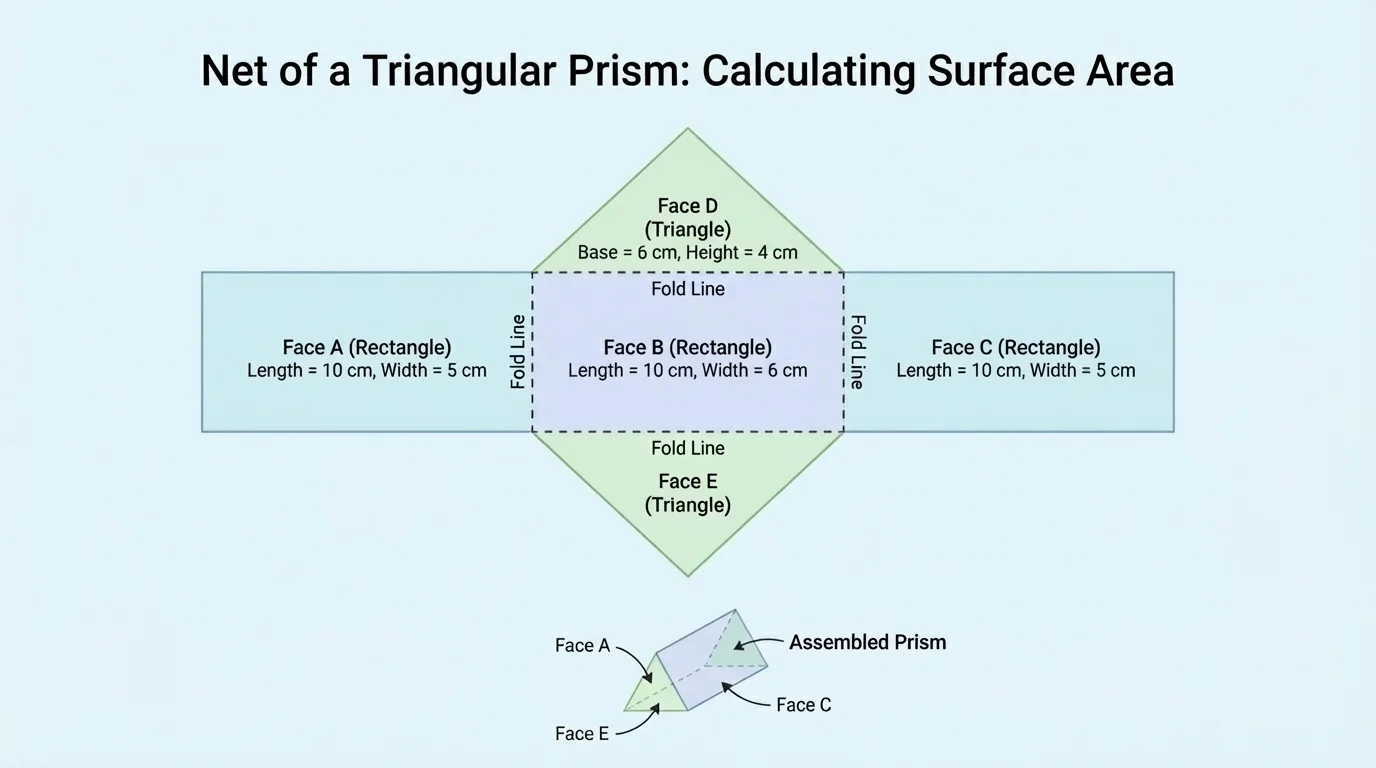
Different solids can have different nets. In fact, one solid can sometimes have more than one correct net. The important thing is that every face is included exactly once, and the faces are attached in a way that allows the solid to fold together without gaps or overlaps.
Later, when you calculate area, the net in [Figure 1] makes it easier to spot which faces are the same size. That saves time because congruent faces have equal area.
Some package designers test nets on paper first before making a box from cardboard. A good net reduces wasted material and helps the package fold neatly.
A prism has two congruent parallel bases. The side faces of a prism are rectangles in the kinds of prisms we study here. A pyramid has one base and triangular faces that meet at a single point called the apex.
Prisms and pyramids have different kinds of nets, and [Figure 2] helps show that difference. In a prism, the two bases are congruent and the side faces connect them. In a pyramid, there is only one base, and all the side faces are triangles.
For a triangular prism, the net contains \(2\) triangles and \(3\) rectangles. For a rectangular pyramid, the net contains \(1\) rectangle and \(4\) triangles. Each triangle in the pyramid net shares one side with the base.
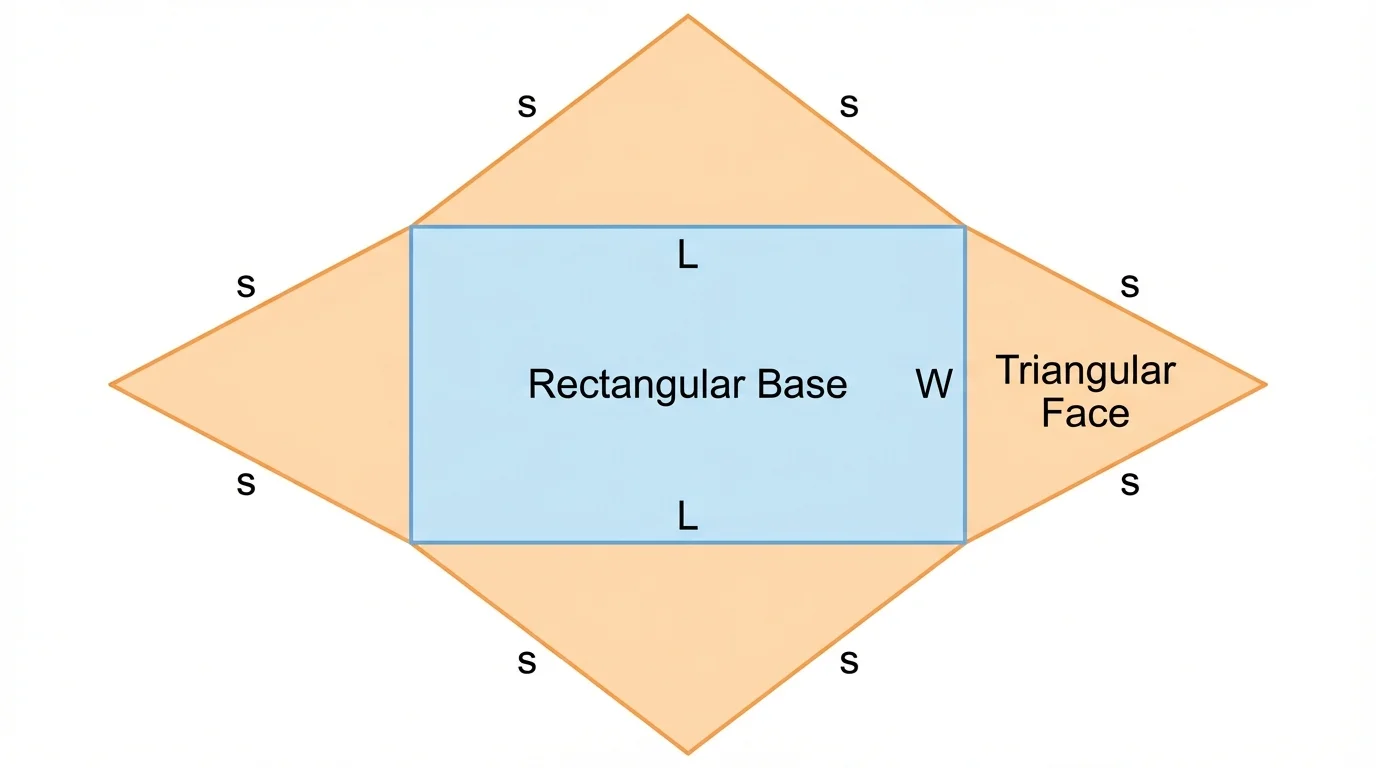
When looking at a net, ask yourself: Which shape is the base or bases? Which shapes are side faces? How many of each do I see? These questions help you organize the figure before doing any calculations.
As with the pyramid net in [Figure 2], you should also check whether the side lengths match along edges that will fold together. If they do not match, the figure cannot close properly.
To find surface area from a net, use a simple process, and [Figure 3] illustrates how the dimensions on the net guide each calculation. First, identify every face. Next, find the area of each rectangle and triangle. Finally, add all the areas.
This approach works because the net shows the entire outside of the solid laid flat. You do not need a memorized surface area formula for the whole solid. You only need the area of rectangles and triangles and careful addition.
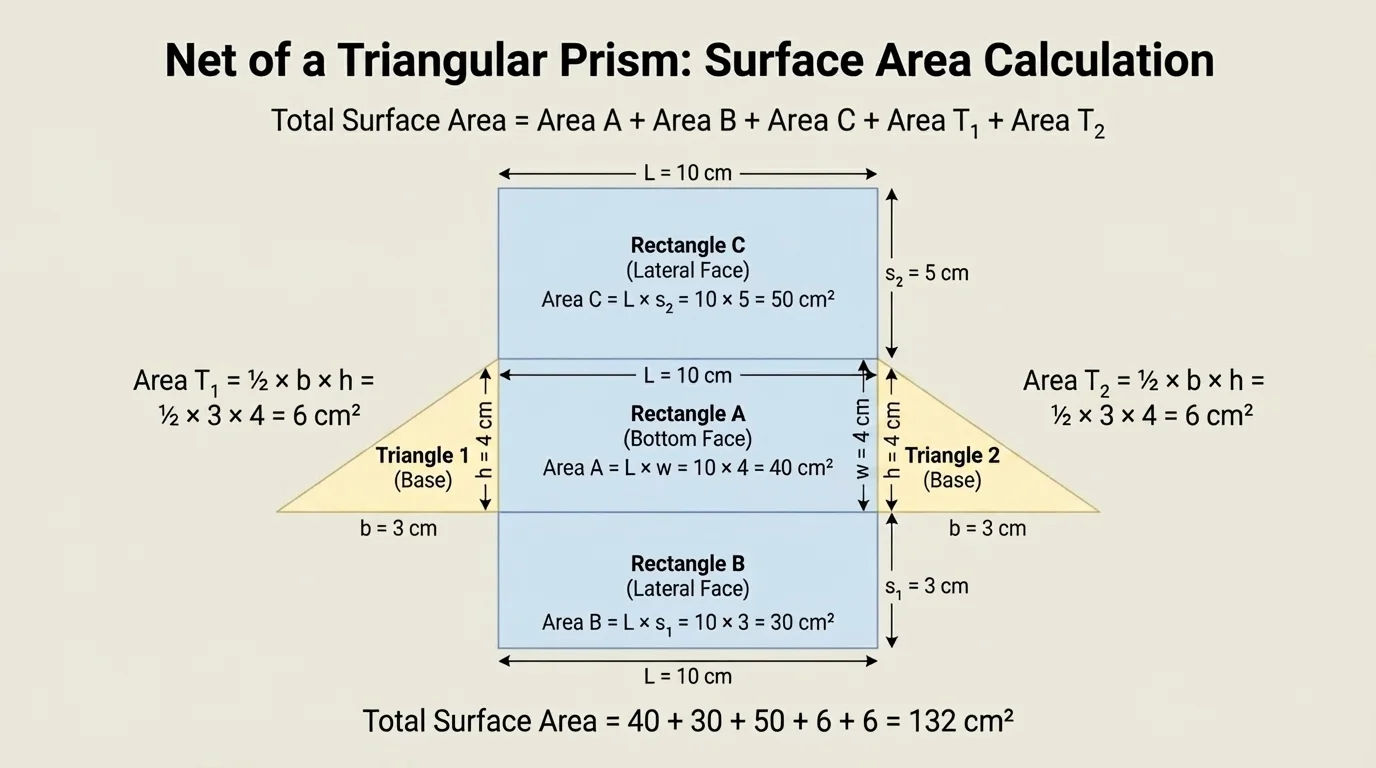
If several faces are congruent, you can find one area and multiply. For example, if the two triangular ends are the same, you may compute the area of one triangle and then double it.
A reliable method
Surface area from a net means adding face areas, not guessing from the outside view. The solid may look complicated in three dimensions, but the net breaks it into simple shapes. When students make mistakes, it is often because they skip the net and try to picture everything mentally.
The same net in [Figure 3] also reminds us to match each measurement to the correct shape. A triangle's height must be the perpendicular height of that triangle, not just any side drawn nearby.
Now let's use nets to solve problems step by step.
Worked example 1: Triangular prism
A triangular prism has a net with \(3\) rectangles and \(2\) congruent triangles. The rectangles measure \(8 \times 5\), \(8 \times 4\), and \(8 \times 3\). Each triangle has base \(3\) and height \(4\). Find the surface area.
Step 1: Find the area of each rectangle.
The rectangle areas are \(8 \times 5 = 40\), \(8 \times 4 = 32\), and \(8 \times 3 = 24\) square units.
Step 2: Find the area of one triangle.
Use \(A = \dfrac{1}{2}bh\): \(\dfrac{1}{2} \cdot 3 \cdot 4 = 6\) square units.
Step 3: Account for both triangles.
There are \(2\) congruent triangles, so their total area is \(2 \cdot 6 = 12\) square units.
Step 4: Add all face areas.
\[40 + 32 + 24 + 12 = 108\]
The surface area is \(108\) square units.
This example shows why nets are so useful: each face becomes an easy area problem.
Worked example 2: Rectangular pyramid
A rectangular pyramid has a net with a rectangular base measuring \(6\) units by \(4\) units. Two triangular faces each have base \(6\) and height \(5\). The other two triangular faces each have base \(4\) and height \(5\). Find the surface area.
Step 1: Find the area of the base.
The rectangular base has area \(6 \times 4 = 24\) square units.
Step 2: Find the area of the two larger triangles.
Area of one triangle: \(\dfrac{1}{2} \cdot 6 \cdot 5 = 15\). For two triangles: \(2 \cdot 15 = 30\).
Step 3: Find the area of the two smaller triangles.
Area of one triangle: \(\dfrac{1}{2} \cdot 4 \cdot 5 = 10\). For two triangles: \(2 \cdot 10 = 20\).
Step 4: Add all areas.
\[24 + 30 + 20 = 74\]
The surface area is \(74\) square units.
Notice that we did not use one formula for the whole pyramid. We used the net and found each area separately.
Worked example 3: Real-world tent problem
A small tent is shaped like a triangular prism. Its net includes \(2\) triangular ends with base \(6\) feet and height \(4\) feet, and \(2\) rectangular sides each measuring \(8\) feet by \(5\) feet. The floor is another rectangle measuring \(8\) feet by \(6\) feet. How much fabric and flooring material cover the outside and bottom of the tent?
Step 1: Find the two triangular ends.
Area of one triangle: \(\dfrac{1}{2} \cdot 6 \cdot 4 = 12\). Two triangles: \(2 \cdot 12 = 24\) square feet.
Step 2: Find the two rectangular sides.
Area of one rectangle: \(8 \times 5 = 40\). Two rectangles: \(2 \cdot 40 = 80\) square feet.
Step 3: Find the floor area.
The floor has area \(8 \times 6 = 48\) square feet.
Step 4: Add all parts.
\[24 + 80 + 48 = 152\]
The tent uses \(152\) square feet of material.
That kind of calculation matters when companies estimate fabric, plastic, cardboard, or metal for real products.
One common mistake is forgetting a face. A triangular prism has \(5\) faces total, not \(4\). If one face is missing from your total, the surface area will be too small.
Another mistake is using the wrong dimensions for a triangle. The base and height must form a perpendicular pair. A slanted side is not automatically the height.
Students also sometimes add edge lengths instead of areas. Surface area is about covering faces, so every part of the answer must come from area calculations such as \(l \times w\) or \(\dfrac{1}{2}bh\).
"If you can flatten the solid in your mind, you can measure the whole outside."
As seen earlier in [Figure 1], a clear net helps prevent these mistakes because it separates the faces so you can count and measure them one by one.
Many real objects can be modeled by solids and their nets. For example, a triangular-prism tent can be connected to its flat pattern. When a company makes a tent, gift package, or roof panel, it needs to know the area of the pieces before cutting the material.
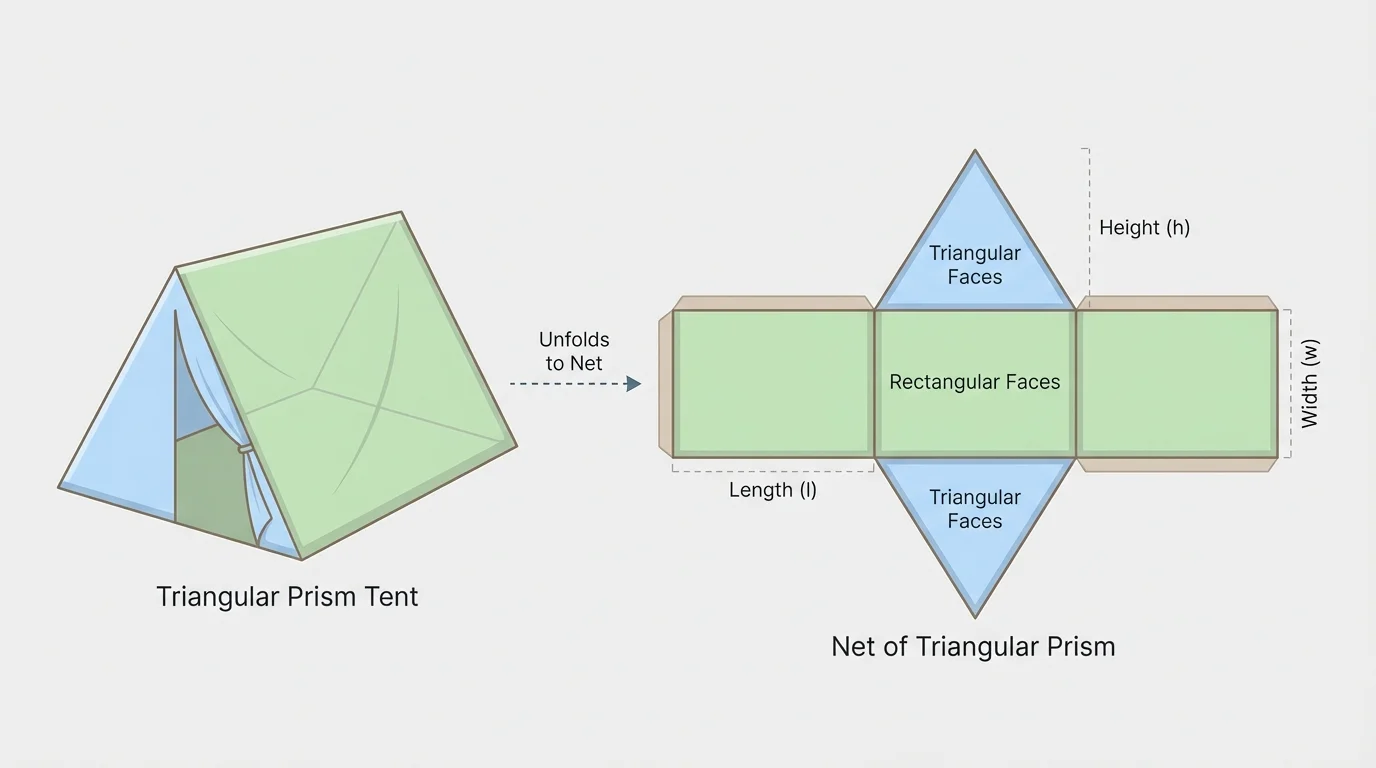
Cardboard boxes are another example. A designer may first draw a net, then compute the area of all the faces to estimate how much cardboard is needed. If the designer changes one dimension, the surface area changes too.
Artists and engineers also use nets. An artist making a paper sculpture must know how the flat parts fold. An engineer may use nets to plan metal panels for a vent, cover, or container.
The tent model in [Figure 4] is especially helpful because it shows that surface area is not just school math. It tells you how much material is needed to cover a shape in real life.
After drawing or studying a net, ask a few questions. Are all faces included? Do matching edges have equal lengths? Will the pieces fold up without overlapping in the wrong way?
You can often test this by lightly sketching fold lines and imagining the faces lifting into place. A correct net for a prism has side faces that wrap around the bases. A correct net for a pyramid has triangles that meet at one point when folded.
| Solid | Faces in the Net | What to Check |
|---|---|---|
| Triangular prism | \(2\) triangles and \(3\) rectangles | The rectangles connect around the triangles |
| Rectangular pyramid | \(1\) rectangle and \(4\) triangles | Each triangle shares an edge with the base |
| Triangular pyramid | \(4\) triangles | All triangles fit together with no gaps |
Table 1. Common solids and what their nets should include.
Checking a net before doing calculations is a smart habit. It helps you understand the figure and catches errors before they affect your answer.
When you study a solid through its net, you turn a three-dimensional problem into several simpler two-dimensional area problems. That makes it easier to identify faces, choose the correct measurements, and check whether your answer is reasonable. Whether you are working with a prism, a pyramid, or a real object such as a tent or package, the same idea applies: find each face, calculate its area, and add the results carefully.
