Modern life can feel far removed from forests, rivers, soils, and oceans, yet every phone, meal, building, and breath depends on them. A city may look like concrete and steel, but it survives only because Earth's systems keep supplying clean water, oxygen, fertile soil, energy resources, and living organisms. The surprising part is that human society is now powerful enough to alter these systems on a planetary scale. That makes sustainability not just an environmental issue, but a scientific, engineering, economic, and ethical challenge.
Human societies rely on natural resources such as freshwater, timber, minerals, fossil fuels, fertile land, and fisheries. These resources support transportation, agriculture, manufacturing, energy production, and public health. But natural resources are not infinite in the way we often use them. Some are renewable only if they are managed carefully, while others form so slowly that for human timescales they are effectively nonrenewable.
At the same time, the living world provides support that is easy to overlook. Forests help regulate climate, wetlands filter water, insects pollinate crops, and microorganisms recycle nutrients. The stability of these processes depends on biodiversity, the variety of life at the level of genes, species, and ecosystems. When biodiversity declines, ecosystems often become less resilient and less able to recover from stress.
Sustainability means meeting present needs without preventing future generations from meeting theirs. It requires using resources at rates that do not cause long-term environmental damage or collapse of the systems that support life.
Natural resources are materials and energy sources obtained from Earth, including water, air, soil, minerals, forests, and fossil fuels.
Ecosystem degradation is the damage or decline of an ecosystem's structure, function, or biodiversity.
For this reason, sustainability is not about stopping all human activity. It is about managing human activity so that Earth's systems can continue to function. Science helps us understand consequences, and engineering helps us design better solutions.
[Figure 1] shows that Earth is not a set of isolated parts. The atmosphere, hydrosphere, geosphere, and biosphere constantly interact. Humans are part of the biosphere, but human societies also create powerful technological systems that move matter and energy on enormous scales. Burning fuel changes the atmosphere, irrigation changes the hydrosphere, mining changes the geosphere, and habitat destruction changes the biosphere.
Consider a simple example: cutting down a forest. Trees no longer remove as much \(CO_2\) from the air through photosynthesis. Soil becomes more exposed to erosion. Water runoff increases because roots no longer hold water in place. Local temperatures may rise because shade is reduced and the land surface changes. Species that lived in the forest lose habitat. One action affects several Earth systems at once.
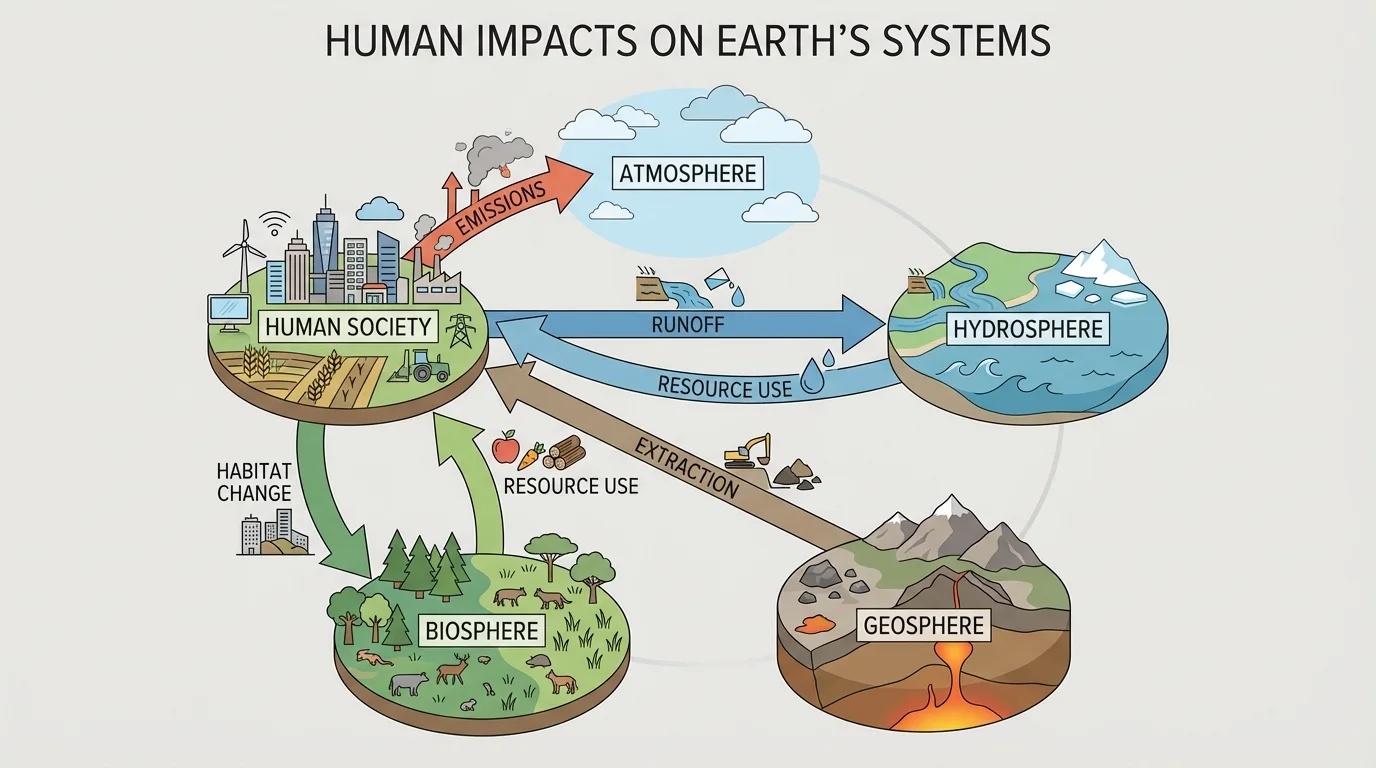
These interactions are why environmental problems are rarely one-dimensional. A solution in one area can help or harm another. For example, a dam may provide low-carbon electricity, but it can also alter river ecosystems, sediment flow, and fish migration. Scientific understanding is therefore essential for predicting trade-offs.
Feedbacks in Earth systems occur when a change in one part of the system causes effects that either amplify the original change or reduce it. Melting ice is one example: less ice means less sunlight is reflected, so more energy is absorbed, which can lead to more warming and more melting. Responsible management tries to avoid harmful feedbacks before they intensify.
Scientists often study these interactions using data from satellites, field measurements, climate models, and ecological surveys. Engineers then use that information to improve energy systems, water systems, and industrial processes.
Human activities affect Earth systems through resource extraction, land-use change, energy use, agriculture, manufacturing, and waste disposal. Some of the most important changes come from the scale of modern society. With billions of people using materials and energy every day, even ordinary actions become significant when multiplied globally.
Fossil fuel combustion is one major driver. Coal, oil, and natural gas store carbon that was buried over millions of years. When they are burned, carbon combines with oxygen to form \(CO_2\). A simplified reaction for methane combustion is \[CH_4 + 2O_2 \rightarrow CO_2 + 2H_2O\]. If \(1\,\textrm{mol}\) of \(CH_4\) burns completely, it produces \(1\,\textrm{mol}\) of \(CO_2\). This matters because greenhouse gases affect Earth's energy balance.
Land-use change is another major factor. Clearing land for farms, roads, housing, and industry replaces natural habitats with human-managed landscapes. This can reduce carbon storage, increase erosion, fragment habitats, and alter water cycles. Urbanization also creates surfaces such as asphalt and concrete that absorb and reradiate heat, contributing to urban heat islands.
Water use changes rivers, aquifers, and wetlands. Groundwater pumped faster than it is recharged can lower water tables. Diverting rivers for irrigation can shrink lakes and wetlands. Polluted runoff from farms and cities can carry fertilizers, pesticides, oils, and plastics into streams and coastal waters.
Mining and material extraction disturb rock, soil, vegetation, and water systems. They provide metals needed for technology and infrastructure, but if poorly managed they can create toxic waste, acid drainage, and long-lasting ecosystem damage. Even supposedly clean technologies still require materials such as lithium, copper, nickel, silicon, and rare earth elements, so sustainability includes how materials are sourced and recycled.
Biodiversity supports human societies through what scientists call ecosystem services. These are benefits provided by natural systems. Some are direct, such as food, wood, fibers, and medicines. Others are indirect but equally important, such as climate regulation, pollination, decomposition, nutrient cycling, flood control, and water purification.
Why does biodiversity matter so much? One reason is resilience. In a diverse ecosystem, different organisms often play overlapping roles. If one species declines, others may partly compensate. In a less diverse system, the loss of one species can have much larger effects. This does not mean every ecosystem is safe from disturbance, but greater diversity often increases stability.
Case study: Pollinators and food supply
Many crops depend on pollinators such as bees, butterflies, moths, birds, and bats. When pollinator populations decline because of habitat loss, pesticide exposure, disease, or climate shifts, crop yields can fall.
Step 1: Identify the ecological role
Pollinators transfer pollen, allowing many flowering plants to reproduce.
Step 2: Connect ecology to agriculture
Fruits, nuts, and many vegetables depend on successful pollination.
Step 3: Recognize the social effect
Lower pollination can reduce food production, raise costs, and threaten livelihoods.
This is a clear example of biodiversity supporting both ecosystems and economies.
Biodiversity loss can happen through habitat destruction, invasive species, pollution, overharvesting, and climate change. Often these causes interact. A coral reef, for instance, may be stressed by warmer water, pollution from land, and overfishing at the same time.
About half of the oxygen produced by photosynthesis each year comes from marine microorganisms, especially phytoplankton. Tiny organisms in the ocean play a huge role in regulating the atmosphere.
The same idea applies on land. Soil organisms decompose dead matter and return nutrients to plants. Without them, nutrient cycles would slow dramatically, reducing productivity across ecosystems.
Climate change is one of the clearest examples of human impact on Earth systems. The climate system depends on flows of energy into and out of Earth. Greenhouse gases absorb some outgoing infrared radiation, warming the lower atmosphere. Human activities increase concentrations of gases such as \(CO_2\), methane, and nitrous oxide, strengthening this effect, as shown in [Figure 2].
A simple way to describe carbon emissions is with the relationship \(E = P \times e\), where \(E\) is total emissions, \(P\) is the amount of energy used, and \(e\) is emissions per unit of energy. If a community uses \(500\) units of energy and the energy source releases \(0.8\) units of emissions per energy unit, then total emissions are \(E = 500 \times 0.8 = 400\) units. Engineers can lower emissions by reducing energy demand, lowering \(e\) through cleaner energy, or both.
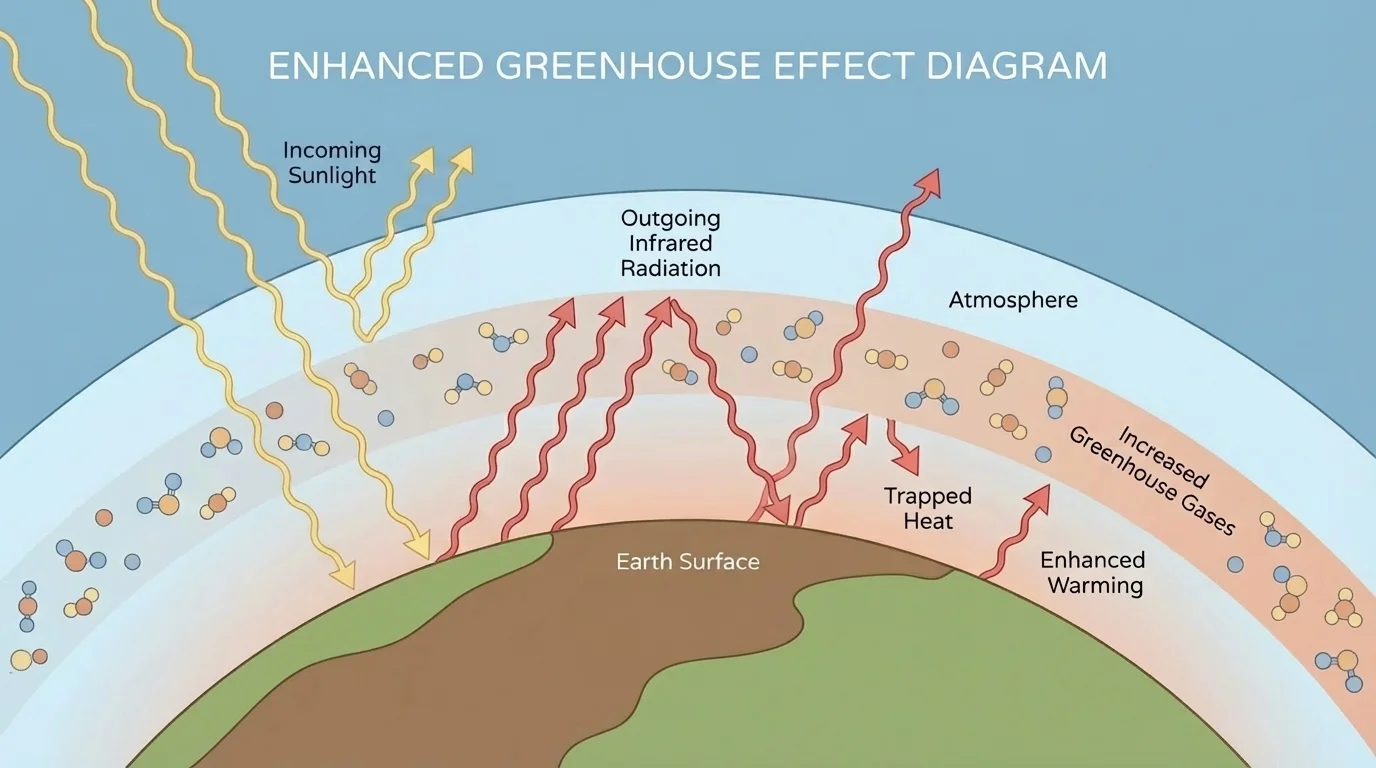
Climate change affects temperature, precipitation, sea level, wildfire risk, storm intensity, glacier mass, and species ranges. It also interacts with agriculture, health, infrastructure, and migration. The issue is not just warming itself, but the chain of environmental and social effects that follow.
Air pollution includes particles and gases that damage health and ecosystems. Burning fuels can release sulfur dioxide, nitrogen oxides, and fine particulate matter. These pollutants can contribute to smog, acid rain, lung disease, and reduced visibility. Technologies such as catalytic converters and smokestack scrubbers reduce these emissions, showing how engineering can directly improve environmental quality.
Water pollution occurs when harmful substances enter lakes, rivers, groundwater, or oceans. Excess fertilizer containing nitrogen and phosphorus can cause eutrophication, in which rapid algal growth reduces oxygen in the water. Low oxygen can kill fish and other organisms. Plastic waste is also a growing concern because it persists, fragments into microplastics, and spreads through food webs.
Soil degradation includes erosion, salinization, nutrient depletion, and contamination. Productive soil forms slowly, yet it can be lost quickly through overgrazing, deforestation, and poor farming practices. Healthy soil is not just dirt; it is a living system that stores water, cycles nutrients, and supports plant growth.
Ocean impacts include warming, acidification, overfishing, and habitat destruction. When more \(CO_2\) dissolves in seawater, it changes ocean chemistry. A simplified reaction is \(CO_2 + H_2O \rightarrow H_2CO_3\), forming carbonic acid. This can lower pH and make it harder for some organisms to build shells or skeletons from calcium carbonate.
To manage resources responsibly, societies need evidence. Scientists use measurements such as atmospheric \(CO_2\) concentration, biodiversity surveys, water quality data, satellite observations of land cover, and rates of species decline. These data reveal trends that may be difficult to see in everyday life.
One useful idea is the ecological footprint, which estimates how much biologically productive land and water area is required to supply resources and absorb wastes for a person or population. If a population's footprint exceeds what ecosystems can regenerate, that pattern is unsustainable.
Another useful idea is life-cycle assessment. Instead of judging a product only by how it is used, scientists and engineers examine extraction, manufacturing, transportation, use, and disposal. An electric vehicle, for example, may reduce emissions during driving, but its total impact also depends on battery production, electricity sources, and recycling systems.
Why numbers matter in sustainability: decisions should be based on measurable rates. A fishery may seem healthy in one year, but if fish are removed faster than populations reproduce, decline is likely over time. The same principle applies to forests, aquifers, and soils: long-term rates matter more than short-term appearances.
This is why sustainability often involves comparing rates. If a forest regrows at \(2\) percent per year but harvesting removes \(5\) percent per year, then the resource shrinks over time. If an aquifer recharges at \(50\) million liters per year and extraction is \(80\) million liters per year, there is a net loss of \(80 - 50 = 30\) million liters each year.
| Environmental issue | Main human drivers | Typical effects | Possible responses |
|---|---|---|---|
| Climate change | Fossil fuel use, deforestation | Warming, sea-level rise, extreme weather | Renewable energy, efficiency, reforestation |
| Water pollution | Runoff, sewage, industry | Eutrophication, disease, habitat damage | Treatment systems, buffer zones, better regulation |
| Habitat loss | Urbanization, farming, logging | Species decline, fragmentation | Protected areas, restoration, land planning |
| Soil degradation | Overgrazing, erosion, poor farming | Lower productivity, sediment runoff | Cover crops, contour plowing, reduced tillage |
| Resource depletion | Overuse of forests, fisheries, aquifers, minerals | Scarcity, conflict, ecosystem stress | Conservation, recycling, sustainable harvest limits |
Table 1. Major environmental issues, their human causes, common effects, and response strategies.
Scientists describe problems, but engineers are essential in building solutions. Cleaner technologies aim to produce the same or greater benefits with less pollution, less waste, and less damage to ecosystems. This can mean using different energy sources, designing more efficient machines, replacing hazardous chemicals, or recovering materials that would otherwise be discarded. These approaches help make resource use more sustainable in practice.
Renewable energy technologies such as solar panels, wind turbines, geothermal systems, and some forms of hydroelectric power can reduce dependence on fossil fuels. They are not impact-free, but they usually produce far less greenhouse gas pollution during operation. Energy storage systems, smarter electrical grids, and improved transmission make these sources more useful at larger scales. Another engineering example is wastewater treatment.
Pollution control technologies reduce harmful emissions before they enter the environment. [Figure 3] shows the main stages of wastewater treatment. In this process, water first passes through screens to remove large debris, then solids settle out, then microorganisms break down organic waste, and finally disinfection reduces pathogens before discharge or reuse.
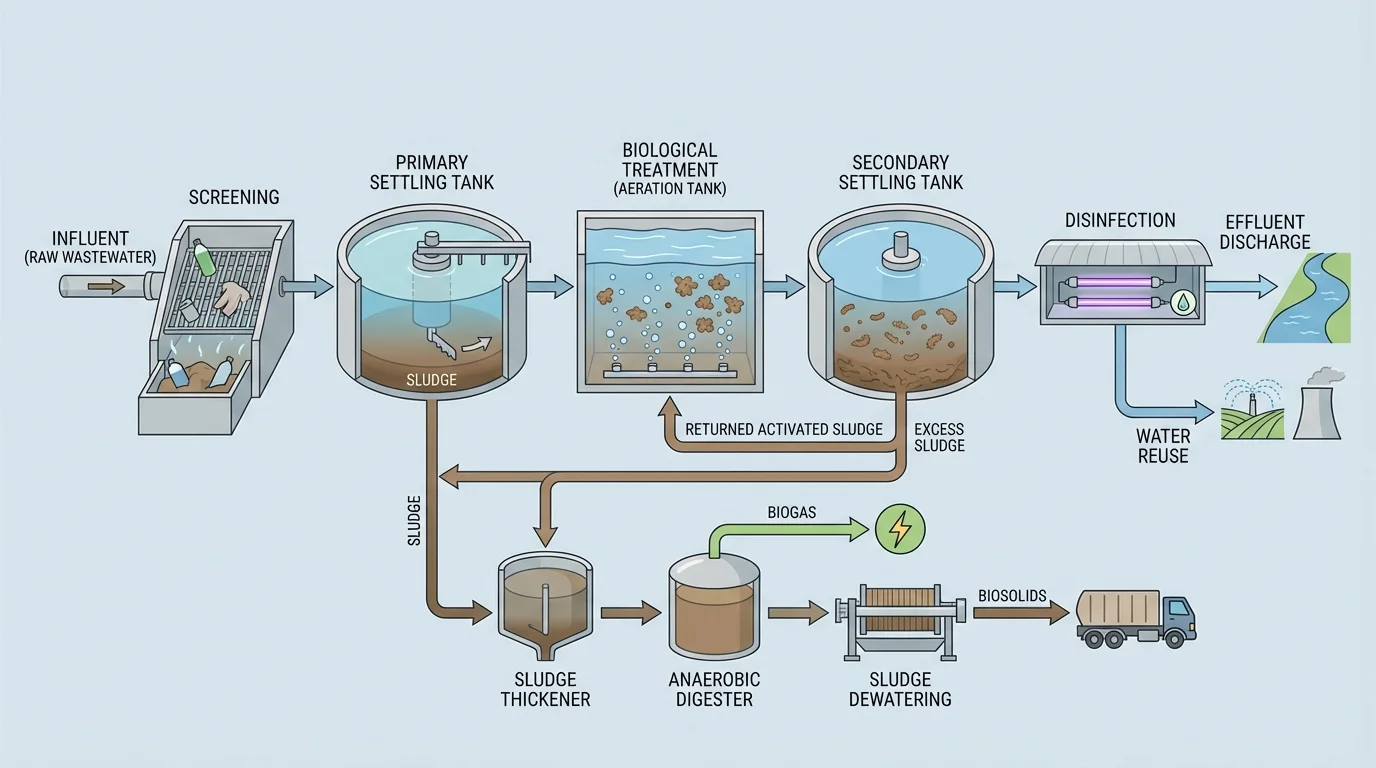
If wastewater initially contains \(120\,\textrm{mg/L}\) of suspended solids, and treatment removes \(75\) percent, the remaining concentration is \(120 \times (1 - 0.75) = 30\,\textrm{mg/L}\). This kind of calculation helps engineers evaluate performance and improve plant design.
Green chemistry tries to reduce waste and toxicity from the start. Instead of dealing with pollution after it is created, chemists redesign reactions and materials to use safer substances, require less energy, and generate fewer harmful by-products. This shift from "cleaning up" to "preventing pollution" is a major scientific advance.
Circular economy design aims to keep materials in use for as long as possible through repair, reuse, remanufacturing, and recycling. In a linear system, resources move from extraction to production to disposal. In a circular system, waste from one stage becomes input for another. This reduces pressure on mines, forests, and landfills.
Sustainable agriculture includes precision irrigation, crop rotation, integrated pest management, reduced tillage, and sensors that help farmers apply water or fertilizer only where needed. If a farm reduces water use from \(1{,}000\) liters per day to \(700\) liters per day, then the daily savings are \(1{,}000 - 700 = 300\) liters. Over \(100\) days, that becomes \(300 \times 100 = 30{,}000\) liters saved.
Real-world application: Precision agriculture
Farmers can use satellite data, soil moisture sensors, and GPS-guided equipment to target resources more accurately.
Step 1: Measure conditions
Sensors identify where soil is dry or nutrient-poor.
Step 2: Apply inputs selectively
Water and fertilizer are delivered only where needed.
Step 3: Reduce waste and runoff
Less excess fertilizer reaches streams, and less water is wasted.
This approach can improve crop yield while lowering environmental harm.
Reducing greenhouse gas buildup requires lowering emissions from major systems, especially electricity, transportation, industry, and buildings. Technology matters most when it changes these systems at scale.
[Figure 4] Using resources responsibly means matching human use to ecological limits. A renewable resource remains renewable only if the rate of use does not consistently exceed the rate of replacement. Forests can regrow, fisheries can reproduce, and groundwater can recharge, but only within limits.
Resource management involves setting harvest levels, protecting habitats, monitoring data, enforcing regulations, and adapting when conditions change. In forestry, selective cutting, buffer zones along streams, and replanting can reduce ecosystem damage compared with clear-cutting large areas without recovery planning.
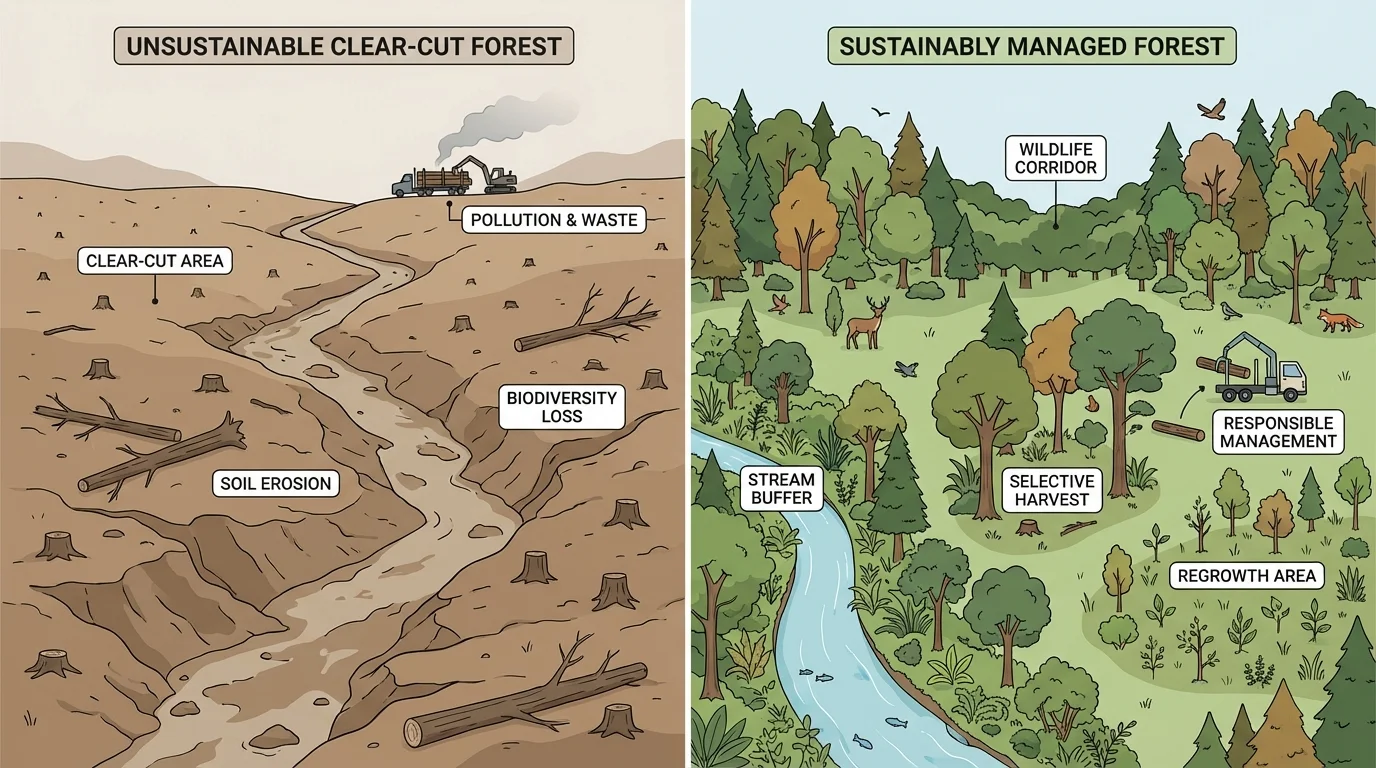
Protected areas, marine reserves, wildlife corridors, and habitat restoration can help preserve biodiversity. Restoration does not always recreate an original ecosystem perfectly, but it can recover many important functions. Wetland restoration, for example, can improve flood control, water filtration, and habitat quality.
Responsible management also includes social knowledge. Indigenous communities and local land users often hold valuable knowledge about seasons, species behavior, and long-term ecological patterns. Scientific data and local knowledge can complement each other rather than compete.
Renewable does not mean unlimited. A resource is renewable only if natural processes replace it fast enough relative to how quickly it is being used.
Economic and political choices matter too. Regulations can limit pollution, incentives can encourage cleaner technology, and international agreements can address problems that cross borders. Since air and water move, environmental management often requires cooperation across regions and nations.
Later applications of sustainable design return to the same principle: systems last longer when extraction is balanced with regeneration and when habitat structure is not destroyed in the process.
One important case is the transition to low-carbon electricity. Countries that expand wind and solar power while improving storage and grid management can lower emissions from electricity generation. The challenge is not only producing power but also storing it, transmitting it, and ensuring reliability during changing weather conditions.
A second case is urban water recycling. [Figure 3] Some cities now treat wastewater to high standards and reuse it for irrigation, industry, or even indirect drinking water supply. This reduces pressure on rivers and aquifers, especially in dry regions. The treatment pathway described earlier becomes especially important where freshwater scarcity is severe.
A third case is materials recycling. Aluminum, steel, glass, paper, and some plastics can be recovered and reused, though with varying efficiency. Recycling usually saves raw material extraction and often saves energy as well. However, the best results occur when products are designed from the beginning to be easy to repair, disassemble, and recover.
A fourth case is conservation biology. Protected areas can reduce habitat loss, but they are most effective when connected by corridors that allow species to move. This becomes increasingly important as climate change shifts suitable habitats. Conservation is therefore not only about protecting places, but also about protecting movement and ecological relationships.
Many sustainability questions involve trade-offs. A new mine may provide materials needed for batteries and renewable energy systems, but it may also disturb land and water. A hydropower project may reduce fossil fuel use but affect river ecosystems. A city may need housing, yet expanding it into wetlands can increase flood risk and habitat loss.
Because of these trade-offs, responsible decisions should be evidence-based and long-term. They should ask not only, "What do we gain now?" but also, "What systems are we weakening for later?" Sustainability includes fairness across generations. Future people will depend on the same atmosphere, freshwater, soils, and biodiversity that support us today.
"We do not inherit the Earth from our ancestors; we borrow it from our children."
— Commonly cited sustainability principle
This idea is ethical, but it is also scientific. Damaged soils grow less food. Polluted aquifers are expensive to clean. Extinct species do not return. Preventing damage is often more effective and less costly than trying to reverse it later.
The sustainability of human societies depends on understanding Earth as a connected system. It also depends on creativity. Scientists monitor environmental change, identify causes, test solutions, and improve predictions. Engineers redesign systems so that energy, food, water, transportation, and manufacturing create less harm. Citizens, communities, and governments then decide which solutions to adopt.
This field includes careers in environmental science, ecology, civil engineering, chemical engineering, renewable energy, conservation biology, urban planning, agriculture, public health, and data science. The common goal across all of them is clear: maintain the natural systems that support life while building societies that are healthier, safer, and more durable.
