For a long time, equations like \(x^2+1=0\) were understood to have no real solutions. After all, no real number squares to \(-1\). But instead of stopping there, mathematics expanded. That move led to complex numbers, which now appear in physics, electrical engineering, signal processing, and many other fields. A quadratic can fail to have real solutions and still have perfectly valid solutions in a larger number system.
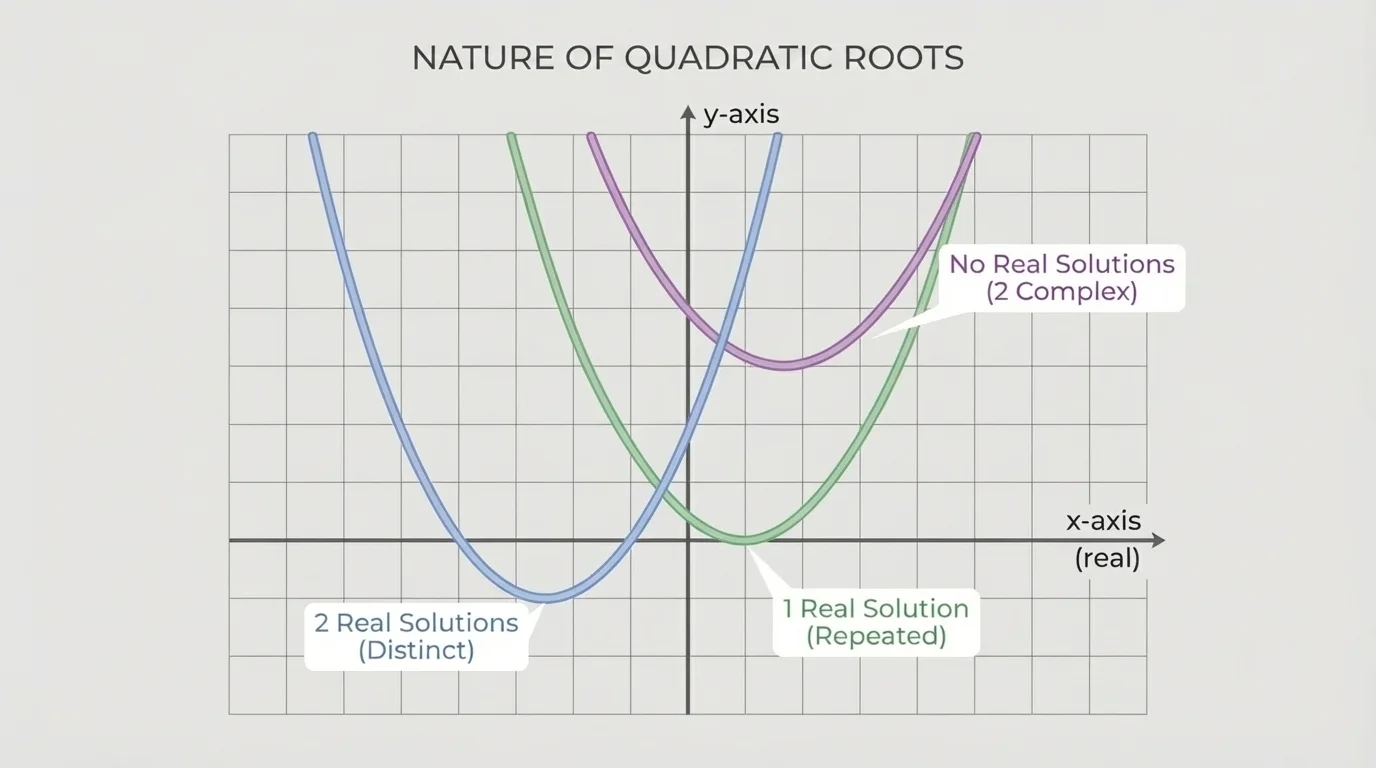
[Figure 1] A quadratic equation with real coefficients usually has the form \(ax^2+bx+c=0\), where \(a\), \(b\), and \(c\) are real numbers and \(a\neq 0\). Sometimes such an equation can be factored over the real numbers. Sometimes it has one repeated real solution. And sometimes the graph never touches the \(x\)-axis at all. In that case, there are no real solutions, but there may still be complex ones.
The key test is the discriminant, the expression \(b^2-4ac\) from the quadratic formula. Its sign tells you what kind of solutions to expect:
| Value of \(b^2-4ac\) | Type of solutions |
|---|---|
| \(b^2-4ac>0\) | Two distinct real solutions |
| \(b^2-4ac=0\) | One real solution repeated twice |
| \(b^2-4ac<0\) | Two complex solutions that are not real |
Table 1. The discriminant determines whether a quadratic has real or complex solutions.
For example, in \(x^2+4x+8=0\), the discriminant is \(4^2-4(1)(8)=16-32=-16\). Since \(-16<0\), this equation has no real solutions. That does not mean it has no solutions at all. It means the solutions are complex.
You already know that solving an equation means finding values that make the equation true. Up to now, those values may have all been real numbers. Here, the number system expands so equations with negative square roots can still be solved.
This expansion is not a trick. It is a consistent mathematical system. Once complex numbers are introduced carefully, the usual solving methods for quadratics still work.
To solve equations with negative square roots, mathematicians define the imaginary unit \(i\) by
\(i^2=-1\)
This definition has far-reaching consequences. Since \(i^2=-1\), \(i\) is a square root of \(-1\), and other negative square roots can be rewritten using \(i\). For example, \(\sqrt{-9}=\sqrt{9}\sqrt{-1}=3i\), and \(\sqrt{-20}=\sqrt{20}\sqrt{-1}=2\sqrt{5}i\).
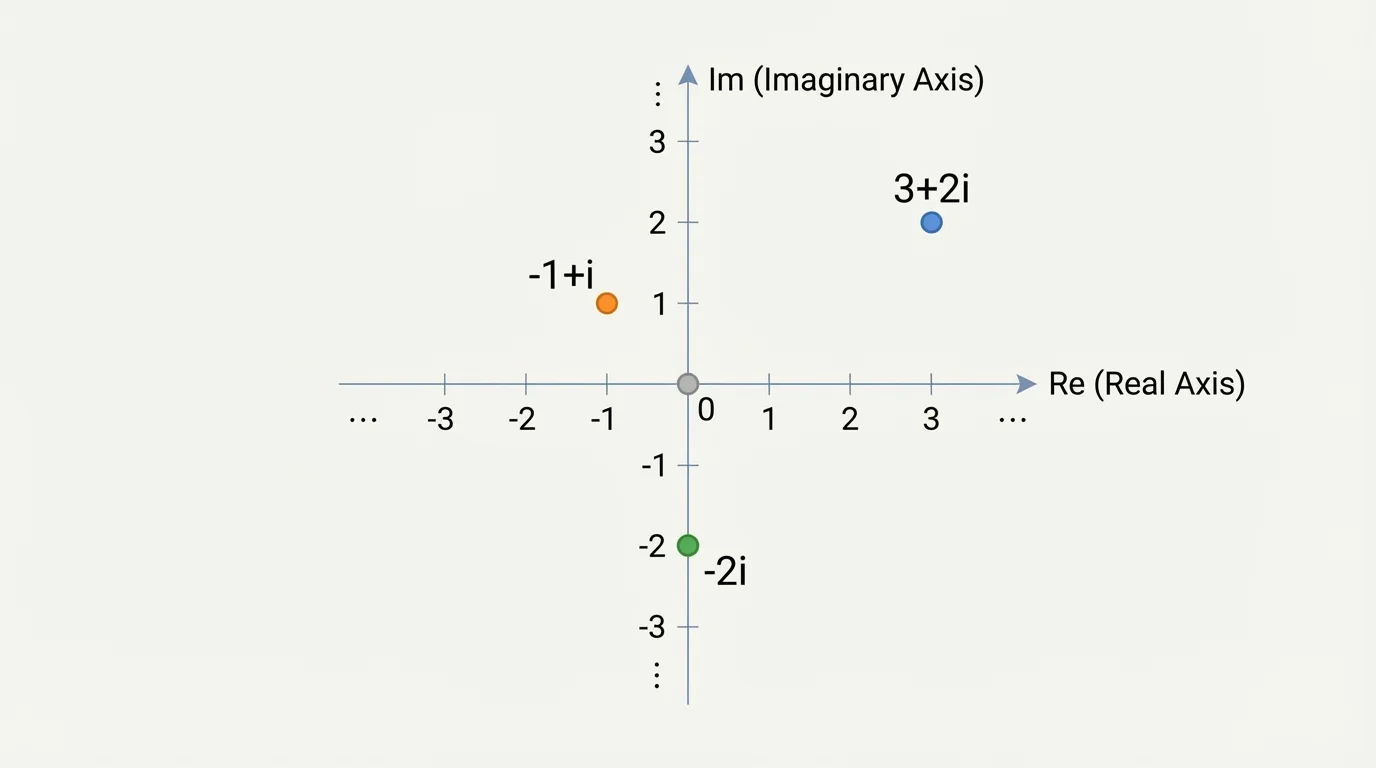
[Figure 2] A standard form of a complex number is \(a+bi\), where \(a\) and \(b\) are real numbers. The number \(a\) is the real part, and \(b\) is the imaginary part. On the complex plane, complex numbers are plotted using a horizontal real axis and a vertical imaginary axis.
Complex number: a number written in the form \(a+bi\), where \(a\) and \(b\) are real numbers.
Imaginary unit: the symbol \(i\), defined by \(i^2=-1\).
Complex conjugate: one of a pair of numbers of the form \(a+bi\) and \(a-bi\).
When solving quadratics, your final answers should usually be simplified into \(a+bi\) form. That means removing radicals from negative numbers and combining like terms if needed.
The simplest quadratics with complex solutions are those that can be solved directly by isolating \(x^2\). If \(x^2=-k\) for some positive number \(k\), then
\[x=\pm \sqrt{-k}=\pm i\sqrt{k}\]
Worked example 1
Solve \(x^2+9=0\).
Step 1: Isolate \(x^2\).
Subtract \(9\) from both sides: \(x^2=-9\).
Step 2: Take square roots.
\(x=\pm\sqrt{-9}\).
Step 3: Rewrite using \(i\).
Since \(\sqrt{-9}=3i\), we get \(x=\pm 3i\).
The solutions are \(x=3i\) and \(x=-3i\).
This method also works if a coefficient is attached to \(x^2\), though you may need to divide first.
Worked example 2
Solve \(2x^2+18=0\).
Step 1: Isolate the squared term.
Subtract \(18\): \(2x^2=-18\).
Step 2: Divide by \(2\).
\(x^2=-9\).
Step 3: Take square roots and simplify.
\(x=\pm\sqrt{-9}=\pm 3i\).
The solutions are \(x=\pm 3i\).
Notice that the two solutions differ only by the sign of the imaginary part. That pattern will appear repeatedly.
Some quadratics are not easy to solve by square roots right away. In that case, completing the square is a powerful method. It rewrites a quadratic so one side becomes a perfect-square trinomial.
Suppose you have \(x^2+6x+13=0\). Factoring over the real numbers does not work. Completing the square does.
How completing the square works
If the coefficient of \(x^2\) is \(1\), move the constant term to the other side, then add the square of half the coefficient of \(x\) to both sides. For \(x^2+bx\), that added value is \(\left(\dfrac{b}{2}\right)^2\).
This method is especially useful because it reveals exactly where the negative square root appears. It also connects algebra to the vertex form of a parabola.
Worked example 3
Solve \(x^2+6x+13=0\) by completing the square.
Step 1: Move the constant term.
\(x^2+6x=-13\).
Step 2: Add the square of half of \(6\).
Half of \(6\) is \(3\), and \(3^2=9\). Add \(9\) to both sides: \(x^2+6x+9=-13+9\).
Step 3: Rewrite the left side as a square.
\((x+3)^2=-4\).
Step 4: Take square roots.
\(x+3=\pm\sqrt{-4}=\pm 2i\).
Step 5: Solve for \(x\).
\(x=-3\pm 2i\).
The solutions are \(x=-3+2i\) and \(x=-3-2i\).
Even though the original equation had only real coefficients, the solution involves complex numbers. This is normal whenever the quadratic's discriminant is negative.
The quadratic formula works for every quadratic equation of the form \(ax^2+bx+c=0\):
\[x=\frac{-b\pm\sqrt{b^2-4ac}}{2a}\]
If \(b^2-4ac<0\), then the square root part becomes imaginary. The formula still works exactly the same way.
Worked example 4
Solve \(x^2-2x+5=0\) using the quadratic formula.
Step 1: Identify \(a\), \(b\), and \(c\).
Here, \(a=1\), \(b=-2\), and \(c=5\).
Step 2: Substitute into the formula.
\(x=\dfrac{-(-2)\pm\sqrt{(-2)^2-4(1)(5)}}{2(1)}\).
Step 3: Simplify the discriminant.
\(x=\dfrac{2\pm\sqrt{4-20}}{2}=\dfrac{2\pm\sqrt{-16}}{2}\).
Step 4: Rewrite the negative square root.
\(\sqrt{-16}=4i\), so \(x=\dfrac{2\pm 4i}{2}\).
Step 5: Simplify.
\(x=1\pm 2i\).
The solutions are \(x=1+2i\) and \(x=1-2i\).
When possible, simplify the square root before writing the final answer. For example, if the formula gives \(\sqrt{-12}\), rewrite it as \(\sqrt{12}i=2\sqrt{3}i\).
Worked example 5
Solve \(3x^2+6x+7=0\).
Step 1: Use \(a=3\), \(b=6\), and \(c=7\).
\(x=\dfrac{-6\pm\sqrt{6^2-4(3)(7)}}{2(3)}\).
Step 2: Simplify the discriminant.
\(x=\dfrac{-6\pm\sqrt{36-84}}{6}=\dfrac{-6\pm\sqrt{-48}}{6}\).
Step 3: Simplify the radical.
\(\sqrt{-48}=\sqrt{48}i=4\sqrt{3}i\).
Step 4: Write the answer in simplest form.
\(x=\dfrac{-6\pm 4\sqrt{3}i}{6}=\dfrac{-3\pm 2\sqrt{3}i}{3}\).
The solutions are \(x=\dfrac{-3+2\sqrt{3}i}{3}\) and \(x=\dfrac{-3-2\sqrt{3}i}{3}\).
If a quadratic equation has real coefficients and one solution is complex, then the other solution is its complex conjugate. So if \(a+bi\) is a solution, then \(a-bi\) is also a solution.
This is why answers such as \(1+2i\) and \(1-2i\), or \(-3+2i\) and \(-3-2i\), appear together. The imaginary parts are opposites, but the real parts match.
There is an important polynomial identity behind this idea:
\[(x-(a+bi))(x-(a-bi))=(x-a)^2+b^2\]
When expanded, the imaginary terms cancel, leaving a polynomial with real coefficients. That cancellation explains why complex roots of real-coefficient quadratics come in conjugate pairs.
Complex numbers may sound abstract, but they are essential in alternating-current circuits, wave motion, and digital signal processing. Engineers often use them because conjugate pairs naturally model oscillations and rotations.
For example, if the solutions to a quadratic are \(2+5i\) and \(2-5i\), then the quadratic can be built as \((x-(2+5i))(x-(2-5i))\). Expanding gives \((x-2)^2+25=x^2-4x+29\), which has real coefficients.
Algebra and graphs tell the same story. When the discriminant is negative, the parabola has no real \(x\)-intercepts. The solutions still exist, but they are not visible as points where the graph crosses the \(x\)-axis on the real coordinate plane.
[Figure 3] You can always check a complex solution by substitution. The key is to use \(i^2=-1\) carefully when simplifying.
Worked example 6
Check that \(x=1+2i\) is a solution of \(x^2-2x+5=0\).
Step 1: Substitute into the equation.
\((1+2i)^2-2(1+2i)+5\).
Step 2: Expand the square.
\((1+2i)^2=1+4i+4i^2=1+4i-4=-3+4i\).
Step 3: Continue simplifying.
\((-3+4i)-2-4i+5\).
Step 4: Combine like terms.
\((-3-2+5)+(4i-4i)=0\).
Since the result is \(0\), \(1+2i\) is a correct solution.
A graph can help you understand what is happening. If a parabola opens upward and its vertex is above the \(x\)-axis, there is no real point where \(y=0\). But the quadratic formula still gives two complex solutions. Earlier, [Figure 1] showed how this differs from the cases with one or two real intercepts.
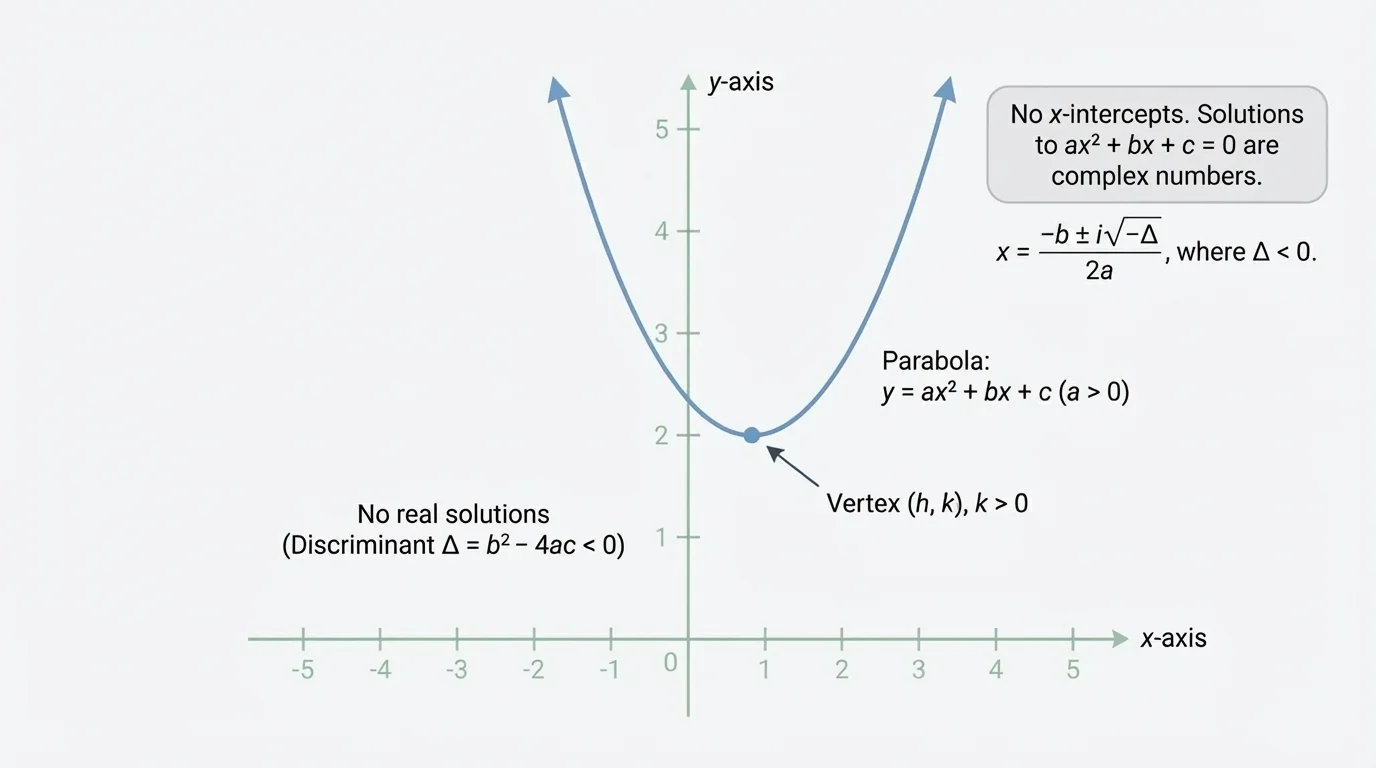
This is a good example of how algebra extends beyond what a standard graph directly shows. The graph is limited to real coordinates, but the equation itself can have solutions in the complex number system.
One common mistake is forgetting the \(\pm\) when taking square roots. If \(x^2=-9\), the solutions are not just \(3i\); they are \(\pm 3i\).
Another mistake is writing \(\sqrt{-9}=-3\). That is incorrect because \((-3)^2=9\), not \(-9\). The correct rewrite is \(\sqrt{-9}=3i\).
Students also sometimes stop too early. For example, if you get \(x=\dfrac{4\pm\sqrt{-36}}{2}\), simplify all the way: \(\sqrt{-36}=6i\), so \(x=\dfrac{4\pm 6i}{2}=2\pm 3i\).
Finally, keep answers in simplified standard form \(a+bi\). That makes them easier to compare, check, and use in later work.
Complex solutions do not usually represent direct measurements like a length or a count of objects, but they still carry important information. In physics and engineering, quadratic and higher-degree equations can describe vibrating systems, electrical circuits, and wave behavior.
For instance, in an electrical circuit with alternating current, equations involving complex numbers help represent both magnitude and phase. The imaginary part is not "fake"; it represents a different kind of mathematical direction, much like the vertical axis on the complex plane shown in [Figure 2].
In control systems and signal processing, conjugate roots often indicate oscillation. If a system's characteristic equation has roots like \(-1+4i\) and \(-1-4i\), the real part relates to growth or decay, while the imaginary part relates to frequency. This is one reason complex solutions are so valuable: they reveal behavior that real-number methods alone would miss.
Even when a context begins with real quantities, the mathematics may naturally lead to complex numbers. That is one of the powerful ideas in algebra: expanding the number system lets us solve more equations and understand more patterns.
