When you climb stairs, you already know a math secret: each step changes the number. One more step means the number gets bigger. One step back means the number gets smaller. That is exactly how addition and subtraction work. We can use counting to help us solve math facts quickly and carefully.
Counting is a way to keep track of how many. When we add, we count forward. When we subtract, we count backward. If we know how to say numbers in order, we can use that skill to solve many problems within \(20\).
For example, if you have \(4\) blocks and get \(2\) more blocks, you can start at \(4\) and count on: \(5, 6\). Now you have \(6\) blocks. If you have \(9\) crackers and eat \(2\), you can start at \(9\) and count back: \(8, 7\). Now \(7\) crackers are left.
Addition means putting more together. Subtraction means taking away. Count on means start at a number and say the next numbers. Count back means start at a number and say the numbers before it.
We do not always need to start at \(1\). A useful strategy is to start at the first number. Then count on or count back the amount that changes, as shown in [Figure 1].
A number path helps us see counting on. If we want to solve \(5 + 2\), we start at \(5\). Then we say the next two numbers: \(6, 7\). So \(5 + 2 = 7\).
When we add \(1\), we move forward one number. When we add \(2\), we move forward two numbers. When we add \(3\), we move forward three numbers. The starting number stays in your head, and your counting tells you the answer.
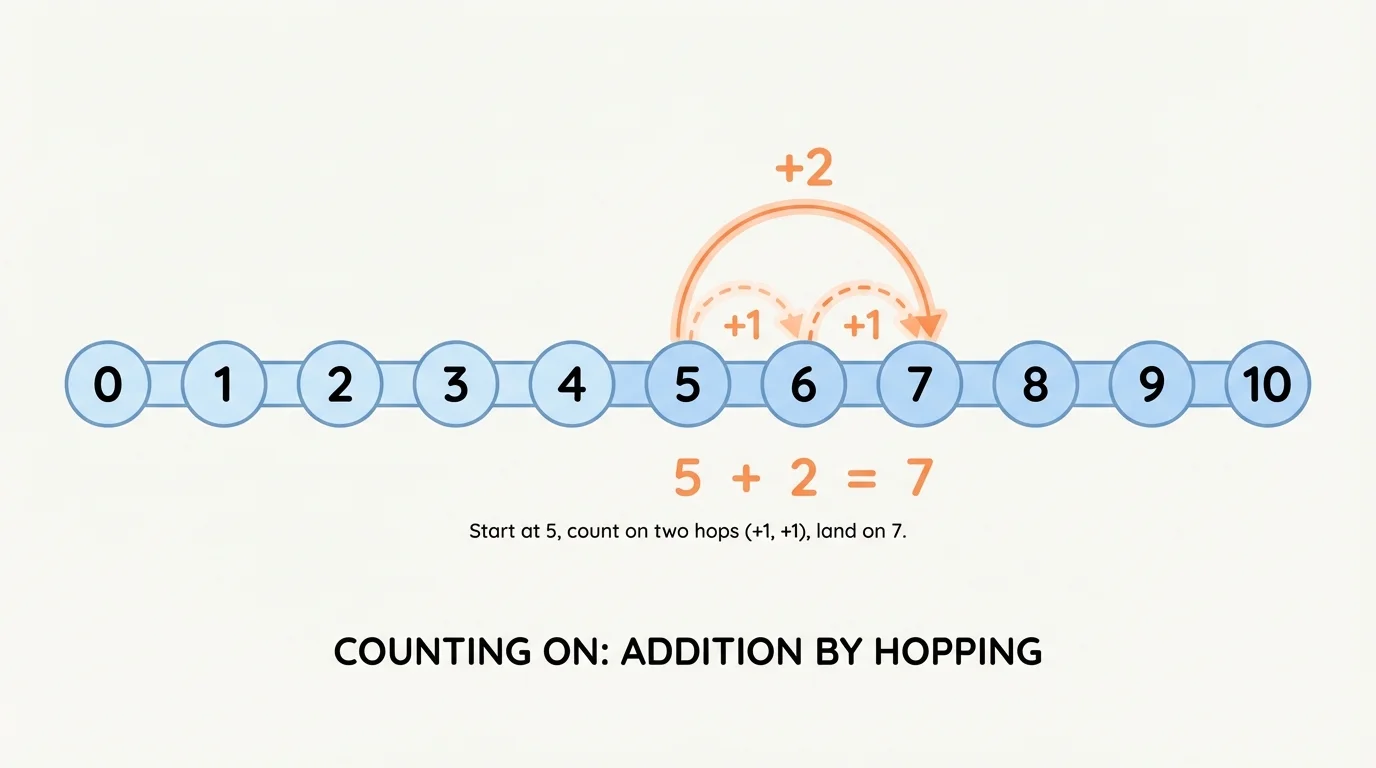
Here are some counting-on examples: start at \(8\), count on \(1\): \(9\), so \(8 + 1 = 9\). Start at \(6\), count on \(2\): \(7, 8\), so \(6 + 2 = 8\). Start at \(9\), count on \(3\): \(10, 11, 12\), so \(9 + 3 = 12\).
You can also hear a pattern. Adding \(2\) means saying the next two numbers. Adding \(3\) means saying the next three numbers. The last number you say is the answer.
Start from the first number
When you solve \(7 + 2\), you do not need to count all the numbers from \(1\). Start at \(7\), then count on \(2\) more: \(8, 9\). This is faster and helps you build number sense.
Later, when you see another problem like \(4 + 2\), the same idea still works: begin at the first number and hop forward the amount you add.
Subtraction works like walking backward on a path. If we want to solve \(8 - 2\), we start at \(8\). Then we say the two numbers before it: \(7, 6\). So \(8 - 2 = 6\).
When we subtract \(1\), we move back one number. When we subtract \(2\), we move back two numbers. When we subtract \(3\), we move back three numbers. The last number you say is what is left.
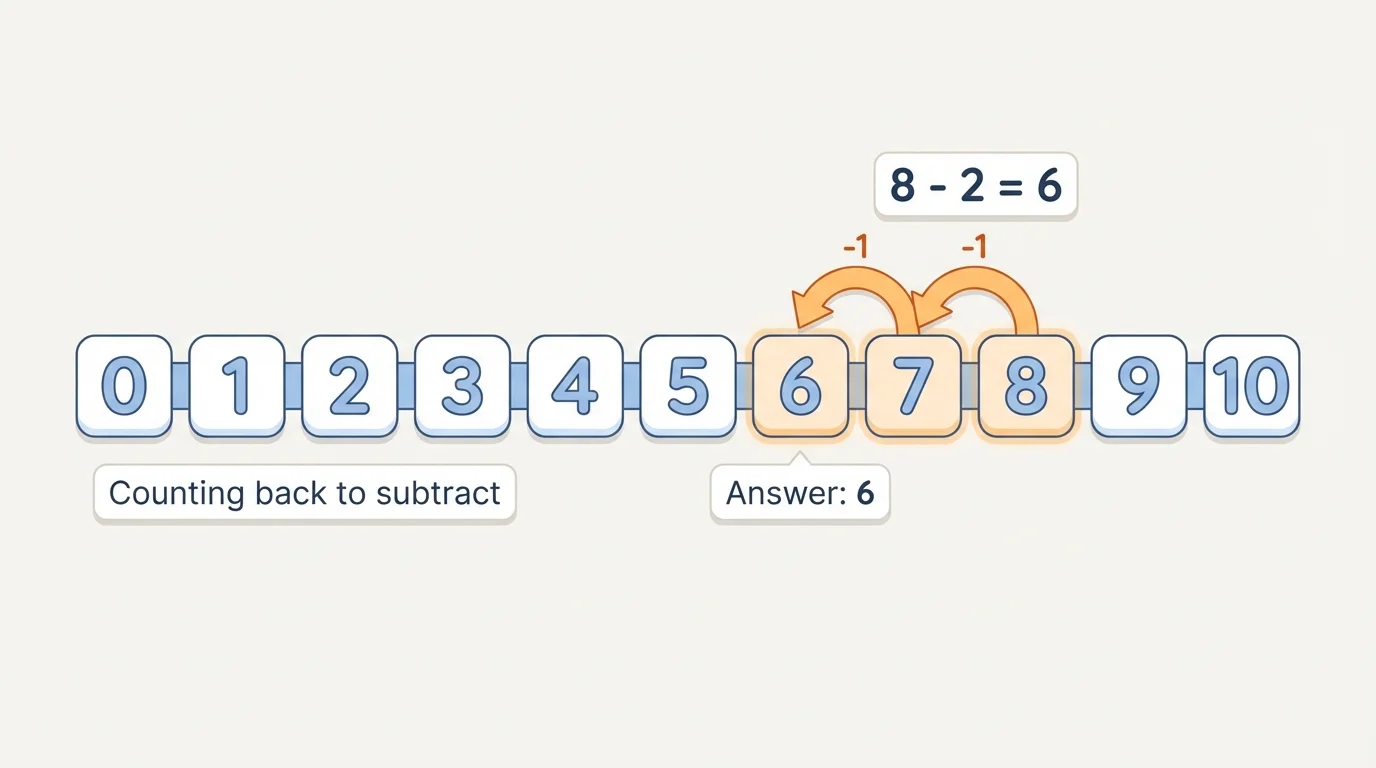
Here are some counting-back examples: start at \(10\), count back \(1\): \(9\), so \(10 - 1 = 9\). Start at \(7\), count back \(2\): \(6, 5\), so \(7 - 2 = 5\). Start at \(12\), count back \(3\): \(11, 10, 9\), so \(12 - 3 = 9\).
Be careful to start on the first number, but do not count it as a jump. If the problem is \(6 - 2\), start at \(6\), then move back to \(5\), then to \(4\). So \(6 - 2 = 4\).
You already know how to say numbers in order forward and backward. That same skill helps you add and subtract, as shown in [Figure 2]. Forward counting helps with addition, and backward counting helps with subtraction.
Notice that each backward hop makes the number smaller by \(1\). Two hops back make the number smaller by \(2\).
The same math idea can be shown in different ways, and [Figure 3] connects pictures, fingers, and paths to the same answer. Some children like to use fingers. Some like counters or cubes. Some like a number path. All of these models help us count correctly.
Suppose the problem is \(4 + 2\). With fingers, you can hold up \(4\) fingers, then raise \(2\) more fingers one at a time as you count: \(5, 6\). With counters, make a group of \(4\), then slide \(2\) more counters in and count on. On a number path, begin at \(4\) and hop forward twice.
Suppose the problem is \(9 - 3\). With fingers, show \(9\) and fold down \(3\) fingers one by one. With objects, begin with \(9\) cubes and take away \(3\). On a number path, start at \(9\) and hop back three times: \(8, 7, 6\). The answer is \(6\).
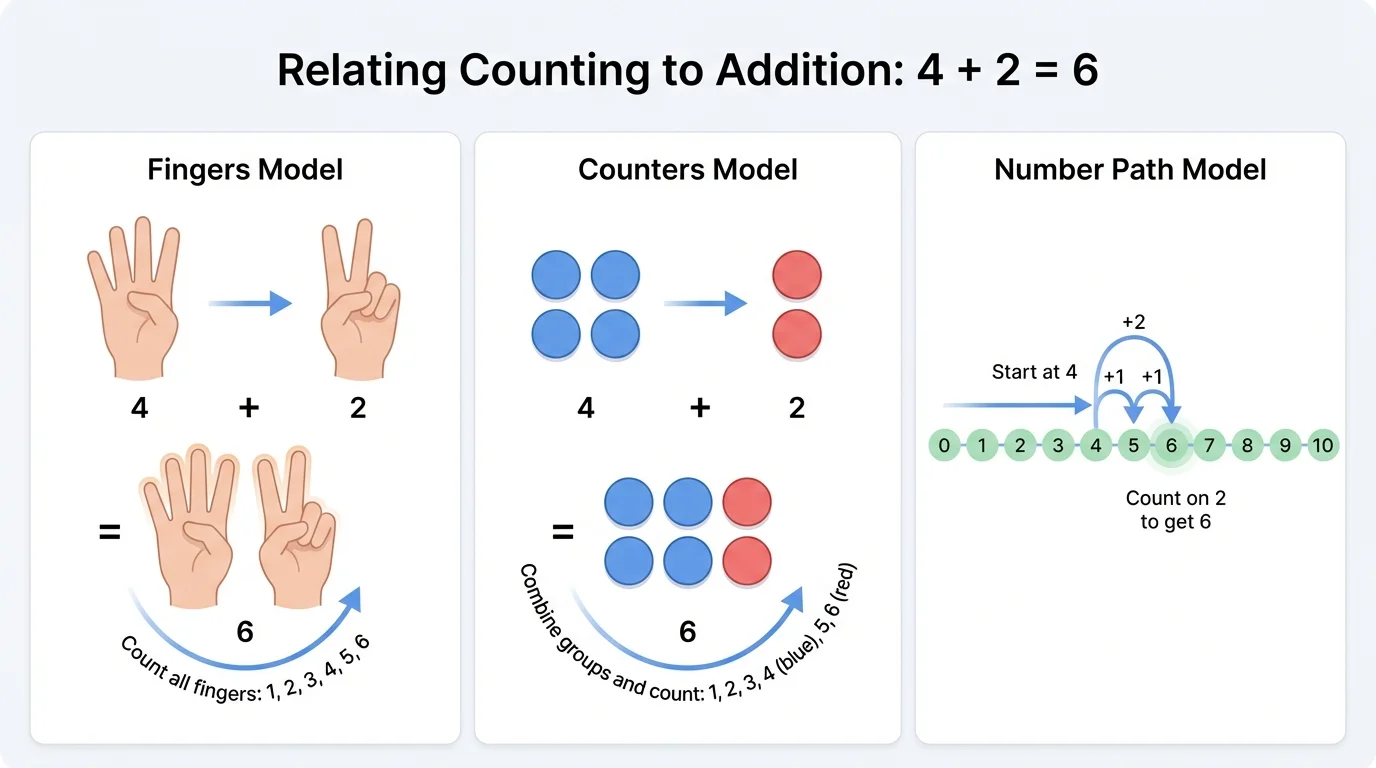
Using different models is helpful because the math stays the same even when the picture changes. All of the models show that counting on gives the same answer for the same addition problem.
Your brain gets stronger at math when you notice number patterns. Seeing that \(5 + 2\), \(6 + 2\), and \(7 + 2\) all mean "count on \(2\)" helps facts become easier to remember.
Let's solve some problems step by step.
Worked example 1
Solve \(3 + 2\).
Step 1: Start at the first number.
Start at \(3\).
Step 2: Count on \(2\) more.
Say \(4, 5\).
Step 3: Use the last number said.
The last number is \(5\).
\(3 + 2 = 5\)
This works because adding \(2\) means moving forward two numbers.
Worked example 2
Solve \(11 - 2\).
Step 1: Start at the first number.
Start at \(11\).
Step 2: Count back \(2\) numbers.
Say \(10, 9\).
Step 3: Use the last number said.
The last number is \(9\).
\(11 - 2 = 9\)
This works because subtracting \(2\) means moving backward two numbers.
Worked example 3
Solve \(7 + 3\).
Step 1: Start at the first number.
Start at \(7\).
Step 2: Count on \(3\) more.
Say \(8, 9, 10\).
Step 3: Use the last number said.
The last number is \(10\).
\(7 + 3 = 10\)
Now you can see that counting on works for bigger numbers too, as long as the total stays within \(20\).
Worked example 4
Solve \(15 - 3\).
Step 1: Start at the first number.
Start at \(15\).
Step 2: Count back \(3\) numbers.
Say \(14, 13, 12\).
Step 3: Use the last number said.
The last number is \(12\).
\(15 - 3 = 12\)
Counting back helps us find how many are left after some are taken away.
A pattern is something that repeats in a helpful way. In counting and math facts, patterns help us think faster.
Look at these addition facts:
| Problem | Count on | Answer |
|---|---|---|
| \(2 + 2\) | \(3, 4\) | \(4\) |
| \(3 + 2\) | \(4, 5\) | \(5\) |
| \(4 + 2\) | \(5, 6\) | \(6\) |
Table 1. Addition facts that all use counting on by \(2\).
Each time, adding \(2\) means saying two numbers after the starting number. Now look at subtraction:
| Problem | Count back | Answer |
|---|---|---|
| \(6 - 2\) | \(5, 4\) | \(4\) |
| \(7 - 2\) | \(6, 5\) | \(5\) |
| \(8 - 2\) | \(7, 6\) | \(6\) |
Table 2. Subtraction facts that all use counting back by \(2\).
Each time, subtracting \(2\) means saying the two numbers before the starting number. Patterns like these help facts make sense.
You use counting for addition and subtraction every day. If you have \(5\) toy cars and a friend gives you \(2\) more, you can count on to find \(5 + 2 = 7\). If you have \(10\) stickers and give away \(3\), you can count back to find \(10 - 3 = 7\).
In a game, if your space marker is on \(8\) and you move ahead \(2\) spaces, counting on tells you that you land on \(10\). If you move back \(2\) spaces, counting back tells you that you land on \(6\).
At school, if \(12\) children are in line and \(2\) go to get books, then \(12 - 2 = 10\) children stay in line. If \(6\) children are waiting and \(3\) more join, then \(6 + 3 = 9\) children are waiting.
These number changes are small, but they happen all the time. Counting gives you a strong way to understand what the numbers are doing.
