What happens when one story has three groups instead of two? You can still solve it. If there are \(3\) birds on a fence, then \(4\) more, and then \(2\) more, your brain can put all the groups together to find the total. That is what happens in three-number addition word problems. They help us count things from real life, like toys, snacks, books, and friends in line.
A word problem is a short math story. It tells about things that are being put together. When we hear or read the story, we listen for the numbers and think, "Are these groups joining?" If the groups join, we add.
For example, if Mia has \(2\) red blocks, \(3\) blue blocks, and \(4\) yellow blocks, all the blocks are together in one collection. We add the three parts: \(2 + 3 + 4\).
Word problem is a math story with numbers and a question. Addition means putting groups together to find how many in all. An unknown is a number we do not know yet.
Sometimes the question asks, "How many are there in all?" Sometimes the question asks for one missing part. Both kinds can use addition thinking.
[Figure 1] You can show the same story in different ways. You might use real objects such as counters, make a quick drawing, or write an equation. All three ways help you see the groups and the total.
If the story says \(4\) apples on one plate, \(5\) apples on another plate, and \(3\) apples in a basket, you can put out \(4\) counters, then \(5\) counters, then \(3\) counters. Then count them all: \(4 + 5 + 3 = 12\).
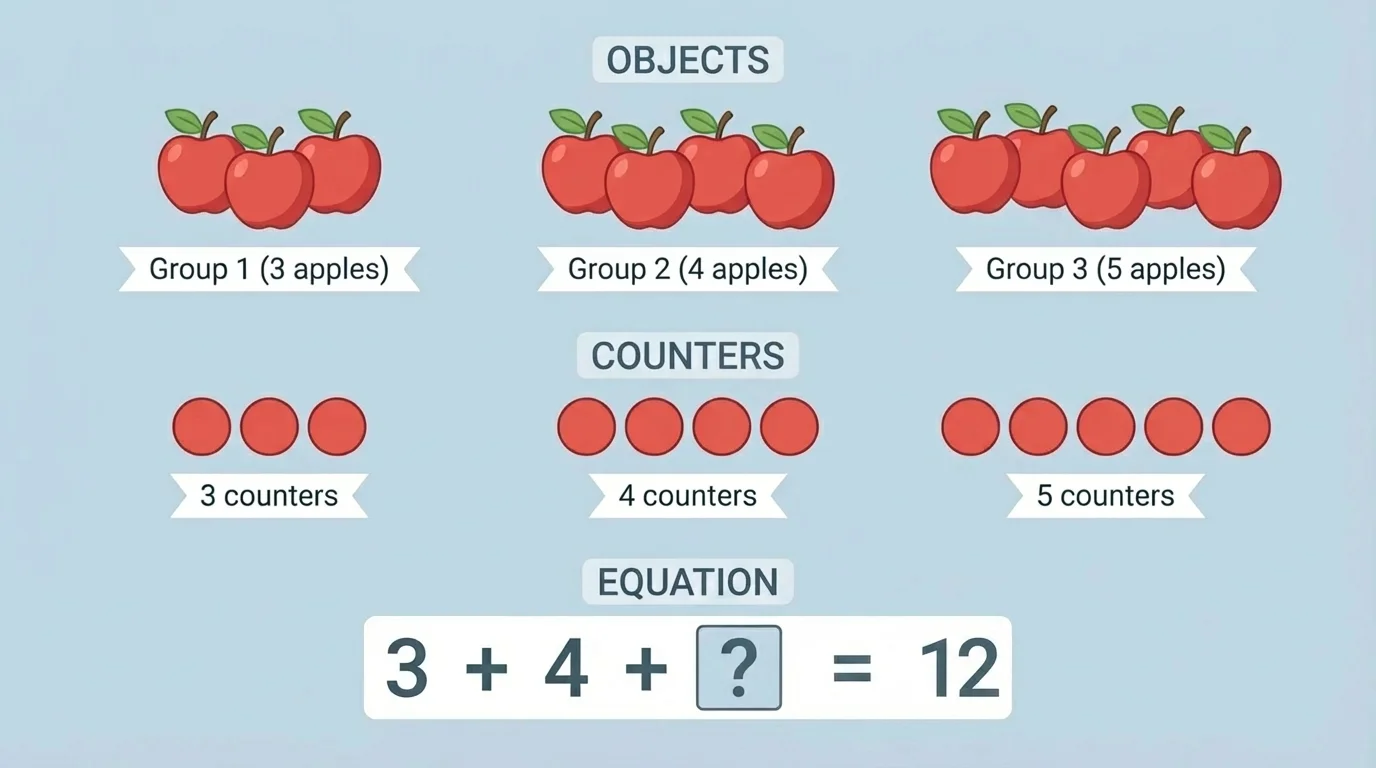
A drawing can be simple. You do not need fancy pictures. You can draw circles, dots, or little marks. The drawing stands for the objects in the story.
An equation is a math sentence. It uses numbers and symbols. For the apple story, the equation is \(4 + 5 + 3 = 12\).
You already know how to add two numbers. Adding three numbers means you are still joining groups, but now there are three parts instead of two.
You can add the first two groups and then add the last group. For example, \(4 + 5 = 9\), and then \(9 + 3 = 12\).
Sometimes one part is missing, and the missing group is still one of the three parts. We can use a symbol such as \(\Box\) to stand for the number we do not know.
Suppose there are \(4\) toy cars in one box, \(3\) toy cars on the floor, and some more toy cars on a shelf. There are \(10\) toy cars in all. We can write:
\(4 + 3 + \Box = 10\)
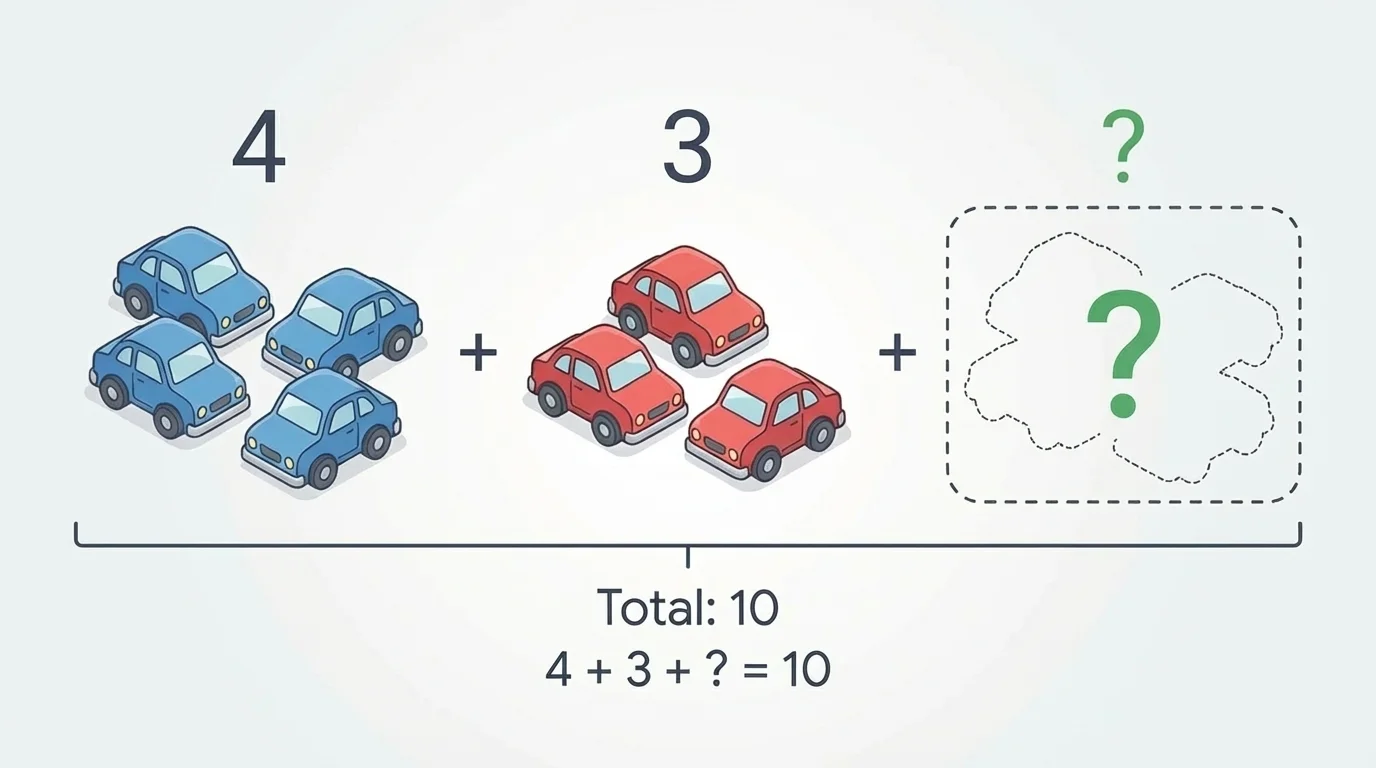
First add the numbers you know: \(4 + 3 = 7\). Then think, "What number needs to be added to \(7\) to make \(10\)?" The missing number is \(3\). So \(\Box = 3\).
Three parts can make one whole
In these problems, each number is a part. When we put all the parts together, we get the whole. If the whole is known, but one part is missing, we can still solve the problem by thinking about what number completes the total.
This means \(4 + 3 + 3 = 10\). The unknown number is not a trick. It is just a part we need to find.
Drawings help us see all the groups together and give one clear picture of that idea before we solve more stories with equations.
Worked example 1
Lena has \(5\) balloons. Her brother has \(2\) balloons. Her friend brings \(4\) balloons. How many balloons are there in all?
Step 1: Find the three groups.
The groups are \(5\), \(2\), and \(4\).
Step 2: Write an equation.
\(5 + 2 + 4 = \Box\)
Step 3: Add.
First, \(5 + 2 = 7\). Then \(7 + 4 = 11\).
So there are \(11\) balloons in all.
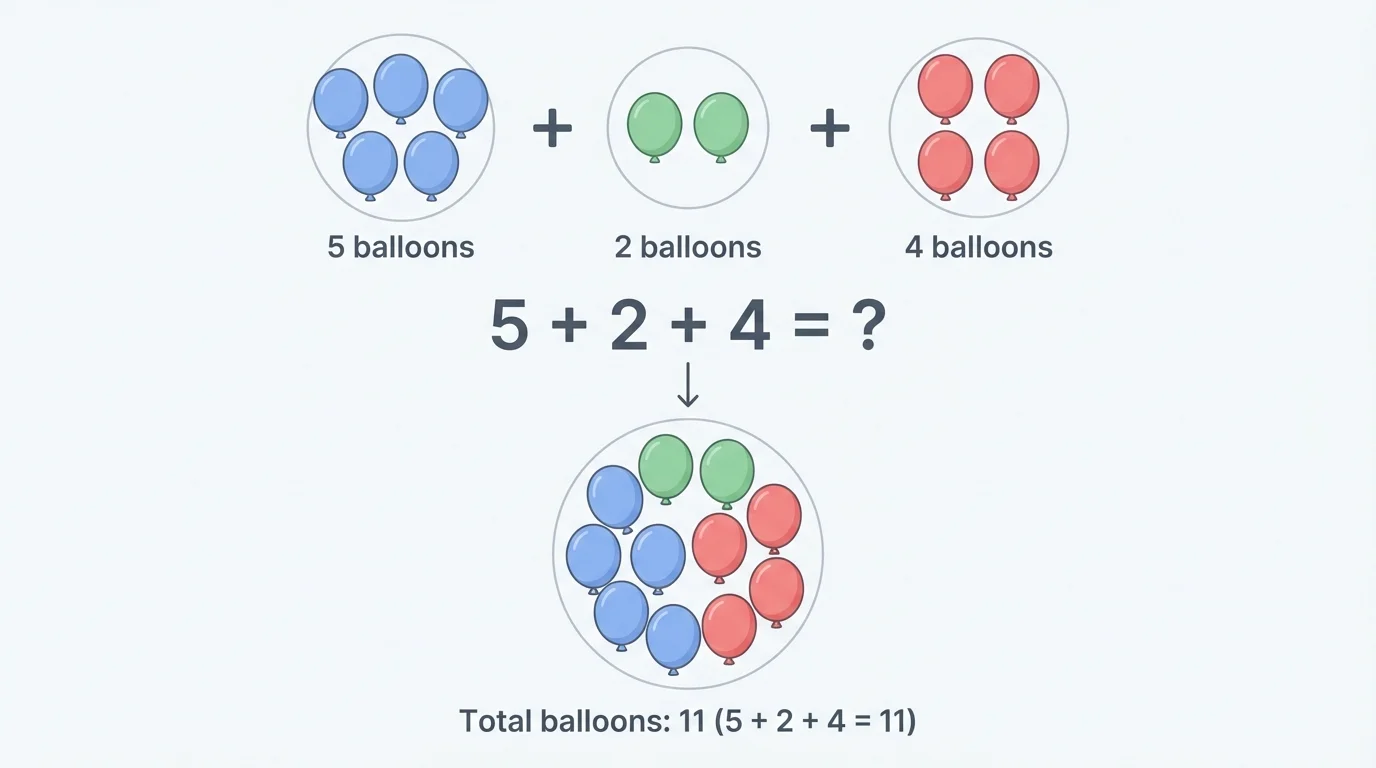
This picture matches the story: three groups become one total. Just as [Figure 1] shows apples in different groups, the balloons can also be shown with objects, drawings, and an equation.
Worked example 2
There are \(3\) ducks in the pond, \(6\) ducks by the grass, and \(1\) duck near the rocks. How many ducks are there in all?
Step 1: Write the addition sentence.
\(3 + 6 + 1 = \Box\)
Step 2: Add the first two numbers.
\(3 + 6 = 9\)
Step 3: Add the last number.
\(9 + 1 = 10\)
So the answer is \(10\).
Notice that the sum is no more than \(20\). That helps keep the numbers small enough to count with objects or drawings.
Worked example 3
Noah has \(2\) crackers. Ava has \(5\) crackers. They have \(9\) crackers in all after Eli adds some crackers. How many crackers does Eli add?
Step 1: Write the equation with an unknown.
\(2 + 5 + \Box = 9\)
Step 2: Add the known numbers.
\(2 + 5 = 7\)
Step 3: Find the missing part.
\(7 + 2 = 9\), so \(\Box = 2\).
Eli adds \(2\) crackers.
When one part is missing, you are still thinking about three groups making one whole, just like the toy-car picture in [Figure 2].
Worked example 4
A class library has \(6\) animal books, \(3\) space books, and \(5\) fairy-tale books. How many books are there in all?
Step 1: Choose addition because the groups are joining.
\(6 + 3 + 5\)
Step 2: Add in parts.
\(6 + 3 = 9\)
Step 3: Finish the total.
\(9 + 5 = 14\)
There are \(14\) books in all.
Not all stories sound the same. Some ask for the total. Some give the total and ask for a missing part. Here are two common patterns.
| Story type | Example equation | What to find |
|---|---|---|
| Total unknown | \(3 + 4 + 2 = \Box\) | Find how many in all |
| One part unknown | \(3 + \Box + 2 = 9\) | Find the missing group |
Table 1. Two common kinds of three-number addition word problems.
Even when the question changes, the big idea stays the same: there are three parts in the story.
Many people solve three-number problems by making a pair first. For example, in \(4 + 1 + 5\), some children see \(4 + 1 = 5\), and then \(5 + 5 = 10\). That is smart number thinking.
You may notice that some numbers are easy partners. If you can make \(10\) first, adding can feel faster and easier.
Three-number addition happens all around you. You might count \(3\) strawberries at breakfast, \(2\) at lunch, and \(4\) at dinner. You might count \(5\) kids on the swings, \(3\) on the slide, and \(2\) on the monkey bars. You might count \(6\) crayons in one box, \(4\) in another, and \(1\) on the desk.
These are all whole numbers. Whole numbers are counting numbers like \(0\), \(1\), \(2\), and \(3\). In this lesson, we use whole numbers whose totals are \(20\) or less.
"Math helps us make sense of the world, one group at a time."
When you listen carefully to a story, look for the groups, decide if they are joining, and then write the matching equation.
After solving, check your answer. Ask yourself these questions: Did I use all three numbers? Did I add when the groups were put together? Is my answer not more than \(20\)? Does the answer fit the story?
For example, if a story has \(2\), \(3\), and \(4\), an answer of \(15\) would not make sense. But \(2 + 3 + 4 = 9\), so \(9\) does make sense.
