Have you ever counted how many crackers are left after snack time, or figured out how many more blocks your friend has than you? That is math in action. Small numbers can tell big stories. When we use addition and subtraction within \(20\), we can solve problems about things being joined, taken away, split apart, or compared.
Word problems are little stories with numbers. We listen to the story, think about what is happening, and decide what math to use. Sometimes things are being added. Sometimes things are being taken away. Sometimes we compare two groups to see which has more or how many more.
We can solve these problems with cubes, counters, fingers, drawings, or equations. An equation is a math sentence with an equals sign, such as \(7 + 5 = 12\). Sometimes we do not know one part of the equation yet, so we use a symbol like \(x\) or \(\square\) for the missing number.
Addition means joining groups or finding how many in all.
Subtraction means taking away, finding how many are left, or finding the difference between two amounts.
Unknown means the number we need to find.
Good problem solvers do not just look for one word. They think about the action in the story. A story about "more" might mean add, but a story asking "how many more" often means compare, which can be solved with subtraction.
There are several kinds of word problems, and each tells a different kind of number story. We can picture joining, taking away, and comparing with small groups of objects. Seeing the action helps us choose whether to add or subtract.
[Figure 1] Adding to means a group gets bigger. Example: Mia has \(6\) stickers. Her teacher gives her \(3\) more. Now she has \(6 + 3 = 9\) stickers.
Taking from means a group gets smaller. Example: There are \(12\) apples. \(4\) are eaten. Now there are \(12 - 4 = 8\) apples left.
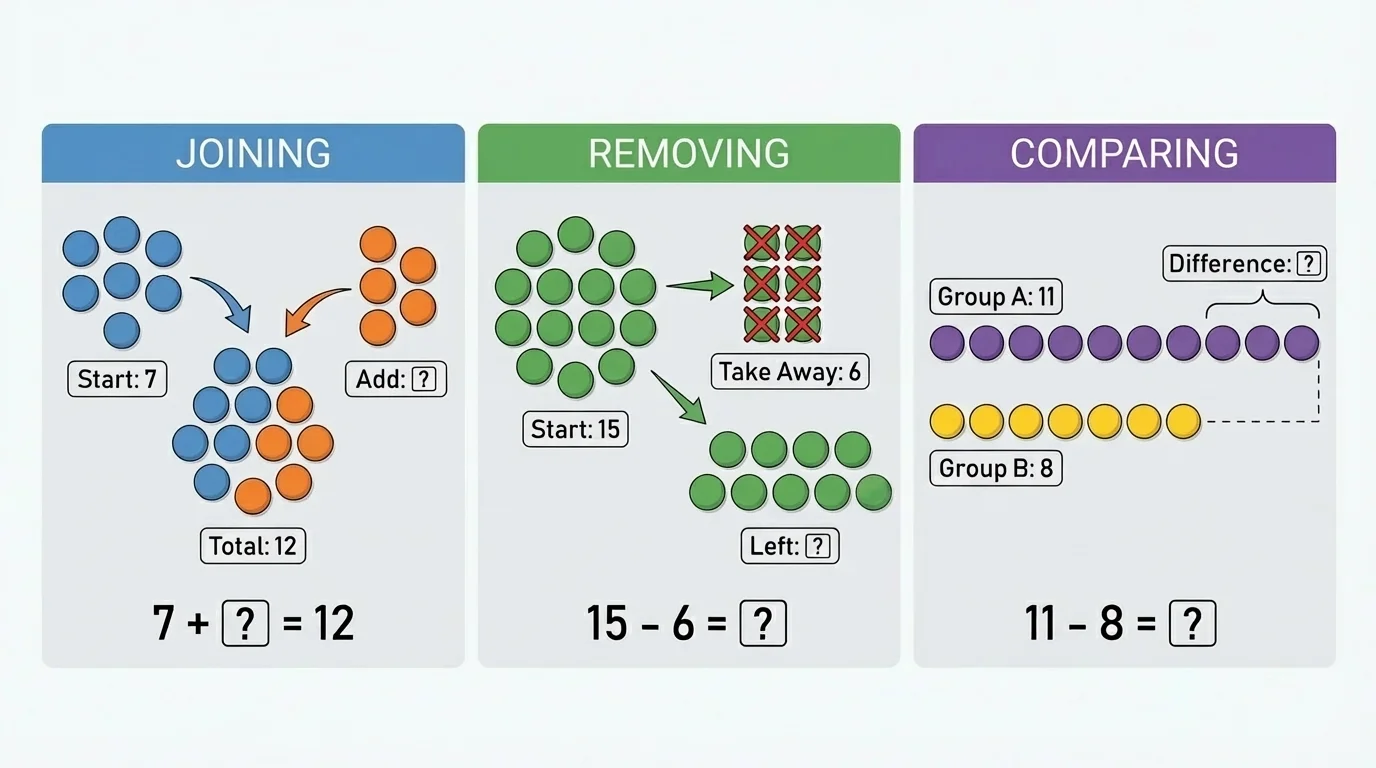
Putting together means two parts make one whole group. Example: \(5\) red balloons and \(7\) blue balloons make \(5 + 7 = 12\) balloons in all.
Taking apart means one whole group is split into parts. Example: There are \(10\) toy cars. \(6\) are on the rug. The rest are in the box. We can write \(6 + x = 10\), so \(x = 4\).
Comparing means looking at two groups to find which has more, which has fewer, or how many more. Example: Ben has \(11\) shells. Ava has \(8\) shells. Ben has \(11 - 8 = 3\) more shells.
You already know how to count on and count back. Those skills help when you solve equations like \(8 + 3\) or \(14 - 2\).
Notice that the unknown number can be anywhere. We might not know the total, the part added, the amount taken away, or the starting amount. That is why it is important to understand the story, not just memorize one rule.
An unknown number is the number we need to discover. We can use a box, a question mark, or a letter such as \(x\).
Here are different ways an unknown can appear:
| Story type | Equation | Unknown place |
|---|---|---|
| Adding to | \(7 + 5 = x\) | Result unknown |
| Adding to | \(7 + x = 12\) | Change unknown |
| Taking from | \(15 - x = 9\) | Part taken unknown |
| Taking from | \(x - 4 = 10\) | Start unknown |
| Comparing | \(13 - 8 = x\) | Difference unknown |
Table 1. Examples of unknown numbers in different positions in addition and subtraction problems.
When the unknown is at the end, the problem may feel easy. When the unknown is at the beginning or in the middle, we can still solve it by thinking about the parts and the whole. For example, in \(x + 4 = 11\), the missing part is \(7\) because \(7 + 4 = 11\).
Parts and whole
Many addition and subtraction problems are about parts and a whole. If you know the two parts, you can add to find the whole. If you know the whole and one part, you can subtract to find the missing part. This works for many story problems up to \(20\).
The compare problems in [Figure 1] also help us see a missing difference. If one group has \(12\) and another has \(9\), the extra part is \(3\).
There is more than one smart way to solve a word problem. Pictures and objects help us see what is happening, and equations help us write the math clearly. A drawing can match a subtraction equation with a missing number.
[Figure 2] You might use counters first. Then you may draw circles or quick marks. After that, you can write an equation. These three ways all show the same thinking.
Suppose there are \(10\) birds on a fence. Some fly away. \(6\) are left. We can draw \(10\) circles, cross out some, and count how many were crossed out. Then we write \(10 - x = 6\). The missing number is \(4\), so \(x = 4\).
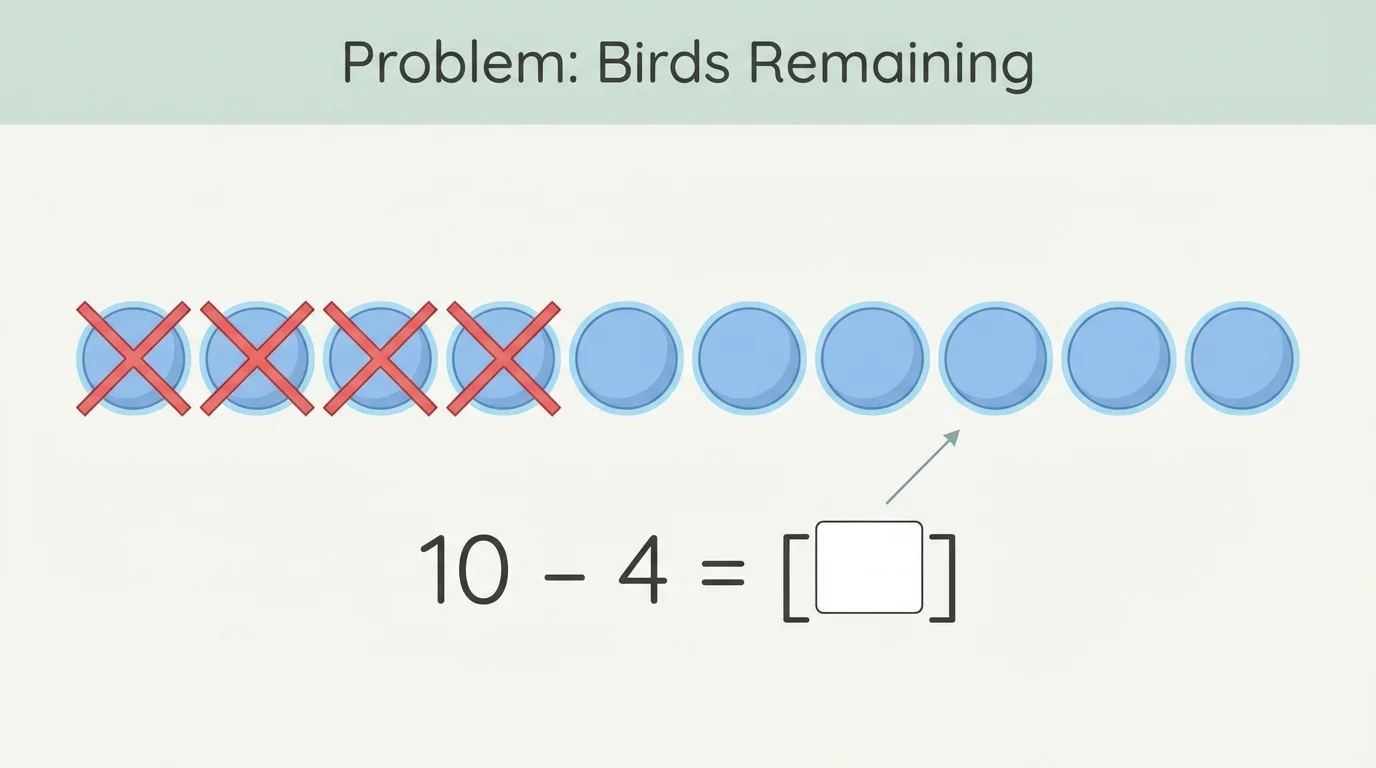
We can also check our answer. If \(10 - 4 = 6\), then the answer makes sense. We can even use addition to check subtraction: \(6 + 4 = 10\).
Some word problems can be solved in more than one way. One child may count on, another may draw a picture, and another may use an equation. If the thinking matches the story and the answer is correct, all of those ways are useful.
A compare problem often asks "how many more" or "how many fewer." In these problems, we look at two groups and find the difference between them.
Let's solve several kinds of problems step by step.
Worked example 1: adding to
Lena has \(8\) toy animals. She gets \(5\) more. How many toy animals does she have now?
Step 1: Think about the story.
The group gets bigger, so we use addition.
Step 2: Write the equation.
\(8 + 5 = x\)
Step 3: Solve.
\(8 + 5 = 13\)
\(x = 13\)
Lena has \(13\) toy animals.
In this example, the unknown is the total. We know both parts, so we add to find the whole.
Worked example 2: taking from with a missing part
There are \(14\) cookies on a plate. Some are eaten. \(9\) cookies are left. How many cookies were eaten?
Step 1: Think about the story.
Some are taken away, so we use subtraction.
Step 2: Write the equation.
\(14 - x = 9\)
Step 3: Solve.
We ask, "What number makes \(14 - x = 9\)?"
Since \(14 - 5 = 9\), the missing number is \(5\).
\(x = 5\)
\(5\) cookies were eaten.
The picture-and-equation method from [Figure 2] works here too. We could draw \(14\) circles and cross out circles until \(9\) remain.
Worked example 3: putting together
A jar has \(6\) green marbles and \(7\) yellow marbles. How many marbles are in the jar?
Step 1: Find the two parts.
The parts are \(6\) and \(7\).
Step 2: Add the parts.
\(6 + 7 = 13\)
Step 3: State the answer.
The whole group has \(13\) marbles.
\(6 + 7 = 13\)
This is a parts-and-whole problem. Two groups are put together to make one larger group.
Worked example 4: comparing
Noah has \(15\) crayons. Zuri has \(11\) crayons. How many more crayons does Noah have than Zuri?
Step 1: Think about the question.
"How many more" tells us to compare two amounts.
Step 2: Write the equation.
\(15 - 11 = x\)
Step 3: Solve.
\(15 - 11 = 4\)
\(x = 4\)
Noah has \(4\) more crayons.
When we compare, we do not combine the groups. We look for the difference between them.
Worked example 5: start unknown
Some frogs were on a log. \(3\) frogs jumped off. Now \(7\) frogs are still on the log. How many frogs were on the log at first?
Step 1: Write what is known.
After \(3\) jumped off, \(7\) stayed.
Step 2: Write the equation.
\(x - 3 = 7\)
Step 3: Solve.
If \(x - 3 = 7\), then \(x = 10\) because \(10 - 3 = 7\).
\(x = 10\)
There were \(10\) frogs at first.
This kind of problem has the unknown at the beginning. It can feel tricky, but the story still makes sense when we think about what happened first.
[Figure 3] Classroom math is full of comparison problems with two groups of crayons. You can compare books on shelves, cubes in bins, or children in two lines. If one group has \(12\) and another has \(9\), the difference is \(12 - 9 = 3\).
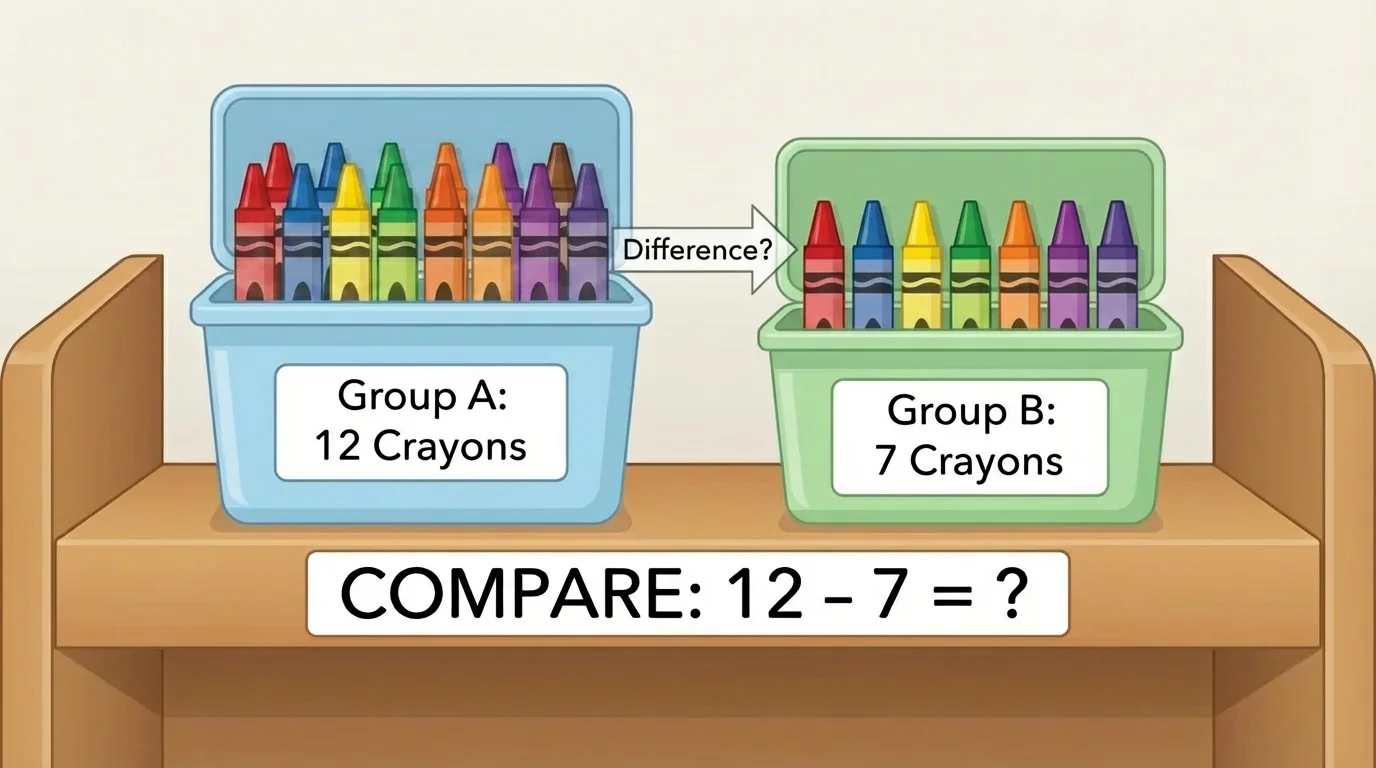
At home, you might count socks, pieces of fruit, toy cars, or spoons at the table. If \(4\) people need spoons and there are \(9\) spoons in a drawer, then \(9 - 4 = 5\) spoons are left. If you already have \(7\) blocks and get \(6\) more, then \(7 + 6 = 13\) blocks are yours now.
The classroom picture in [Figure 3] also reminds us that compare problems are about two amounts side by side. We are not putting all the crayons together. We are finding how much larger one group is than the other.
Sometimes children rush and choose the wrong operation. Here are helpful questions to ask:
Always make sure your answer is reasonable. If a problem starts with \(9\) apples and some are taken away, the number left cannot be bigger than \(9\). If you add two groups, the total should be larger than each part.
You can use a number sentence to show your thinking clearly. A number sentence is an equation such as \(9 + 4 = 13\) or \(13 - 4 = 9\). These equations help turn the story into math.
"Math stories help numbers come alive."
With practice, you will notice that addition and subtraction are connected. If \(8 + 6 = 14\), then \(14 - 6 = 8\) and \(14 - 8 = 6\). This connection helps when the unknown number is in a different place.
