Have you noticed that some number problems feel fast, like \(5 + 5\), while others feel trickier, like \(8 + 6\)? An important idea is that young mathematicians do not always count every dot one by one. They look for patterns and use smart strategies. When you learn these strategies, numbers within \(20\) become friendlier and much easier to solve.
Adding and subtracting within \(20\) means working with numbers from \(0\) to \(20\). A big goal is to be fluent, which means you can solve many facts quickly and correctly, especially facts within \(10\). When you know facts like \(3 + 4 = 7\) and \(9 - 2 = 7\), you can use them to solve larger facts too.
Quick facts within \(10\) are like stepping-stones. If you know \(6 + 4 = 10\), then you can use that idea in many other problems. If you know \(7 - 3 = 4\), that helps when you see numbers inside bigger subtraction problems.
Some very helpful facts are doubles, such as \(1 + 1 = 2\), \(2 + 2 = 4\), \(3 + 3 = 6\), and \(5 + 5 = 10\). Another helpful group is the ways to make \(10\): \(1 + 9\), \(2 + 8\), \(3 + 7\), \(4 + 6\), and \(5 + 5\). These facts help us build new answers.
Remember: When you add, you combine amounts to find a total. When you subtract, you take away or find how many are left. A number line, fingers, counters, and known facts can all help, but strong fact fluency helps you work faster.
You do not need to use the same strategy every time. Good mathematicians look at the numbers first. Then they choose a strategy that makes the problem easier.
One useful strategy is counting on. If you solve \(9 + 3\), start with \(9\) and count on: \(10, 11, 12\). Another powerful strategy is making ten. We try to change the numbers a little so one part becomes \(10\), because adding to \(10\) is easy.
[Figure 1] For example, in \(8 + 6\), the \(6\) can be broken into \(2 + 4\). Then \(8 + 2 = 10\), and \(10 + 4 = 14\). So \(8 + 6 = 14\). We did not change the total. We just rearranged the numbers into an easier form.
Another way is to make an equivalent easier sum. If you know doubles, then \(6 + 7\) can become \(6 + 6 + 1\). Since \(6 + 6 = 12\), we get \(12 + 1 = 13\). This is sometimes called a near-double. It works because \(7\) is just \(1\) more than \(6\).
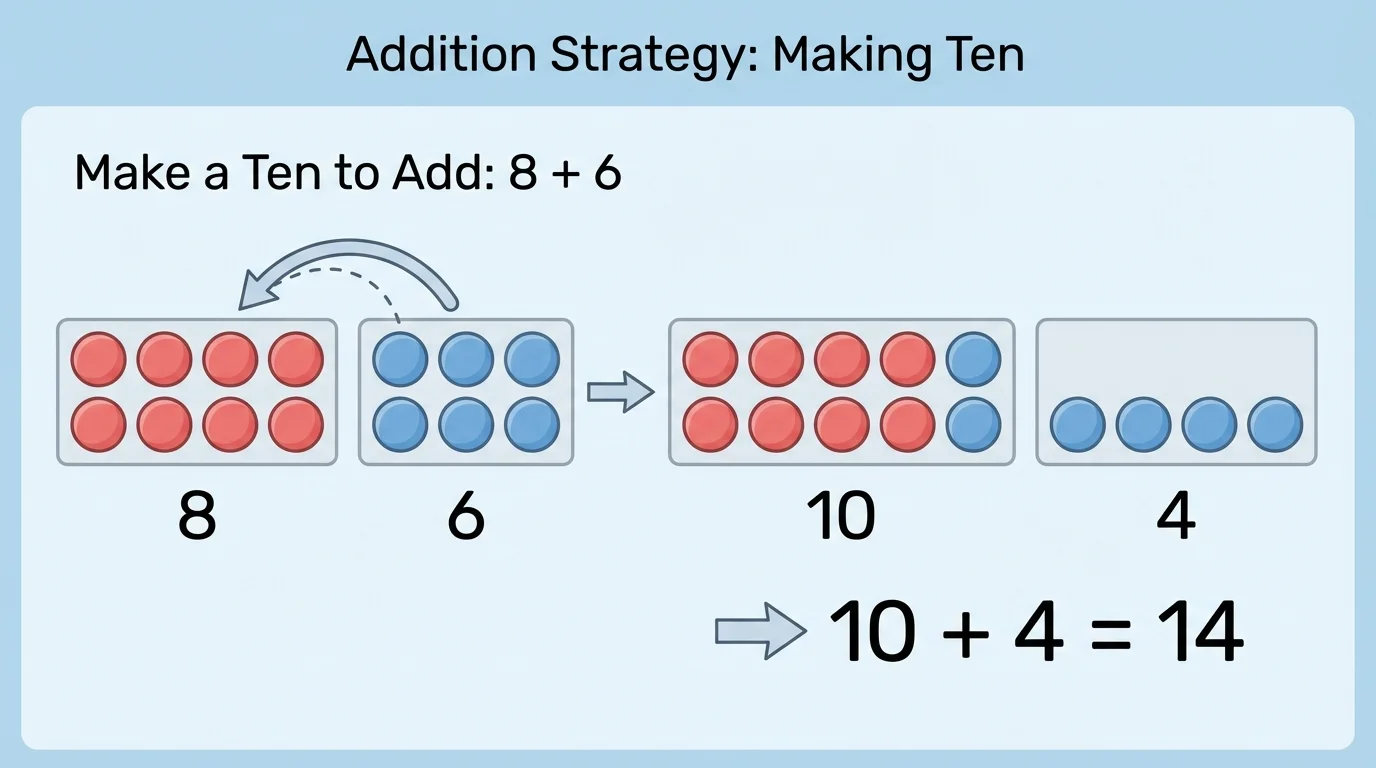
Counting on works well when one number is small, like \(11 + 2\) or \(7 + 1\). Making \(10\) works especially well with facts like \(9 + 5\), \(8 + 7\), or \(6 + 8\). Near-doubles work well with pairs like \(4 + 5\), \(7 + 8\), and \(3 + 4\).
Choosing an addition strategy
If one addend is close to \(10\), making \(10\) is often the best choice. If the numbers are almost doubles, use a double you know. If one number is very small, counting on may be quickest.
When we use these strategies, we are still finding the same sum. We are just taking an easier path. The counters in [Figure 1] show that \(8 + 6\) and \(10 + 4\) both have the same total.
Subtraction also has smart paths. One important method is to decompose, or break apart, the number you are subtracting. This helps you land on \(10\) first. Reaching \(10\) can make the rest of the subtraction very easy.
[Figure 2] Look at \(13 - 4\). Instead of taking away \(4\) all at once, break \(4\) into \(3 + 1\). First do \(13 - 3 = 10\). Then do \(10 - 1 = 9\). So \(13 - 4 = 9\). This works because we subtracted the same amount, just in two parts.
You can also count back for some problems. For \(15 - 2\), count back two numbers: \(14, 13\). So \(15 - 2 = 13\). But if the number you subtract is larger, breaking it apart may be easier than counting back many steps.
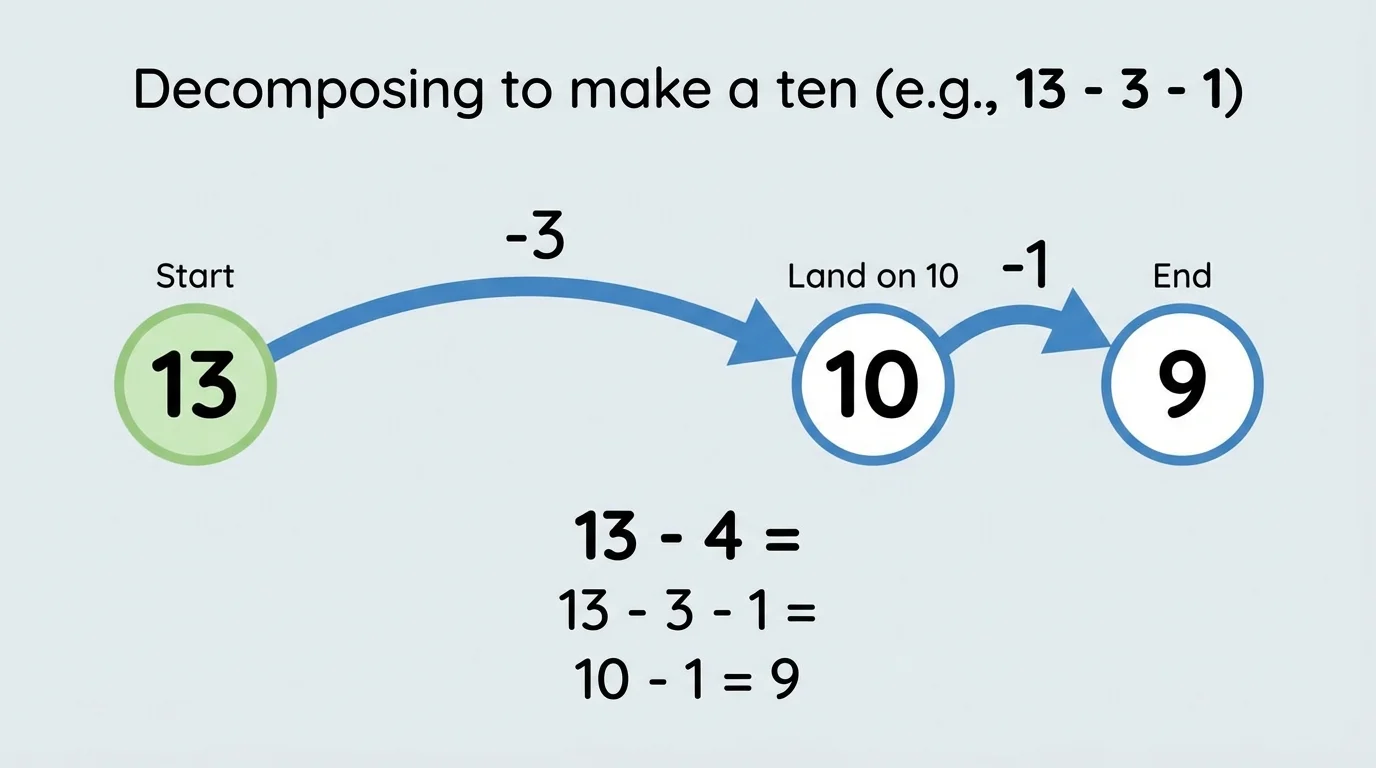
Sometimes it helps to think, "What gets me to \(10\) first?" In \(12 - 5\), you can take away \(2\) to get \(10\), and then take away \(3\) more. So \(12 - 5 = 12 - 2 - 3 = 10 - 3 = 7\).
The jumps in [Figure 2] remind us that subtraction does not have to happen in one giant step. Smaller steps can be smarter.
Addition and subtraction are connected. They belong to the same fact family. If you know one addition fact, you can use it to solve two subtraction facts.
[Figure 3] For example, if \(8 + 4 = 12\), then \(12 - 8 = 4\) and \(12 - 4 = 8\). The same three numbers stay together. This is a very powerful idea because one known fact can unlock other facts.
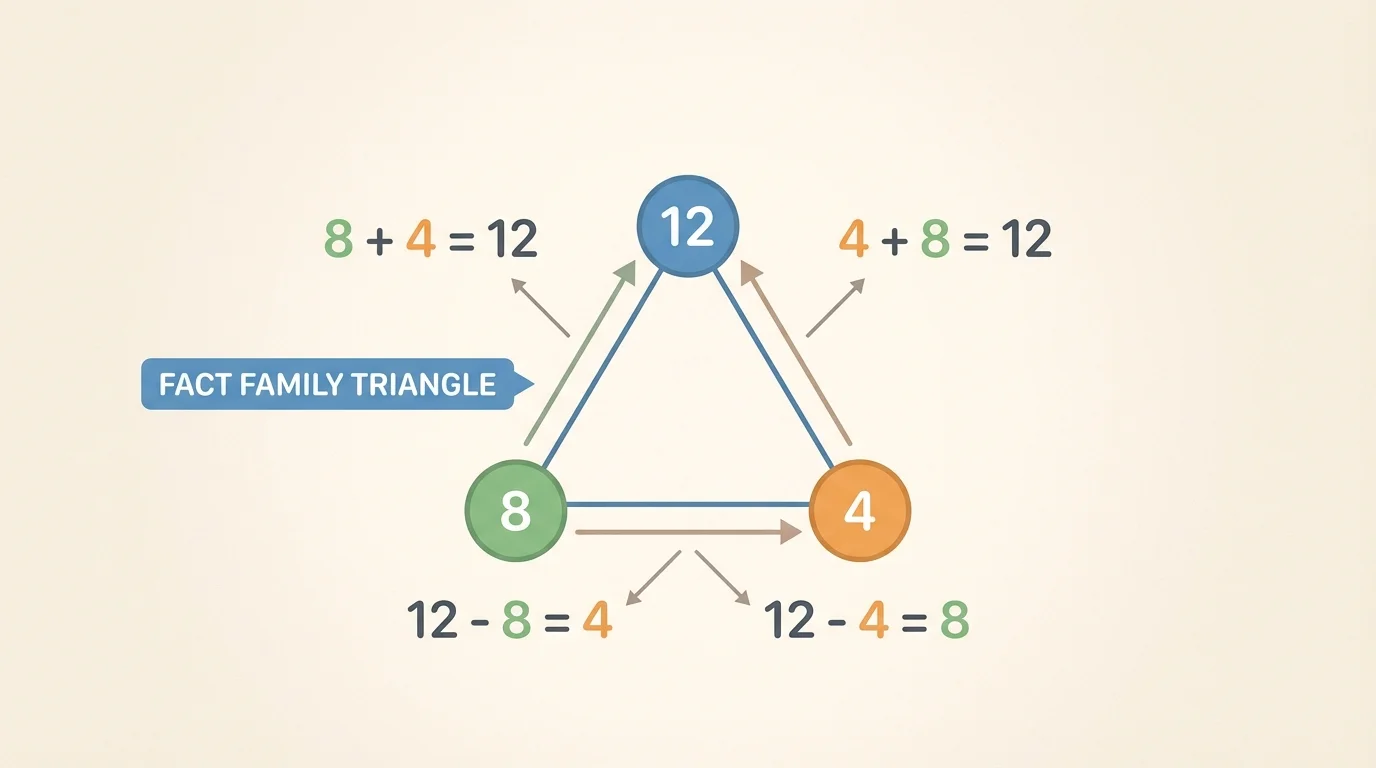
If you know \(7 + 3 = 10\), then you also know \(10 - 7 = 3\) and \(10 - 3 = 7\). This means learning addition facts helps subtraction, and learning subtraction facts helps addition too.
| Known fact | Related facts |
|---|---|
| \(5 + 5 = 10\) | \(10 - 5 = 5\) |
| \(6 + 4 = 10\) | \(10 - 6 = 4\), \(10 - 4 = 6\) |
| \(9 + 2 = 11\) | \(11 - 9 = 2\), \(11 - 2 = 9\) |
Table 1. Examples of how one addition fact helps with subtraction facts.
Later, when you solve a subtraction problem and feel stuck, think about the partner addition fact. The fact family in [Figure 3] helps show why this works.
Worked example 1
Solve \(9 + 5\) by making \(10\).
Step 1: Break apart \(5\).
\(5 = 1 + 4\)
Step 2: Use \(1\) to make \(10\).
\(9 + 1 = 10\)
Step 3: Add the leftover \(4\).
\(10 + 4 = 14\)
\(9 + 5 = 14\)
Making \(10\) is a fast choice here because \(9\) is only \(1\) away from \(10\).
Worked example 2
Solve \(13 - 6\) by breaking apart the \(6\).
Step 1: Think about how to reach \(10\) first.
From \(13\), subtract \(3\) to get \(10\).
Step 2: Since \(6 = 3 + 3\), subtract the other \(3\).
\(10 - 3 = 7\)
Step 3: Put the two subtraction parts together.
\(13 - 6 = 13 - 3 - 3 = 7\)
\(13 - 6 = 7\)
This works because reaching \(10\) first makes the steps simple and clear.
Worked example 3
Solve \(6 + 7\) using an easier known sum.
Step 1: Notice that \(6\) and \(7\) are almost doubles.
\(7 = 6 + 1\)
Step 2: Use the double.
\(6 + 6 = 12\)
Step 3: Add the extra \(1\).
\(12 + 1 = 13\)
\(6 + 7 = 13\)
Near-doubles are helpful when two numbers are close together.
Worked example 4
If \(8 + 4 = 12\), solve \(12 - 8\).
Step 1: Think about the partner addition fact.
\(8 + 4 = 12\)
Step 2: Ask, "What goes with \(8\) to make \(12\)?"
The answer is \(4\).
\(12 - 8 = 4\)
This is a great example of using the relationship between addition and subtraction.
These strategies help in everyday situations. Suppose you have \(8\) crayons and a friend gives you \(6\) more. You can think \(8 + 2 = 10\), then \(10 + 4 = 14\). Now you know there are \(14\) crayons.
Or maybe there are \(13\) crackers on a plate and \(4\) are eaten. You can think \(13 - 3 = 10\), then \(10 - 1 = 9\). So \(9\) crackers are left.
At recess, if \(7\) children are playing and \(3\) more join, you know \(7 + 3 = 10\). Then if \(2\) children leave, \(10 - 2 = 8\). Quick facts help you keep track without starting over each time.
Your brain gets faster with number facts when you notice patterns. Facts that make \(10\), doubles, and near-doubles are some of the strongest patterns in early math.
Real life is full of adding and subtracting: toys, books, blocks, points in a game, and students in line. Smart strategies save time and help you feel confident.
When you see an addition problem, ask yourself: can I count on, make \(10\), or use a double? When you see a subtraction problem, ask: can I get to \(10\) first, or can a partner addition fact help me?
There is not just one right way to think. The answer must be correct, but the path can change. For \(10 + 7\), you may just know it is \(17\). For \(8 + 7\), making \(10\) may be best: \(8 + 2 + 5 = 10 + 5 = 15\). For \(14 - 5\), you can break apart \(5\) into \(4 + 1\), so \(14 - 4 - 1 = 10 - 1 = 9\).
The more you use these ideas, the more numbers start to fit together like puzzle pieces. Soon, facts within \(20\) feel much easier because you are using what you already know within \(10\).
