What if a math sentence had a secret hiding inside it? Sometimes a number is missing, and your job is to be a number detective. You look at the parts you know, think about how addition and subtraction work, and find the number that makes the equation true.
A math sentence like \(8 + \Box = 11\) or \(9 - \Box = 4\) is called an equation. One number is missing. We need to find that number so both sides match. When the missing number is correct, the equation is true.
Missing number means the number that belongs in the box, blank, or question mark to make an equation true.
True means both sides of the equation have the same value.
In grade 1 math, we work with whole numbers. These are counting numbers like \(0, 1, 2, 3\), and more. We do not use fractions or decimals here.
[Figure 1] If you see \(6 + \Box = 10\), you can think, "What number goes with \(6\) to make \(10\)?" You can count on: \(7, 8, 9, 10\). That is \(4\) counts, so the missing number is \(4\).
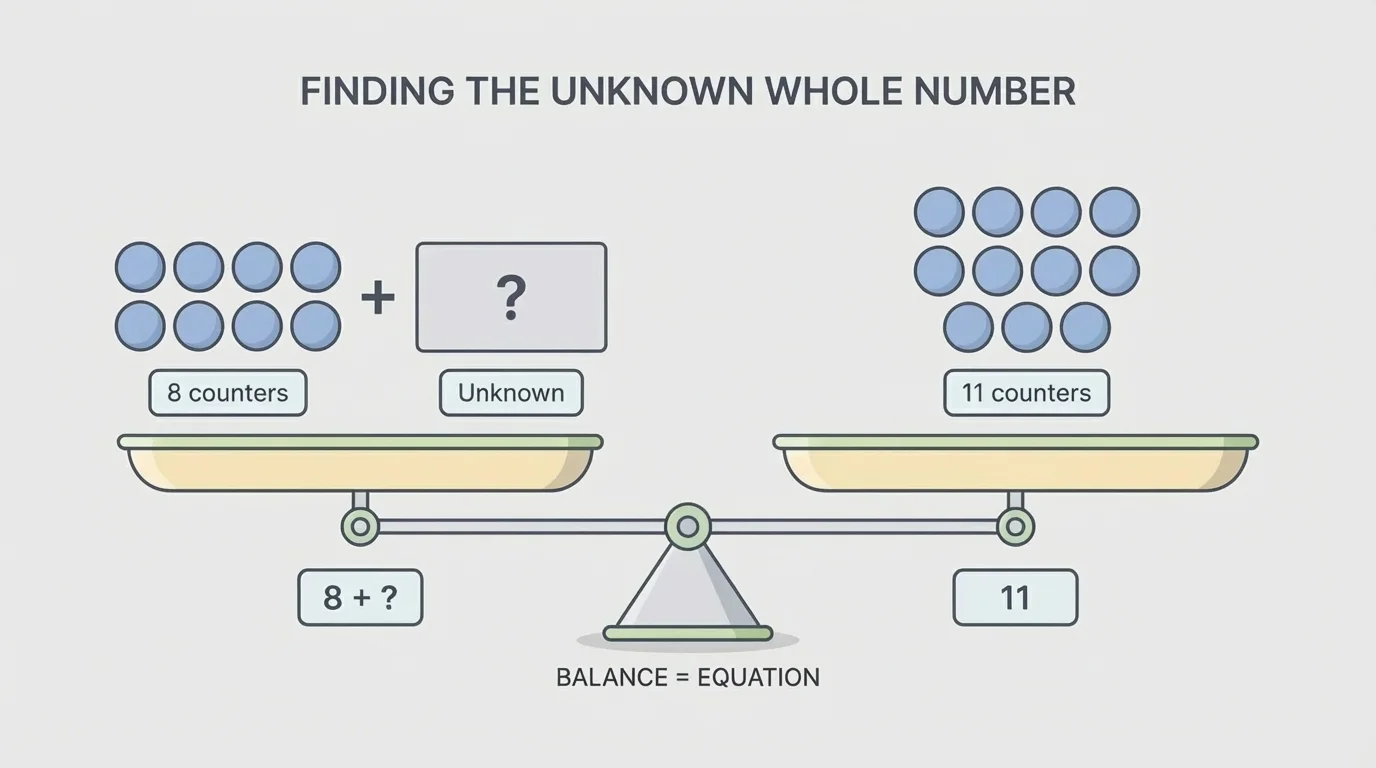
In an addition equation, you put parts together to make a whole. If one part is missing, think about how many more are needed.
Example: \(8 + \Box = 11\). Start at \(8\). Count on to \(11\): \(9, 10, 11\). You counted up by \(3\), so \(8 + 3 = 11\).
You can also use what you know: if \(5 + 2 = 7\), then in \(5 + ? = 7\), the missing number is \(2\).
Sometimes the missing number is first. In \(\Box + 4 = 9\), ask, "What number plus \(4\) makes \(9\)?" The answer is \(5\), because \(5 + 4 = 9\).
Addition means putting together. Subtraction means taking away or finding how many are left or how many more.
When you solve addition equations, you can count on, use objects, draw quick dots, or remember a fact you already know.
Subtraction can help find a missing number too. In \(\Box - 3 = 5\), a number had \(3\) taken away, and \(5\) was left. So ask, "What number is \(3\) more than \(5\)?" The answer is \(8\), because \(8 - 3 = 5\).
Sometimes the missing number comes after the minus sign. In \(9 - \Box = 4\), ask, "How many were taken away from \(9\) to leave \(4\)?" The answer is \(5\), because \(9 - 5 = 4\).
Subtraction can mean difference, which is how much bigger one number is than another. The difference between \(9\) and \(4\) is \(5\).
[Figure 2] Three numbers can work together in a fact family. A fact family helps you see how addition and subtraction are related with one set of three numbers.
If the numbers are \(3\), \(5\), and \(8\), the related facts are \(3 + 5 = 8\), \(5 + 3 = 8\), \(8 - 3 = 5\), and \(8 - 5 = 3\).
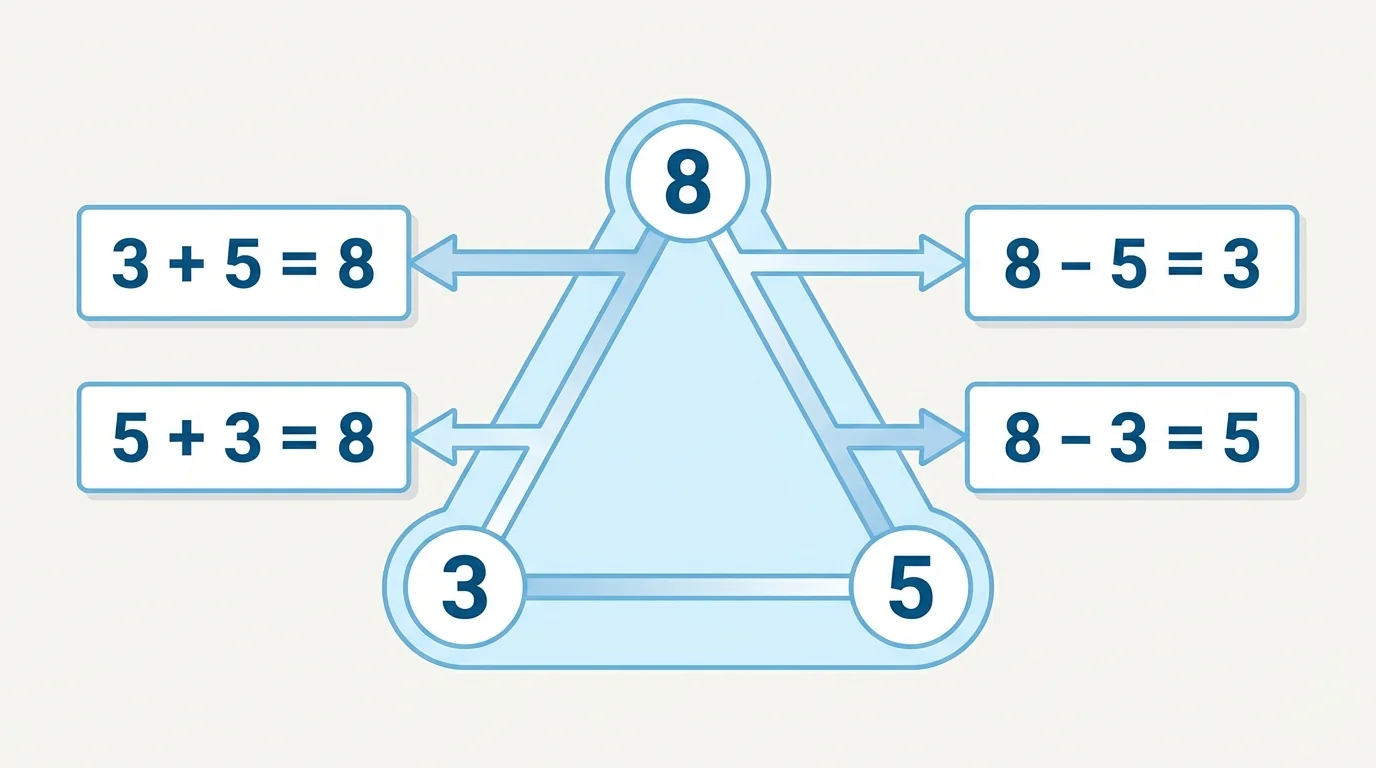
Fact families are helpful when a number is missing. If you know \(6 + 2 = 8\), then you also know \(8 - 6 = 2\) and \(8 - 2 = 6\). One fact helps you find another fact.
Addition and subtraction are connected. If you know the whole and one part, you can find the other part. If you know both parts, you can find the whole. That is why addition and subtraction help each other.
This is why missing-number equations are not just guessing. They are about using what you know about numbers that belong together.
Example 1
Find the missing number in \(8 + \Box = 11\).
Step 1: Think about what the equation means.
We need a number that goes with \(8\) to make \(11\).
Step 2: Count on from \(8\).
\(9, 10, 11\)
Step 3: Count how many numbers you said.
That is \(3\) counts.
The missing number is \(3\).
\(8 + 3 = 11\)
You can solve this same kind of problem with cubes, fingers, or drawings. The important idea is to find how many more are needed.
Example 2
Find the missing number in \(\Box - 3 = 5\).
Step 1: Think about what happened.
A number had \(3\) taken away, and \(5\) was left.
Step 2: Add back the \(3\).
\(5 + 3 = 8\)
Step 3: Check the equation.
\(8 - 3 = 5\)
The missing number is \(8\).
\(8 - 3 = 5\)
Notice how subtraction and addition work together. To find the starting number, we added the number that was taken away.
Example 3
Find the missing number in \(6 + 6 = ?\).
Step 1: Add the two numbers.
\(6 + 6 = 12\)
Step 2: Put the answer in the blank.
The missing number is \(12\).
\(6 + 6 = 12\)
In this equation, the missing number is at the end. You still want the equation to be true.
Example 4
Find the missing number in \(9 - \Box = 4\).
Step 1: Ask how many are taken away.
What number, when subtracted from \(9\), leaves \(4\)?
Step 2: Think of the related addition fact.
\(4 + 5 = 9\)
Step 3: Use that fact.
So \(9 - 5 = 4\).
The missing number is \(5\).
\(9 - 5 = 4\)
We can use the fact family from [Figure 2] in the same way here: one addition fact helps us solve a subtraction fact.
After you find a missing number, always check it. Put your answer back into the equation and see if it is true.
If you think \(8 + \Box = 11\) has answer \(2\), check it: \(8 + 2 = 10\). That is not true, so \(2\) is not correct.
If you try \(3\), check: \(8 + 3 = 11\). That is true, so \(3\) is correct.
Many number puzzles use missing numbers. When you solve them, you are practicing how numbers fit together like puzzle pieces.
Checking helps you be careful and confident. Good mathematicians do not just give an answer. They make sure the answer works.
You use missing-number math in everyday life with apples and groups of objects. If you have \(6\) apples and want \(8\), you ask, "How many more do I need?" That is \(6 + \Box = 8\), so the answer is \(2\).
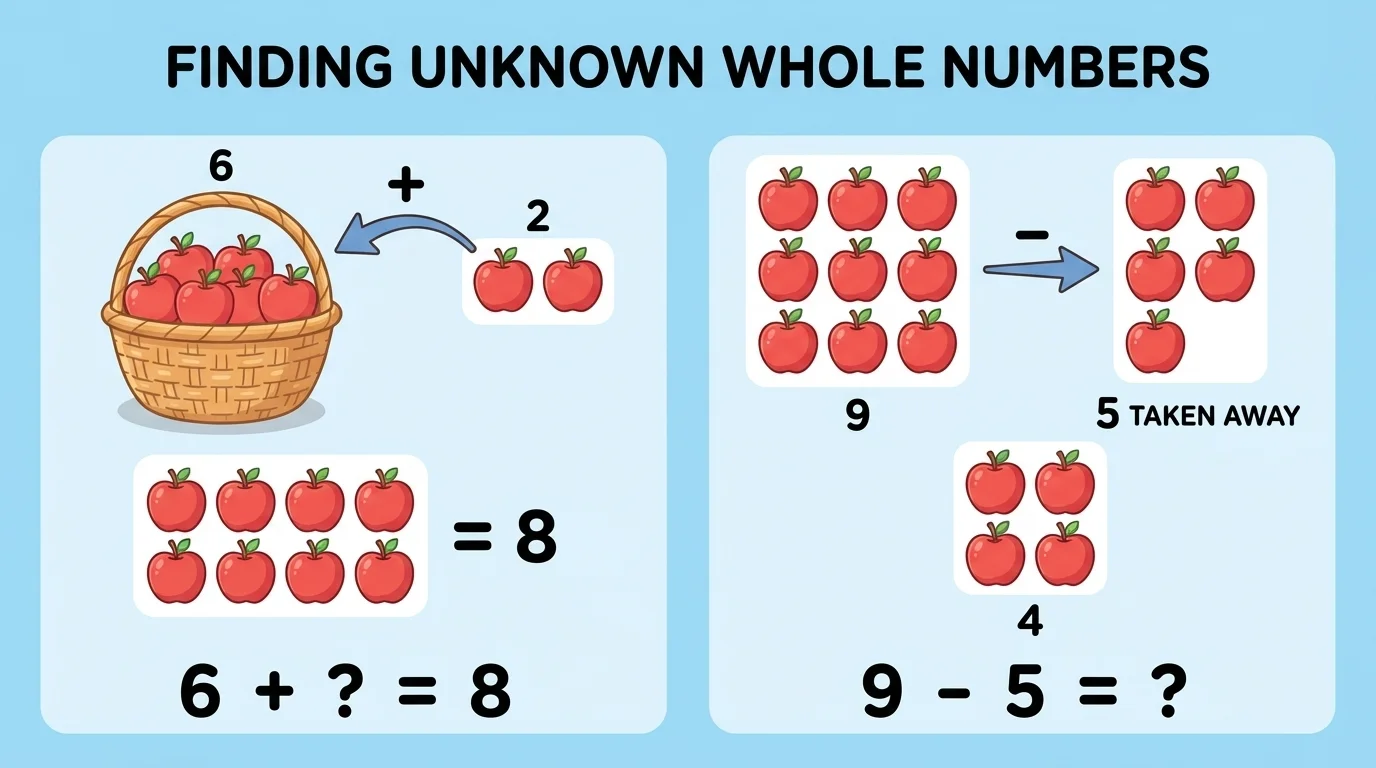
If there are \(9\) blocks on the floor and \(4\) are left after cleanup, you can ask, "How many were put away?" That is \(9 - \Box = 4\), so the answer is \(5\).
When you share crackers, count toys, or put books on a shelf, you often figure out a missing number. Math helps you know how many more, how many left, or how many altogether.
Later, when you solve harder problems, this same idea stays important. You will still look for the missing part that makes an equation true.
