What comes after 99? Some children think counting gets tricky there, but it is really like climbing one more step on a staircase. Numbers keep going: 100, 101, 102, and so on. When you can count to 120, you can count stickers, books, days on a chart, and many other things in the world around you.
We use numbers when we count crayons, line up in class, look at page numbers, and check how many days have passed in school. A number can tell how many. A written number like 37 or 114 is called a numeral. Numerals help us write the count so we do not have to count all over again.
When we count, each new number means one more. If you know 58, then the next number is 59. After that comes 60. Counting is a pattern, and learning the pattern helps numbers feel friendly.
Counting means saying numbers in order to tell how many. One more means the next number in the counting sequence. A numeral is the written symbol for a number, like 7, 45, or 120.
Some numbers are small, like 3. Some are much bigger, like 118. But they all fit in the counting sequence when we count by ones.
When you count forward, you say numbers in order, adding 1 each time. A number path, as shown in [Figure 1], helps us see that numbers keep moving forward even when we cross from the 90s to 100. If you start at 12, you count 13, 14, 15, 16, and so on.
You do not always have to start at 1. You can start at any number less than 120. For example, if you start at 47, the next numbers are 48, 49, 50, 51, and 52. Notice how after 49 comes 50.
Counting across 100 is important too. If you start at 98, the numbers go 99, 100, 101, 102. After 99, we do not go back to 0. We keep going to 100.
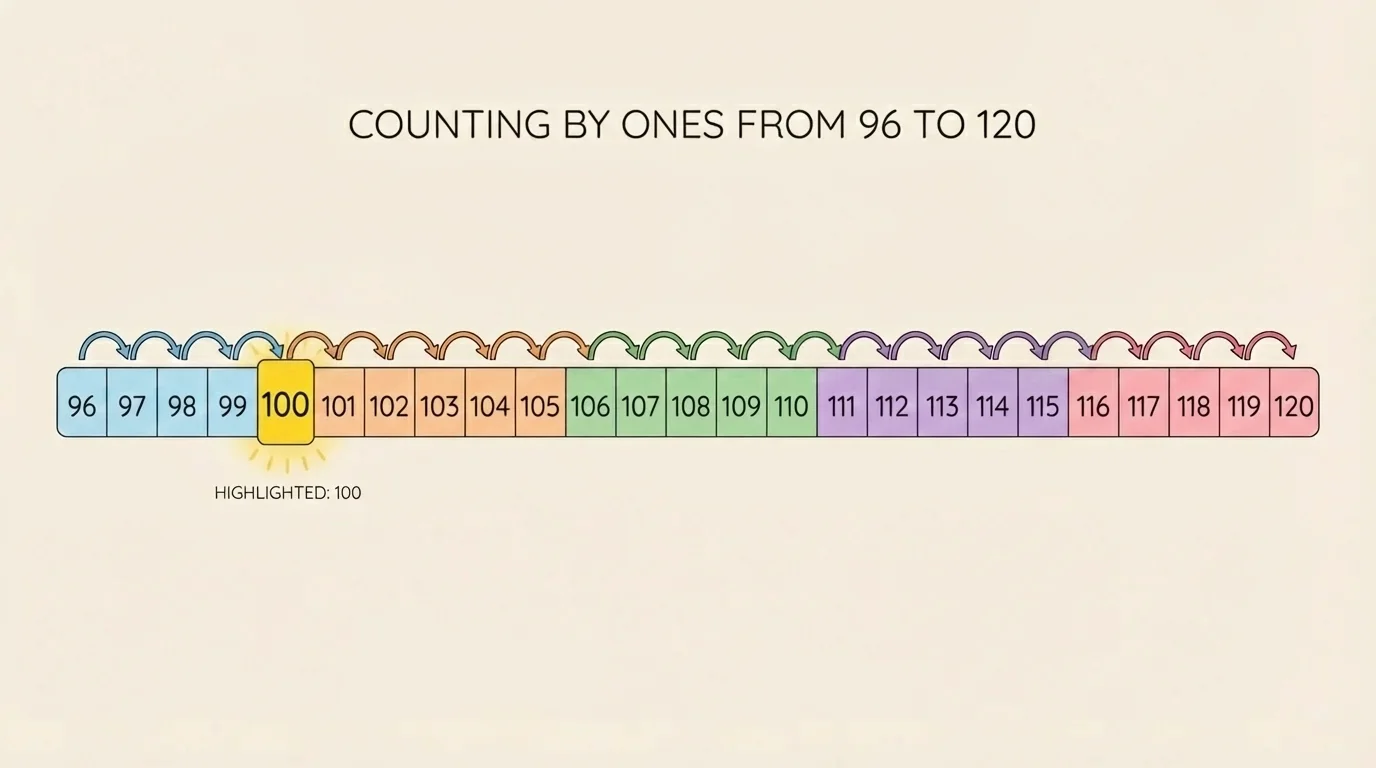
Counting to 120 also means knowing the last part of the sequence: 110, 111, 112, 113, 114, 115, 116, 117, 118, 119, 120. These numbers still grow by 1 each time.
Later, when you count larger groups, the same pattern you see in [Figure 1] still helps. The next number is always one more than the number before it.
You already know how to count to smaller numbers such as 10 and 20. Counting to 120 uses that same idea again and again: say the next number, then the next one after that.
Sometimes the tricky parts are when the tens change: 19 to 20, 29 to 30, 39 to 40, and so on. These are important places to practice noticing the pattern.
We can read a numeral and say its number name. We can also write the numeral when we hear the number name. For example, the numeral 35 is read as thirty-five. The numeral 100 is read as one hundred. The numeral 120 is read as one hundred twenty.
Here are some examples:
| Numeral | How to read it |
|---|---|
| 7 | seven |
| 14 | fourteen |
| 46 | forty-six |
| 89 | eighty-nine |
| 103 | one hundred three |
| 117 | one hundred seventeen |
Table 1. Examples of written numerals and the number names we say when we read them.
Teen numbers need special care. 14 is fourteen, and 40 is forty. They sound a little alike, but they are very different numbers. One is in the teens, and one has 4 tens.
The number word for 40 is spelled forty, not fourty. English number words have some surprising spellings.
When you write numerals, each digit matters. Writing 51 is not the same as writing 15. The digits are the same, but the order changes the number.
A number can be made of tens and ones. This is called place value. The parts of a number are easier to see in [Figure 2]. In 34, there are 3 tens and 4 ones.
If a number has 2 tens and 7 ones, the numeral is 27. If a number has 9 tens and 0 ones, the numeral is 90.
Numbers past 99 can also be understood in tens and ones. For example, 112 means 11 tens and 2 ones. That is why counting after 109 goes to 110, then 111, then 112.
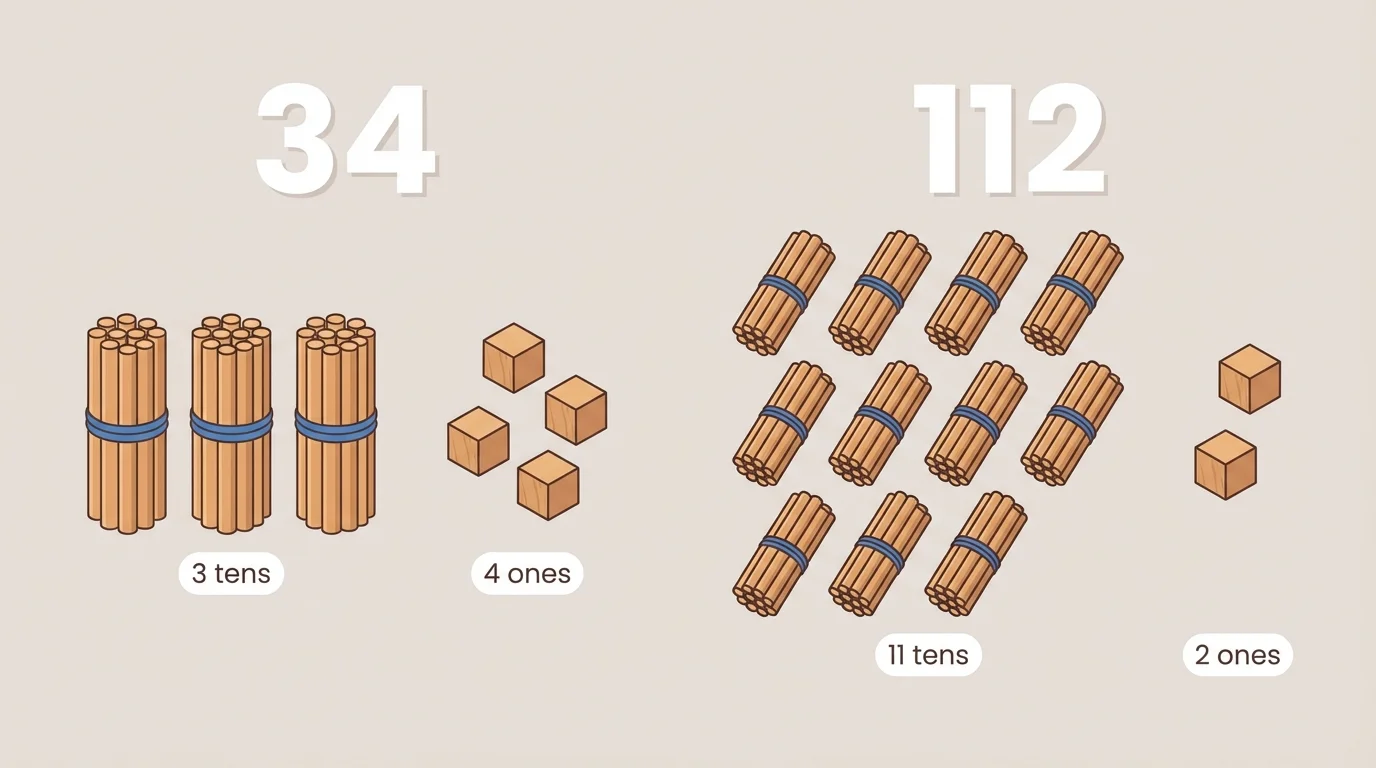
Thinking about tens and ones helps with reading, writing, and counting. When you see 76, you can think 7 tens and 6 ones. When you see 120, you can think of it as 12 tens and 0 ones.
Why tens matter
Our number system groups things in sets of 10. That is why numbers change in a pattern: after 19 comes 20, after 29 comes 30, and after 99 comes 100. Each new ten starts a new group.
As you keep counting, this idea keeps helping. Ones build up, and every group of 10 ones makes another ten.
Sometimes you count real things, not just say numbers. Counting objects in rows, as shown in [Figure 3], helps you keep track of the total. After you count the objects, you write the numeral that matches the total.
Suppose you count toy cars. If there are 11 toy cars, you write the numeral 11. If there are 25 blocks, you write 25. The numeral tells how many objects are in the set.
It helps to touch or move each object once while counting. That way you do not skip any objects, and you do not count the same object twice.
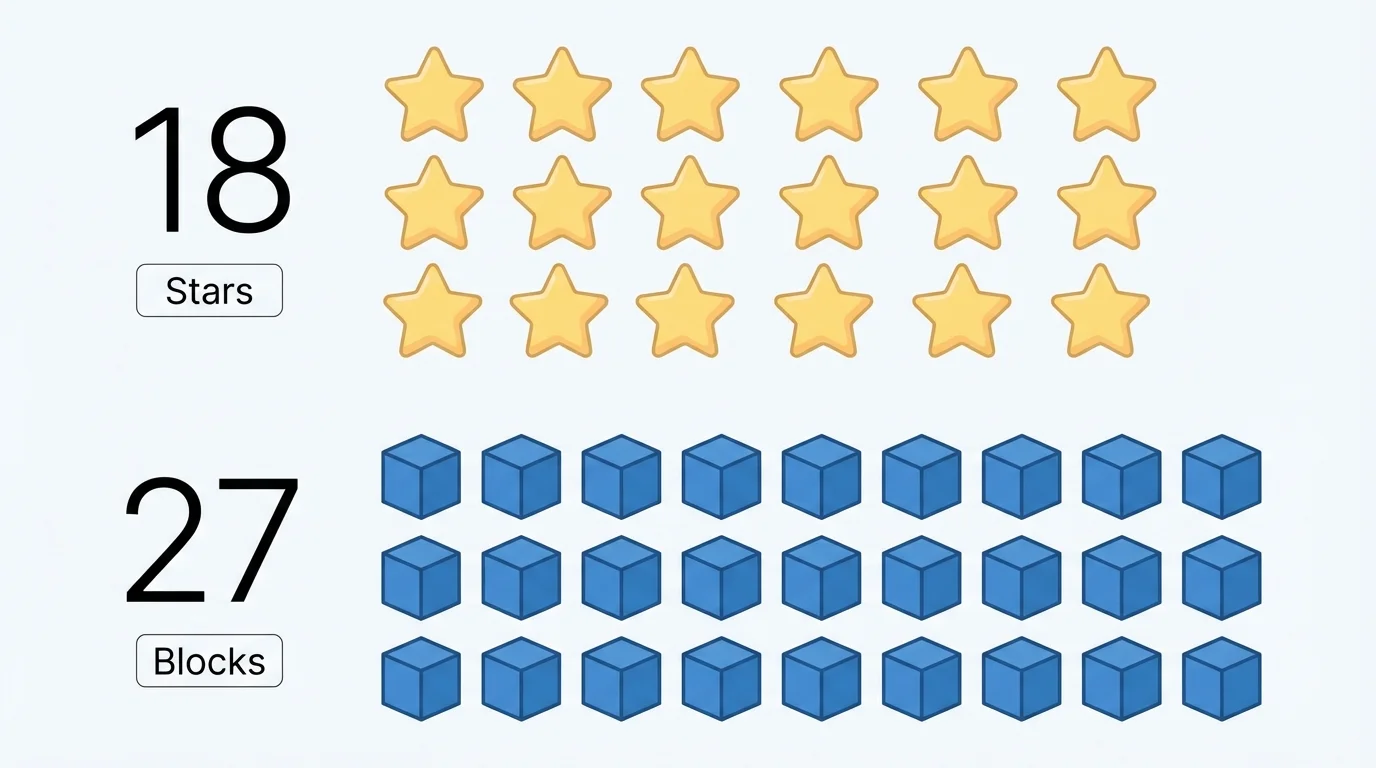
You can also look at groups and make a smart count. For example, if you see 3 full rows of 10 cubes and 4 extra cubes, you know the numeral is 34. That matches the tens-and-ones idea we used earlier.
Later, when you organize objects into rows or groups, the picture in [Figure 3] still helps you remember to count carefully and then write the matching numeral.
Let us work through some examples step by step.
Worked example 1
Start at 57 and count on 5 numbers.
Step 1: Say the number after 57.
The next number is 58.
Step 2: Keep counting by ones.
58, 59, 60, 61, 62
Step 3: Check that you counted 5 numbers after 57.
The counted numbers are 58, 59, 60, 61, 62.
The answer is 62, the fifth number when counting on.
This example shows how the count keeps going even when we cross from 59 to 60.
Worked example 2
Write the numeral for one hundred eight.
Step 1: Listen for the hundreds part.
One hundred means 100.
Step 2: Listen for the ones part.
Eight means 8 ones.
Step 3: Put the parts together.
\(100 + 8 = 108\)
The numeral is 108.
Reading and writing numbers works best when you pay attention to each part of the number name.
Worked example 3
A jar has 1 group of 10 buttons and 6 more buttons. What numeral matches the buttons?
Step 1: Count the ten.
One group of 10 is 10.
Step 2: Add the extra ones.
\(10 + 6 = 16\)
Step 3: Write the numeral.
The numeral for the buttons is 16.
The set of buttons is represented by 16.
Matching numerals to objects tells the total in a clear, quick way.
Worked example 4
What number comes next: 98, 99, 100, 101, ?
Step 1: Notice the pattern.
Each number is 1 more than the one before.
Step 2: Add one more to 101.
\(101 + 1 = 102\)
Step 3: Write the next numeral.
The next number is 102.
The answer is 102.
That is an important pattern because it shows how counting continues after 99.
You might count how many days you have been in school, how many books are on a shelf, or how many beads are in a jar. If a class collects 115 cans for a food drive, the numeral 115 tells the total clearly. If a calendar chart reaches day 120, students can read that numeral and know exactly how many days have passed.
Games also use counting. On a board game, you may move from space 38 to 39 to 40. In a sticker collection, you may already have 99 stickers, then get one more and have 100.
A 120-chart is useful because it shows many number patterns at once. You can see numbers growing across rows and also going up and down in columns.
When numbers are useful in real life, reading and writing them becomes even more important.
One common mistake is mixing up teen numbers and tens numbers, such as 14 and 40. Another common mistake is forgetting what comes after 99. The correct next number is 100.
Some children also skip a number when counting. For example, they might say 67, 68, 70 and miss 69. Counting carefully by ones helps prevent this.
When writing numerals, be sure to write the digits in the correct order. 73 and 37 are different numbers. Thinking about tens and ones can help you decide which numeral is correct.
