Did you notice something special about the teen numbers? Every number from \(11\) to \(19\) follows the same pattern. They all begin with a ten, and then they add some more ones. That means \(11\) is not just a number name. It represents \(1\) ten and \(1\) one. The same idea works all the way to \(19\).
The numbers \(11, 12, 13, 14, 15, 16, 17, 18, 19\) are called teen numbers. They come right after \(10\) and before \(20\). Each one is made from one ten and some extra ones.
Here is the pattern:
\(11 = 1\) ten and \(1\) one
\(12 = 1\) ten and \(2\) ones
\(13 = 1\) ten and \(3\) ones
\(14 = 1\) ten and \(4\) ones
\(15 = 1\) ten and \(5\) ones
\(16 = 1\) ten and \(6\) ones
\(17 = 1\) ten and \(7\) ones
\(18 = 1\) ten and \(8\) ones
\(19 = 1\) ten and \(9\) ones
Tens and ones are parts of a number. A ten means a group of \(10\). Ones are single things. In teen numbers, there is always \(1\) group of \(10\), and then some extra ones.
When we say a teen number, we are really talking about a group of \(10\) and some more. This idea is called place value. Place value helps us know what each digit means in a number.
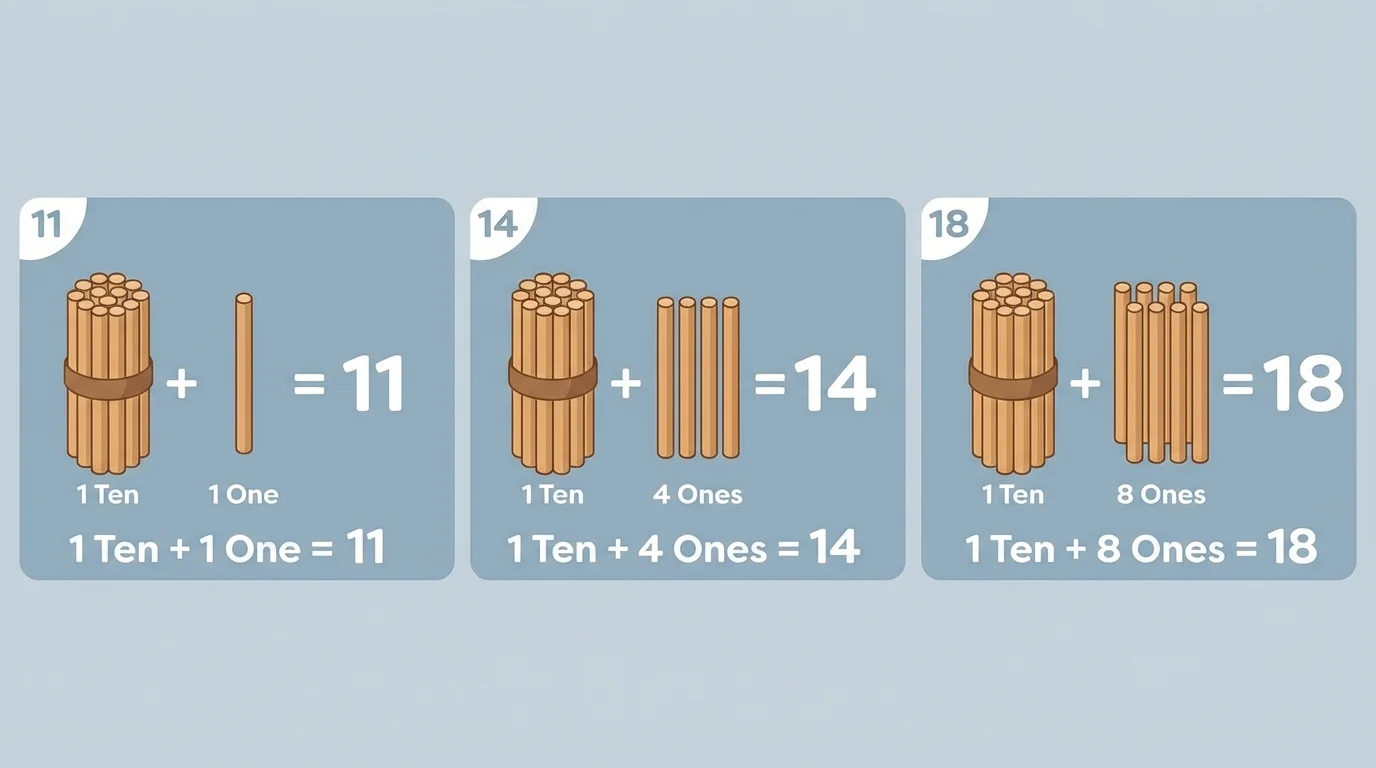
Look closely at a teen number, as [Figure 1] shows with bundles and single sticks. In every teen number, the digit \(1\) means \(1\) ten. The second digit tells how many ones there are.
For example, in \(14\), the \(1\) means \(1\) ten, and the \(4\) means \(4\) ones. So \(14\) is \(10 + 4\).
We can write teen numbers as a ten plus ones:
\(11 = 10 + 1\)
\(12 = 10 + 2\)
\(13 = 10 + 3\)
\(14 = 10 + 4\)
\(15 = 10 + 5\)
\(16 = 10 + 6\)
\(17 = 10 + 7\)
\(18 = 10 + 8\)
\(19 = 10 + 9\)
This is why teen numbers are special. They all have the same number of tens: \(1\). Only the ones change. When you look again at [Figure 1], you can see that the bundle of \(10\) stays the same, but the single sticks grow from \(1\) to \(9\).
You already know that \(10\) means one full group of ten. Teen numbers start with that full group and then add more ones.
If you have \(1\) ten and \(6\) ones, you have \(16\). If you have \(1\) ten and \(9\) ones, you have \(19\). If there are no extra ones, that is just \(10\), not a teen number.
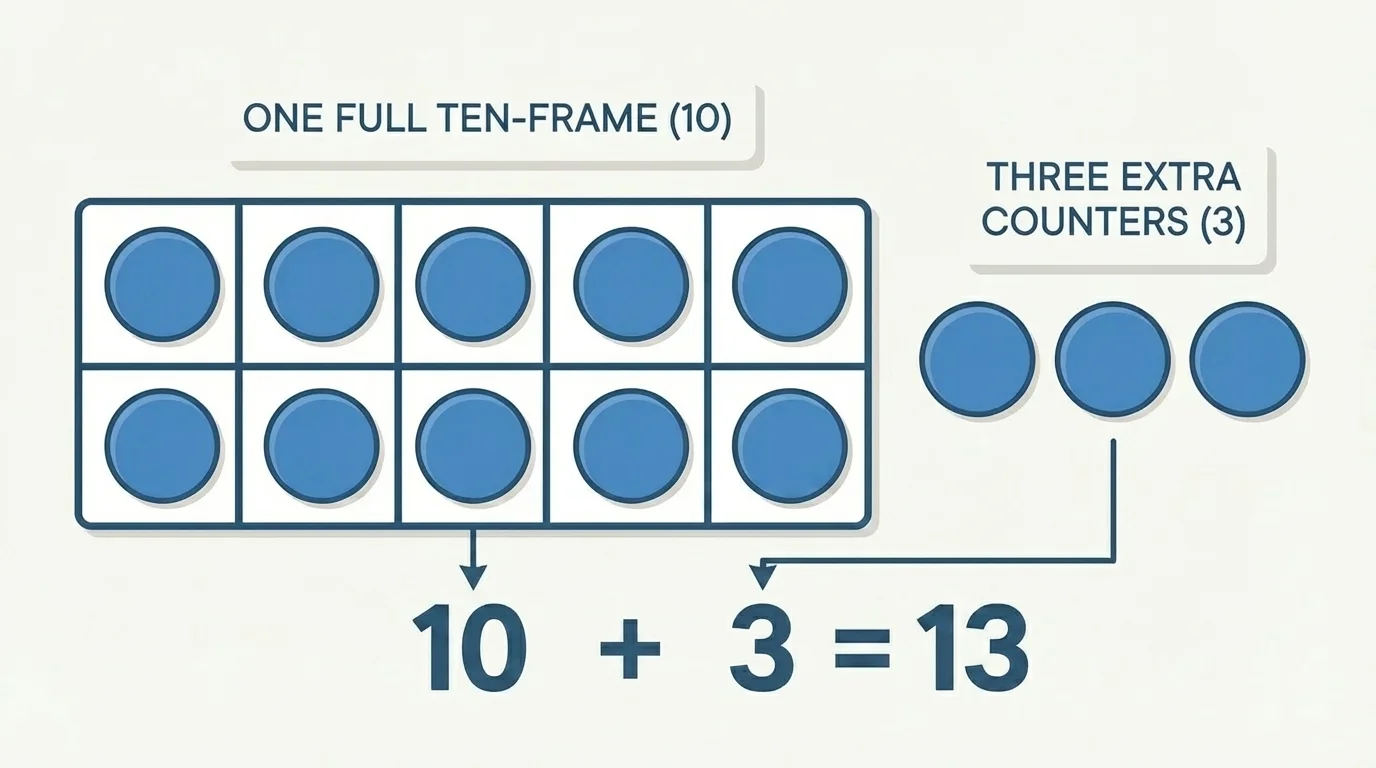
[Figure 2] One easy way to see teen numbers is with a ten-frame. A full ten-frame shows \(10\). Then we add extra counters. A ten-frame shows \(13\) clearly with one full frame and \(3\) more counters.
If one ten-frame is full and there are \(5\) more counters, the number is \(15\). If one ten-frame is full and there are \(8\) more counters, the number is \(18\).
You can build teen numbers in many ways:
For example, if you have a bundle of \(10\) straws and \(2\) single straws, you have \(12\). If you have a group of \(10\) blocks and \(7\) more blocks, you have \(17\).
The words for teen numbers can sound a little tricky. Even when the names sound different, the math idea stays the same: each teen number is still \(1\) ten and some ones.
Some number names do not sound exactly like their digits. For example, \(11\) is called eleven and \(12\) is called twelve. But they still mean \(10 + 1\) and \(10 + 2\).
Let's look at some teen numbers step by step.
Example 1
How many tens and ones are in \(14\)?
Step 1: Look at the first digit.
In \(14\), the first digit is \(1\). That means \(1\) ten.
Step 2: Look at the second digit.
The second digit is \(4\). That means \(4\) ones.
Step 3: Put the parts together.
\(14 = 10 + 4\).
The number \(14\) has \(1\) ten and \(4\) ones.
That same thinking works for every teen number.
Example 2
What number is \(1\) ten and \(7\) ones?
Step 1: Start with the ten.
\(1\) ten means \(10\).
Step 2: Add the ones.
\(10 + 7 = 17\).
Step 3: Say the number.
The number is \(17\).
Answer: \(1\) ten and \(7\) ones make \(17\).
When you know the ten and the ones, you can build the whole number.
Example 3
A child has \(10\) toy cars in a box and \(3\) more toy cars on the floor. How many toy cars are there?
Step 1: Find the ten.
The box has \(10\) toy cars.
Step 2: Add the ones.
There are \(3\) more on the floor, so \(10 + 3 = 13\).
Step 3: Name the number.
The total is \(13\).
Answer: There are \(13\) toy cars.
We can also look backward. If the number is \(18\), we can break it apart into \(10\) and \(8\). That means \(1\) ten and \(8\) ones.
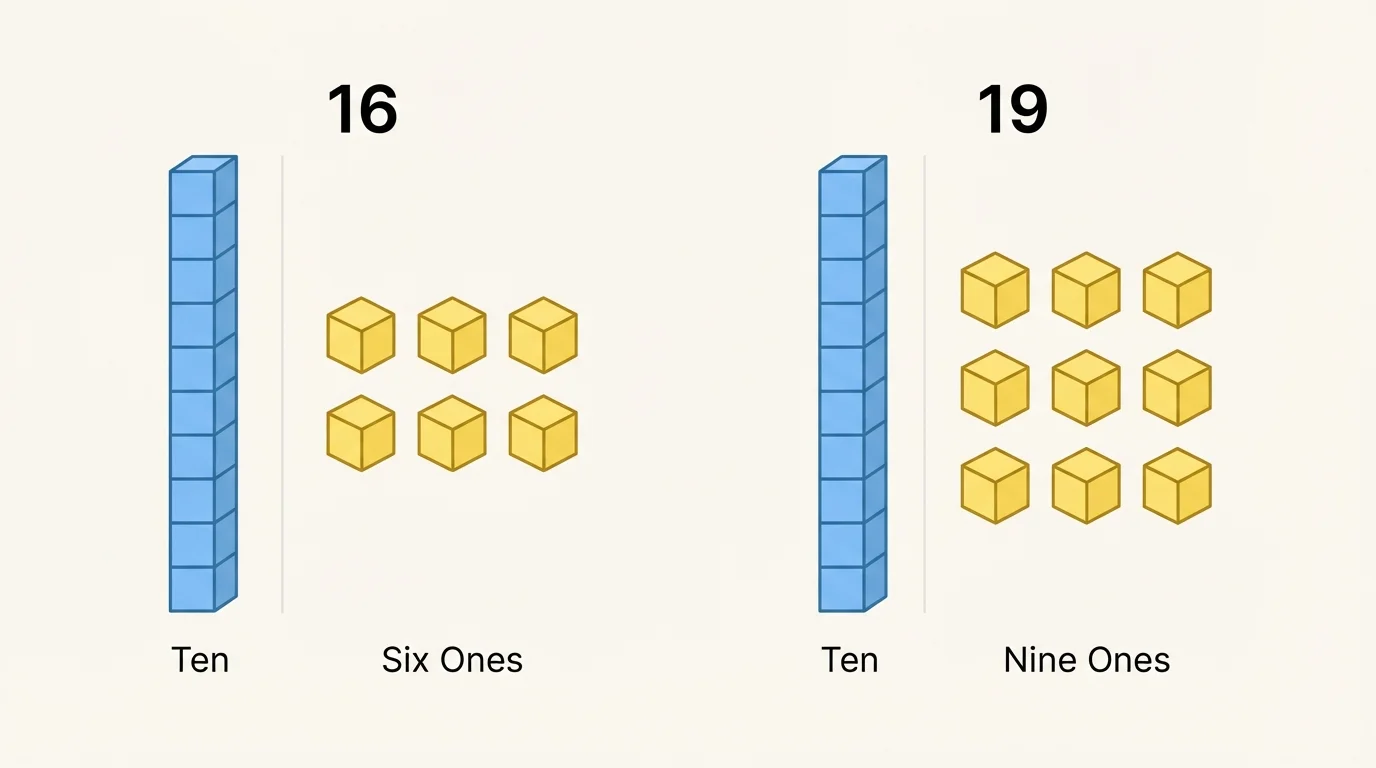
[Figure 3] Sometimes two teen numbers both have \(1\) ten, so we look at the ones to compare them. The numbers \(16\) and \(19\) each have the same ten, but the ones are different.
Since \(9\) ones is more than \(6\) ones, \(19\) is greater than \(16\). We can write \(19 > 16\).
Here are more comparisons:
When both numbers have \(1\) ten, the ones tell which number is bigger. Looking back at [Figure 3], you can see that the extra ones make the difference.
Teen numbers are all around you. A carton may hold \(10\) crayons, and you may have \(6\) more crayons in your desk. That makes \(16\) crayons.
You might see \(10\) apples in a bowl and \(4\) more on the table. That is \(14\) apples. Or maybe there are \(10\) children on the playground and \(9\) more join them. Then there are \(19\) children.
These real-world stories help us remember that teen numbers are made by putting a ten together with some ones.
Sometimes students mix up the digits in teen numbers. For example, \(12\) does not mean \(2\) tens. It means \(1\) ten and \(2\) ones.
The first digit in every teen number from \(11\) to \(19\) is \(1\). That first digit always tells us there is exactly \(1\) ten. The second digit tells the number of ones.
| Number | Tens | Ones | As an addition sentence |
|---|---|---|---|
| \(11\) | \(1\) | \(1\) | \(10 + 1\) |
| \(13\) | \(1\) | \(3\) | \(10 + 3\) |
| \(15\) | \(1\) | \(5\) | \(10 + 5\) |
| \(18\) | \(1\) | \(8\) | \(10 + 8\) |
| \(19\) | \(1\) | \(9\) | \(10 + 9\) |
Table 1. Examples of teen numbers written as tens, ones, and addition sentences.
If you can say, "one ten and some ones," you can understand every teen number from \(11\) to \(19\).
