Have you ever counted a big pile of blocks and wished there were a faster way? Counting by ones is good, but counting gets easier when we make groups. In math, one very special group is a group of 10. When we put 10 ones together, we can think of them as one bundle. That bundle is called a ten.
[Figure 1] Let us start with ones. A one is one single thing: one cube, one straw, or one counter. If we count 1, 2, 3, 4, 5, 6, 7, 8, 9, 10, we have counted 10 ones. Instead of thinking about all 10 ones one by one, we can group them together. That grouped set is easier to count.
Think about 10 little sticks. If they are all loose, you can count them one at a time. But if you tie them together, now you have 1 bundle of ten. The amount did not change. It is still 10. We are just seeing it in a new way.
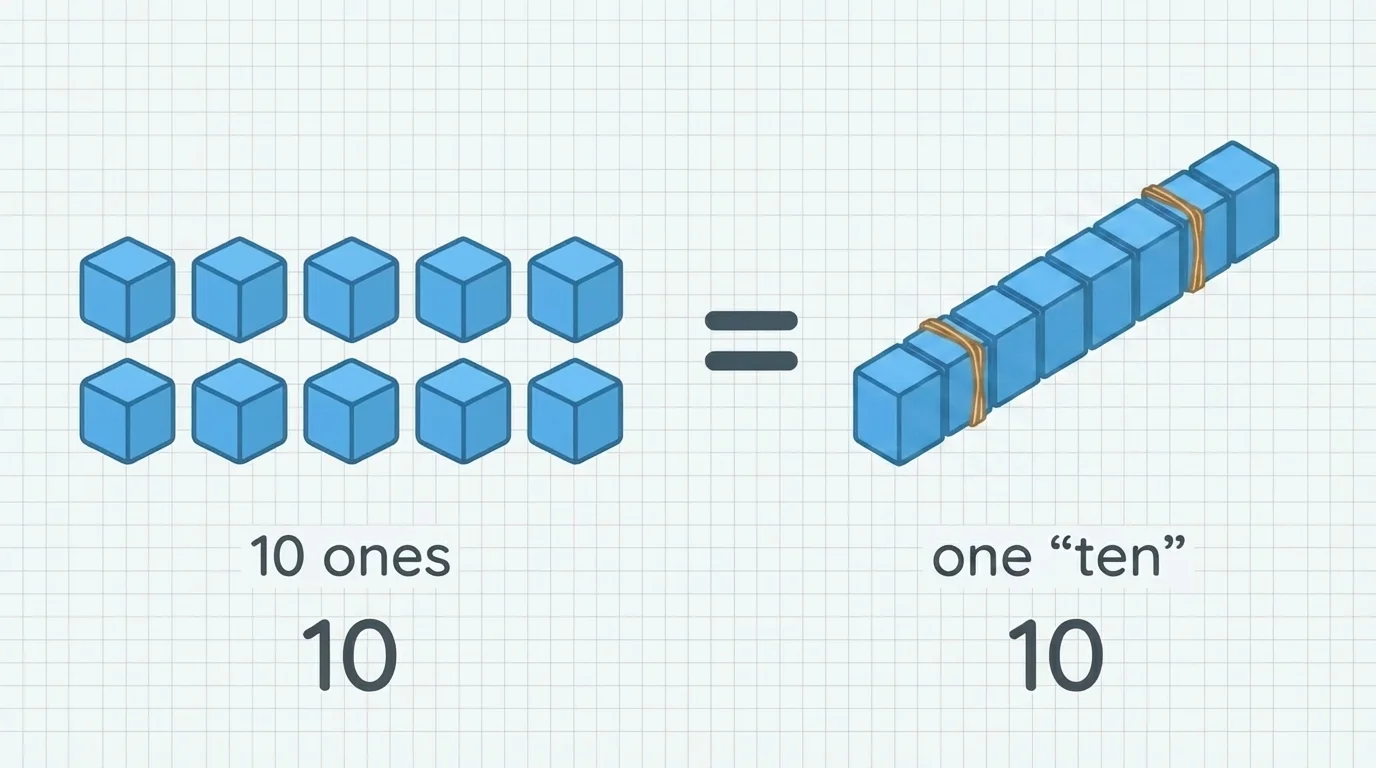
Ten means a bundle of 10 ones. Place value means that where a digit is in a number tells what it is worth. In a two-digit number, one digit tells the tens and the other digit tells the ones.
So, 10 ones and 1 ten mean the same amount. We can write that idea like this: \(10\textrm{ ones} = 1\textrm{ ten}\). This is an important math idea because it helps us understand bigger numbers.
A ten is not just the number name for 10. It is also a way to group things. When you hear "one ten," think "one bundle of 10 ones." If you have 2 tens, that means you have 20 ones. If you have 3 tens, that means you have 30 ones.
This helps us count faster. Instead of saying 1, 2, 3, 4, 5, 6, 7, 8, 9, 10, 11, 12 one by one, we can say 1 ten and 2 ones. That is another way to think about 12.
You already know how to count by ones. Now you are building a new idea: every time you get to 10 ones, you can make 1 ten.
This trading idea is very helpful. If you keep counting ones and reach 10, you can make one ten. Then you can keep counting the extra ones after that.
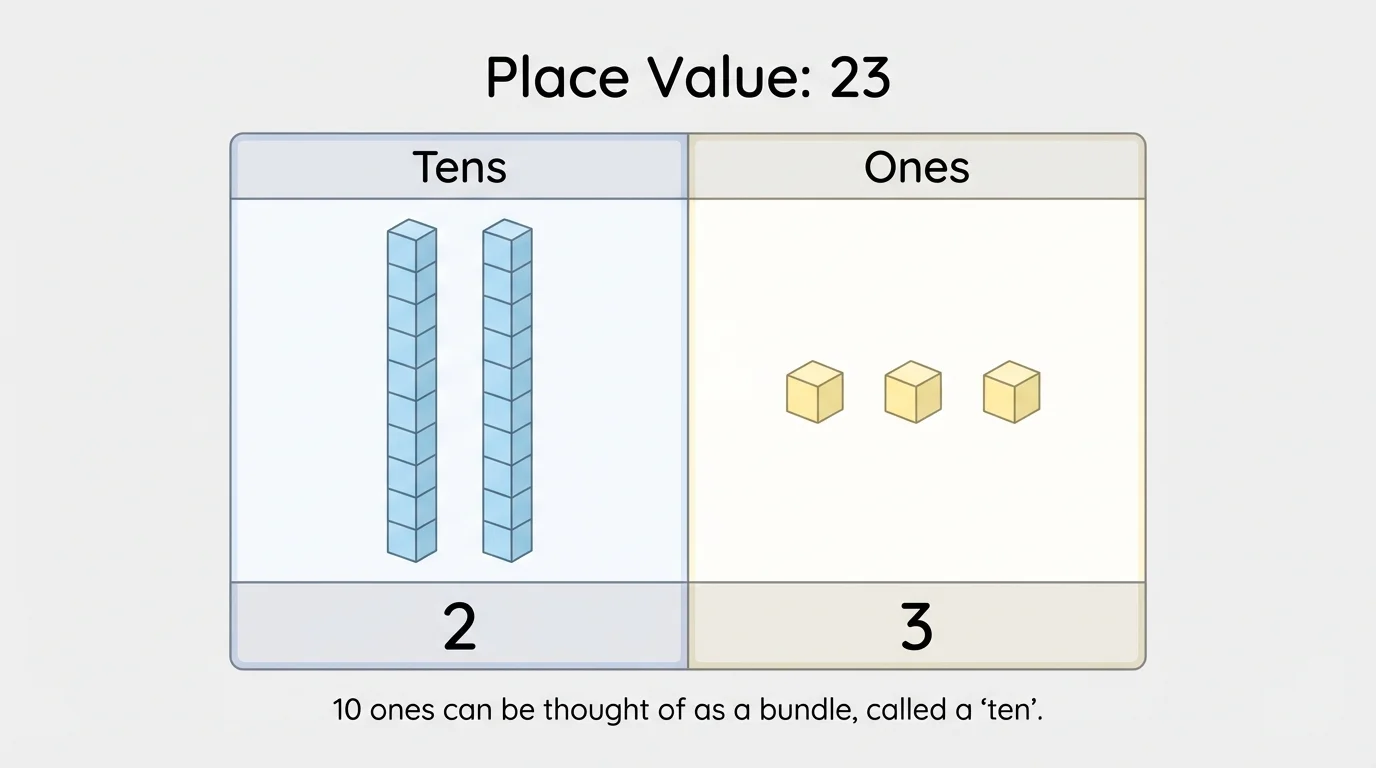
[Figure 2] A two-digit number has a tens digit and a ones digit. This is called place value. The digit on the left tells the number of tens, and the digit on the right tells the number of ones. For example, in 23, the 2 means 2 tens, and the 3 means 3 ones. A place value picture makes this easy to see.
So we can write: \(23 = 2\textrm{ tens} + 3\textrm{ ones}\). Since 2 tens = 20, this also means \(23 = 20 + 3\).
Let us look at more numbers. The number 14 means 1 ten and 4 ones. The number 30 means 3 tens and 0 ones. The number 19 means 1 ten and 9 ones.
Numbers from 11 to 19 are special because they all have 1 ten. Only the ones change. That means: \(11 = 1\textrm{ ten} + 1\textrm{ one}\), \(15 = 1\textrm{ ten} + 5\textrm{ ones}\), and \(18 = 1\textrm{ ten} + 8\textrm{ ones}\).
Numbers like 20, 30, and 40 have 0 ones. They are made of only tens: \(20 = 2\textrm{ tens}\) and \(30 = 3\textrm{ tens}\).
Why bundles help
Bundling makes counting easier because your brain can think about groups instead of many separate objects. One bundle of 10 and 3 extra ones is much quicker to understand than counting all 13 objects one at a time.
This same idea works with base-ten blocks. A long rod can stand for 1 ten, and a small cube can stand for 1 one. When you see 4 rods and 2 small cubes, you know the number is 42. We are still using the same idea we saw earlier in [Figure 2]: tens on one side, ones on the other.
Now let us solve some examples step by step.
Example 1
What does 12 mean in tens and ones?
Step 1: Look at the tens digit.
In 12, the tens digit is 1. That means 1 ten.
Step 2: Look at the ones digit.
The ones digit is 2. That means 2 ones.
Step 3: Say the whole number in tens and ones.
\(12 = 1\textrm{ ten} + 2\textrm{ ones}\)
The number 12 is 1 ten and 2 ones.
Notice that the first digit tells the number of tens. The second digit tells the number of ones.
Example 2
What does 27 mean in tens and ones?
Step 1: Find the tens.
The digit 2 is in the tens place, so it means 2 tens.
Step 2: Find the ones.
The digit 7 is in the ones place, so it means 7 ones.
Step 3: Write the number in two ways.
\(27 = 2\textrm{ tens} + 7\textrm{ ones}\)
\(27 = 20 + 7\)
The number 27 is 2 tens and 7 ones.
When you know tens and ones, numbers become easier to read and understand.
Example 3
What number is 3 tens and 4 ones?
Step 1: Change the tens into a number.
3 tens means 30.
Step 2: Add the ones.
4 ones means 4.
Step 3: Put them together.
\(30 + 4 = 34\)
The number is 34.
We can go the other way too. If someone says a number, you can break it apart into tens and ones.
Example 4
What does 40 mean in tens and ones?
Step 1: Look at the tens digit.
The digit 4 means 4 tens.
Step 2: Look at the ones digit.
The digit 0 means 0 ones.
Step 3: Write the answer.
\(40 = 4\textrm{ tens} + 0\textrm{ ones}\)
The number 40 has no extra ones. It is all tens.
Math has patterns everywhere. When a number ends in 0, it has 0 ones. When a number is between 11 and 19, it has 1 ten. The ones digit tells how many extra ones there are.
Here is a quick look at some numbers:
| Number | Tens | Ones |
|---|---|---|
| 11 | 1 | 1 |
| 16 | 1 | 6 |
| 20 | 2 | 0 |
| 25 | 2 | 5 |
| 33 | 3 | 3 |
Table 1. Examples of two-digit numbers written as tens and ones.
If you read the table across, you can see that the first digit tells the tens and the second digit tells the ones. That is the heart of place value.
People use grouping all the time. A carton of eggs often has 12 eggs, but many classroom math tools use groups of 10 because our number system is built on tens.
Our hands may be one reason tens feel so natural. We have 10 fingers, so grouping by 10 is a very old and useful idea.
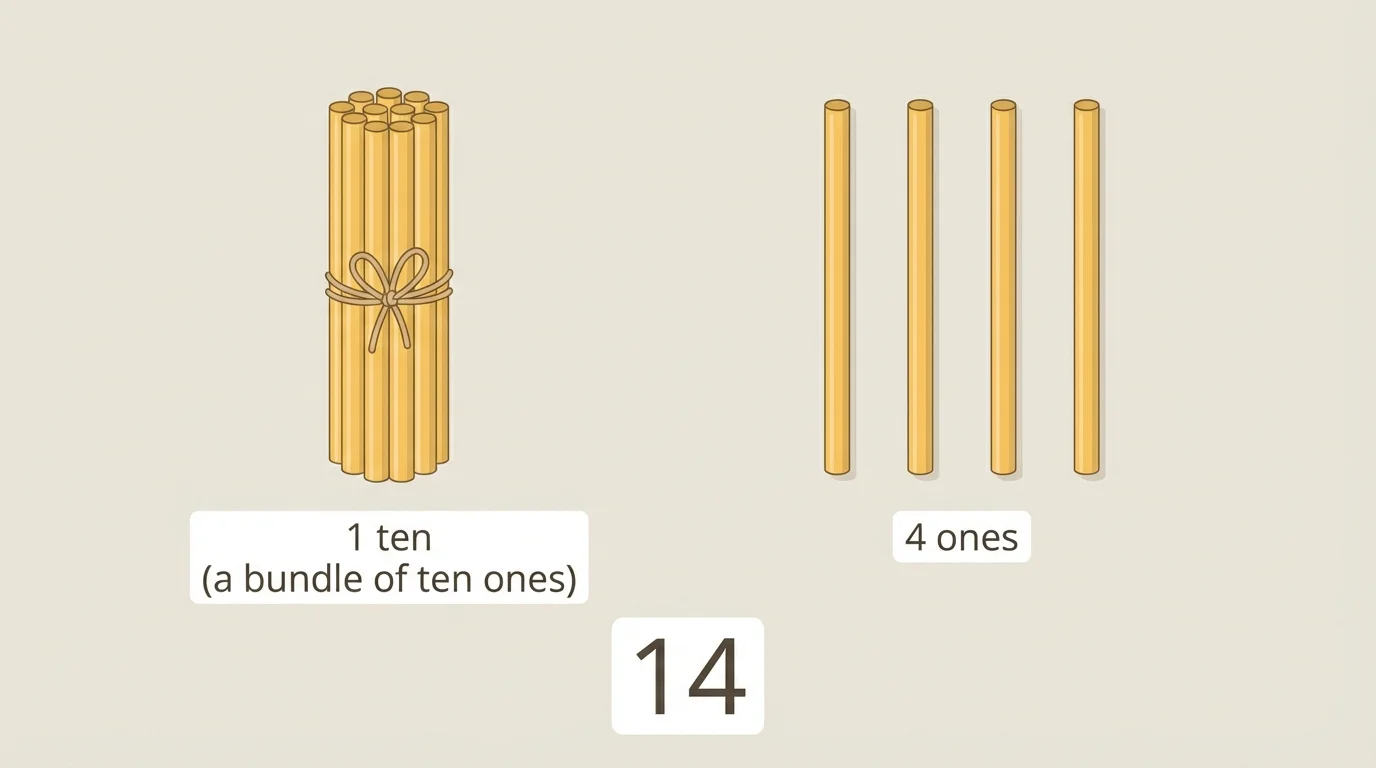
[Figure 3] Bundles of ten help in real life too. A teacher may put straws into bundles of 10. Then a student can quickly see 14 as 1 bundle of ten and 4 extra straws. That is much faster than counting all 14 straws one by one.
If you have pencils in packs, snack crackers in groups, or stickers arranged in rows of 10, you are using the same math idea. Grouping helps us count, compare, and talk about amounts.
Suppose a class has 32 crayons. You can think of that as 3 tens and 2 ones. If another class has 29 crayons, that is 2 tens and 9 ones. Seeing the tens first helps you compare numbers. Since 3 tens is more than 2 tens, 32 is greater than 29.
This is why understanding tens and ones matters so much. It helps with reading numbers, counting larger groups, comparing numbers, and getting ready for adding and subtracting later. The bundle in [Figure 1] and the straw group in [Figure 3] both show the same important idea: 10 ones can be thought of as 1 ten.
