If you have \(2\) piles of blocks, one with \(4\) tens and another with \(6\) tens, which pile is greater? You can tell quickly without counting every single block. That is the power of place value. It helps us compare numbers quickly and correctly.
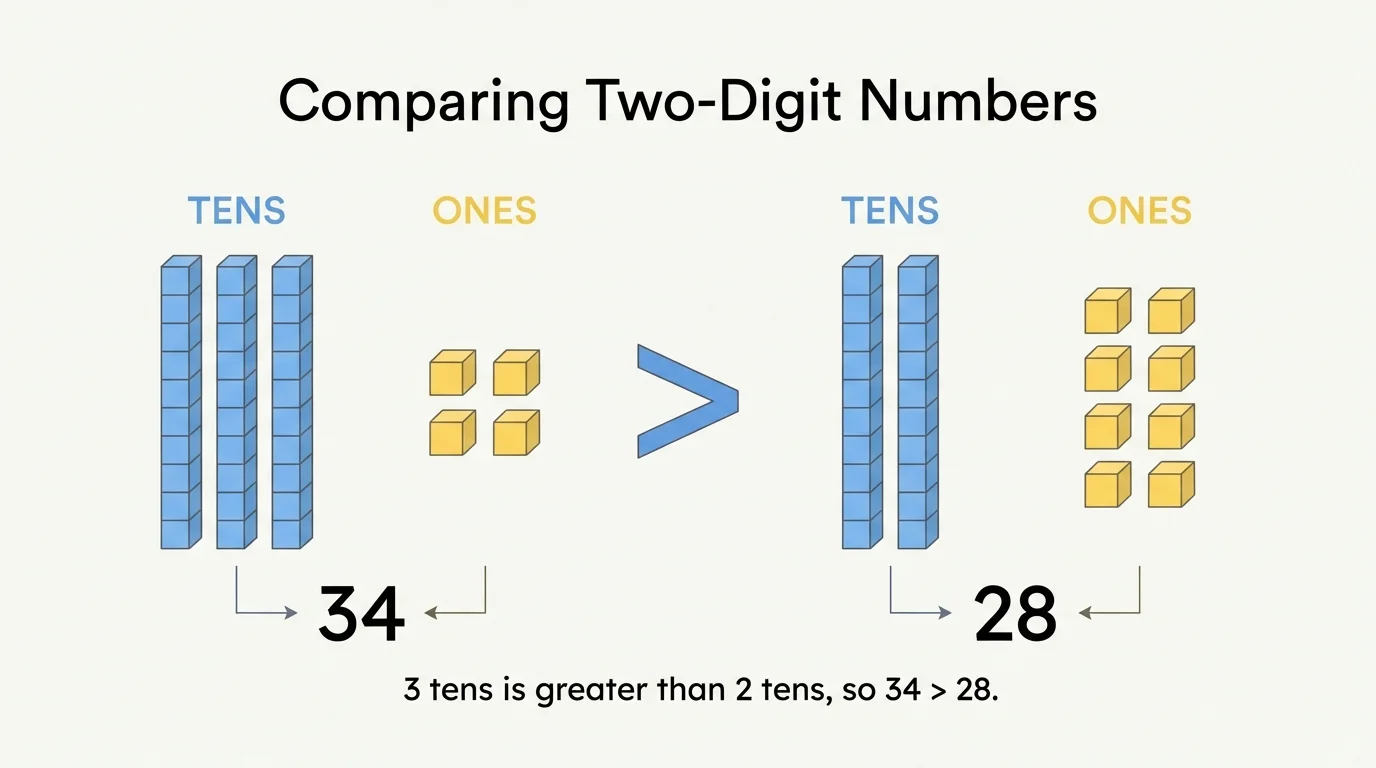
A two-digit number has a tens digit and a ones digit. The tens digit tells how many groups of \(10\) there are. The ones digit tells how many extra ones there are. As [Figure 1] shows, the number \(34\) means \(3\) tens and \(4\) ones.
We can think about \(34\) like this: \(34 = 30 + 4\). We can also think about \(58\) like this: \(58 = 50 + 8\). When we compare numbers, we use the meaning of the digits, not just how the digits look.
Place value means each digit has a value based on where it is in the number. In a two-digit number, the left digit tells tens and the right digit tells ones.
For example, in \(27\), the \(2\) means \(2\) tens, or \(20\). The \(7\) means \(7\) ones. So \(27\) is \(20 + 7\).
When we compare two two-digit numbers, we usually look at the tens first. As [Figure 2] illustrates, the number with more tens is greater because tens are big groups of \(10\).
Compare \(47\) and \(62\). The number \(47\) has \(4\) tens. The number \(62\) has \(6\) tens. Since \(6\) tens is more than \(4\) tens, we know \(62\) is greater than \(47\).
We write that comparison like this: \(47 < 62\) We can also write it the other way: \(62 > 47\)
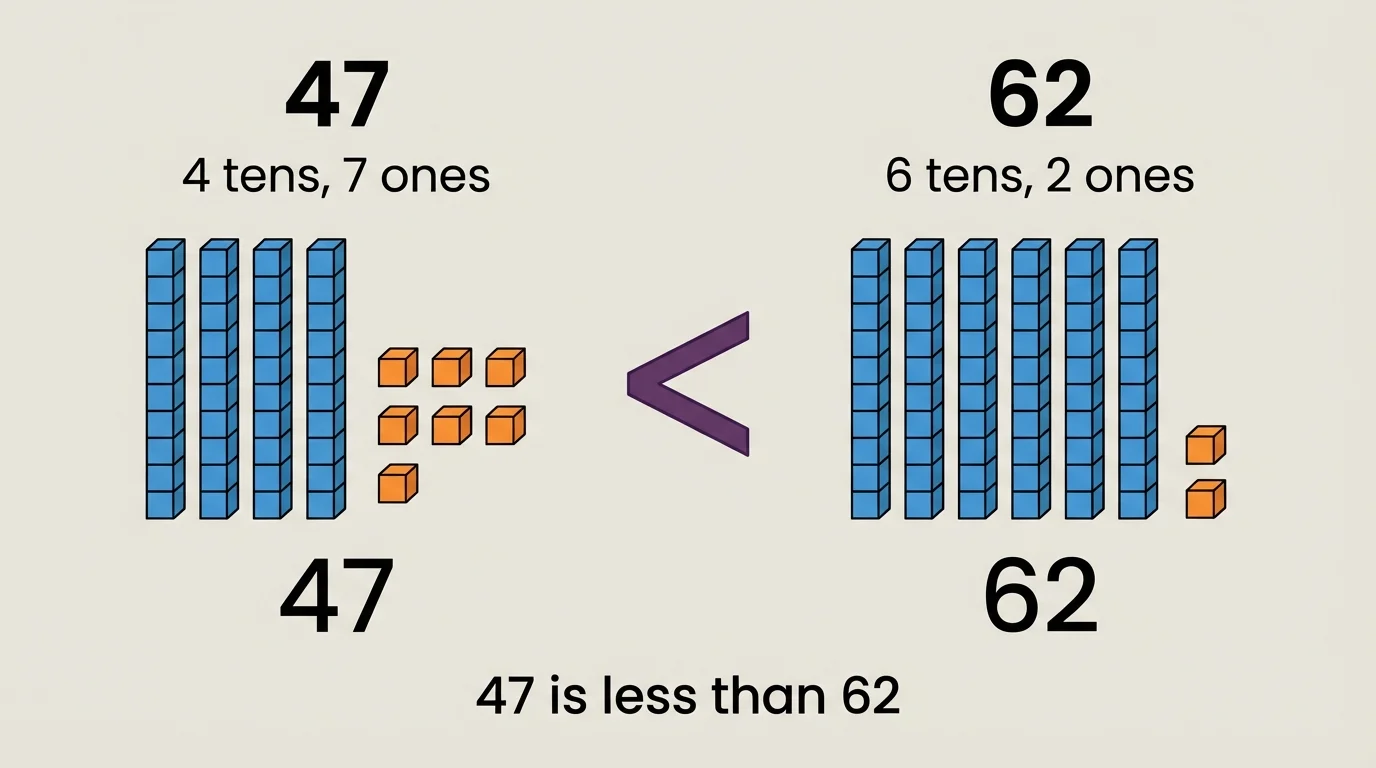
Notice something important: even though \(47\) has \(7\) ones and \(62\) has only \(2\) ones, \(62\) is still greater. The tens digit matters more because each ten is a whole group of \(10\).
Big idea: tens are compared before ones. If the tens digits are different, you do not need to compare the ones digits. The number with the larger tens digit is the larger number.
This is why \(81\) is greater than \(79\). The \(8\) tens in \(81\) are more than the \(7\) tens in \(79\), even though \(1\) is less than \(9\).
Sometimes the tens digits match. Then we look at the ones digits. Both numbers have \(5\) tens, so the ones decide which number is greater.
As [Figure 3] shows, compare \(53\) and \(58\). Both numbers have \(5\) tens. Now compare the ones: \(3\) ones and \(8\) ones. Since \(8 > 3\), we know \(58\) is greater than \(53\).
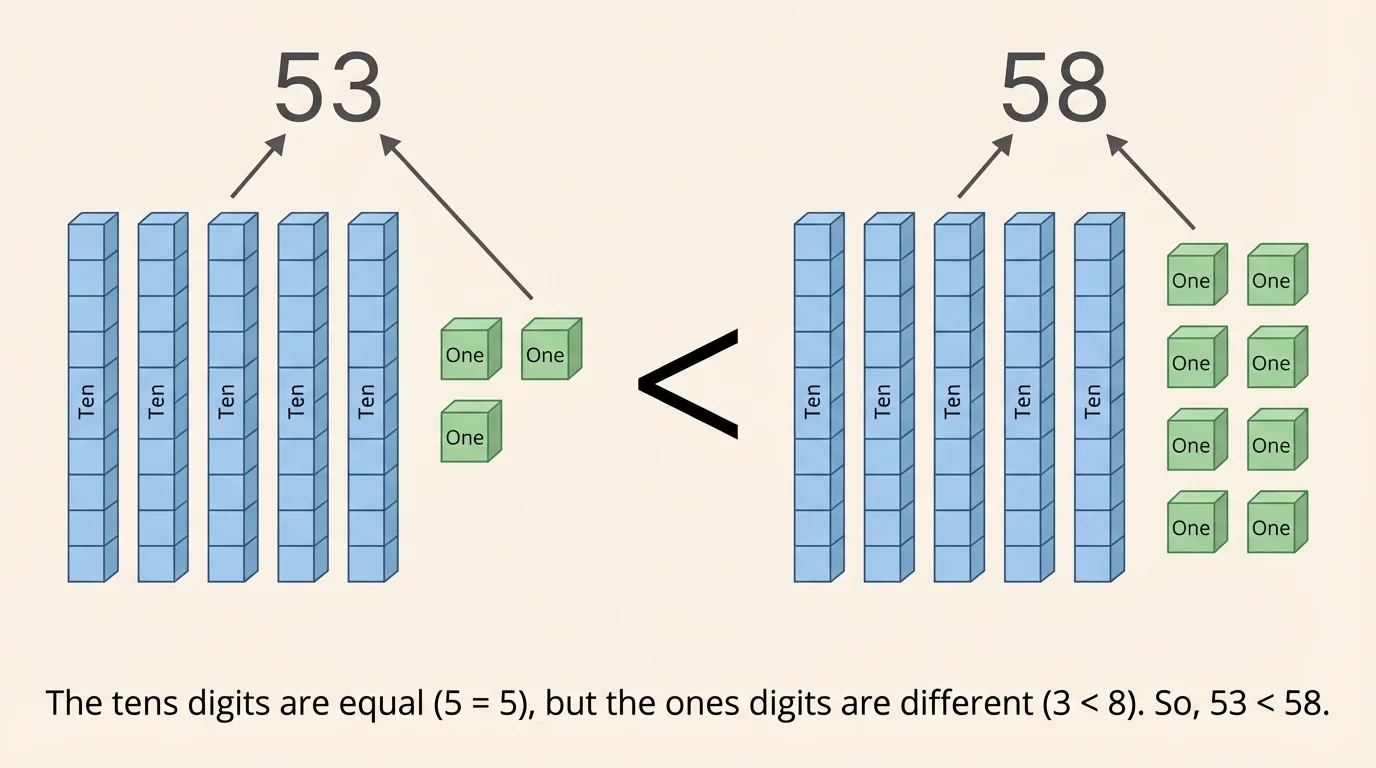
We write it like this: \(53 < 58\)
If both the tens digits and the ones digits are the same, then the numbers are equal. For example, \(44 = 44\)
We use comparison symbols to show which number is greater, smaller, or the same.
| Symbol | Meaning | Example |
|---|---|---|
| \(>\) | is greater than | \(72 > 68\) |
| \(<\) | is less than | \(25 < 31\) |
| \(=\) | is equal to | \(46 = 46\) |
Table 1. The meanings of the comparison symbols.
A good way to remember is that the open part of the symbol points to the greater number. So in \(19 < 24\), the open part faces \(24\), the larger number.
You already know how to count by tens and ones. Comparing two-digit numbers uses that same idea: first think about the tens, then think about the ones if you need to.
As we saw earlier in [Figure 1], numbers are made of tens and ones. That place-value idea helps every comparison you make.
Example 1
Compare \(26\) and \(41\).
Step 1: Look at the tens digits.
In \(26\), the tens digit is \(2\). In \(41\), the tens digit is \(4\).
Step 2: Compare the tens.
Since \(4 > 2\), \(4\) tens is more than \(2\) tens.
Step 3: Write the comparison.
\(26 < 41\)
The number \(41\) is greater.
In this example, we did not need to compare the ones digits because the tens digits were different.
Example 2
Compare \(67\) and \(63\).
Step 1: Look at the tens digits.
Both numbers have \(6\) tens.
Step 2: Look at the ones digits.
The ones digits are \(7\) and \(3\).
Step 3: Compare the ones.
Since \(7 > 3\), \(67\) is greater than \(63\).
Step 4: Write the comparison.
\(67 > 63\)
This matches the idea shown in [Figure 3]: if the tens are the same, the ones decide.
Example 3
Compare \(55\) and \(55\).
Step 1: Compare the tens digits.
Both numbers have \(5\) tens.
Step 2: Compare the ones digits.
Both numbers have \(5\) ones.
Step 3: Write the comparison.
\(55 = 55\)
The numbers are equal.
Equal numbers have the same tens and the same ones.
Even a tiny change in the tens digit changes a number by \(10\). Changing only the ones digit changes a number by just \(1\).
That is why the tens place is so important when comparing two-digit numbers.
Comparing numbers helps in everyday life. You might compare how many stickers are in two boxes, how many points two teams scored, or how many books are on two shelves.
Suppose one class collects \(38\) cans and another class collects \(42\) cans. Compare the tens first: \(3\) tens and \(4\) tens. Since \(4 > 3\), we know \(38 < 42\) The second class collected more cans.
Suppose two players score \(54\) points and \(59\) points. Both scores have \(5\) tens, so compare the ones: \(4 < 9\). Therefore, \(54 < 59\)
The same thinking works for seats on buses, toy cars in bins, or pages in books. Place value helps us decide quickly which amount is more.
One mistake is looking only at the ones digits. For example, in \(32\) and \(47\), the ones are \(2\) and \(7\), but you should compare the tens first. Since \(3\) tens is less than \(4\) tens, \(32 < 47\)
Another mistake is turning the symbol the wrong way. In \(61 > 16\), the open side faces \(61\), the greater number.
Think again about [Figure 2]: more tens means a greater number. That idea helps you avoid many mistakes.
