Have you ever seen things packed in groups, like crayons in boxes or straws tied in bundles? Grouping helps us count fast. Instead of counting one by one all the way to \(30\), we can think, "That is \(3\) tens!" That is what makes the numbers \(10, 20, 30, 40, 50, 60, 70, 80, 90\) so special.
These numbers are called tens numbers. Each one is made of some tens and no extra ones. When we say \(10\), we mean one ten. When we say \(20\), we mean two tens. When we say \(90\), we mean nine tens.
Here is the pattern:
\(10 = 1\) ten, \(20 = 2\) tens, \(30 = 3\) tens, \(40 = 4\) tens, \(50 = 5\) tens, \(60 = 6\) tens, \(70 = 7\) tens, \(80 = 8\) tens, and \(90 = 9\) tens.
You already know that \(10\) ones make one ten. So if you have \(2\) tens, that is the same as \(20\) ones, and if you have \(5\) tens, that is the same as \(50\) ones.
These numbers all have two digits. The first digit tells the number of tens. The second digit tells the number of ones. For these special numbers, the ones digit is always \(0\).
In [Figure 1], place value helps us see what each digit means. In a two-digit number, the digit on the left tells the tens, and the digit on the right tells the ones. For the tens numbers in this lesson, the right digit is always \(0\), so there are no ones left over.
For example, in \(40\), the \(4\) means \(4\) tens. The \(0\) means \(0\) ones. So \(40\) is \(4\) tens and \(0\) ones. In \(70\), the \(7\) means \(7\) tens and the \(0\) means \(0\) ones.
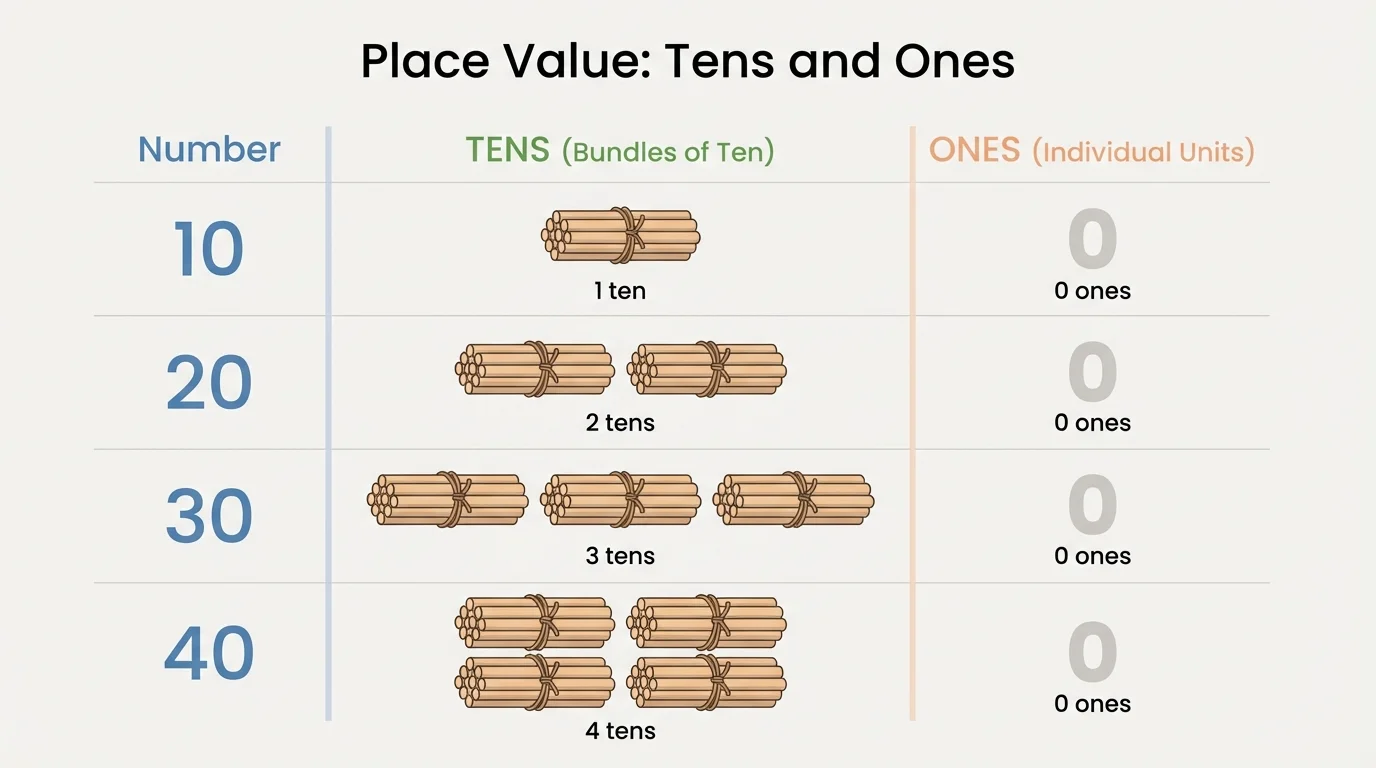
Tens digit means the digit that tells how many tens are in a two-digit number.
Ones digit means the digit that tells how many ones are in a two-digit number.
We can write these ideas with equations too:
\(10 = 1 \times 10 + 0\)
\(20 = 2 \times 10 + 0\)
\(30 = 3 \times 10 + 0\)
\(40 = 4 \times 10 + 0\)
\(50 = 5 \times 10 + 0\)
\(60 = 6 \times 10 + 0\)
\(70 = 7 \times 10 + 0\)
\(80 = 8 \times 10 + 0\)
\(90 = 9 \times 10 + 0\)
This is why all of these numbers end in \(0\). They are made of whole tens and no ones.
When we read tens numbers, we match the numeral, the word, and the number of tens, as [Figure 2] shows. This helps us understand that the number is not just a name. It tells us exactly how many groups of ten we have.
If the tens digit is \(3\), the number is \(30\), which means \(3\) tens. If the tens digit is \(8\), the number is \(80\), which means \(8\) tens. The ones digit is \(0\) in both cases.
| Number | Word | Tens | Ones |
|---|---|---|---|
| \(10\) | ten | \(1\) | \(0\) |
| \(20\) | twenty | \(2\) | \(0\) |
| \(30\) | thirty | \(3\) | \(0\) |
| \(40\) | forty | \(4\) | \(0\) |
| \(50\) | fifty | \(5\) | \(0\) |
| \(60\) | sixty | \(6\) | \(0\) |
| \(70\) | seventy | \(7\) | \(0\) |
| \(80\) | eighty | \(8\) | \(0\) |
| \(90\) | ninety | \(9\) | \(0\) |
Table 1. Tens numbers matched with their words and their numbers of tens and ones.
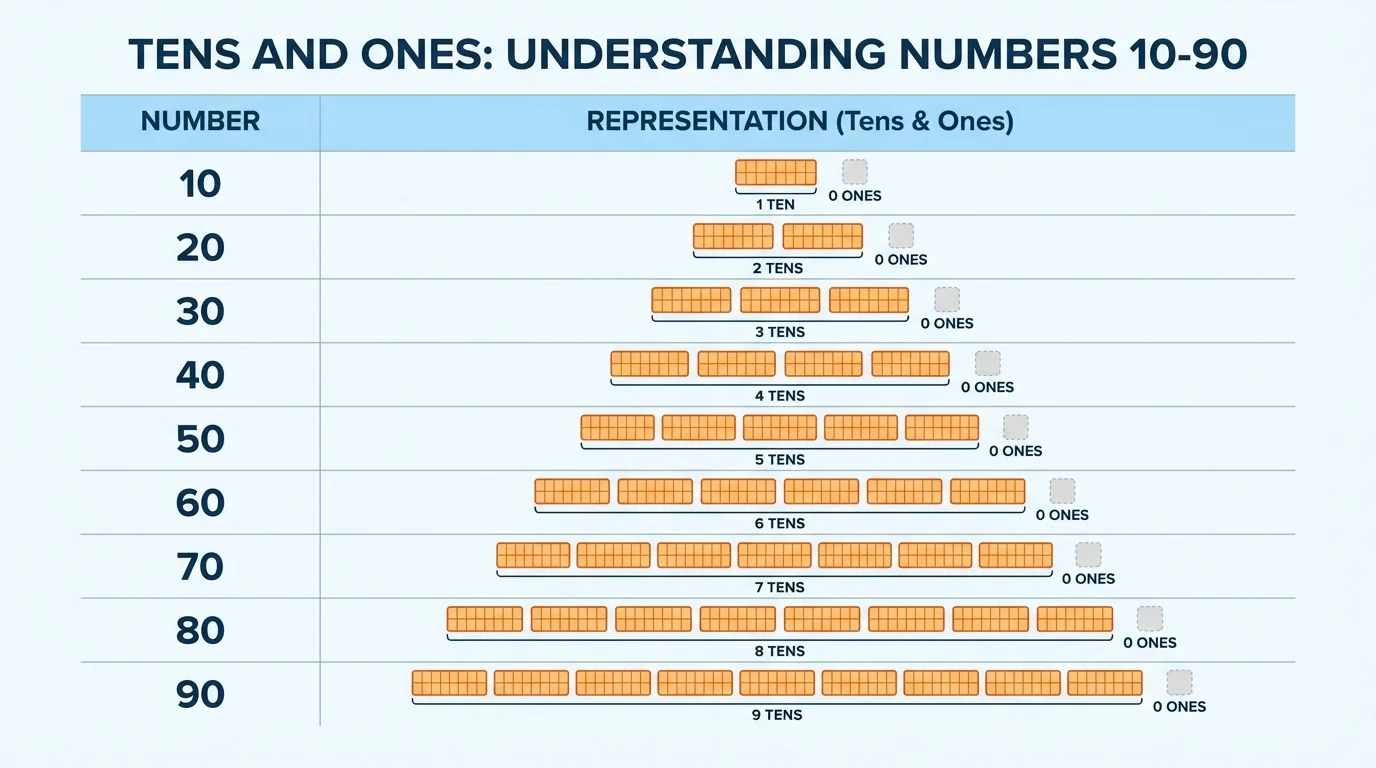
Notice a pattern: the numbers get bigger by one more ten each time. Going from \(20\) to \(30\) means adding one more ten. Going from \(60\) to \(70\) also means adding one more ten.
The number word forty is spelled without a u. It is \(40\), not another spelling that may look similar.
We can also compare tens numbers. Since \(5\) tens is more than \(3\) tens, \(50 > 30\). Since \(7\) tens is less than \(9\) tens, \(70 < 90\).
Let's look at some step-by-step examples. Each one uses tens and ones.
Example 1: What does \(20\) mean?
Step 1: Look at the tens digit.
In \(20\), the tens digit is \(2\).
Step 2: Look at the ones digit.
In \(20\), the ones digit is \(0\).
Step 3: Say what the number means.
\(20\) means \(2\) tens and \(0\) ones.
So, \(20\) is two tens.
That same idea works for every tens number. The left digit tells the tens, and the right digit stays \(0\).
Example 2: Build a number from tens
A student has \(6\) groups of ten blocks and no single blocks. What number is that?
Step 1: Count the tens.
There are \(6\) tens.
Step 2: Count the ones.
There are \(0\) ones.
Step 3: Write the number.
\(6\) tens and \(0\) ones is \(60\).
The number is \(60\).
When there are no ones, the number ends with \(0\). That is a big clue.
Example 3: Which number is greater, \(40\) or \(90\)?
Step 1: Compare the tens.
\(40\) has \(4\) tens. \(90\) has \(9\) tens.
Step 2: Decide which has more tens.
Since \(9 > 4\), \(9\) tens is more than \(4\) tens.
Step 3: State the comparison.
\(90 > 40\).
So, \(90\) is greater.
Here is one more example to make the pattern extra clear.
Example 4: Write the number for \(8\) tens and \(0\) ones
Step 1: Put the tens digit first.
\(8\) tens means the tens digit is \(8\).
Step 2: Put the ones digit second.
\(0\) ones means the ones digit is \(0\).
Step 3: Write the full number.
The number is \(80\).
So, \(8\) tens and \(0\) ones is \(80\).
We use tens numbers all the time. A teacher might count straws in bundles of \(10\). If there are \(3\) bundles, that is \(30\) straws. If there are \(7\) bundles, that is \(70\) straws.
A box might hold \(10\) markers. Then \(5\) full boxes hold \(50\) markers. This is easier than counting each marker one by one. Thinking in tens helps us count quickly and clearly.
Why grouping by ten helps
Our number system is built on groups of ten. When we see a tens number, we can think of equal groups. That makes counting, comparing, and building numbers much easier.
Later, when we see numbers like \(24\) or \(68\), the same idea still works. But those numbers have tens and some ones. For example, \(24\) is \(2\) tens and \(4\) ones. That is different from \(20\), which is \(2\) tens and \(0\) ones.
[Figure 3] Counting by tens is like making big jumps on a number line. Each jump adds one more ten. When we count forward by tens, we say \(10, 20, 30, 40, 50, 60, 70, 80, 90\).
If we count backward by tens, we can say \(90, 80, 70, 60, 50, 40, 30, 20, 10\). Each step changes by \(10\).
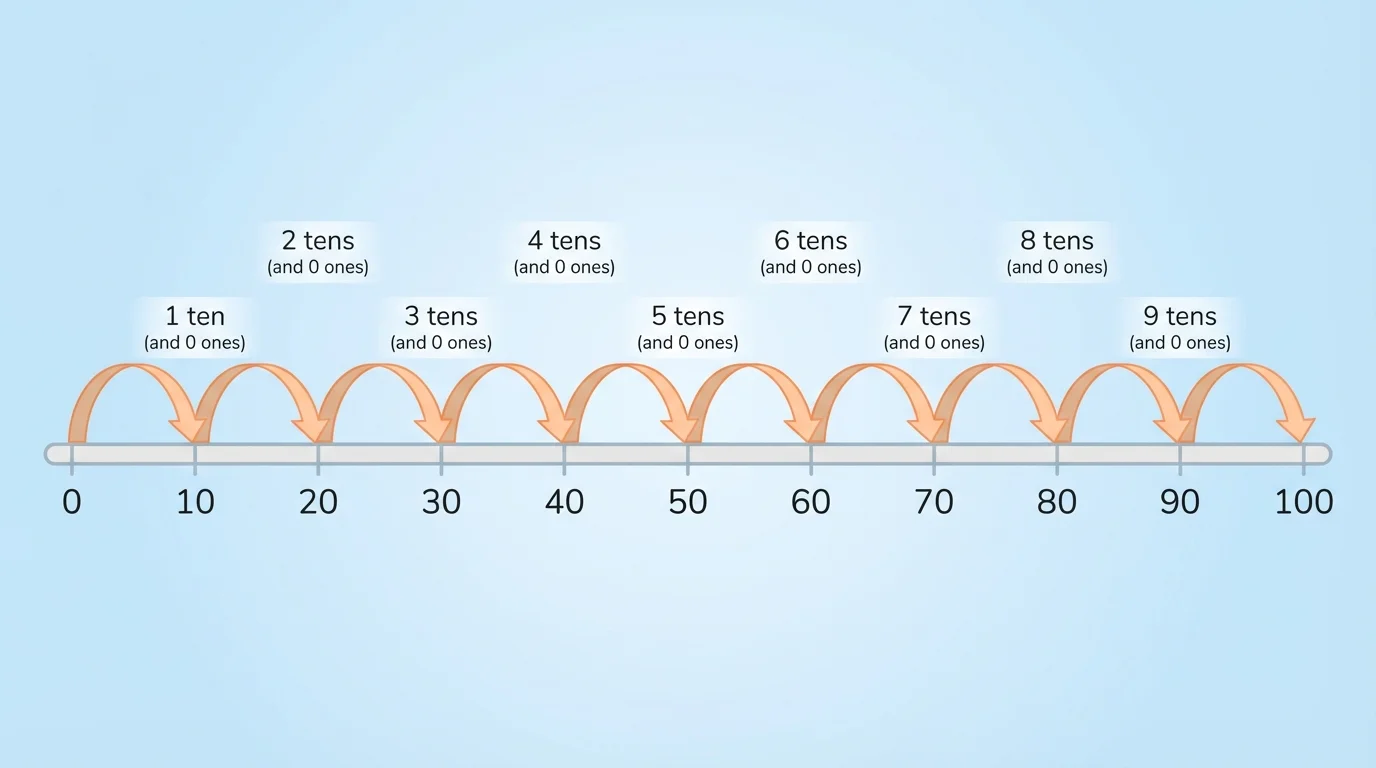
We can write these jumps with simple number sentences: \(10 + 10 = 20\), \(20 + 10 = 30\), and \(80 + 10 = 90\). We can also go back: \(90 - 10 = 80\), \(50 - 10 = 40\).
Looking back at [Figure 1], each new bundle of ten makes the number grow by one ten. Looking at [Figure 2], the numeral and number word match that same pattern.
Sometimes numbers can look a little alike, but place value helps us. The number \(20\) is not the same as \(2\). The number \(2\) means two ones. The number \(20\) means two tens.
Also, \(30\) is not the same as \(13\). The number \(30\) has \(3\) tens and \(0\) ones. The number \(13\) has \(1\) ten and \(3\) ones.
If the ones digit is \(0\), the number is a tens number. If the ones digit is not \(0\), then the number has some extra ones too.
"The digits tell a story about how many tens and how many ones a number has."
So when you see \(50\), think: \(5\) tens, \(0\) ones. When you see \(90\), think: \(9\) tens, \(0\) ones. That is the special idea for all the tens numbers in this lesson.
