If you have 23 toy cars and then get 4 more, how can you find the total quickly? Big numbers can look tricky at first, but they become easier when we notice how numbers are built. In math, we can break numbers into tens and ones and use that idea to add in smart ways.
[Figure 1] A two-digit number has a place value structure. The first digit tells how many tens. The second digit tells how many ones. For example, the two-digit number 34 means 3 tens and 4 ones. We can write this as \(34 = 30 + 4\).
Thinking about numbers in parts helps us add. When we add, we add tens to tens and ones to ones. Sometimes the ones make a new ten.
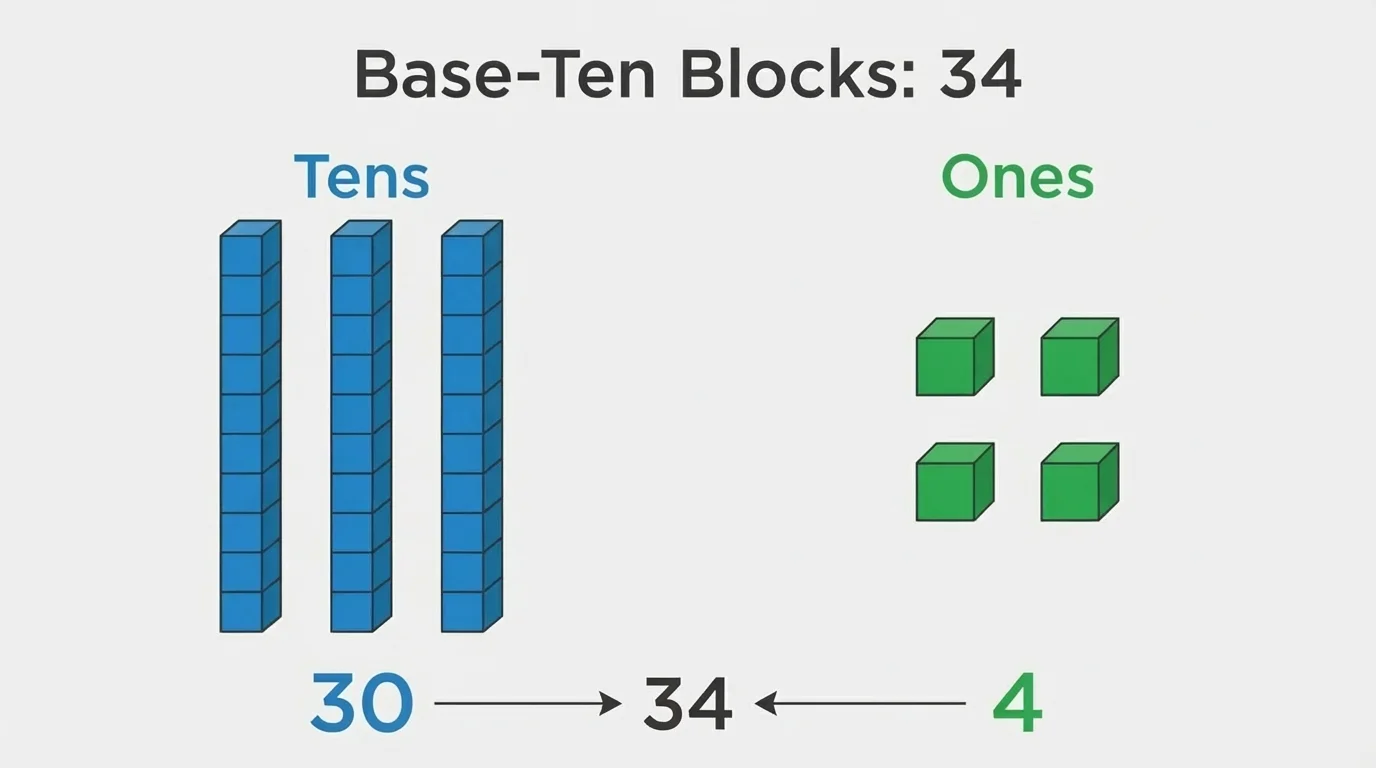
Here are some examples of two-digit numbers written in tens and ones:
| Number | Tens | Ones | Expanded Form |
|---|---|---|---|
| \(26\) | \(2\) | \(6\) | \(20 + 6\) |
| \(41\) | \(4\) | \(1\) | \(40 + 1\) |
| \(58\) | \(5\) | \(8\) | \(50 + 8\) |
Table 1. Two-digit numbers shown as tens and ones.
Place value means each digit in a number has a job. In a two-digit number, one digit tells the tens and one digit tells the ones.
When you understand tens and ones, adding gets much easier because you can work with small parts of a number instead of the whole number all at once.
When you add a two-digit number and a one-digit number, you usually add the ones first. For example, in \(23 + 4\), the number \(23\) has \(2\) tens and \(3\) ones. The number \(4\) has \(4\) ones. Add the ones: \(3 + 4 = 7\). The tens stay the same, so \(23 + 4 = 27\).
This works because \(23 = 20 + 3\). Then \((20 + 3) + 4 = 20 + 7 = 27\). We used place value to break apart the number and put it back together.
Solved example 1
Find \(32 + 5\).
Step 1: Break the two-digit number into tens and ones.
\(32 = 30 + 2\)
Step 2: Add the ones.
\(2 + 5 = 7\)
Step 3: Put the tens and ones back together.
\(30 + 7 = 37\)
So, \(32 + 5 = 37\)
You can also show this with a written method. Line up the ones under the ones place.
\[\begin{array}{r} 32 \\ +\;5 \\ \hline 37 \end{array}\]
We added the ones: \(2 + 5 = 7\). The tens stayed \(3\) tens.
[Figure 2] Sometimes the ones add to 10 or more. Then we compose a ten, or make a new group of ten.
Look at \(28 + 7\). The number \(28\) has \(2\) tens and \(8\) ones. Add \(7\) more ones. Now there are \(15\) ones. But \(15\) ones can be changed into \(1\) ten and \(5\) ones. So now we have \(3\) tens and \(5\) ones, which is \(35\). The ones are traded for a new ten, which helps us keep tens and ones organized.
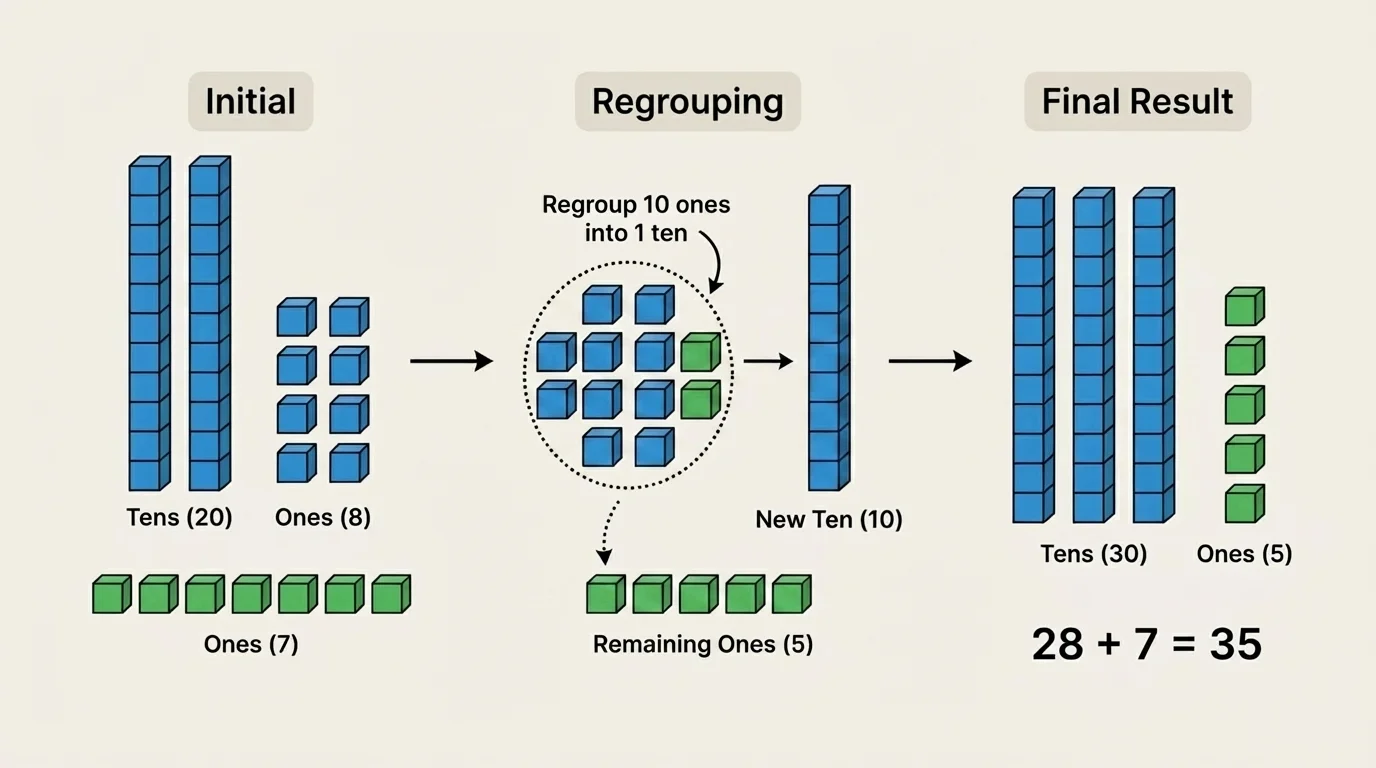
This is why we say sometimes it is necessary to make a new ten. We do not lose any ones. We just regroup them in a better way.
Making a new ten happens when the ones in an addition problem reach at least \(10\). Since \(10\) ones equal \(1\) ten, we move that group into the tens place.
The written method also shows this idea clearly.
Solved example 2
Find \(28 + 7\).
Step 1: Add the ones.
\(8 + 7 = 15\)
Step 2: Change \(15\) ones into \(1\) ten and \(5\) ones.
Now the tens are \(2 + 1 = 3\) tens.
Step 3: Write the answer.
\(3\) tens and \(5\) ones make \(35\).
So, \(28 + 7 = 35\)
Here is the vertical form:
\[\begin{array}{r} 28 \\ +\;7 \\ \hline 35 \end{array}\]
First we add the ones. Since \(8 + 7 = 15\), we write \(5\) ones and make \(1\) new ten. Later, when you do bigger addition problems, this idea will help you a lot.
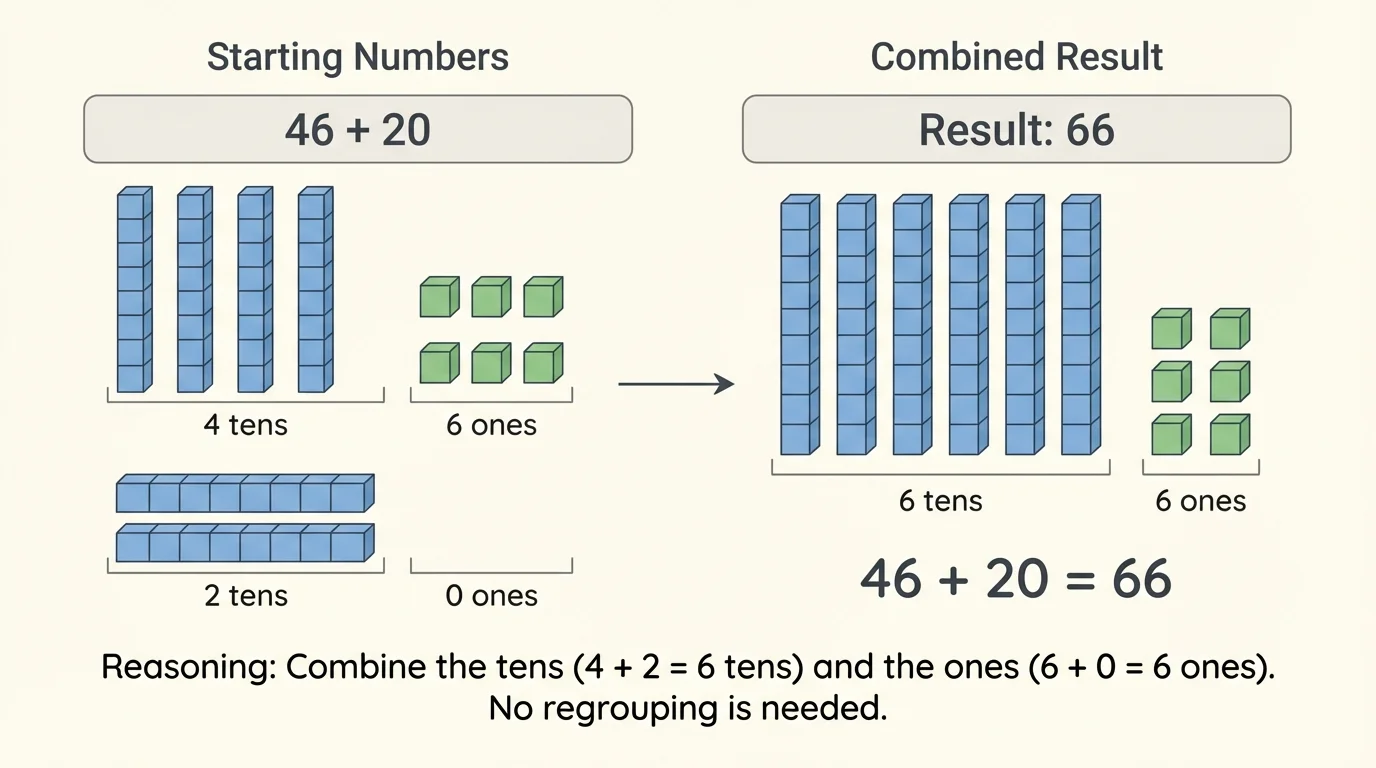
[Figure 3] A multiple of 10 is a number like \(10\), \(20\), \(30\), or \(40\). These numbers have only tens and no extra ones. When we add a multiple of \(10\) to a two-digit number, we add tens to tens. The ones stay the same.
For example, in \(46 + 20\), the number \(46\) has \(4\) tens and \(6\) ones. The number \(20\) has \(2\) tens. Add the tens: \(4 + 2 = 6\) tens. The ones are still \(6\). So \(46 + 20 = 66\).
Solved example 3
Find \(57 + 30\).
Step 1: Break apart the numbers.
\(57 = 50 + 7\) and \(30 = 30\)
Step 2: Add the tens.
\(50 + 30 = 80\)
Step 3: Keep the ones.
\(80 + 7 = 87\)
So, \(57 + 30 = 87\)
The vertical method looks like this:
\[\begin{array}{r} 57 \\ +\;30 \\ \hline 87 \end{array}\]
We add the tens: \(5\) tens plus \(3\) tens equals \(8\) tens. The ones digit stays \(7\).
Math is powerful because one problem can be solved in more than one way. For \(36 + 8\), you might add the ones: \(6 + 8 = 14\), then make a new ten and get \(44\). You can also think, "What does \(36\) need to get to \(40\)?" It needs \(4\). Since \(8 = 4 + 4\), you can do \(36 + 4 = 40\), then \(40 + 4 = 44\).
This strategy is called making a friendly ten. It uses the idea that numbers can be broken apart. Because \(8\) can be split into \(4\) and \(4\), the total stays the same.
Another helpful idea is the relationship between addition and subtraction. If \(36 + 8 = 44\), then \(44 - 8 = 36\). Subtraction can help us check whether our addition answer makes sense.
Solved example 4
Find \(36 + 8\) by making a ten.
Step 1: Think about the next ten after \(36\).
\(36 + 4 = 40\)
Step 2: Split \(8\) into \(4 + 4\).
Use one \(4\) to get to \(40\).
Step 3: Add the rest.
\(40 + 4 = 44\)
So, \(36 + 8 = 44\)
The regrouping idea from [Figure 2] and the tens idea from [Figure 3] both help here. We are always watching the tens and ones carefully.
Our number system is called base ten because ten ones make one ten. That is exactly why making a new ten works in addition.
When you solve addition problems, it is good to explain your thinking. You might say, "I added the ones first," or "I made a new ten," or "I added tens to tens and kept the ones the same." Explaining helps your math grow stronger.
Addition within \(100\) is useful every day. If a class has \(24\) crayons and gets \(5\) more, the class has \(29\) crayons. If a shelf has \(43\) books and someone puts \(20\) more on it, there are \(63\) books. These are the same math ideas you use on paper.
When you count stickers, toys, blocks, or snacks, you are often adding ones or tens. Place value helps you count quickly and carefully.
You can use subtraction to check an addition problem. If you think \(57 + 30 = 87\), then try \(87 - 30\). If you get \(57\), your addition is correct.
You can also ask whether your answer is reasonable. In \(28 + 7\), the answer should be more than \(28\). It should also be close to \(35\) because \(28\) is close to \(30\), and \(30 + 7 = 37\). A check like this helps you notice mistakes.
Remember that \(10\) ones make \(1\) ten, and numbers like \(20\), \(30\), and \(40\) are groups of tens.
As we saw earlier with [Figure 1], numbers are built from tens and ones. That simple idea helps you add many kinds of numbers within \(100\).
