Have you ever counted things in groups to make counting faster? If you have a box with \(70\) crayons, you do not have to count each crayon one by one. You can think of \(70\) as seven tens. That same smart idea helps us subtract, too. When we subtract numbers like \(70 - 30\), we are really taking away three tens from seven tens.
When a number ends in \(0\), like \(10\), \(20\), \(50\), or \(90\), it can be a group of tens. A multiple of 10 is a number you get by counting by tens: \(10, 20, 30, 40, 50, 60, 70, 80, 90\).
These numbers have a tens part and a ones part. For example, \(40\) means \(4\) tens and \(0\) ones. \(80\) means \(8\) tens and \(0\) ones. This is called place value. Place value helps us see what each digit means.
Tens are groups of \(10\). A number like \(60\) has \(6\) tens and \(0\) ones. Subtract means to take away. When we subtract multiples of \(10\), we can think about taking away whole tens.
If we know that \(50\) is \(5\) tens, then \(50 - 20\) means \(5\) tens minus \(2\) tens. That leaves \(3\) tens, which is \(30\).
In [Figure 1], we can use a model to show subtraction. A model is a picture or object that helps us think. One good model is tens rods or quick drawings of long sticks for tens.
Start with \(7\) tens. Cross out \(3\) tens. Count the tens left. There are \(4\) tens left, so \(70 - 30 = 40\).
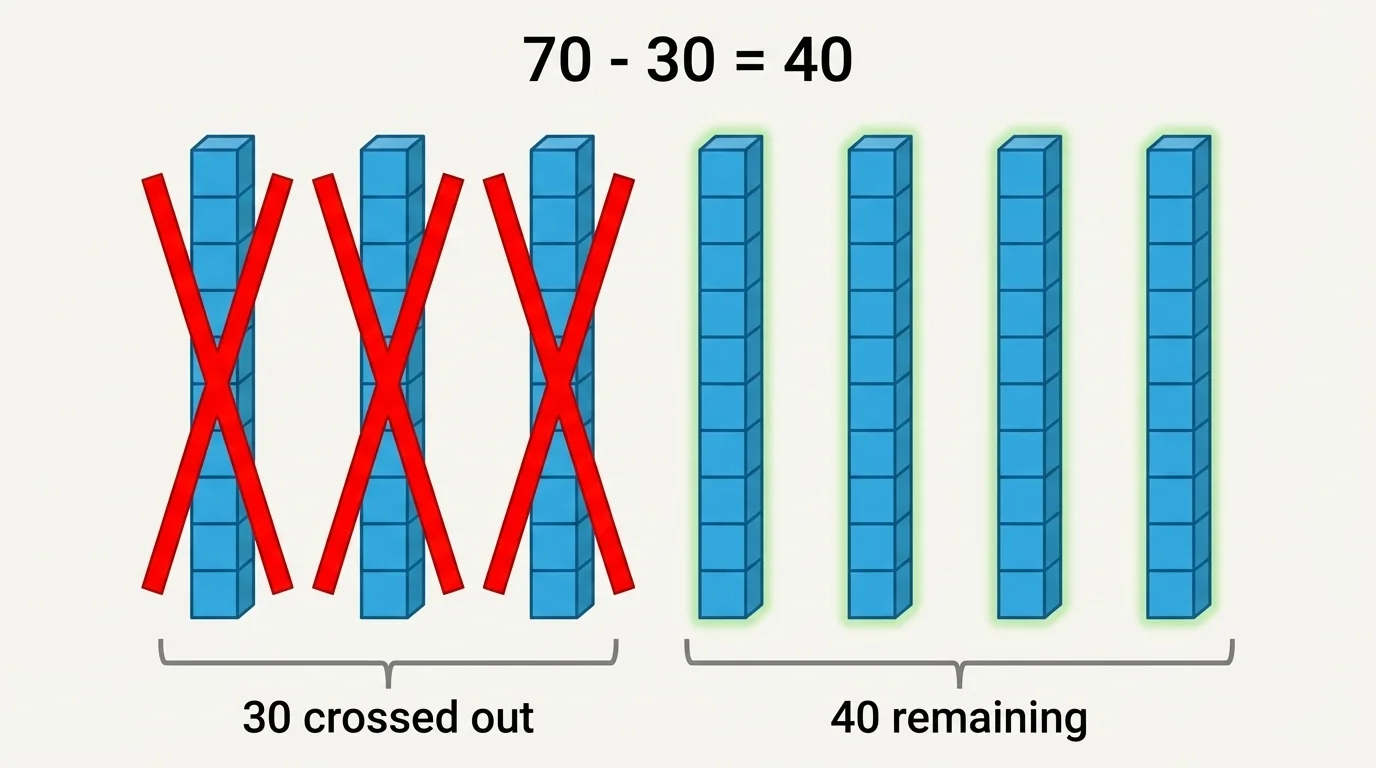
You can do the same with circles grouped into tens, linking cubes connected in sets of \(10\), or drawn bundles of straws. The important idea is that we are not taking away single ones. We are taking away whole tens.
Look at another one: \(90 - 50\). Think of \(90\) as \(9\) tens. Take away \(5\) tens. That leaves \(4\) tens. So \(90 - 50 = 40\).
Solved example 1
Find \(60 - 20\).
Step 1: Think in tens.
\(60\) is \(6\) tens, and \(20\) is \(2\) tens.
Step 2: Subtract the tens.
\(6\) tens \(-\) \(2\) tens \(= 4\) tens.
Step 3: Write the answer as a number.
\(4\) tens is \(40\).
So, \[60 - 20 = 40\]
Notice that the ones stay \(0\). That happens because both numbers are made of only tens.
Place value makes subtraction simple. If both numbers have \(0\) ones, we can look at just the tens. For \(80 - 30\), think: \(8\) tens minus \(3\) tens equals \(5\) tens. So the answer is \(50\).
This works because \(80 = 8\) tens and \(30 = 3\) tens. When we subtract, we subtract the number of tens: \(8 - 3 = 5\). Then we write \(5\) tens as \(50\).
Why this works
Each ten is worth \(10\). If you have \(7\) tens and take away \(2\) tens, you still have whole tens left. So \(70 - 20\) is the same idea as \(7 - 2\), but the answer is in tens: \(5\) tens, or \(50\).
We can even think about zero difference. If we subtract the same amount, nothing is left. For example, \(40 - 40 = 0\). We started with \(4\) tens and took away \(4\) tens.
Solved example 2
Find \(40 - 40\).
Step 1: Name the tens.
\(40\) is \(4\) tens.
Step 2: Take away the same tens.
\(4\) tens \(-\) \(4\) tens \(= 0\) tens.
Step 3: Write the result.
\(0\) tens is \(0\).
So, \(40 - 40 = 0\)
The drawing showed that crossing out tens helps us see what is left. Place value thinking does the same thing in our minds.
Subtraction and addition are connected. If you know \(50 - 20 = 30\), then you can check by adding: \(30 + 20 = 50\). The answer to the subtraction problem is the difference, and \(30 + 20 = 50\) is the related addition fact.
Here is another one: if \(90 - 60 = 30\), then check with \(30 + 60 = 90\). If the addition makes the starting number, the subtraction makes sense.
You already know how to count by tens: \(10, 20, 30, 40, 50, 60, 70, 80, 90\). Subtracting multiples of \(10\) uses that same counting-by-tens idea, but now we count backward or take away groups of ten.
This relationship also helps when one number is missing. For example, to solve \(70 - 30\), you can ask, "\(30\) and what number make \(70\)?" The answer is \(40\), because \(30 + 40 = 70\).
We can also write subtraction in vertical format. This written method matches the place value idea. We line up the tens above the tens and the ones above the ones.
In [Figure 2], for \(80 - 50\), the \(8\) and \(5\) are in the tens place. The \(0\) and \(0\) are in the ones place. We subtract the ones first: \(0 - 0 = 0\). Then we subtract the tens: \(8 - 5 = 3\). The answer is \(30\).
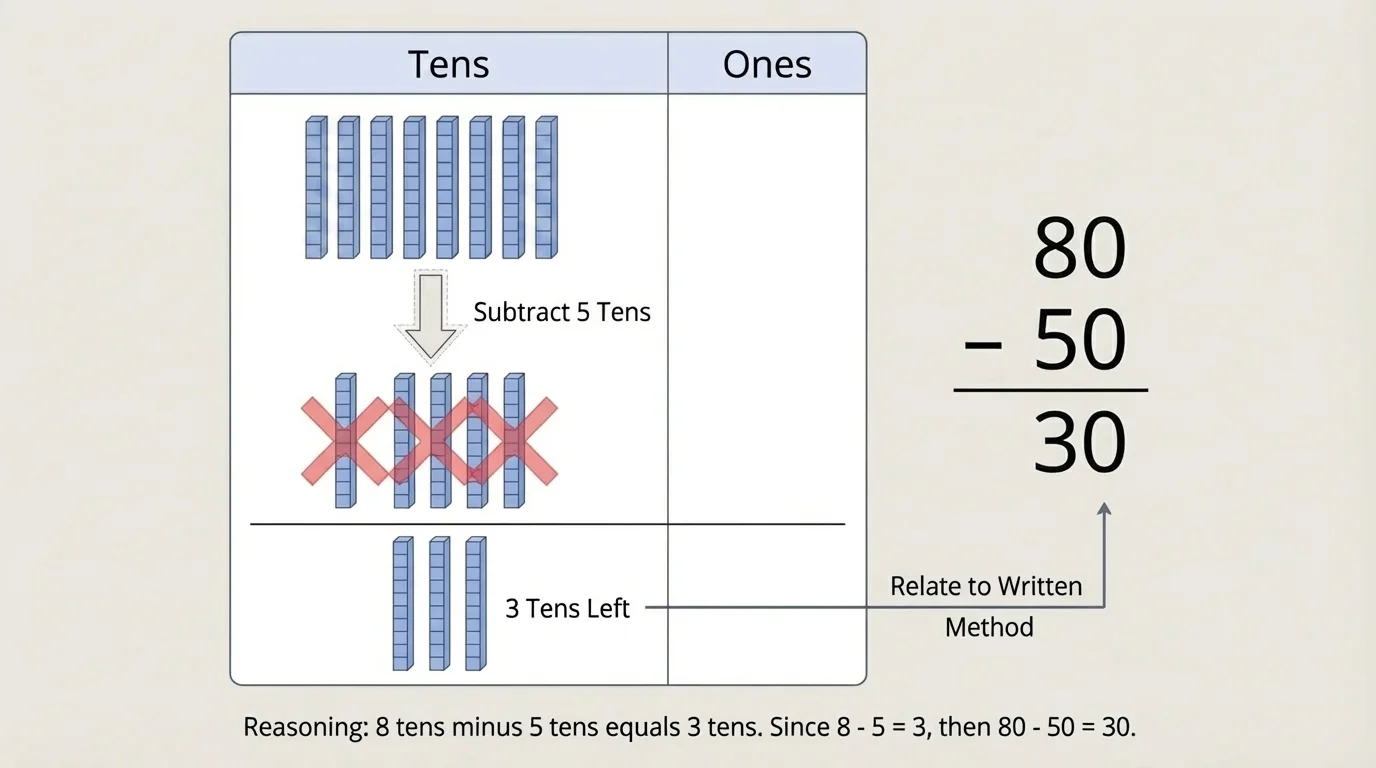
Here is the written method:
\[\begin{array}{r} 80 \\-\;50 \hline30\end{array}\]
We can read that as: \(8\) tens minus \(5\) tens equals \(3\) tens. The \(0\) ones stay \(0\).
Solved example 3
Find \(90 - 10\) and show a written method.
Step 1: Think about tens.
\(90\) is \(9\) tens. \(10\) is \(1\) ten.
Step 2: Subtract the tens.
\(9\) tens \(-\) \(1\) ten \(= 8\) tens.
Step 3: Write it vertically.
\[\begin{array}{r} 90 \\-\;10 \hline80\end{array}\]
So, \[90 - 10 = 80\]
When you line up the numbers correctly, the written method and the tens-thinking method give the same answer.
Subtracting tens happens in everyday life. If a classroom has \(70\) blocks and \(20\) are put away, then \(70 - 20 = 50\) blocks are still out. If there are \(60\) stickers and \(30\) are given away, then \(30\) stickers remain.
You might also use it in games. If a team starts with \(80\) points in a challenge and loses \(40\) points, the team has \(40\) points left. Thinking in tens helps you solve it quickly.
Counting and subtracting by tens is a big shortcut. Instead of thinking about \(70\) tiny ones, you can think about just \(7\) big groups of ten.
The place-value chart still helps us remember why vertical subtraction works: each digit has a job in its own place.
There are a few important things to remember. First, in this kind of subtraction, the first number is the same as or greater than the second number, so the answer is greater than or equal to \(0\). For example, \(50 - 20 = 30\) and \(30 - 30 = 0\).
Second, keep thinking in tens. For \(70 - 40\), do not say \(3\). The answer is \(3\) tens, which is \(30\).
Third, line up places when you use the written method. Tens go under tens, and ones go under ones. That is why \(60 - 50 = 10\), not \(1\). It is \(1\) ten.
With drawings, place value, addition facts, and vertical subtraction, you have more than one smart way to subtract multiples of \(10\).
