How can you find out how long your pencil is if you do not have a ruler? You can still measure it. You can use small objects, like cubes or paper clips, and line them up from one end of the pencil to the other. When we do this carefully, we learn the pencil's length by counting the units.
Length tells how long something is from one end to the other end. A book has a length. A crayon has a length. Your desk has a length too.
When we measure length, we are finding out how many small equal pieces fit along the object. If an eraser is as long as \(3\) units of cubes, then the cubes help us tell the eraser's length.
Length is how long an object is from one end to the other.
Unit is the small object or amount we use to measure.
Measure means to find out how long something is by using units.
We are not guessing. We are counting carefully. If an object is covered by \(6\) equal cubes lined up end to end, then its length is \(6\) cube lengths.
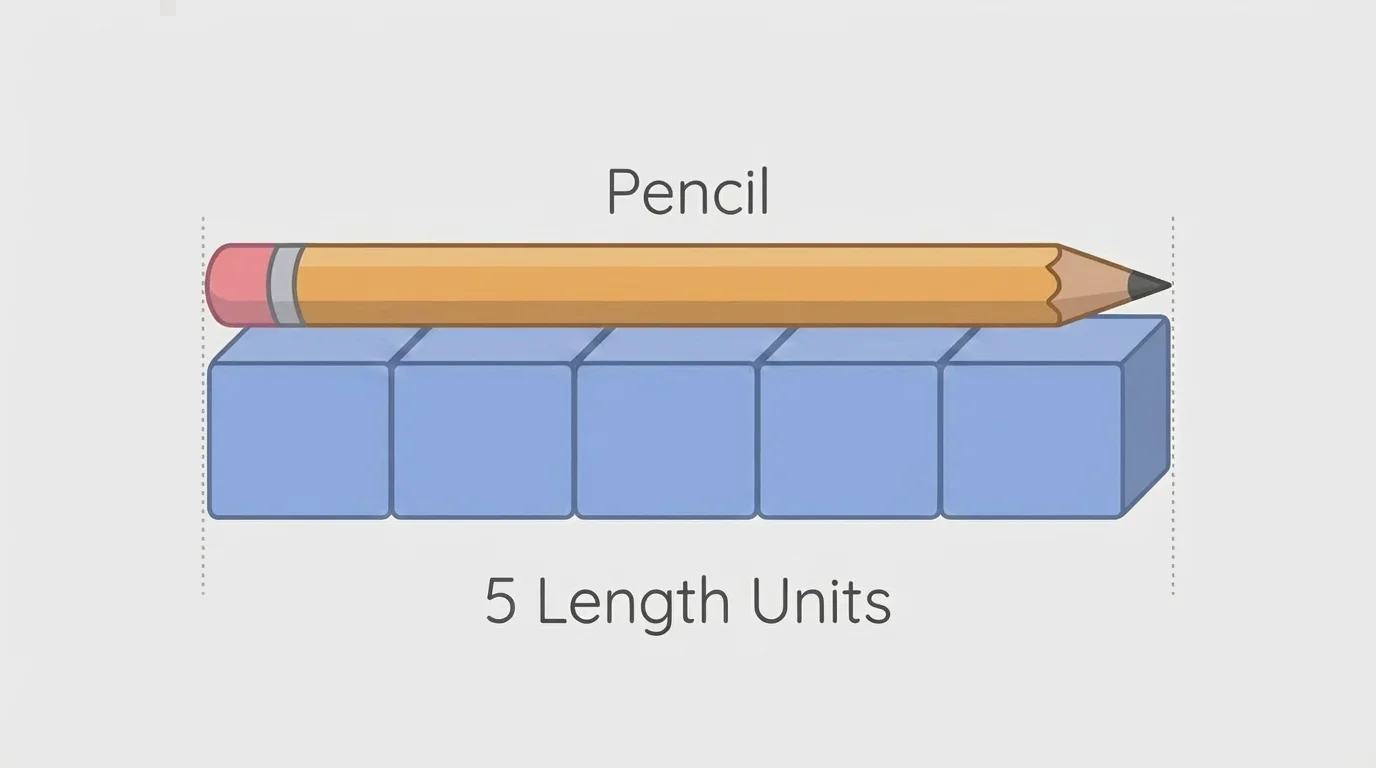
A length unit is the shorter object we use to measure something longer. We place copies of that unit in a line, one after another. The units must touch, with no spaces in between and no pieces covering the same spot, as [Figure 1] shows.
If we use cubes to measure a marker, we begin at one end of the marker. Then we put the first cube right at the end. Next, we put another cube touching it. We keep going until we reach the other end of the marker.
All the units should be the same size. If one cube is big and one cube is small, the measurement will not be accurate. Equal units help everyone get the same answer.
When you count objects, each object gets one count. Measuring works the same way. Each length unit counts once.
You can measure with cubes, tiles, craft sticks, or paper clips if they are all the same size. The important idea is that each unit is equal to the others.
After the units are lined up correctly, we count them. The number of units tells the object's length. Careful placement matters because a gap or an overlap can change the count, as [Figure 2] illustrates.
Suppose a ribbon is covered by \(4\) equal paper clips placed end to end. Then the ribbon is \(4\) paper clips long. If a toy car is covered by \(7\) small cubes, then the toy car is \(7\) cube lengths long.
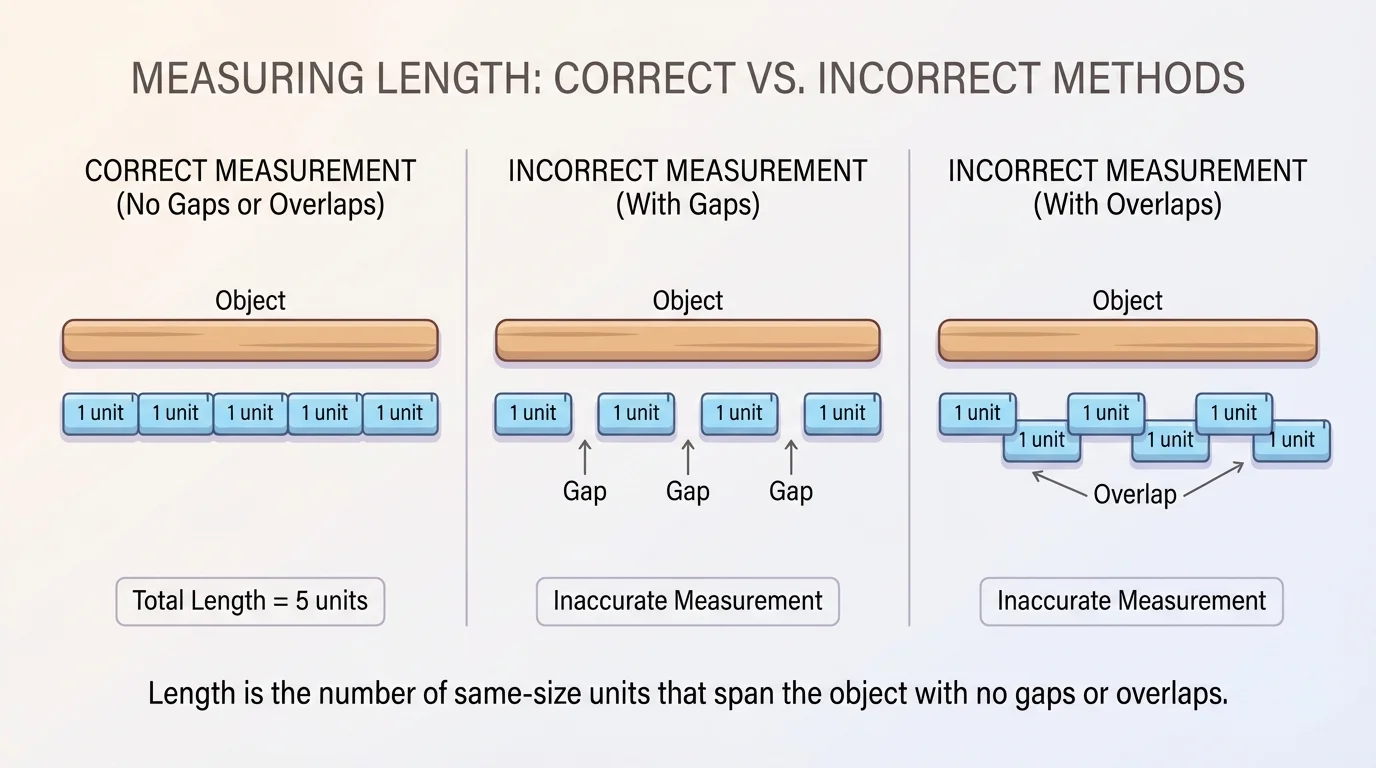
We can say the measurement in words: "The book is \(5\) cubes long." We can also say, "Its length is \(5\) cube lengths." Both mean the number of same-size units that span the object.
If the units stop before the end, the object is longer than the count you have. If the units go past the end, the count is too much. Good measuring means matching the object from one end to the other end.
How measuring works
Measuring length is really counting equal spaces. Each same-size unit covers one part of the object. When the whole object is covered with no gaps or overlaps, the total number of units tells the length.
When you look back at [Figure 1], you can see why the units must form one straight row along the object. That helps us count the exact length.
Let's see how to measure by using equal units and careful counting.
Worked example 1
A crayon is measured with cubes. There are \(5\) cubes lined up from one end of the crayon to the other.
Step 1: Look at the measuring units.
The cubes are the same size, so they are equal units.
Step 2: Count the cubes.
There are \(5\) cubes.
Step 3: Tell the length.
The crayon is \(5\) cubes long.
Answer: The crayon's length is \(5\) cube lengths.
Notice that we did not skip any cubes and we did not count any cube twice.
Worked example 2
A small book is measured with paper clips. The paper clips are all the same size. There are \(6\) paper clips from one end of the book to the other.
Step 1: Check the units.
All paper clips are the same size.
Step 2: Count the units.
\(1, 2, 3, 4, 5, 6\)
Step 3: Write the measurement.
The book is \(6\) paper clips long.
Answer: The book is \(6\) paper clips long.
We can measure many classroom objects this way, even when we do not use inches or centimeters.
Worked example 3
A desk edge is measured with tiles. One tile is placed on top of another by mistake, so the tiles overlap.
Step 1: Find the mistake.
The tiles overlap, so they do not each cover their own space.
Step 2: Fix the line of tiles.
Place the tiles end to end so they touch but do not cover each other.
Step 3: Count again.
Now there are \(8\) tiles in a correct row.
Answer: The desk edge is \(8\) tiles long when measured correctly.
This example shows that careful placement changes the answer. That is why measuring is more than just counting. We must line up the units correctly first.
If one child uses big paper clips and another child uses small paper clips, they may get different numbers for the same object. That happens because the units are not equal. Accurate measurement uses same-size units, as [Figure 3] makes clear.
For example, one ribbon might be \(4\) large clips long, but \(6\) small clips long. The ribbon did not change. The unit changed. So we must always pay attention to what unit we are using.
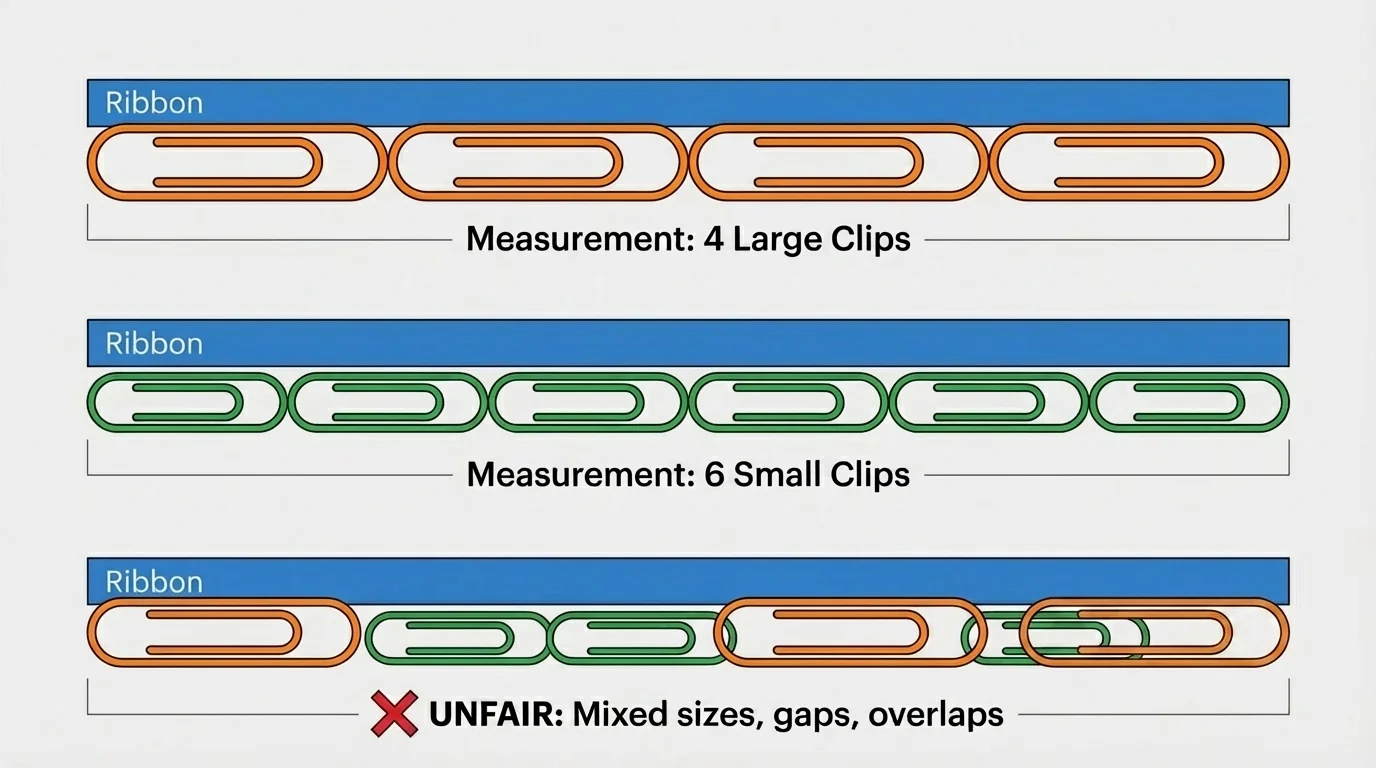
Mixed units are not a good measuring tool. If we use one large clip, one small clip, and one medium clip together, the count does not tell a clear length.
Builders, tailors, and scientists all need measurements they can trust. Even when the units are fancy tools, the big idea is the same: use equal units carefully.
Looking again at [Figure 2], we can also see that same-size units are not enough by themselves. The units must also be lined up with no gaps and no overlaps.
Measuring length helps us every day. A teacher may check whether a shelf is long enough for books. A child may see how long a string needs to be for an art project. A carpenter measures wood before cutting it.
Even when adults use rulers and tape measures, they are still using units. A ruler has many equal units marked on it. The idea is just like using cubes lined up end to end.
If a garden marker is \(3\) craft sticks long, that tells us something useful. If a table is \(10\) cubes long, we can compare it to another table that is \(8\) cubes long. Since \(10 > 8\), the first table is longer when both are measured with the same unit.
Good measurers follow a few important habits. Start at one end of the object. Put the first unit right there. Keep all the units in one straight line. Make sure they touch. Count each unit once.
If the object is curved or the units are crooked, the measurement may not be correct. Straight lines help us measure length clearly. That is why the row of cubes in [Figure 1] is so neat and easy to count.
Sometimes you may need to measure again. That is a smart idea. Measuring twice helps you check your answer.
| Careful measuring | Not careful measuring |
|---|---|
| Units are the same size | Units are different sizes |
| Units touch end to end | There are gaps |
| No units cover each other | Units overlap |
| Count each unit once | Skip or double-count units |
Table 1. This table compares correct measuring habits with mistakes that make measurements inaccurate.
When we measure, we are really answering one question: "How many same-size units fit along this object?" That number is the length.
