Have you ever had three crayons on your desk and wondered which one is the longest? It can feel like a tiny mystery, but math gives us a smart way to find out. When we compare lengths, we are looking at how long objects are from one end to the other. We can compare objects that are side by side, and we can also compare them indirectly by using a third object to help.
Length tells how long something is. A pencil, a book, and a ribbon all have length. When we compare lengths, we use words like longer, shorter, and same length.
Length is the distance from one end of an object to the other end.
Order means to put things in a list, such as from shortest to longest.
Compare indirectly means to use another object to help compare two things when they are not together.
For example, if a red crayon is longer than a blue crayon, we can say the red crayon is longer and the blue crayon is shorter. If two straws match exactly from end to end, they are the same length.
To put three objects in order, look carefully at all three. A good way is to line up one end of each object at the same starting place. Then you can see which object stops first, which stops next, and which goes farthest. This is how we order objects from shortest to longest, as shown in [Figure 1].
Suppose you have a spoon, a marker, and a paintbrush. If the spoon ends first, the marker ends next, and the paintbrush goes the farthest, then the order from shortest to longest is: spoon, marker, paintbrush.
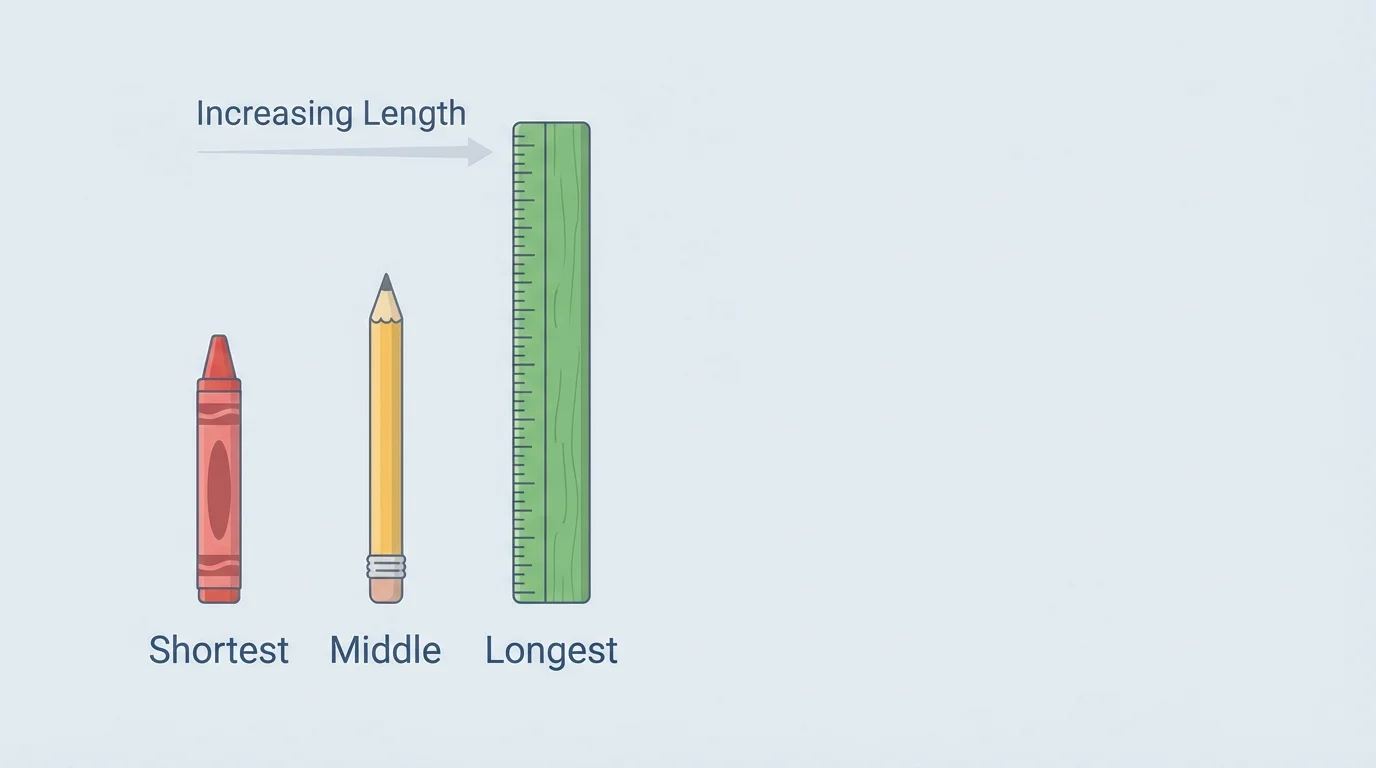
You can also order from longest to shortest. That is just the reverse order. If shortest to longest is spoon, marker, paintbrush, then longest to shortest is paintbrush, marker, spoon.
When you compare, make sure the objects are straight and one end matches up. If one object starts farther over, it may look longer even when it is not.
Words help us describe the order. We can say: first shortest, next longer, last longest. With three objects, one object may be the shortest, one may be the longest, and one may be in the middle.
A fair comparison means we start correctly. Put one end of each object together. If the left ends match, then look at the right ends. The object that reaches farther is longer. If both ends match exactly, the objects are the same length.
Sometimes objects trick our eyes. A ribbon may be curled. A string may be bent. Before comparing, straighten the object carefully. A bent object can look shorter than it really is.
Another important idea is that moving an object does not change its length. If a pencil is a certain length, sliding it to another place on the desk does not make it longer or shorter. Its length stays the same.
Sometimes two objects cannot be put next to each other. Maybe one book is on your desk and another object is across the room. In that case, we can use a third object to help. This is called an indirect comparison, and [Figure 2] shows how a strip of paper can help.
A paper strip, a string, or a row of cubes can be the helper object. First, match the helper to the length of one object. Then carry the helper to the second object and compare. If the helper is longer than the second object, then the first object was longer. If the helper is shorter than the second object, then the first object was shorter.
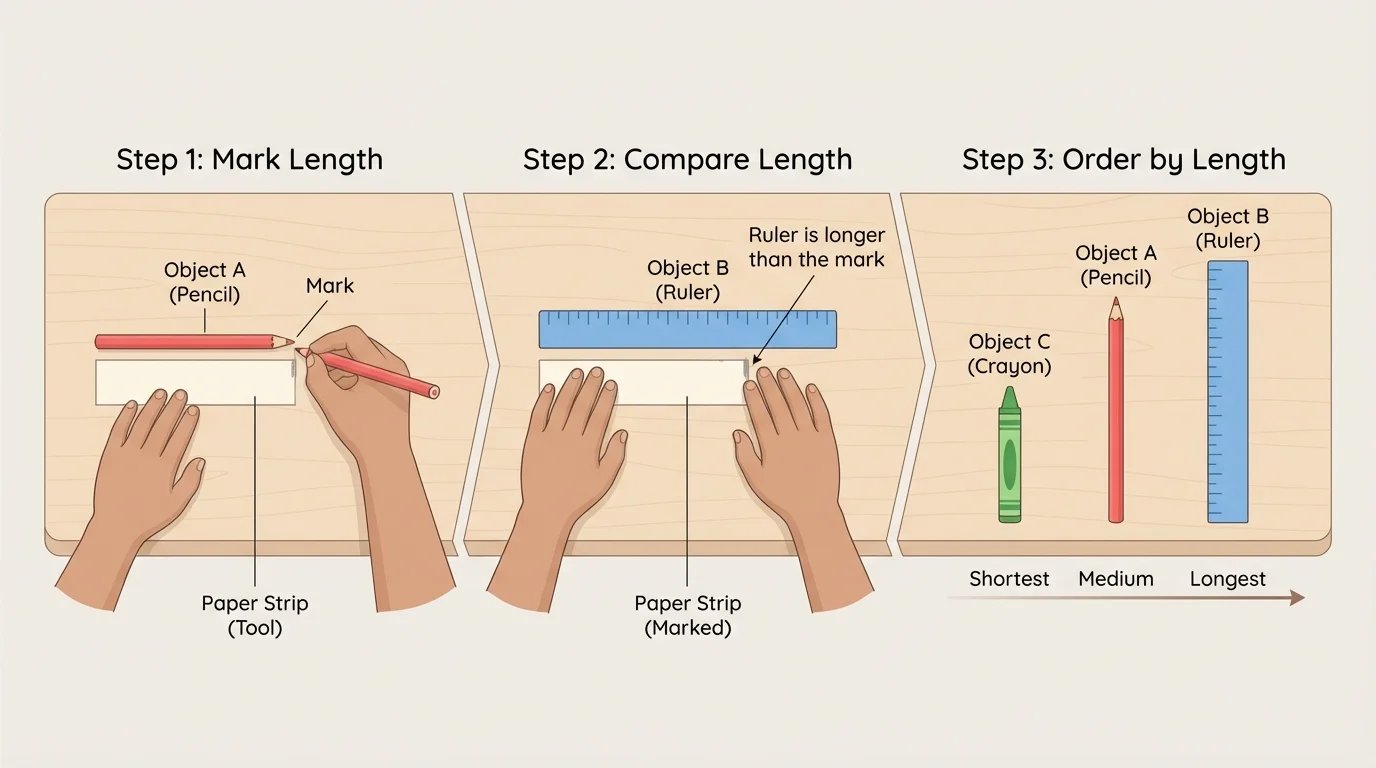
Here is the big idea: if object A is longer than the helper, and object B matches the helper, then object A is longer than object B. The helper lets us compare even when A and B are not side by side.
How indirect comparison works
Think of the helper object as a messenger. It "carries" the length of one object to another place. If the same helper is used carefully, it helps us compare lengths without moving the original objects together.
You can use indirect comparison in many places. You might compare the length of your desk to the length of a bookshelf by using a string. You might compare a scarf at home to a drawer by using a ribbon as the helper.
Let's solve some length problems step by step.
Example 1: Ordering three objects
You have a crayon, a pencil, and an eraser. When you line up one end, the eraser ends first, the crayon ends next, and the pencil ends last.
Step 1: Start all objects at the same end.
This makes the comparison fair.
Step 2: See which object stops first.
The eraser stops first, so it is the shortest.
Step 3: See which object goes farthest.
The pencil goes farthest, so it is the longest.
The order from shortest to longest is eraser, crayon, pencil.
Notice that we did not need a ruler or unit measurements. We only needed to compare the objects carefully.
Example 2: Using a paper strip
A table is too big to move next to a bench. You use a strip of paper. The strip matches the table edge. Then you place the strip on the bench, and the strip sticks out past the bench.
Step 1: Match the strip to the table edge.
The strip now shows the table's length.
Step 2: Compare the strip to the bench.
The strip is longer than the bench.
Step 3: Decide which original object is longer.
Since the strip matches the table and is longer than the bench, the table is longer than the bench.
The table is longer than the bench.
This method works because the strip keeps the same length when you move it.
Example 3: An object is moved
A red straw and a blue straw are the same length. Then the blue straw is slid to the right, so it looks longer.
Step 1: Think about what changed.
Only the position changed. The straw itself did not grow.
Step 2: Line up one end again.
Now the ends match fairly.
Step 3: Compare the far ends.
They end at the same place.
The straws are the same length.
Even if an object is moved, turned, or placed somewhere else, its length does not change.
Ordering and comparing lengths helps in everyday life. You may put pencils in order in a cup, from shortest to longest. You may choose which ribbon is long enough to wrap a gift. A builder compares wood pieces. A cook may compare two pieces of spaghetti before breaking them. A gardener may compare plant stems.
In the classroom, you might check whether a book fits in your desk. At home, you might compare a toy car to a shelf space. If the shelf and toy are not together, a string can help. That is why indirect comparison is so useful.
Careful comparing matters. If ends do not match or objects are bent, our answer may be wrong even when we look closely.
One common mistake is not lining up the same ends. Another is comparing a curved string to a straight pencil. A smart checker, as shown in [Figure 3], lines up the ends, straightens the objects, and looks again.
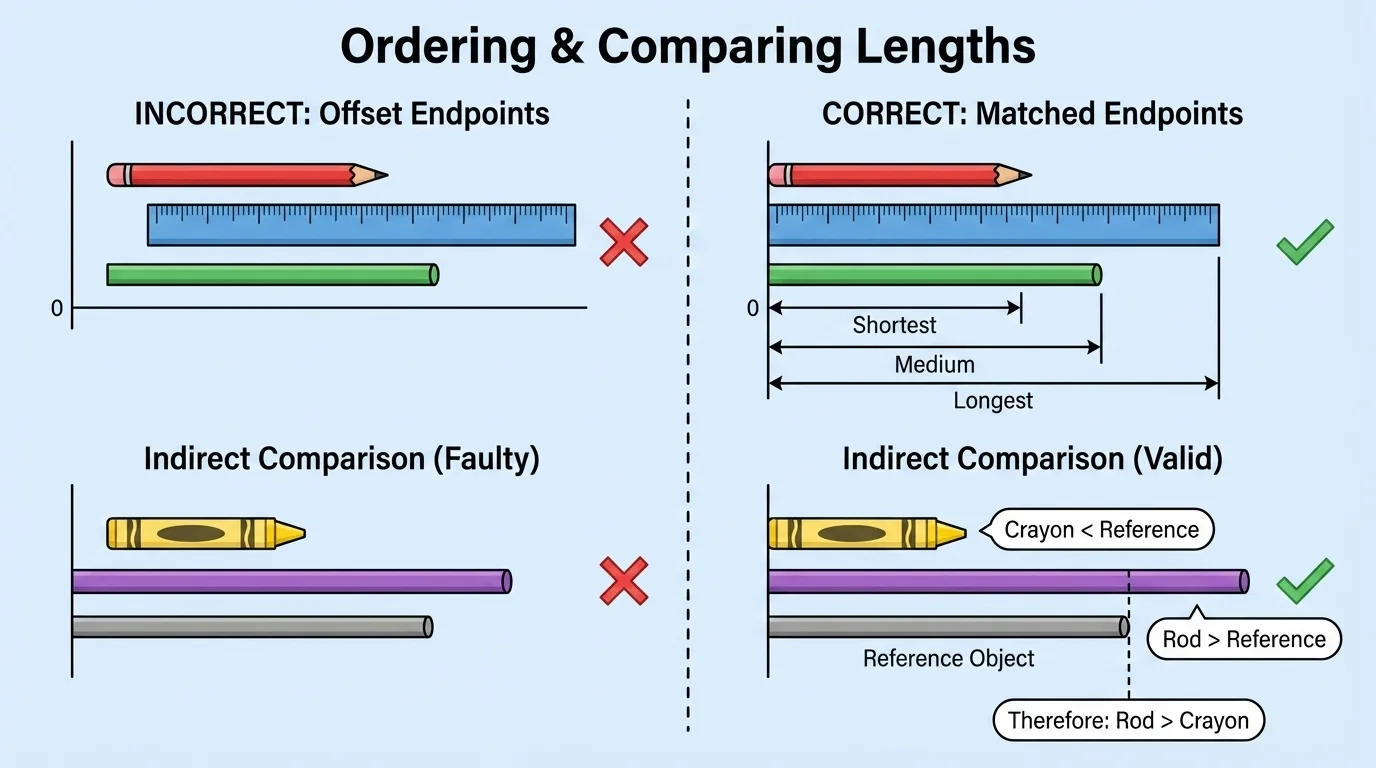
Another mistake is using a different helper object halfway through an indirect comparison. If you start with one strip of paper, keep using that same strip carefully throughout the comparison.
Your eyes can be fooled when one object starts farther ahead than another. Lining up one end is like giving every object the same starting line in a race.
When you are not sure, check again. Ask yourself: Are the objects straight? Did I line up one end? Did I use the same helper object? These good habits help you compare lengths correctly every time.
