What happens if you have \(34\) blocks and someone gives you \(10\) more? You do not need to count \(35, 36, 37\), and so on. There is a faster way. You can use the way numbers are built. This helps you think quickly about math.
[Figure 1] shows that a two-digit number has tens and ones. In \(34\), the \(3\) means \(3\) tens, and the \(4\) means \(4\) ones. Adding \(10\) means adding one more ten. Subtracting \(10\) means taking away one ten. The ones do not change.
Look at \(34\). It is \(3\) tens and \(4\) ones. If we add \(10\), we get \(4\) tens and \(4\) ones. That is \(44\). If we subtract \(10\), we get \(2\) tens and \(4\) ones. That is \(24\).
Tens and ones are parts of a two-digit number. The tens tell how many groups of \(10\), and the ones tell how many extra ones.
You can think of it like this:
\[34 + 10 = 44\]
Only the tens change. The ones stay \(4\).
And:
\[34 - 10 = 24\]
Again, only the tens change. The ones stay \(4\).
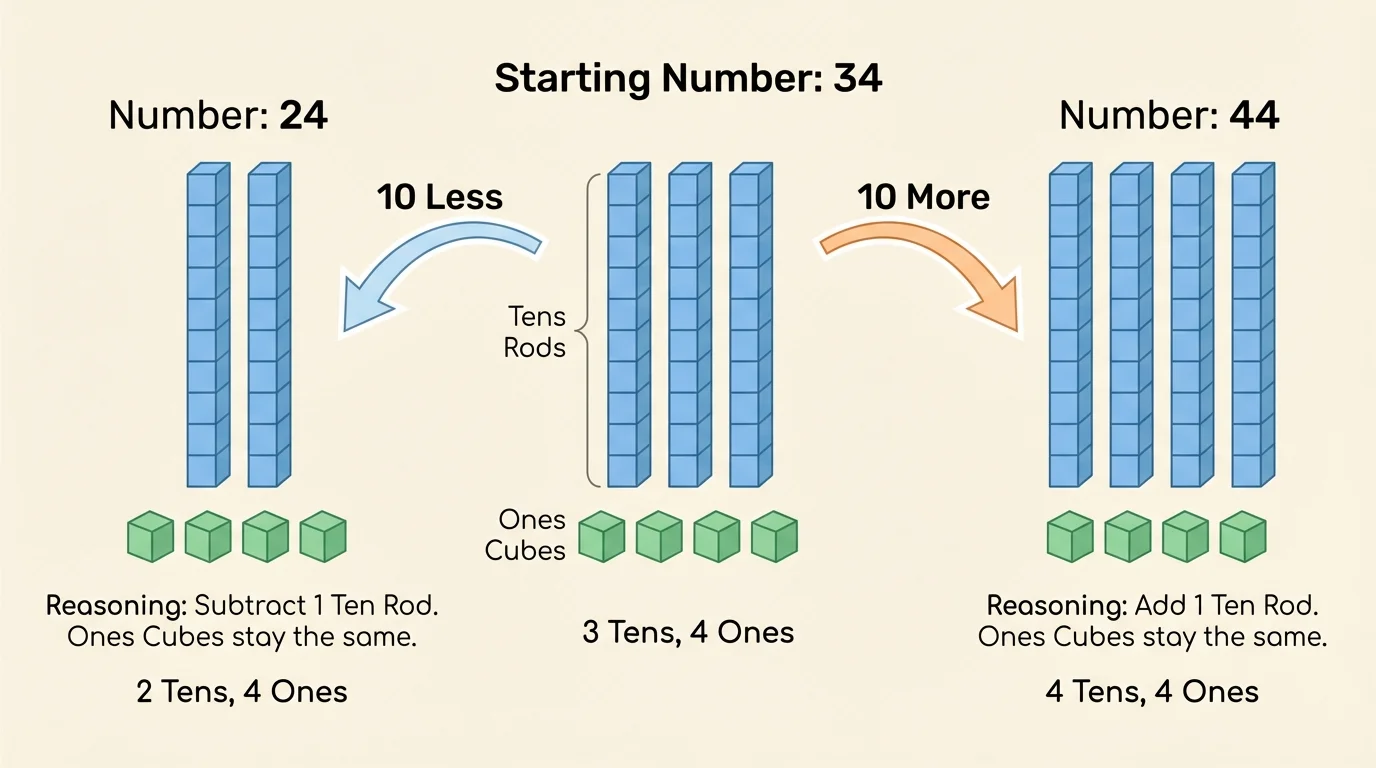
When we add or subtract \(10\), we are working with whole tens. We are not adding or taking away any ones. That is why the ones digit stays the same.
For example, \(57\) has \(5\) tens and \(7\) ones. If we add \(10\), we get \(6\) tens and \(7\) ones. So \(57 + 10 = 67\). If we take away \(10\), we get \(4\) tens and \(7\) ones. So \(57 - 10 = 47\).
The big idea is simple: adding \(10\) changes the tens digit by \(1\), and subtracting \(10\) changes the tens digit by \(1\) in the other direction. The ones digit stays the same.
This is a mental math strategy. That means you can solve it in your head.
Let's solve some examples step by step.
Example 1
Find \(10\) more than \(23\).
Step 1: Look at the tens and ones.
\(23\) is \(2\) tens and \(3\) ones.
Step 2: Add one more ten.
\(2\) tens becomes \(3\) tens.
Step 3: Keep the ones the same.
The \(3\) ones stay \(3\).
So, \[23 + 10 = 33\]
You did not need to count one by one. You just changed the tens.
Example 2
Find \(10\) less than \(68\).
Step 1: Look at the tens and ones.
\(68\) is \(6\) tens and \(8\) ones.
Step 2: Take away one ten.
\(6\) tens becomes \(5\) tens.
Step 3: Keep the ones the same.
The \(8\) ones stay \(8\).
So, \[68 - 10 = 58\]
Notice that the ones digit did not change.
Example 3
Find both \(10\) more and \(10\) less than \(41\).
Step 1: Look at the number.
\(41\) is \(4\) tens and \(1\) one.
Step 2: Add one ten.
\(41 + 10 = 51\).
Step 3: Take away one ten.
\(41 - 10 = 31\).
The answers are \[41 + 10 = 51\] and \[41 - 10 = 31\].
Here is one more quick example: \(75 + 10 = 85\), and \(75 - 10 = 65\). The ones digit stays \(5\), just like we saw earlier in [Figure 1].
[Figure 2] shows a helpful pattern on a number chart. Moving down one row means \(10\) more, and moving up one row means \(10\) less.
Look at these numbers:
| Number | \(10\) less | \(10\) more |
|---|---|---|
| \(26\) | \(16\) | \(36\) |
| \(42\) | \(32\) | \(52\) |
| \(59\) | \(49\) | \(69\) |
| \(81\) | \(71\) | \(91\) |
Table 1. A set of two-digit numbers with \(10\) less and \(10\) more.
In every row, the ones stay the same. Only the tens change. That pattern helps you know the answer fast.
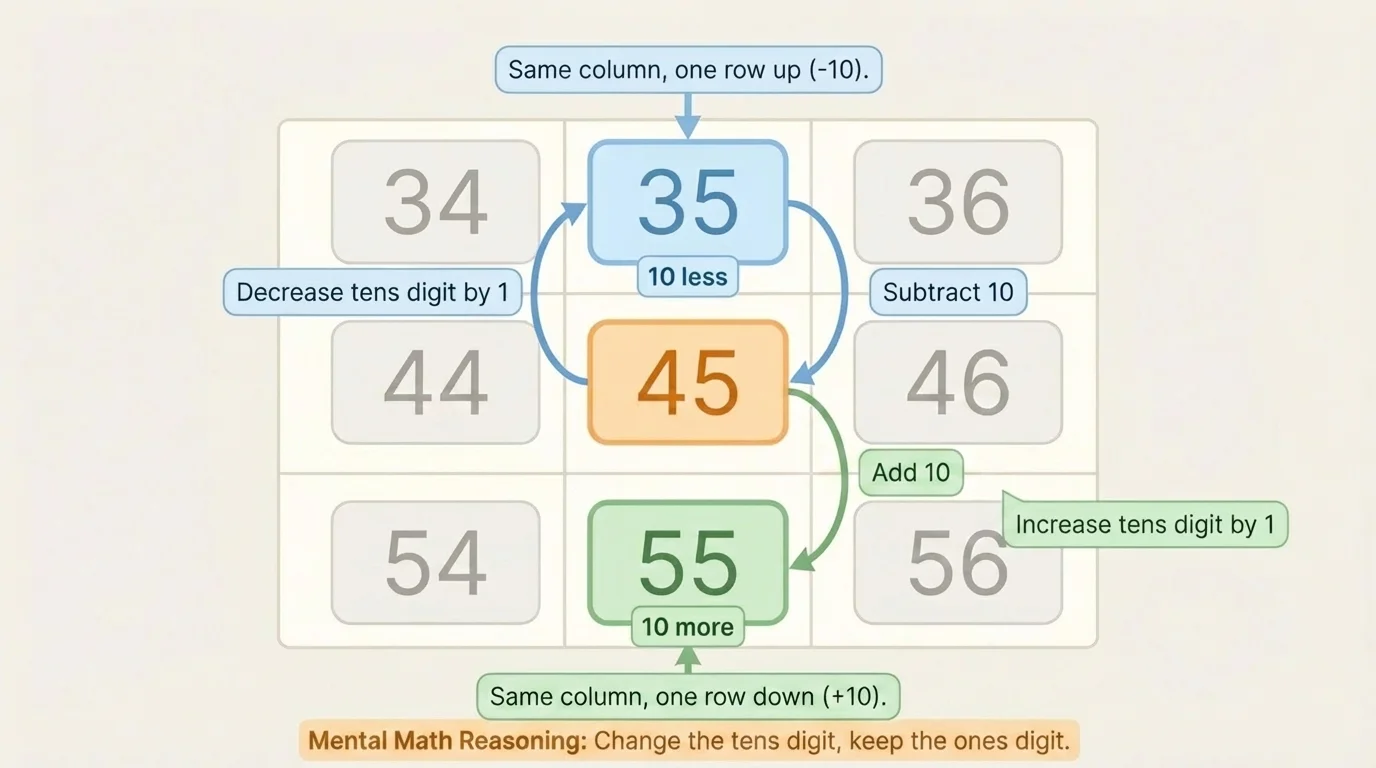
A hundred chart has a secret pattern: numbers in the same column all have the same ones digit. That is why moving up or down by \(10\) keeps the ones the same.
If you know that \(53\) is in a column with \(43\) above it and \(63\) below it, then you can quickly say \(10\) less is \(43\) and \(10\) more is \(63\).
This math idea helps in everyday life. If there are \(32\) crayons in a box and \(10\) more crayons are added, there are \(42\) crayons. If \(10\) crayons are taken out, there are \(22\) crayons.
It also helps with time and counting groups. If a class has \(54\) stickers and gets \(10\) more, the class has \(64\) stickers. If the class gives away \(10\), then \(54 - 10 = 44\).
You already know how to count by tens: \(10, 20, 30, 40, 50\), and so on. Finding \(10\) more or \(10\) less uses that same idea with a two-digit number.
When you use place value, you do not have to count each number. You can think about tens and ones instead.
Be careful to stay with two-digit numbers when needed. For example, \(10\) less than \(14\) is \(4\). That answer is not a two-digit number anymore. Also, \(10\) more than \(95\) is \(105\), which is a three-digit number.
But the same rule still works: add or subtract one ten, and keep the ones the same. For \(14\), the \(1\) ten goes away, so only \(4\) ones are left. For \(95\), adding one more ten makes \(10\) tens and \(5\) ones, which is \(105\).
