A day can feel like a little parade of times: breakfast time, school time, lunch time, play time, and bedtime. Clocks help us know when each part of the day happens. When you can read a clock, you can tell if it is time for school at \(8{:}00\), lunch at \(12{:}00\), or bedtime at \(8{:}30\).
We use time every day. We look at clocks to know when to wake up, when a class starts, and when a story is over. Some clocks are round with hands. Some clocks show numbers. Both kinds tell the same time.
An analog clock has hands that move around a circle. A digital clock shows time with numbers, such as \(3{:}00\) or \(4{:}30\).
Time tells when something happens.
Hour is a unit of time equal to \(60\) minutes, like from \(1{:}00\) to \(2{:}00\).
Half-hour means half of one hour. Half of \(60\) minutes is \(30\) minutes.
When we tell time in this lesson, we will focus on times that are exactly on the hour and times that are on the half-hour. That means times ending in \(:00\) and times ending in \(:30\).
An analog clock has important parts. As [Figure 1] shows, it has numbers from \(1\) to \(12\), a short hand, and a long hand. Each part helps us read the time.
The short hand is called the hour hand. It tells the hour. The long hand is called the minute hand. It points to the minutes. For this lesson, we will use the minute hand to spot \(:00\) and \(:30\).
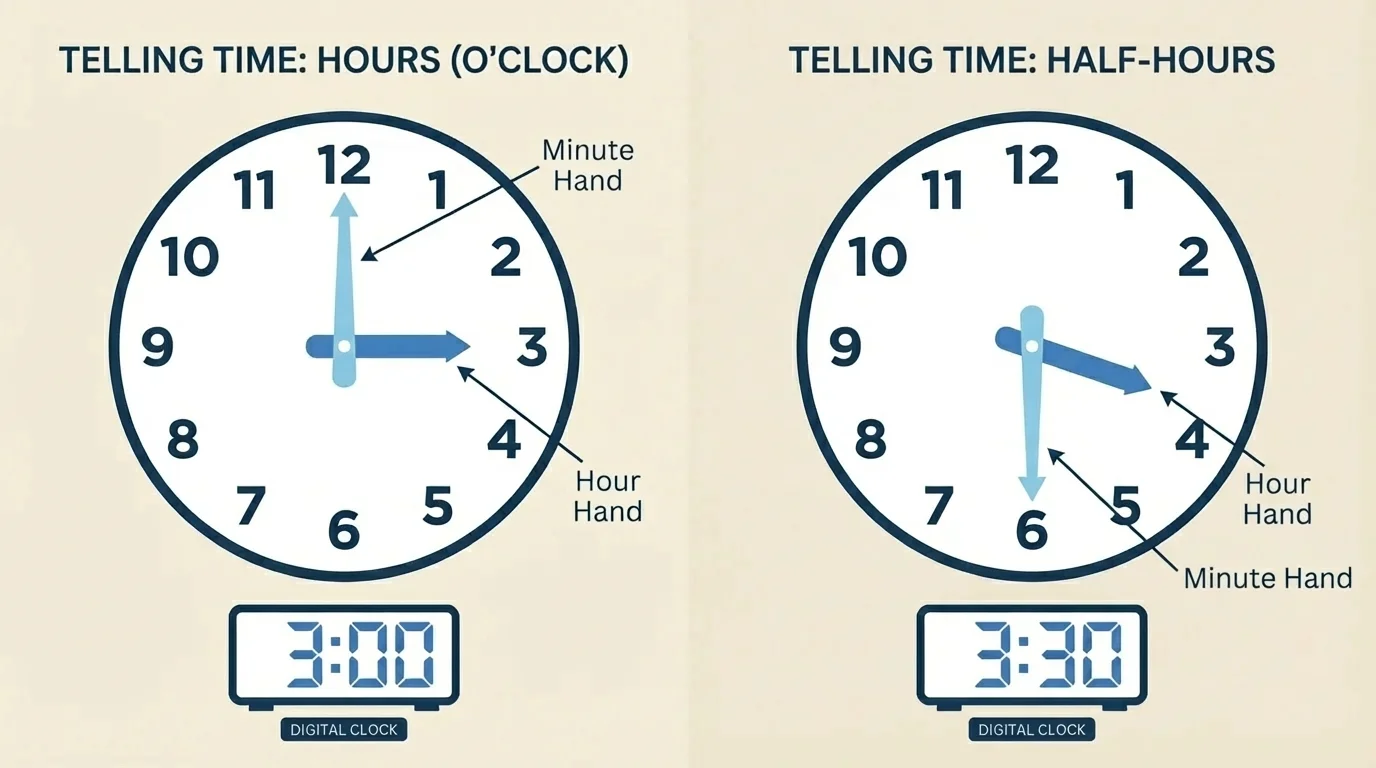
When the minute hand points to \(12\), the time is exactly on the hour. When the minute hand points to \(6\), the time is half past the hour. The hour hand moves too. It does not jump. It moves slowly as time passes.
That is why the hour hand can point right at a number sometimes, but between two numbers at other times. We will use that idea when we read half-hours.
You already know how to count to \(12\). That helps on a clock because the numbers go around the clock face from \(1\) to \(12\).
On a clock, the top number is \(12\). Then the numbers go around in order. After \(12\) comes \(1\), then \(2\), and so on. The hands move around this circle over and over each day.
Let's start with times on the hour. If the minute hand points to \(12\), we say "o'clock." If the hour hand points to \(5\), the time is \(5{:}00\), or five o'clock.
On a digital clock, the numbers after the colon show the minutes. When those numbers are \(00\), the time is an exact hour.
| Analog Clock Clue | Digital Time | Words |
|---|---|---|
| Minute hand at \(12\), hour hand at \(1\) | \(1{:}00\) | one o'clock |
| Minute hand at \(12\), hour hand at \(4\) | \(4{:}00\) | four o'clock |
| Minute hand at \(12\), hour hand at \(9\) | \(9{:}00\) | nine o'clock |
Table 1. Examples of times to the hour on analog and digital clocks.
As we saw with the clock parts in [Figure 1], the short hand tells which hour to say. The long hand tells whether it is exactly on the hour or not.
As [Figure 2] shows, half-hour times happen in the middle of two hours. A half-hour means \(30\) minutes have passed. The digital clock shows this with \(:30\).
On an analog clock, when the minute hand points to \(6\), that means \(30\) minutes. We say "half past." If the hour hand is between \(2\) and \(3\), the time is \(2{:}30\), or half past two.
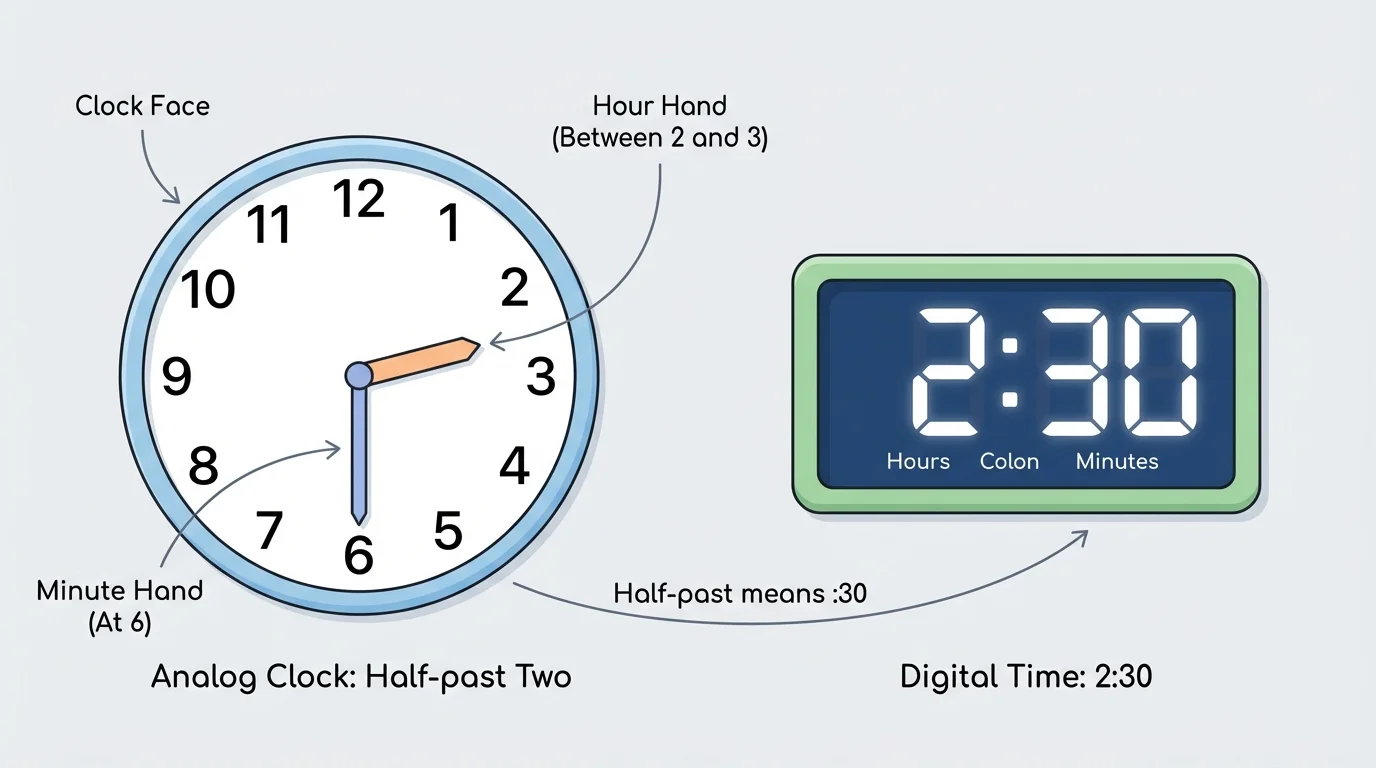
Notice something important: at \(2{:}30\), the hour hand is not on \(3\). It is still between \(2\) and \(3\) because it is still in the hour after \(2\), but not yet \(3{:}00\).
Here are more half-hour examples: \(6{:}30\) is half past six, and \(10{:}30\) is half past ten. The minute hand stays at \(6\) for all half-hour times.
How half-hour time works
One full hour has \(60\) minutes. Half of \(60\) is \(30\). So when \(30\) minutes pass after an hour, the digital clock shows \(:30\), and the minute hand points to \(6\).
The clock in [Figure 2] helps us see why the hour hand sits between numbers. It has moved halfway from one hour to the next.
There is a simple way to read a clock every time. First, look at the minute hand. If it points to \(12\), the time ends in \(:00\). If it points to \(6\), the time ends in \(:30\).
Next, look at the hour hand. If the minute hand is at \(12\), say the number where the hour hand points. If the minute hand is at \(6\), say the smaller hour, the one the hand has already passed.
For example, if the minute hand is at \(6\) and the hour hand is between \(7\) and \(8\), the time is \(7{:}30\), not \(8{:}30\). We say the hour that has already started.
Worked example 1
An analog clock has the minute hand at \(12\) and the hour hand at \(3\). What time is it?
Step 1: Look at the minute hand.
The minute hand is at \(12\), so the time is on the hour. That means the minutes are \(00\).
Step 2: Look at the hour hand.
The hour hand points to \(3\).
Step 3: Write the time.
The time is \(3{:}00\).
The clock says three o'clock.
When the minute hand points to \(12\), the job is easy: just read the hour hand and write \(:00\).
Worked example 2
A digital clock shows \(5{:}30\). How would you say it in words?
Step 1: Look at the minutes.
The minutes are \(30\), so it is a half-hour.
Step 2: Look at the hour.
The hour is \(5\).
Step 3: Say the time in words.
\(5{:}30\) is half past five.
The time in words is half past five.
Digital clocks are helpful because the numbers tell us the hour and minutes right away.
Worked example 3
An analog clock has the minute hand at \(6\) and the hour hand between \(8\) and \(9\). What time is it?
Step 1: Read the minute hand.
The minute hand is at \(6\), so the minutes are \(30\).
Step 2: Read the hour hand.
The hour hand is between \(8\) and \(9\). It has passed \(8\), so the hour is \(8\).
Step 3: Write the time.
The time is \(8{:}30\).
The clock says half past eight.
This is the same half-hour idea shown earlier in [Figure 2]: the minute hand is at \(6\), and the hour hand sits between two numbers.
Clocks help us plan our day. As [Figure 3] shows, you might wake up at \(7{:}00\), go to school at \(8{:}30\), eat lunch at \(12{:}00\), and get ready for bed at \(8{:}30\).
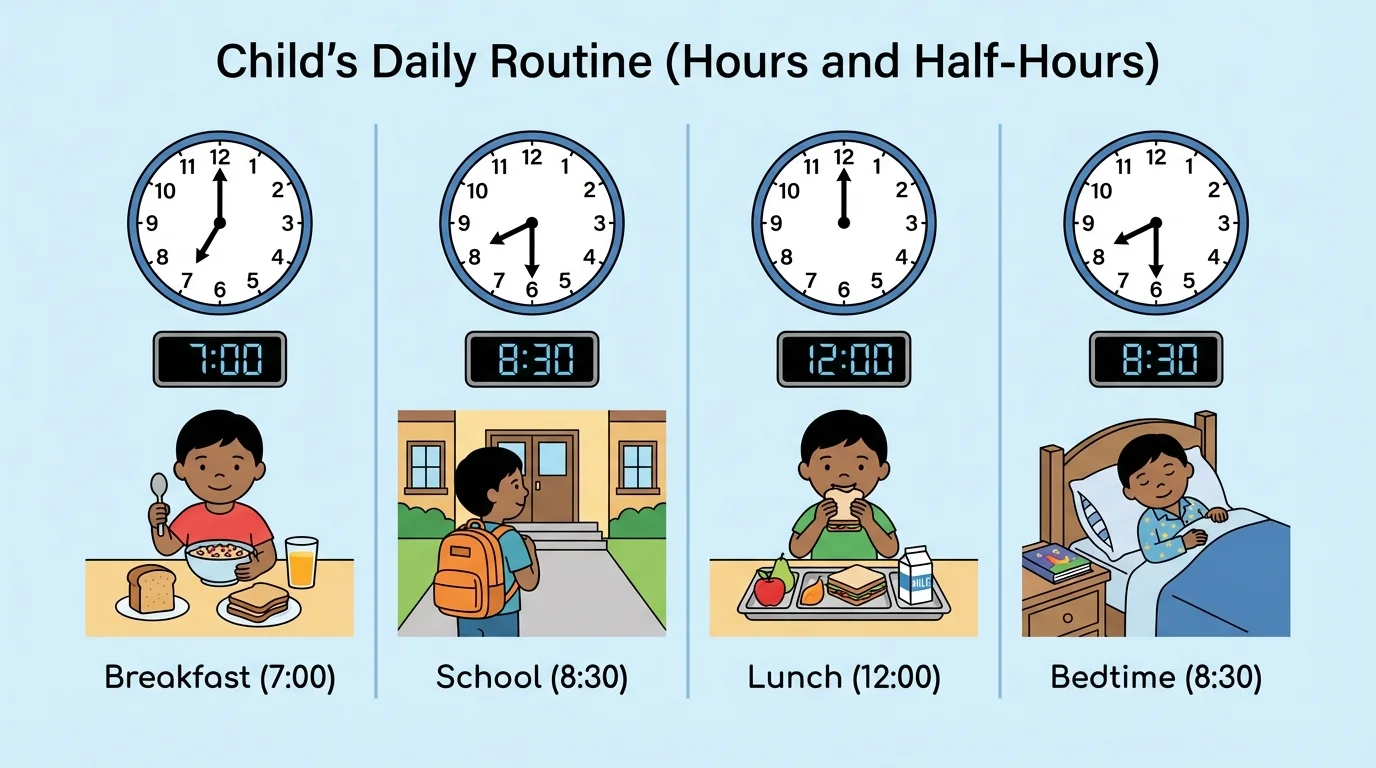
When people say, "School starts at \(8{:}30\)," they are using time to the half-hour. When someone says, "The movie starts at \(6{:}00\)," they are using time to the hour.
Reading time helps us be on time. It helps us know when to line up for lunch, when a bus comes, and when a game begins.
Many ovens, microwaves, watches, and tablets show digital time, but many classrooms and homes still use analog clocks. Learning both kinds helps you in many places.
Later, when you look at your own day, you can match events to times such as \(9{:}00\), \(10{:}30\), or \(1{:}00\). The routine in [Figure 3] reminds us that time connects math to everyday life.
We can write time in number form and in word form. Both ways mean the same thing.
| Number Form | Word Form |
|---|---|
| \(2{:}00\) | two o'clock |
| \(11{:}00\) | eleven o'clock |
| \(1{:}30\) | half past one |
| \(4{:}30\) | half past four |
Table 2. Times written in number form and word form.
Remember, \(:00\) means an exact hour, and \(:30\) means a half-hour. On an analog clock, \(:00\) matches a minute hand at \(12\), and \(:30\) matches a minute hand at \(6\).
