Look around your room. A window, a book, a slice of pizza, and a sign may all look different, but shapes help us describe them. A shape can be tiny or huge, standing up or turned sideways, red or green, and it is still the same kind of shape if its most important parts stay the same. Learning to notice those important parts helps us name, build, and draw shapes correctly.
A attribute is a part or feature of a shape. Some attributes are defining attributes. These are the parts a shape must have. For example, a triangle is still a triangle when it is turned or made bigger, because the important parts stay the same:
[Figure 1] Other shapes also have defining attributes. A rectangle is a closed shape with \(4\) sides and \(4\) corners. A circle is round and has no straight sides. These important parts help us know the shape name.
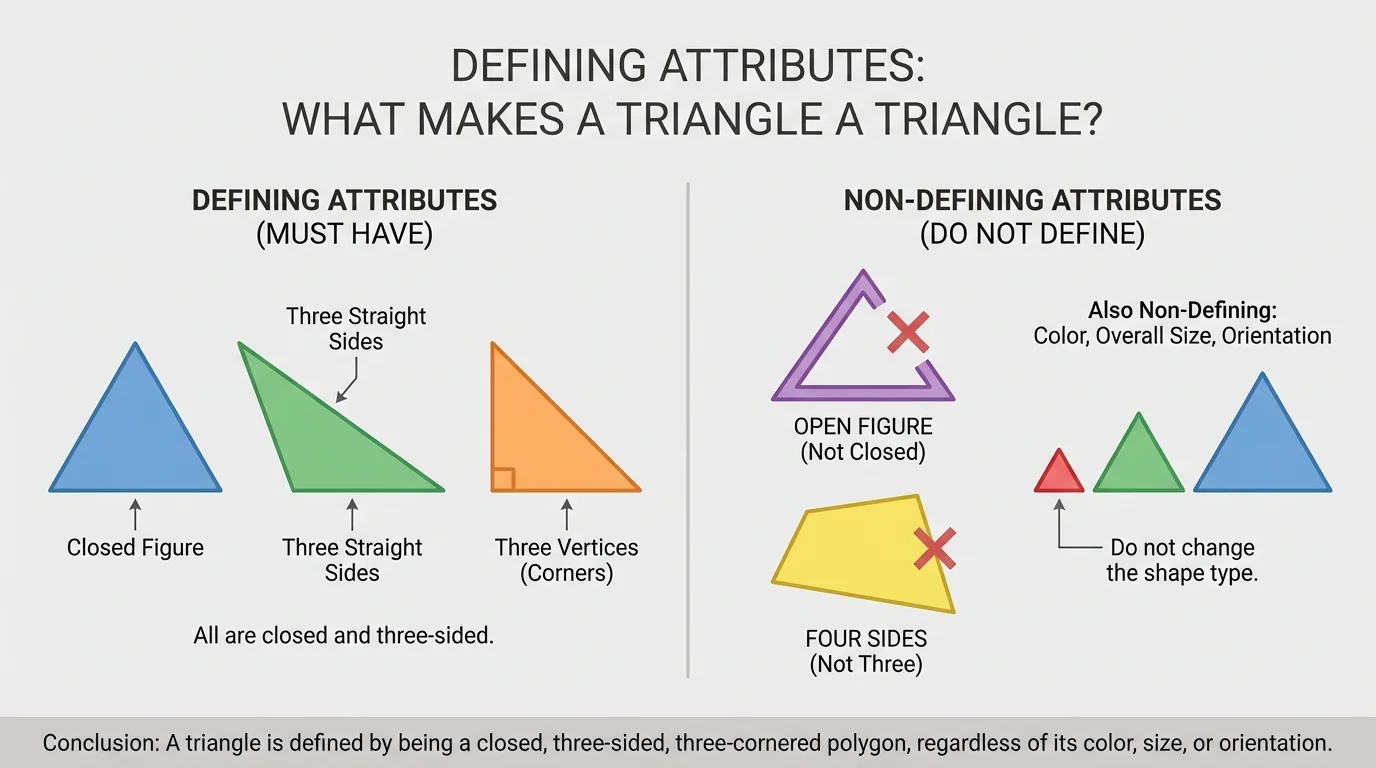
Defining attributes are the important parts that tell what shape something is.
Non-defining attributes are parts that can change without changing the shape name.
When we name a shape, we should think about its sides, corners, and whether it is closed. A shape is closed when all the sides join and there is no gap. If there is a little opening, the shape is not closed, so it is not a complete polygon like a triangle or rectangle.
Some shape features do not decide the shape name. These are non-defining attributes. Color does not change a triangle. Size does not change a triangle. Turning it does not change it either. A small blue triangle and a large green triangle are both triangles.
[Figure 2] This means we do not say, "It is not a triangle because it is upside down." We also do not say, "It is not a rectangle because it is skinny." We look for the important parts first.
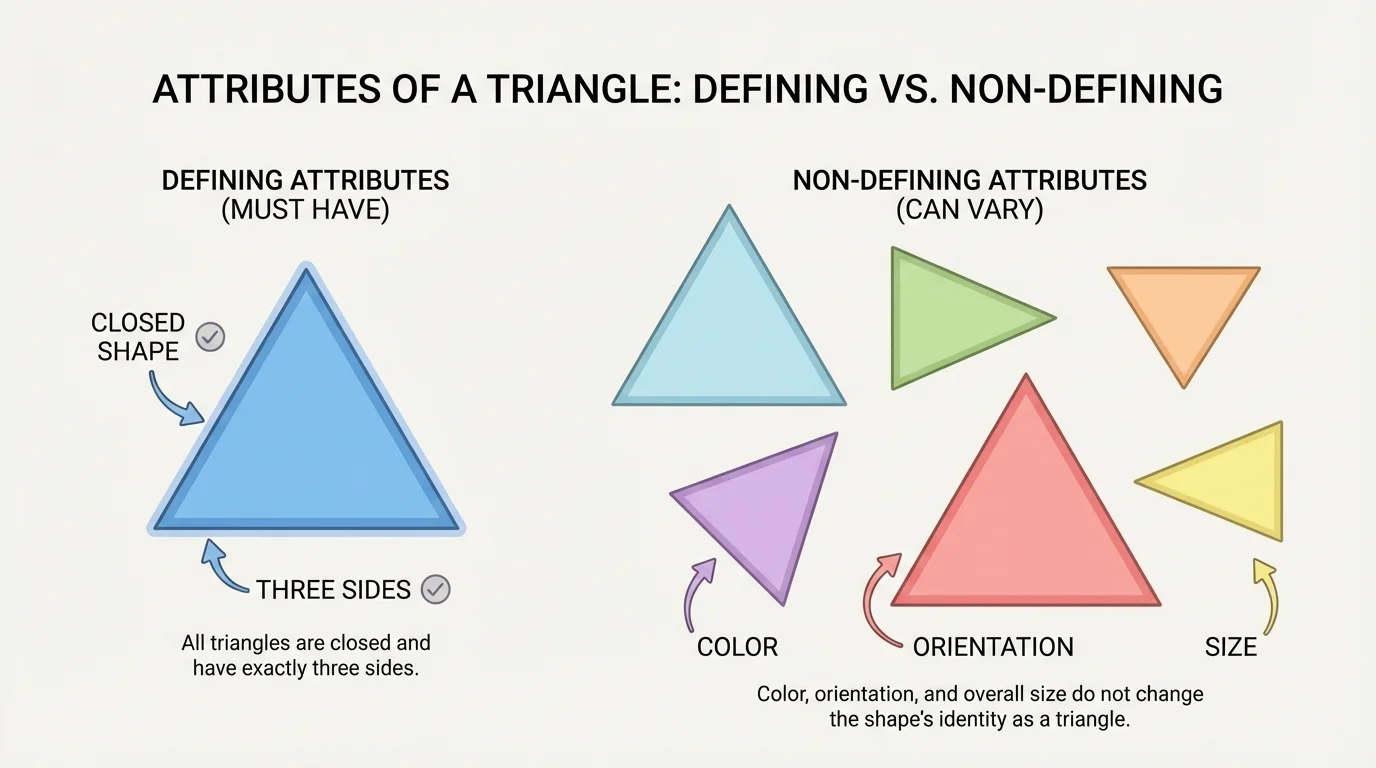
Here are some examples of non-defining attributes:
These can all change while the shape stays the same kind of shape.
Solved example 1
Which picture shows a triangle: a red shape with \(3\) sides and \(3\) corners, or a blue shape with \(4\) sides?
Step 1: Look at the defining attributes.
A triangle must be closed and have exactly \(3\) sides.
Step 2: Check each shape.
The red shape has \(3\) sides and \(3\) corners. The blue shape has \(4\) sides.
Step 3: Decide.
The red shape is the triangle.
Color does not matter. The number of sides does matter.
A triangle has two big defining attributes: it is closed, and it has exactly \(3\) straight sides. It also has \(3\) corners. If one side bends, or if the sides do not meet, then it is not a triangle.
Triangles can look very different. One triangle may be tall. Another may be wide. One may point up. Another may point left. We still check the same important parts. This is why the different triangles in [Figure 1] all belong in the triangle group.
A shape with \(3\) sides but a gap is not a triangle because it is open. A shape that is closed but has \(4\) sides is also not a triangle. We must check all the defining attributes, not just one.
Same shape, new look
Turning, sliding, or making a shape larger does not change its name. The shape name changes only when the defining attributes change. A triangle stays a triangle if it still has \(3\) straight sides and is closed.
We can also compare shapes. A triangle has \(3\) sides. A rectangle has \(4\) sides. A circle has \(0\) straight sides. Counting sides helps us sort shapes into groups.
| Shape | Closed? | Straight sides | Corners |
|---|---|---|---|
| Triangle | Yes | \(3\) | \(3\) |
| Rectangle | Yes | \(4\) | \(4\) |
| Circle | Yes | \(0\) | \(0\) |
Table 1. A comparison of important attributes of three common shapes.
Solved example 2
A shape is green, turned sideways, and has \(3\) straight sides. All the sides meet. Is it a triangle?
Step 1: Ignore the non-defining attributes.
Green color and sideways position do not decide the shape name.
Step 2: Check the defining attributes.
The shape has \(3\) straight sides and is closed.
Step 3: Decide.
Yes, it is a triangle.
The answer is triangle because the important parts match.
When we build shapes with sticks, straws, or craft sticks, we must pay attention to the important parts. A child making a triangle uses \(3\) sticks and joins the ends so there is no gap.
[Figure 3] When we draw shapes, we also watch the sides and corners. To draw a triangle, draw one straight side, then a second straight side, then a third straight side that connects back to the start. Now the shape is closed.
To build a rectangle, use \(4\) straight sides and close the shape. If one stick is missing, the shape is open and not a rectangle. Building helps us feel how shapes are put together.
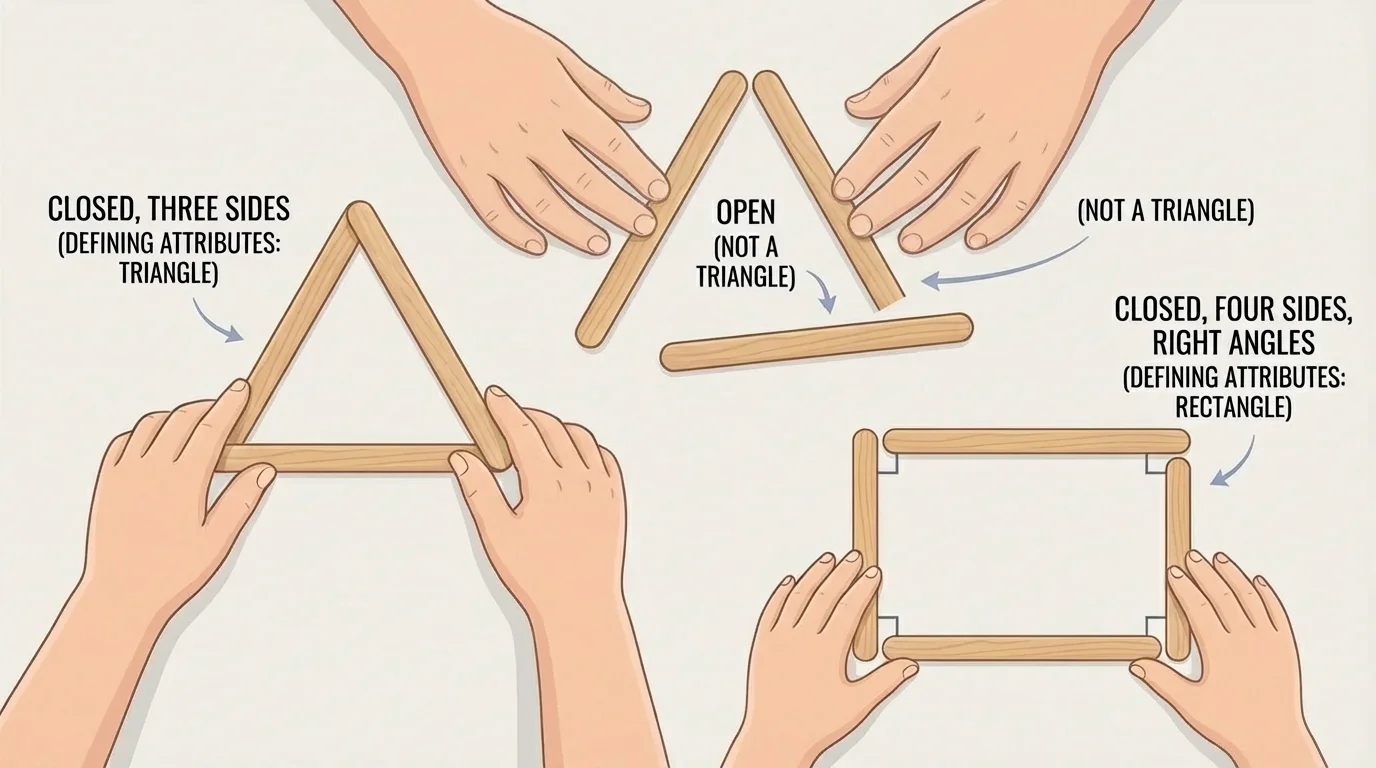
Here is a simple way to think while building or drawing:
Solved example 3
Mia draws a shape with \(3\) straight sides, but one end does not touch. Is it a triangle?
Step 1: Count the sides.
The shape has \(3\) sides.
Step 2: Check if it is closed.
One end does not touch, so there is a gap.
Step 3: Decide.
No, it is not a triangle.
A triangle needs both defining attributes: \(3\) sides and a closed shape.
Sometimes children think a shape must "stand up" the right way to be named correctly. But a triangle turned upside down is still a triangle, just like the triangles we studied earlier in [Figure 2]. The important parts do not change when we turn the shape.
Builders, artists, and designers all pay attention to shape attributes. Strong bridges often use many triangles because triangles hold their shape well.
Shapes are everywhere. A yield sign is a triangle. Floor tiles may be squares or rectangles. Pizza slices often look like triangles. When you look at these objects, you can ask: What shape is it? What important parts help me know?
In art, people may use the same shape many times in different sizes and colors. In buildings, windows can be rectangles even if they are tall, wide, or turned in a picture. In toys and puzzles, pieces still belong to the same shape family when only the non-defining attributes change.
Knowing the difference between defining and non-defining attributes helps us sort shapes, draw them correctly, and talk about them clearly. It also helps us explain why one shape belongs in a group and another shape does not.
You already know how to count. Counting sides and corners is one of the best ways to identify shapes.
As you study more shapes, keep using the same careful thinking. Ask, "Which parts must stay the same?" and "Which parts can change?" That is how mathematicians look at shapes.
