For a long time, people thought the number system was complete once negative numbers and fractions were accepted. But then equations such as \(x^2 + 1 = 0\) created a problem: no real number squared gives \(-1\). That obstacle did not end mathematics. Instead, it opened the door to one of its most powerful ideas: a new number called \(i\), which lets us work with quantities that real numbers alone cannot describe.
In the real number system, squares are always nonnegative. If \(x\) is real, then \(x^2 \ge 0\). That means an equation like \(x^2 = -1\) has no real solution.
This does not mean the equation is meaningless. It means the real number system is too limited for this situation. Mathematicians expanded the number system by defining a new number, the imaginary unit, written as \(i\), so that
\(i^2 = -1\)
Once this definition is accepted, many equations that had no solution in the real numbers suddenly do have solutions. For example, if \(x^2 = -1\), then \(x = i\) or \(x = -i\).
Remember that solving an equation often leads mathematicians to enlarge the number system. Natural numbers were expanded to integers so subtraction like \(3 - 5\) made sense, integers were expanded to rational numbers so division like \(1 \div 2\) made sense, and real numbers are expanded to include complex numbers so equations like \(x^2 = -1\) make sense.
The key idea is not that \(i\) is "fake." It is a number defined by a new rule, and that rule is extremely useful.
A complex number is any number that can be written in the form
\(a + bi\)
where \(a\) and \(b\) are real numbers.
Imaginary unit: The number \(i\) defined so that \(i^2 = -1\).
Complex number: Any number of the form \(a + bi\), where \(a\) and \(b\) are real.
Standard form: Writing a complex number as \(a + bi\).
In the expression \(a + bi\), the number \(a\) is the real part, and the number \(b\) is the coefficient of the imaginary part. For example:
This is an important idea: the complex numbers include the real numbers as a special case.
When a complex number is written as \(a + bi\), we can identify its parts clearly:
So for \(z = -8 + 3i\), the real part is \(-8\) and the imaginary part is \(3\).
Be careful with language. Some textbooks say "imaginary part" to mean the coefficient \(b\), while others may informally refer to the term \(bi\). In school algebra, it is usually safest to identify the real part as \(a\) and the imaginary part as \(b\) when the number is in the form \(a + bi\).
Special cases still fit the same pattern:
The word imaginary sounds like these numbers are less real than other numbers, but they are essential in physics, engineering, and computer science. Modern technology would be much harder to describe without them.
Two complex numbers are equal only if their real parts are equal and their imaginary parts are equal. For example, if \(a + bi = 2 + 7i\), then \(a = 2\) and \(b = 7\).
[Figure 1] Complex numbers are easier to understand when represented visually. Instead of placing them on a number line, we place them on a plane called the complex plane. The horizontal axis represents real values, and the vertical axis represents imaginary values.
A complex number \(a + bi\) is represented by the point \((a, b)\). For instance, \(3 + 2i\) corresponds to the point \((3, 2)\), and \(-2 + i\) corresponds to the point \((-2, 1)\).
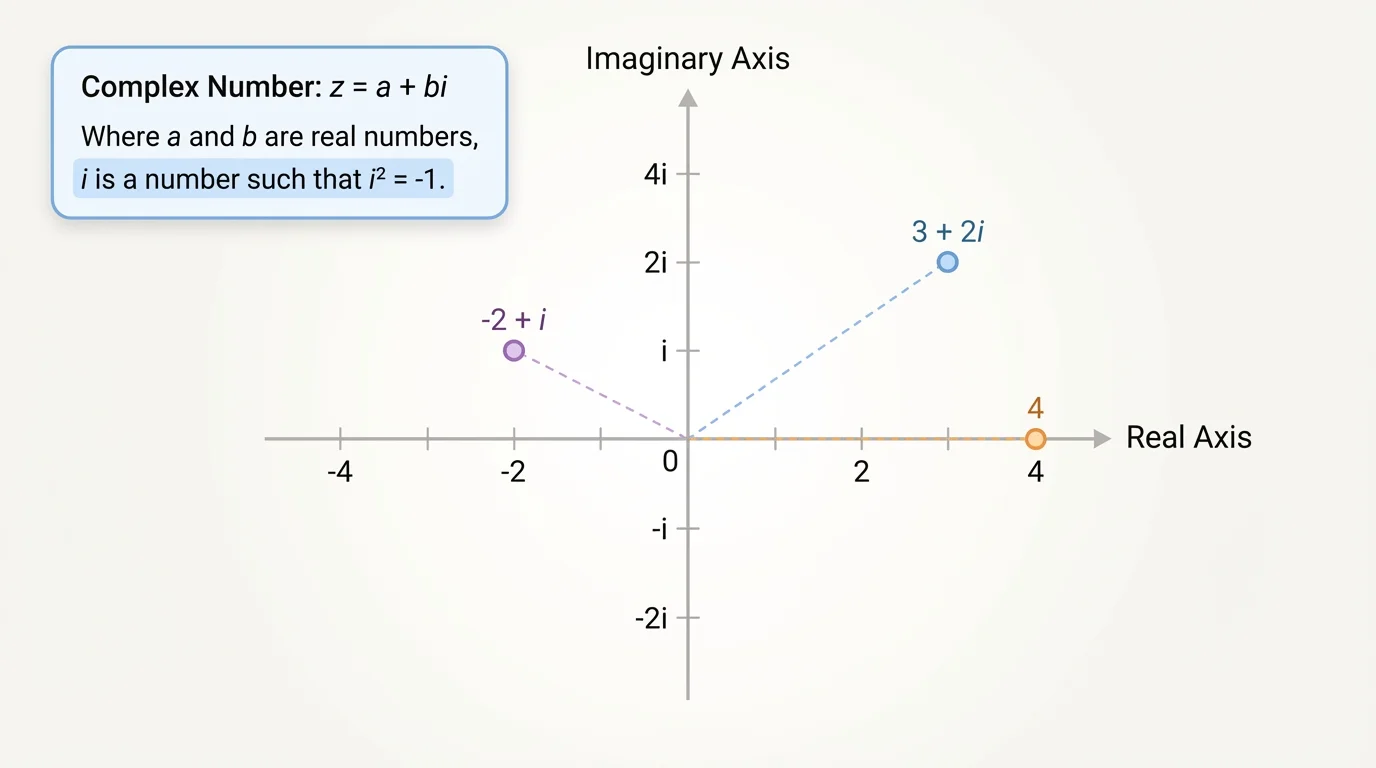
This idea is similar to graphing ordered pairs in coordinate geometry. The difference is that the vertical direction does not mean another real variable such as \(y\); it measures multiples of \(i\).
The complex plane helps students see that complex numbers are not random symbols. They have location, structure, and geometry. Later in mathematics, this visual model becomes extremely important.
Complex numbers follow many of the same algebra rules used with variables, but every result must be simplified using the defining fact \(i^2 = -1\).
Addition and subtraction work by combining like parts. Add real parts to real parts and imaginary parts to imaginary parts.
For example,
\[(3 + 5i) + (2 - 4i) = 5 + i\]
and
\[(7 - 2i) - (1 + 6i) = 6 - 8i\]
Multiplication uses the distributive property, just as with binomials:
\[(a + bi)(c + di) = ac + adi + bci + bdi^2\]
Since \(i^2 = -1\), this becomes
\[(a + bi)(c + di) = (ac - bd) + (ad + bc)i\]
Powers of \(i\) follow a repeating pattern, as [Figure 2] illustrates. Start with the definition \(i^2 = -1\), then multiply by \(i\) again and again:
After that, the pattern repeats every four powers.
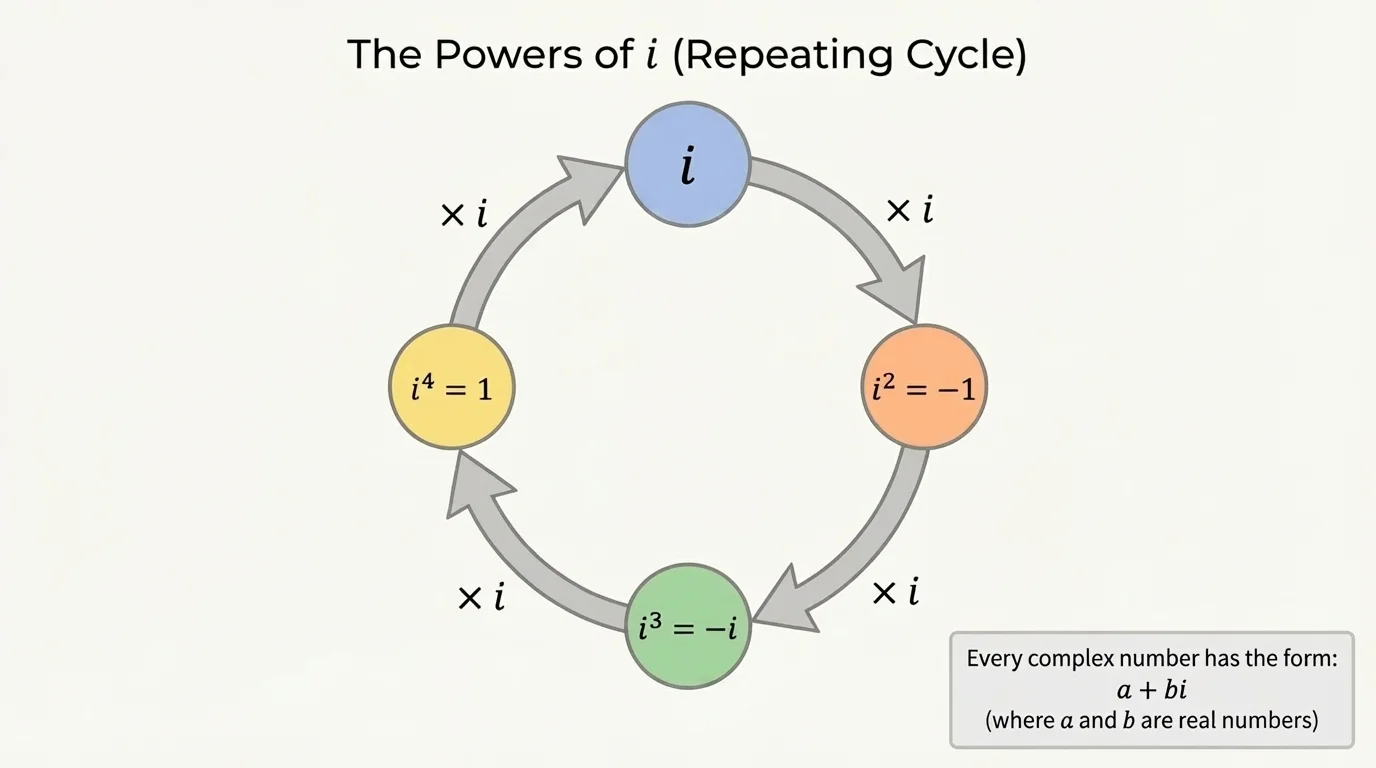
This repeating cycle is useful for simplifying expressions like \(i^{11}\) or \(i^{22}\). Since the powers repeat every \(4\), we can reduce the exponent by looking at the remainder when dividing by \(4\).
Why the form \(a + bi\) matters
When you add, subtract, or multiply complex numbers, the answer can always be rewritten in the form \(a + bi\). This means the complex number system is closed under operations such as addition, subtraction, and multiplication. A number system becomes more powerful when its operations stay inside the system.
As we saw on the complex plane in [Figure 1], combining complex numbers is like combining horizontal and vertical components. Addition combines real coordinates and imaginary coordinates separately.
Worked example 1
Write \(-4 + 9i\) in standard form and identify its real and imaginary parts.
Step 1: Check whether the number is already in the form \(a + bi\).
The number \(-4 + 9i\) already matches the standard form \(a + bi\).
Step 2: Identify \(a\) and \(b\).
Here, \(a = -4\) and \(b = 9\).
The real part is \(-4\), and the imaginary part is \(9\).
Notice that identifying the parts is easy only when the number is written clearly in standard form.
Worked example 2
Simplify \((6 - 3i) + (-2 + 8i)\).
Step 1: Group real parts and imaginary parts.
\((6 - 3i) + (-2 + 8i) = (6 - 2) + (-3i + 8i)\)
Step 2: Combine like terms.
\((6 - 2) + (-3i + 8i) = 4 + 5i\)
The simplified result is
\(4 + 5i\)
Addition and subtraction of complex numbers are usually straightforward because they work like combining like terms in algebra.
Worked example 3
Simplify \((3 + 2i)(4 - 5i)\).
Step 1: Use the distributive property.
\((3 + 2i)(4 - 5i) = 3(4) + 3(-5i) + 2i(4) + 2i(-5i)\)
Step 2: Multiply each term.
\(= 12 - 15i + 8i - 10i^2\)
Step 3: Replace \(i^2\) with \(-1\).
\(12 - 15i + 8i - 10(-1) = 12 - 15i + 8i + 10\)
Step 4: Combine like terms.
\(12 + 10 = 22\) and \(-15i + 8i = -7i\)
So the product is
\(22 - 7i\)
Multiplication is where many students make mistakes, especially by forgetting that \(i^2 = -1\), not \(1\).
Worked example 4
Simplify \(i^{11}\).
Step 1: Use the repeating cycle of powers of \(i\).
The pattern is \(i, -1, -i, 1\), then it repeats every \(4\).
Step 2: Find the remainder when dividing \(11\) by \(4\).
\(11 \div 4\) leaves a remainder of \(3\).
Step 3: Match the remainder to the cycle.
Since a remainder of \(3\) corresponds to \(i^3\), we get \(i^{11} = i^3 = -i\).
The simplified result is
\(-i\)
The cycle shown earlier in [Figure 2] makes this kind of simplification much faster.
Several facts about complex numbers are worth remembering.
For example, if \(x + yi = 4 - 2i\), then \(x = 4\) and \(y = -2\).
| Number | Standard form | Real part | Imaginary part |
|---|---|---|---|
| \(8\) | \(8 + 0i\) | \(8\) | \(0\) |
| \(-5i\) | \(0 - 5i\) | \(0\) | \(-5\) |
| \(2 + 7i\) | \(2 + 7i\) | \(2\) | \(7\) |
| \(-3 - i\) | \(-3 - i\) | \(-3\) | \(-1\) |
Table 1. Examples of complex numbers in standard form with their real and imaginary parts.
A common mistake is to say that \(3 + 4i\) has imaginary part \(4i\). In many algebra courses, the imaginary part is identified as \(4\), while \(4i\) is the imaginary term. Be consistent with the convention used by your class.
Complex numbers may seem abstract at first, but they are deeply connected to real technology. Electrical engineers use them to analyze circuits with alternating current. In those circuits, voltage and current can shift out of sync, and complex numbers provide a compact way to track both magnitude and phase.
They also appear in wave motion, sound analysis, quantum physics, and digital signal processing. When music is compressed, transmitted, or filtered, the mathematics often involves complex numbers. The reason is that oscillations and rotations are described naturally with real and imaginary components working together.
Why engineers like complex numbers
A changing signal often has two linked features: size and timing. Complex numbers can package both into one expression. What looks abstract in algebra becomes practical in systems that involve waves, cycles, and repeated motion.
Even if you are only beginning to study them, complex numbers already show something important about mathematics: when a problem cannot be solved inside an existing system, mathematicians can build a larger system with clear rules and powerful results.
