A single quadratic function can look ordinary in one form and suddenly become revealing in another. That is one of the most powerful ideas in algebra: the expression changes, but the function does not. A parabola that seems hard to read in standard form can quickly reveal where it crosses the x-axis, where it turns, and how it mirrors itself once you rewrite it. Engineers use this idea when analyzing motion, businesses use it when studying profit, and scientists use it when modeling paths and rates of change.
A quadratic function is a function that can be written in the form \[f(x)=ax^2+bx+c\] where \(a\neq 0\). Its graph is a parabola. Depending on the values of \(a\), \(b\), and \(c\), the parabola may open upward or downward, cross the x-axis twice, touch it once, or not cross it at all.
Different equivalent forms of the same quadratic highlight different features. Standard form, factored form, and vertex form are all useful. Learning when and why to rewrite a quadratic is a major step toward understanding functions instead of just manipulating symbols.
Zeros are the x-values for which a function equals \(0\). On a graph, they are the x-intercepts if the graph crosses or touches the x-axis.
Extreme value is the highest or lowest output of the function. For a parabola, this occurs at the vertex.
Symmetry means one side of the graph is a mirror image of the other side across a line called the axis of symmetry.
For quadratics, these ideas are tightly connected. The zeros tell you where the graph is at height \(0\), the extreme value tells you the turning point, and symmetry explains why points on opposite sides of the vertex line have the same y-value.
The three most important forms are shown below.
| Form | General expression | What it reveals most clearly |
|---|---|---|
| Standard form | \(f(x)=ax^2+bx+c\) | Overall structure, y-intercept \((0,c)\) |
| Factored form | \(f(x)=a(x-r_1)(x-r_2)\) | Zeros \(r_1\) and \(r_2\) |
| Vertex form | \(f(x)=a(x-h)^2+k\) | Vertex \((h,k)\), extreme value, symmetry |
Table 1. The main equivalent forms of a quadratic function and the features each form reveals.
In vertex form, the graph has vertex \((h,k)\). If \(a>0\), the parabola opens upward and the vertex gives a minimum value of \(k\). If \(a<0\), it opens downward and the vertex gives a maximum value of \(k\).
In factored form, the numbers \(r_1\) and \(r_2\) are the zeros. Setting each factor equal to zero gives the x-values where the function equals zero. This is often the fastest way to find x-intercepts.
When a quadratic can be factored, its graph becomes much easier to read. As [Figure 1] shows, if \[f(x)=a(x-r_1)(x-r_2),\] then the zeros are \(x=r_1\) and \(x=r_2\).
To find the zeros, set the function equal to \(0\). Because a product is zero only when at least one factor is zero, solve \(x-r_1=0\) and \(x-r_2=0\). These zeros become x-intercepts on the graph if they are real numbers.
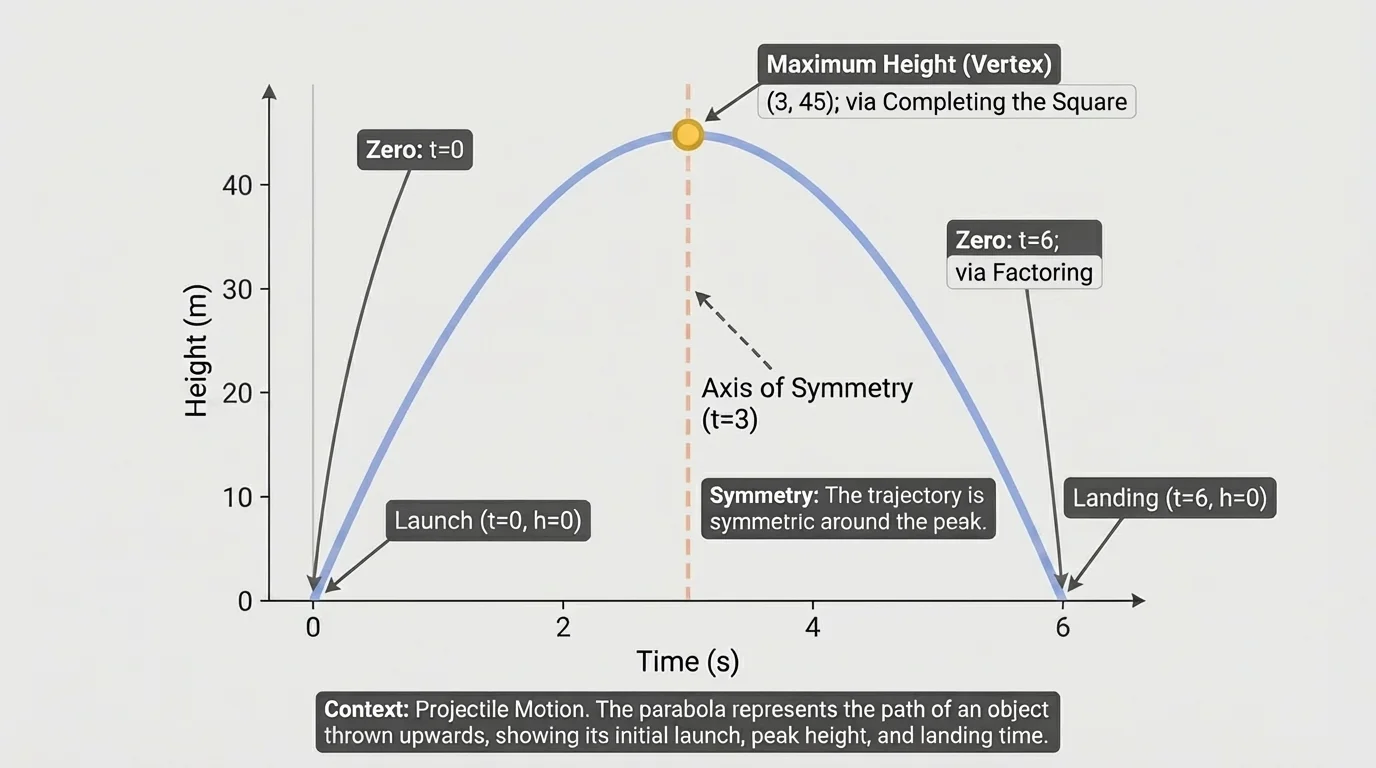
The axis of symmetry lies halfway between the zeros when the zeros are real. If the zeros are \(r_1\) and \(r_2\), then the axis of symmetry is \[x=\frac{r_1+r_2}{2}.\] This midpoint idea is useful even before you convert to vertex form.
Factoring does not always work nicely over the integers, but when it does, it gives quick insight. It is especially useful when the question asks for x-intercepts or when the context makes the zeros important, such as the times when an object is on the ground or the side lengths that make an area zero.
Sometimes a quadratic is not already in a helpful form. Completing the square rewrites it into vertex form, which immediately reveals the turning point. Start with standard form: \[f(x)=ax^2+bx+c.\]
When \(a=1\), the process is especially direct. For example, with \(x^2+bx\), take half of \(b\), square it, and add and subtract that value: \[x^2+bx=x^2+bx+\left(\frac{b}{2}\right)^2-\left(\frac{b}{2}\right)^2.\] The first three terms form a perfect square trinomial.
As [Figure 2] illustrates, if \(a\neq 1\), first factor out \(a\) from the \(x^2\) and \(x\) terms, complete the square inside the parentheses, and then simplify. The final goal is a form like \[f(x)=a(x-h)^2+k,\] where the vertex is \((h,k)\) and the axis of symmetry is \(x=h\).
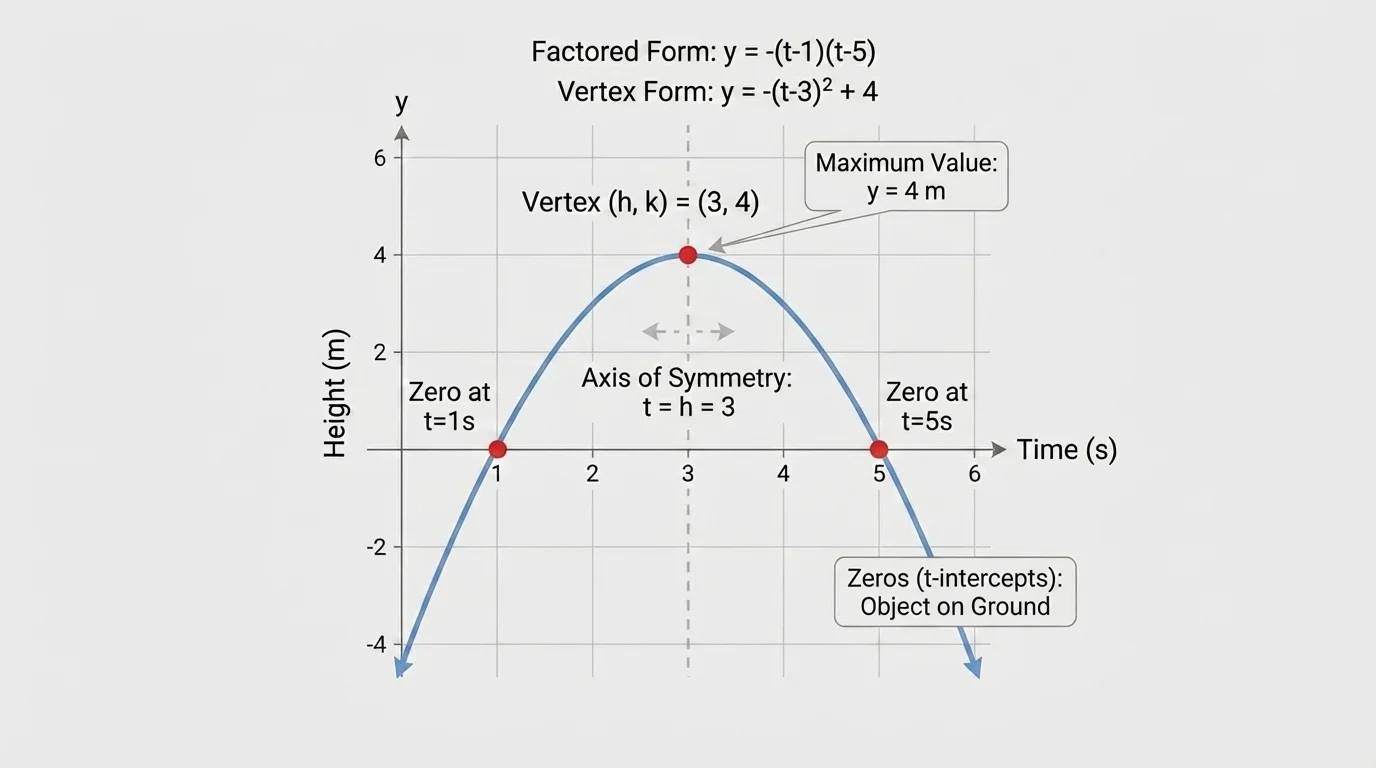
This method is more than an algebra trick. It translates a hard-to-read expression into a form that tells you the most important feature of the parabola: where it changes direction. Later, when you interpret a real situation, that turning point may represent a maximum height, a minimum cost, or a best possible value.
To complete the square, remember two earlier ideas: a perfect square trinomial such as \(x^2+6x+9=(x+3)^2\), and the zero product property, which says if \(ab=0\), then \(a=0\) or \(b=0\).
The sign of \(a\) still matters after rewriting. If \(a>0\), the vertex is the lowest point on the graph. If \(a<0\), the vertex is the highest point. That tells you whether the extreme value is a minimum or a maximum.
A parabola is symmetric about a vertical line. In vertex form, that line is easy to identify: if \[f(x)=a(x-h)^2+k,\] then the graph is symmetric about \(x=h\).
In standard form, the axis of symmetry can be found using \[x=-\frac{b}{2a}.\] This value gives the x-coordinate of the vertex. Substituting it into the function gives the y-coordinate of the vertex, which is the extreme value.
Symmetry means points equally far from the axis have the same output. If the axis is \(x=3\), then \(f(2)=f(4)\), \(f(1)=f(5)\), and so on. That mirror structure helps you sketch graphs and check whether your work makes sense.
Why symmetry matters
Symmetry is not just a graphing feature. It explains why the vertex sits halfway between equal-height points and why, when there are two real zeros, the vertex lies exactly midway between them. This is why factoring and completing the square tell a consistent story about the same function from different angles.
As we saw earlier in [Figure 1], when a parabola crosses the x-axis twice, the axis of symmetry runs through the midpoint of those intercepts. In [Figure 2], that same line passes through the vertex, showing that zeros and extreme values are connected by one geometric idea.
Worked example
Analyze \(f(x)=(x-1)(x-5)\). Find the zeros, the vertex, the extreme value, and the axis of symmetry.
Step 1: Find the zeros from factored form.
Set each factor equal to zero: \(x-1=0\) gives \(x=1\), and \(x-5=0\) gives \(x=5\).
So the zeros are \(1\) and \(5\). The x-intercepts are \((1,0)\) and \((5,0)\).
Step 2: Find the axis of symmetry.
The axis is halfway between the zeros: \(x=\dfrac{1+5}{2}=3\).
Step 3: Find the vertex by evaluating the function at \(x=3\).
Compute \(f(3)=(3-1)(3-5)=2(-2)=-4\).
So the vertex is \((3,-4)\).
Step 4: Identify the extreme value.
The leading coefficient is positive, so the parabola opens upward. Therefore, the vertex gives a minimum value.
The minimum value is \(-4\), and it occurs at \(x=3\).
This example shows how much you can learn without expanding anything. Factored form gave the zeros immediately, symmetry gave the axis, and one substitution gave the vertex.
Worked example
Analyze \(g(x)=x^2-6x+2\). Rewrite it in vertex form, then state the vertex, axis of symmetry, and minimum value.
Step 1: Group the \(x\)-terms.
Write \(g(x)=x^2-6x+2\).
Step 2: Complete the square.
Half of \(-6\) is \(-3\), and \((-3)^2=9\).
Add and subtract \(9\): \(g(x)=x^2-6x+9-9+2\).
Step 3: Rewrite.
The first three terms form a square: \(g(x)=(x-3)^2-7\).
Step 4: Read the graph features from vertex form.
The vertex is \((3,-7)\). The axis of symmetry is \(x=3\). Since the coefficient of \((x-3)^2\) is positive, the parabola opens upward.
The minimum value is \(-7\), and it occurs when \(x=3\).
If you wanted the zeros too, you would solve \((x-3)^2-7=0\), which gives \((x-3)^2=7\), so \(x=3\pm\sqrt{7}\). This shows that vertex form can also lead to zeros, even when factoring is not simple.
Worked example
Analyze \(h(x)=-(x+2)^2\). Find the zero, vertex, axis of symmetry, and maximum value.
Step 1: Identify the form.
This is already in vertex form with \(a=-1\), \(h=-2\), and \(k=0\).
Step 2: Read the vertex and axis.
The vertex is \((-2,0)\), and the axis of symmetry is \(x=-2\).
Step 3: Find the zero.
Set the function equal to zero: \(-(x+2)^2=0\). Then \((x+2)^2=0\), so \(x=-2\).
This is a repeated root because the same factor occurs twice.
Step 4: Identify the extreme value.
Because \(a<0\), the parabola opens downward. So the vertex gives a maximum value.
The maximum value is \(0\), and it occurs at \(x=-2\).
This case is important because the graph touches the x-axis and turns around instead of crossing it. A repeated root means the graph is tangent to the x-axis at that point.
A quadratic can have two real zeros, one repeated real zero, or no real zeros. All three cases still fit the same symmetry rules, even though the graph looks different in each one.
That means the algebraic form and the graph continue to match. A repeated factor in factored form corresponds to a vertex lying exactly on the x-axis.
Equivalent forms are like different camera angles on the same object. One angle highlights intercepts, another highlights the turning point, and another shows how the function is built.
| Question | Best form to use | Reason |
|---|---|---|
| What are the zeros? | Factored form | Set each factor equal to \(0\) |
| What is the vertex? | Vertex form | Read \((h,k)\) directly |
| What is the extreme value? | Vertex form | The y-coordinate of the vertex is the minimum or maximum |
| What is the axis of symmetry? | Vertex or factored form | Use \(x=h\) or the midpoint of the zeros |
| What is the y-intercept? | Standard form | Read \(c\) as \(f(0)\) |
Table 2. Which form of a quadratic function most efficiently reveals different properties.
Proficient students of algebra do not just solve; they choose an efficient form. That choice makes analysis faster and interpretation clearer.
Quadratics often describe situations with a rise and fall, or a best possible value. In many real settings, the zeros, vertex, and symmetry have clear meanings.
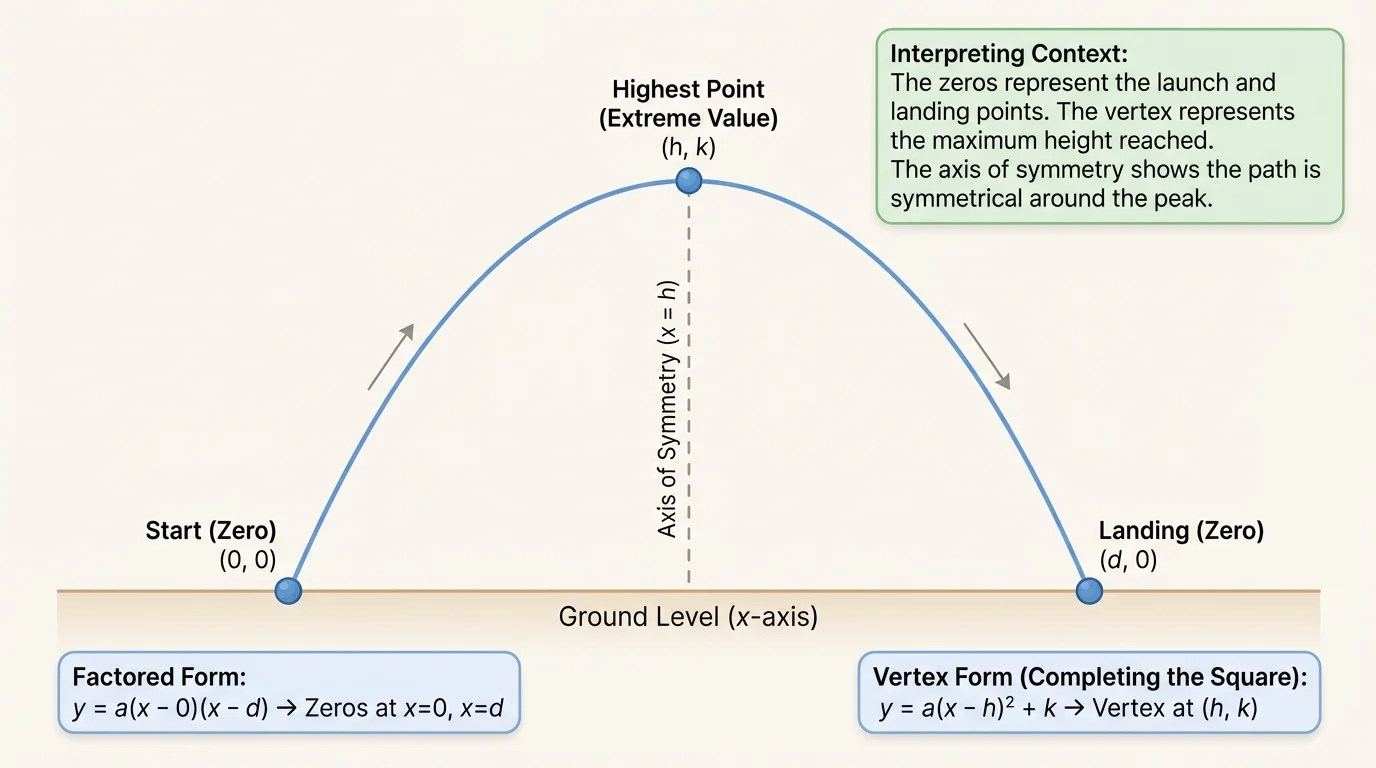
As [Figure 3] illustrates, the height of a launched object, the profit from selling a product, or the area of a rectangle with a fixed perimeter can all be modeled by quadratic functions. Rewriting the function helps you explain the meaning of the graph, not just calculate points.
Suppose a ball's height is modeled by \[h(t)=-16t^2+48t.\] Here, \(t\) is time in seconds and \(h(t)\) is height in feet.
Worked example
Find when the ball is on the ground, when it reaches its maximum height, and what that maximum height is.
Step 1: Find the zeros by factoring.
Factor: \(h(t)=-16t(t-3)\).
Set equal to \(0\): \(-16t(t-3)=0\), so \(t=0\) or \(t=3\).
Step 2: Interpret the zeros.
The ball is on the ground at \(t=0\) and again at \(t=3\). The first zero is the launch time, and the second is the landing time.
Step 3: Find the axis of symmetry.
The midpoint of \(0\) and \(3\) is \(t=\dfrac{0+3}{2}=1.5\).
Step 4: Find the maximum height.
Evaluate the function at \(t=1.5\): \(h(1.5)=-16(1.5)^2+48(1.5)=-16(2.25)+72=-36+72=36\).
The ball reaches a maximum height of \(36\) feet at \(t=1.5\) seconds.
In this context, the zeros are not just numbers. They are physically meaningful times. The vertex is the highest point of the ball's path, matching the peak shown in [Figure 3].
Suppose a garden has width \(x\) meters and length \(20-x\) meters. Its area is \[A(x)=x(20-x)=-x^2+20x.\] This quadratic opens downward, so its vertex gives a maximum area.
Complete the square: \[A(x)=-(x^2-20x)=-(x^2-20x+100-100)=-(x-10)^2+100.\] The vertex is \((10,100)\), so the maximum area is \(100\) square meters when the width is \(10\) meters and the length is also \(10\) meters.
Here, the symmetry has a practical meaning: rectangles with dimensions equally far from \(10\) and \(10\) have the same area. The best area occurs at the balanced center.
One common mistake is reading the vertex incorrectly from vertex form. In \((x-4)^2+1\), the vertex is \((4,1)\), not \((-4,1)\). The sign inside the parentheses is opposite the x-coordinate of the vertex.
Another common mistake is forgetting to factor out the leading coefficient before completing the square when \(a\neq 1\). For example, in \(2x^2+8x+3\), you should first write \(2(x^2+4x)+3\) before completing the square inside the parentheses.
A useful check is to compare forms. If you factor a quadratic and then find the vertex, the axis of symmetry should be the midpoint of the zeros. If those results do not agree, something went wrong.
"A function can stay the same while its form changes enough to reveal hidden structure."
This is exactly why equivalent forms matter so much in algebra. Rewriting is not busywork. It is a way of seeing.
