A pilot changing direction, a game designer rotating a character, and an engineer analyzing forces all encounter the same mathematical idea: certain angles produce exact trigonometric values. Instead of messy decimals, angles like \(\pi/6\), \(\pi/4\), and \(\pi/3\) give values involving only \(1\), \(2\), and square roots. Even better, once those values are known, the unit circle lets us predict trig values for related angles such as \(\pi-x\), \(\pi+x\), and \(2\pi-x\) without starting from scratch.
In trigonometry, the most useful exact values come from special triangles. These are right triangles with side lengths that follow fixed geometric patterns. From them, we can determine exact values of sine, cosine, and tangent for a few key angles. Then the unit circle extends those ideas far beyond acute angles.
Angles will be written in radians because that is the standard notation in advanced mathematics. Remember the basic conversions: \(\pi/6 = 30^\circ\), \(\pi/4 = 45^\circ\), and \(\pi/3 = 60^\circ\).
From right-triangle trigonometry, for an acute angle \(\theta\), \(\sin \theta = \dfrac{\textrm{opposite}}{\textrm{hypotenuse}}\), \(\cos \theta = \dfrac{\textrm{adjacent}}{\textrm{hypotenuse}}\), and \(\tan \theta = \dfrac{\textrm{opposite}}{\textrm{adjacent}} = \dfrac{\sin \theta}{\cos \theta}\).
Those definitions work directly for acute angles in right triangles. To handle any real angle, positive or negative, we need the unit circle.
As shown in [Figure 1], the unit circle is the circle centered at the origin with radius \(1\). On that circle, every angle \(x\) lands at a point whose coordinates determine the trigonometric functions. If the point is \((a,b)\), then \(a = \cos x\) and \(b = \sin x\).
This gives the key relationship:
\[ (\cos x, \sin x) \]
for the point on the unit circle corresponding to angle \(x\). Since tangent is sine divided by cosine,
\[ \tan x = \frac{\sin x}{\cos x} \]
whenever \(\cos x \neq 0\).
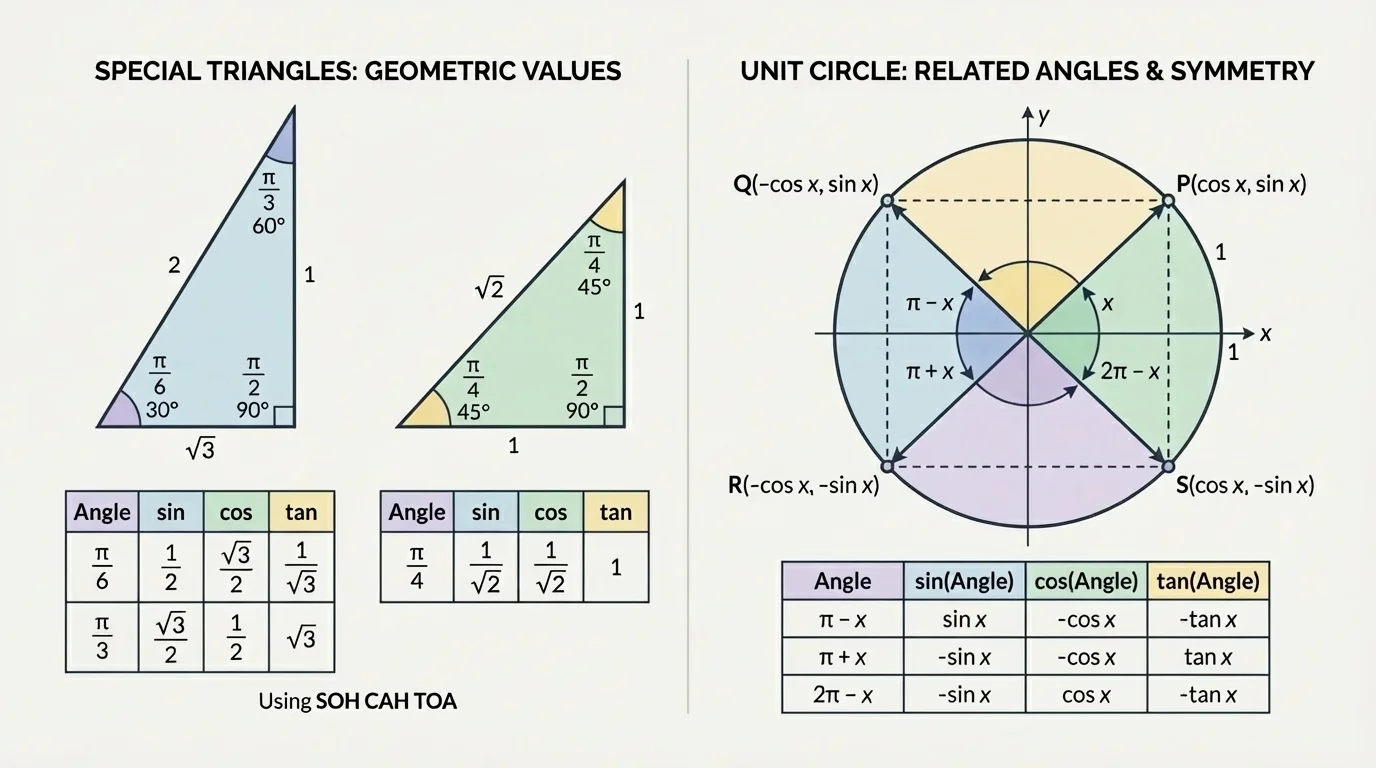
This coordinate viewpoint is powerful because geometry on the circle reveals patterns. Reflecting a point across the \(y\)-axis changes the sign of the \(x\)-coordinate but not the \(y\)-coordinate. Reflecting across the \(x\)-axis changes the sign of the \(y\)-coordinate but not the \(x\)-coordinate. Later, those reflections will become formulas for \(\pi-x\), \(\pi+x\), and \(2\pi-x\).
Sine gives the \(y\)-coordinate of a point on the unit circle. Cosine gives the \(x\)-coordinate. Tangent is the ratio \(\dfrac{\sin x}{\cos x}\), so it depends on both coordinates and is undefined when \(\cos x = 0\).
The unit circle also explains why trig functions are not limited to angles inside one triangle. A right triangle only covers acute angles, but a full circle covers all real numbers.
As shown in [Figure 2], a special triangle with angles \(45^\circ\), \(45^\circ\), and \(90^\circ\) has two equal legs. Start with a right isosceles triangle whose legs each have length \(1\).
By the Pythagorean theorem, the hypotenuse is
\[ \sqrt{1^2 + 1^2} = \sqrt{2} \]
Now use the trigonometric ratios for one of the \(45^\circ\) angles:
\(\sin(\pi/4) = \dfrac{1}{\sqrt{2}}\), \(\cos(\pi/4) = \dfrac{1}{\sqrt{2}}\), and \(\tan(\pi/4) = \dfrac{1}{1} = 1\).
Rationalizing the denominator gives the exact values most often used:
\[ \sin\left(\frac{\pi}{4}\right) = \cos\left(\frac{\pi}{4}\right) = \frac{\sqrt{2}}{2}, \qquad \tan\left(\frac{\pi}{4}\right) = 1 \]
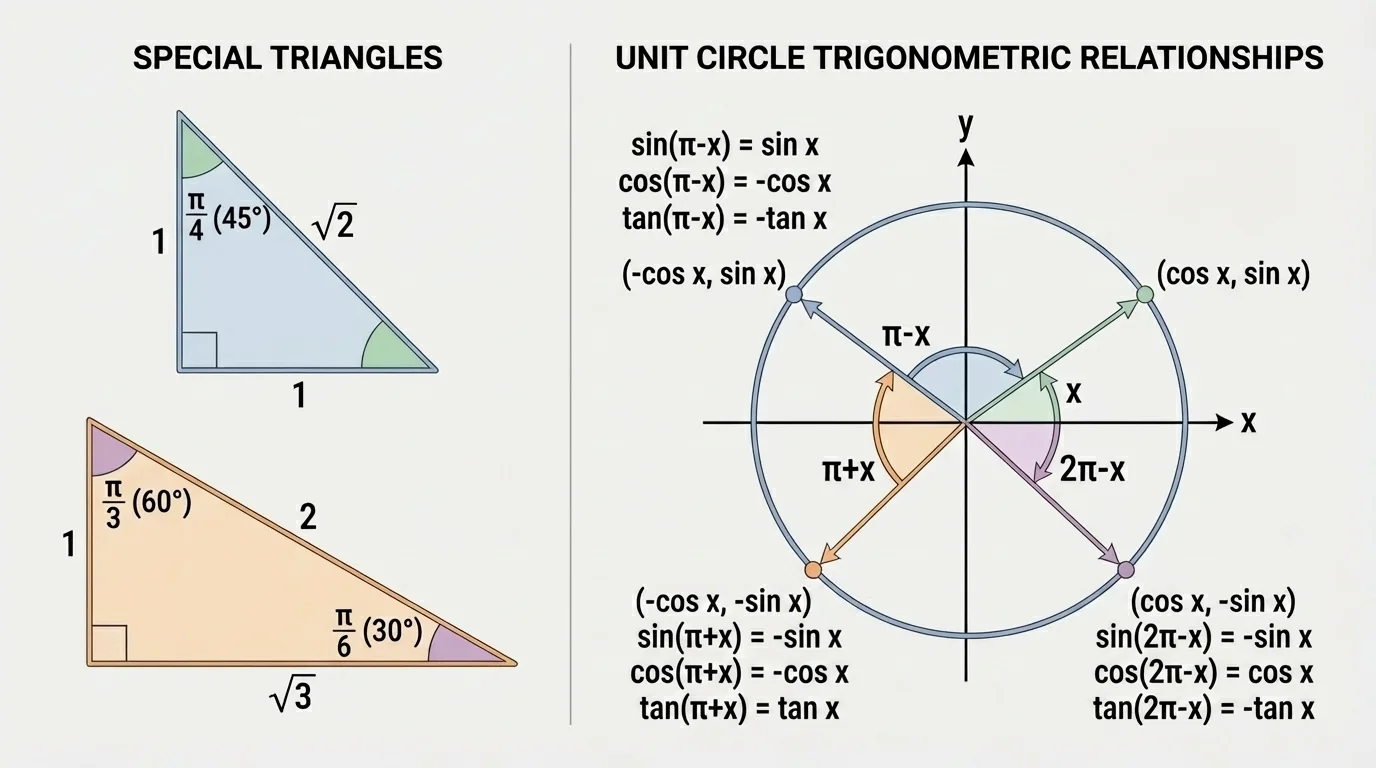
The equality of sine and cosine here makes sense: in this triangle, the opposite and adjacent sides are the same length. That symmetry will matter again when we compare exact trig values across the special angles.
As shown in [Figure 3], the other essential special triangle comes from an equilateral triangle. If you split an equilateral triangle down the middle, you create two right triangles with angles \(30^\circ\), \(60^\circ\), and \(90^\circ\).
Suppose the original equilateral triangle has side length \(2\). Then each half has hypotenuse \(2\), one short leg \(1\), and the other leg found by the Pythagorean theorem:
\[ \sqrt{2^2 - 1^2} = \sqrt{4-1} = \sqrt{3} \]
So the side ratio in a \(30^\circ\)-\(60^\circ\)-\(90^\circ\) triangle is
\[ 1 : \sqrt{3} : 2 \]
Now find the trig values.
For \(\pi/6\), which is \(30^\circ\): opposite \(= 1\), adjacent \(= \sqrt{3}\), hypotenuse \(= 2\).
\[ \sin\left(\frac{\pi}{6}\right) = \frac{1}{2}, \qquad \cos\left(\frac{\pi}{6}\right) = \frac{\sqrt{3}}{2}, \qquad \tan\left(\frac{\pi}{6}\right) = \frac{1}{\sqrt{3}} = \frac{\sqrt{3}}{3} \]
For \(\pi/3\), which is \(60^\circ\): opposite \(= \sqrt{3}\), adjacent \(= 1\), hypotenuse \(= 2\).
\[ \sin\left(\frac{\pi}{3}\right) = \frac{\sqrt{3}}{2}, \qquad \cos\left(\frac{\pi}{3}\right) = \frac{1}{2}, \qquad \tan\left(\frac{\pi}{3}\right) = \sqrt{3} \]
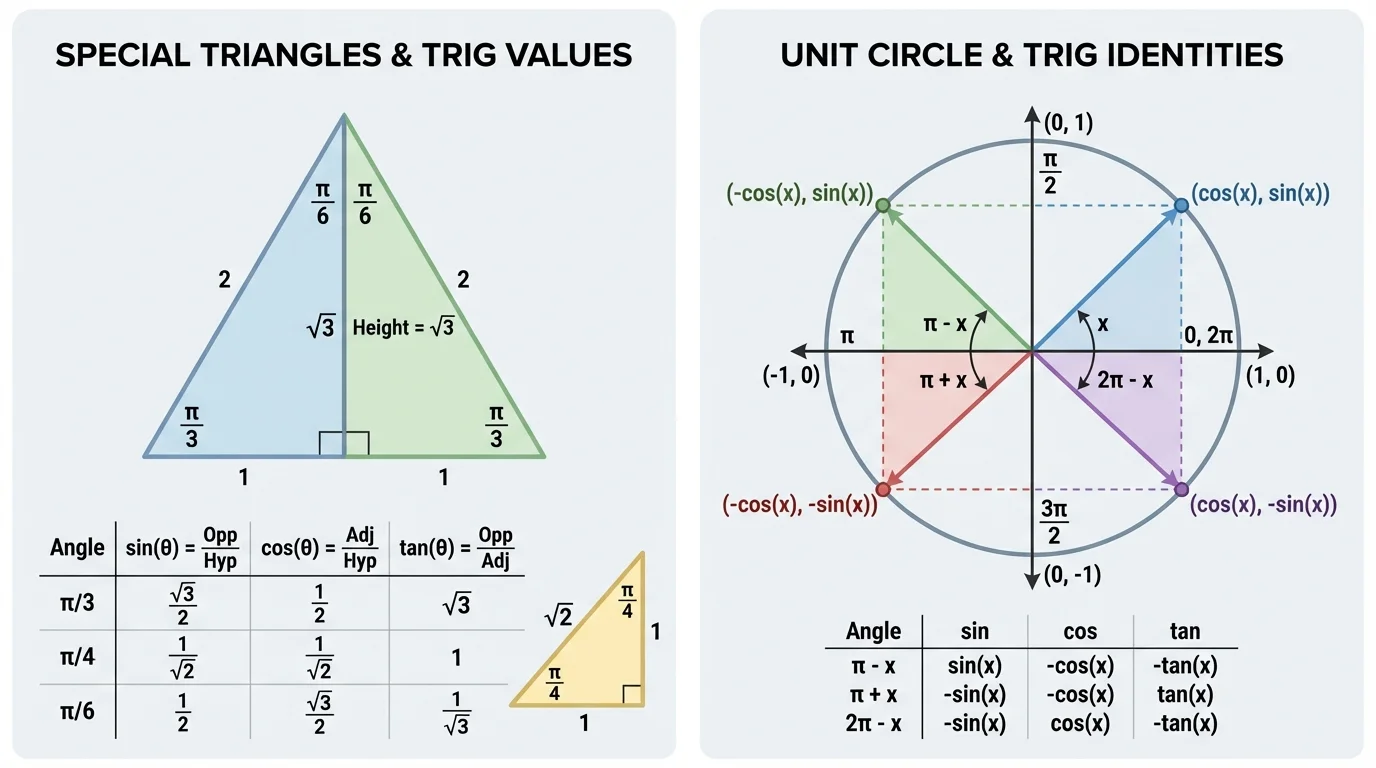
Notice the pattern: the sine and cosine values for \(\pi/6\) and \(\pi/3\) switch places. That is because \(30^\circ\) and \(60^\circ\) are complementary angles in the same triangle.
These exact trig values are used in computer graphics and robotics because exact expressions with square roots preserve more precision than rounded decimal approximations. Exact forms help preserve precision in symbolic calculations.
Seen on the unit circle, these same trigonometric values become coordinates of important points. For example, angle \(\pi/3\) lands at \(\left(\dfrac{1}{2}, \dfrac{\sqrt{3}}{2}\right)\), while angle \(\pi/6\) lands at \(\left(\dfrac{\sqrt{3}}{2}, \dfrac{1}{2}\right)\).
It helps to organize the results so patterns are easier to spot.
| Angle | Degrees | \(\sin\) | \(\cos\) | \(\tan\) |
|---|---|---|---|---|
| \(\pi/6\) | \(30^\circ\) | \(\dfrac{1}{2}\) | \(\dfrac{\sqrt{3}}{2}\) | \(\dfrac{\sqrt{3}}{3}\) |
| \(\pi/4\) | \(45^\circ\) | \(\dfrac{\sqrt{2}}{2}\) | \(\dfrac{\sqrt{2}}{2}\) | \(1\) |
| \(\pi/3\) | \(60^\circ\) | \(\dfrac{\sqrt{3}}{2}\) | \(\dfrac{1}{2}\) | \(\sqrt{3}\) |
Table 1. Exact values of sine, cosine, and tangent for the most common special angles in the first quadrant.
One useful memory pattern for sine in the first quadrant is
\[ \frac{\sqrt{1}}{2}, \; \frac{\sqrt{2}}{2}, \; \frac{\sqrt{3}}{2} \]
for \(\pi/6\), \(\pi/4\), and \(\pi/3\). Cosine follows the same numbers in reverse order.
As shown in [Figure 4], the real power of the reference angle idea appears when we compare related angles on the unit circle. If angle \(x\) lands at the point \((\cos x, \sin x)\), then reflecting that point into other quadrants changes signs in predictable ways.
Think of \(x\) as a positive acute angle first. Then \(\pi-x\) is in Quadrant II, \(\pi+x\) is in Quadrant III, and \(2\pi-x\) is in Quadrant IV. The coordinates are determined by symmetry.
For \(\pi-x\), the point is the reflection of the point for \(x\) across the \(y\)-axis. That keeps the \(y\)-coordinate the same and changes the sign of the \(x\)-coordinate:
\[ \cos(\pi-x) = -\cos x, \qquad \sin(\pi-x) = \sin x \]
So tangent becomes
\[ \tan(\pi-x) = \frac{\sin(\pi-x)}{\cos(\pi-x)} = \frac{\sin x}{-\cos x} = -\tan x \]
For \(\pi+x\), the point is opposite the point for \(x\) through the origin, so both coordinates change sign:
\[ \cos(\pi+x) = -\cos x, \qquad \sin(\pi+x) = -\sin x, \qquad \tan(\pi+x) = \tan x \]
For \(2\pi-x\), the point is the reflection of the point for \(x\) across the \(x\)-axis. The \(x\)-coordinate stays the same, and the \(y\)-coordinate changes sign:
\[ \cos(2\pi-x) = \cos x, \qquad \sin(2\pi-x) = -\sin x, \qquad \tan(2\pi-x) = -\tan x \]
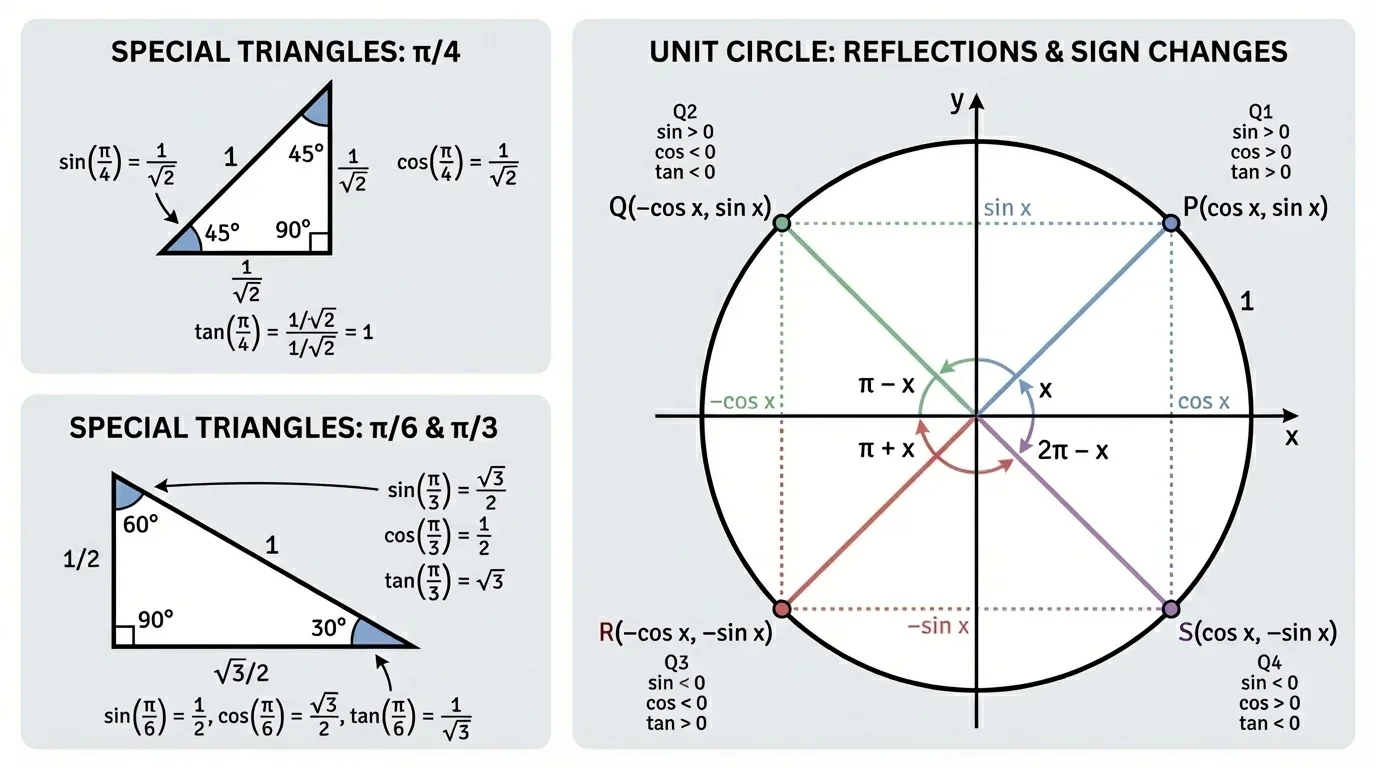
These identities are not limited to acute angles. Because the unit circle definition works for any real number, the relationships above hold for any real \(x\), as long as tangent is defined.
Why the signs change
On the unit circle, cosine is the horizontal coordinate and sine is the vertical coordinate. So sign changes come from location: Quadrant II has negative \(x\)-values and positive \(y\)-values, Quadrant III has both negative, and Quadrant IV has positive \(x\)-values and negative \(y\)-values. Tangent follows from the ratio \(\dfrac{\sin x}{\cos x}\), so it is positive when sine and cosine have the same sign and negative when they have different signs.
As seen earlier in [Figure 1], once you picture trig values as coordinates rather than just triangle ratios, these identities become geometric facts instead of formulas to memorize blindly.
The best way to make these relationships stick is to work through exact-value problems carefully.
Worked example 1
Find the exact values of \(\sin(\pi/4)\), \(\cos(\pi/4)\), and \(\tan(\pi/4)\).
Step 1: Use the \(45^\circ\)-\(45^\circ\)-\(90^\circ\) triangle.
Let each leg be \(1\). Then the hypotenuse is \(\sqrt{2}\).
Step 2: Compute sine and cosine.
\(\sin(\pi/4) = \dfrac{1}{\sqrt{2}} = \dfrac{\sqrt{2}}{2}\) and \(\cos(\pi/4) = \dfrac{1}{\sqrt{2}} = \dfrac{\sqrt{2}}{2}\).
Step 3: Compute tangent.
\(\tan(\pi/4) = \dfrac{1}{1} = 1\).
Therefore, \[ \sin\left(\frac{\pi}{4}\right) = \frac{\sqrt{2}}{2}, \quad \cos\left(\frac{\pi}{4}\right) = \frac{\sqrt{2}}{2}, \quad \tan\left(\frac{\pi}{4}\right) = 1 \]
Example 1 uses triangle geometry directly. The next examples combine exact values with unit-circle identities.
Worked example 2
Express \(\sin(\pi-\pi/6)\), \(\cos(\pi-\pi/6)\), and \(\tan(\pi-\pi/6)\) exactly.
Step 1: Use the identities for \(\pi-x\).
\(\sin(\pi-x) = \sin x\), \(\cos(\pi-x) = -\cos x\), and \(\tan(\pi-x) = -\tan x\).
Step 2: Substitute \(x = \pi/6\).
We know \(\sin(\pi/6) = \dfrac{1}{2}\), \(\cos(\pi/6) = \dfrac{\sqrt{3}}{2}\), and \(\tan(\pi/6) = \dfrac{\sqrt{3}}{3}\).
Step 3: Apply the signs.
\(\sin(\pi-\pi/6) = \dfrac{1}{2}\), \(\cos(\pi-\pi/6) = -\dfrac{\sqrt{3}}{2}\), and \(\tan(\pi-\pi/6) = -\dfrac{\sqrt{3}}{3}\).
So, \[ \sin\left(\frac{5\pi}{6}\right) = \frac{1}{2}, \quad \cos\left(\frac{5\pi}{6}\right) = -\frac{\sqrt{3}}{2}, \quad \tan\left(\frac{5\pi}{6}\right) = -\frac{\sqrt{3}}{3} \]
Notice how the reference angle stays \(\pi/6\), but the quadrant changes the signs.
Worked example 3
Find the exact value of \(\cos(2\pi-\pi/3)\).
Step 1: Use the identity for \(2\pi-x\).
\(\cos(2\pi-x) = \cos x\).
Step 2: Substitute \(x = \pi/3\).
\(\cos(2\pi-\pi/3) = \cos(\pi/3)\).
Step 3: Use the special-angle value.
\(\cos(\pi/3) = \dfrac{1}{2}\).
Therefore, \[ \cos\left(\frac{5\pi}{3}\right) = \frac{1}{2} \]
The same approach works for sine and tangent. Identify the form of the angle first, then apply the sign changes from the correct quadrant.
Worked example 4
Find \(\tan(\pi+\pi/4)\).
Step 1: Use the identity for \(\pi+x\).
\(\tan(\pi+x) = \tan x\).
Step 2: Substitute \(x = \pi/4\).
\(\tan(\pi+\pi/4) = \tan(\pi/4)\).
Step 3: Evaluate the special-angle tangent.
\(\tan(\pi/4) = 1\).
Thus, \[ \tan\left(\frac{5\pi}{4}\right) = 1 \]
That result may seem surprising at first because \(5\pi/4\) is in Quadrant III, but both sine and cosine are negative there, so their ratio is positive.
Exact trig values are not just classroom exercises. In physics, a force at angle \(\pi/3\) can be split into horizontal and vertical components using \(\cos(\pi/3) = \dfrac{1}{2}\) and \(\sin(\pi/3) = \dfrac{\sqrt{3}}{2}\). If a force of \(10\) newtons acts at \(\pi/3\), its components are \(10 \cdot \dfrac{1}{2} = 5\) horizontally and \(10 \cdot \dfrac{\sqrt{3}}{2} = 5\sqrt{3}\) vertically.
Surveyors and engineers also use these angles. A ramp making a \(30^\circ\) angle with the ground has slope \(\tan(\pi/6) = \dfrac{\sqrt{3}}{3}\). That exact value helps in design calculations before decimal approximations are used.
In computer animation and robotics, rotating an object by \(\pi-x\) or \(2\pi-x\) changes coordinate signs in the same way that the unit circle predicts. The reflection patterns from [Figure 4] are directly connected to how software updates positions and directions in a coordinate plane.
One common mistake is mixing up radians and degrees. If the problem gives \(\pi/6\), do not treat it as \(6^\circ\). It is \(30^\circ\).
Another mistake is getting the correct reference angle but the wrong sign. For example, \(\cos(\pi-\pi/6)\) has reference angle \(\pi/6\), so its magnitude is \(\dfrac{\sqrt{3}}{2}\), but because the angle lies in Quadrant II, cosine must be negative.
A third mistake is forgetting that tangent can be undefined. Since \(\tan x = \dfrac{\sin x}{\cos x}\), any angle where \(\cos x = 0\) makes tangent undefined.
"On the unit circle, signs come from position, and values come from reference angles."
This is a strong principle to remember because it separates two jobs: first find the special-angle value, then decide the sign from the quadrant.
Special triangles give exact trigonometric values in the first quadrant. The unit circle then extends those values to many other angles through symmetry. As seen in [Figure 2] and [Figure 3], geometry provides the exact numbers; as shown by the reflections on the unit circle, geometry also controls the signs.
That is one of the elegant ideas of trigonometry: a few simple shapes unlock a huge network of exact relationships.
