A calculator can display values like \(0.75\), \(\dfrac{5}{8}\), and \(\sqrt{2}\), but those numbers do not all behave the same way. Some can be written exactly as fractions, and some cannot. That difference matters in algebra, geometry, engineering, and computer science, because the kind of number you start with often determines the kind of number you end with after adding or multiplying.
Suppose a square has side length \(1\). Its diagonal is \(\sqrt{2}\), which is irrational. If you increase that length by \(2\) units, do you suddenly get a rational number? If you double it, does it become rational? Questions like these are not just about arithmetic. They are about the structure of the real number system and about which properties stay true under operations.
In mathematics, recognizing patterns is powerful. Rational numbers are stable under addition and multiplication: when you combine two rational numbers in either of those ways, the result is still rational. But mixing rational and irrational numbers leads to different results, and understanding why is more important than memorizing rules.
You already know that a fraction has the form \(\dfrac{a}{b}\), where \(a\) and \(b\) are integers and \(b \neq 0\). You also know that integers are rational because any integer \(n\) can be written as \(\dfrac{n}{1}\).
To reason carefully, we need clear definitions.
A rational number is any number that can be written in the form \(\dfrac{a}{b}\), where \(a\) and \(b\) are integers and \(b \neq 0\). An irrational number is a real number that cannot be written in that form. Their decimal patterns help distinguish them, as [Figure 1] shows through examples of terminating, repeating, and nonrepeating decimals.
Examples of rational numbers include \(\dfrac{3}{4}\), \(-2\), \(0.125\), and \(0.333\ldots\). The last decimal is rational because \(0.333\ldots = \dfrac{1}{3}\). Rational numbers either terminate or repeat in decimal form.
Examples of irrational numbers include \(\sqrt{2}\), \(\pi\), and \(\sqrt{7}\). Their decimal expansions do not terminate and do not repeat in a repeating pattern. That does not make them "messy" or "incorrect"; it simply means they cannot be written as exact fractions of integers.
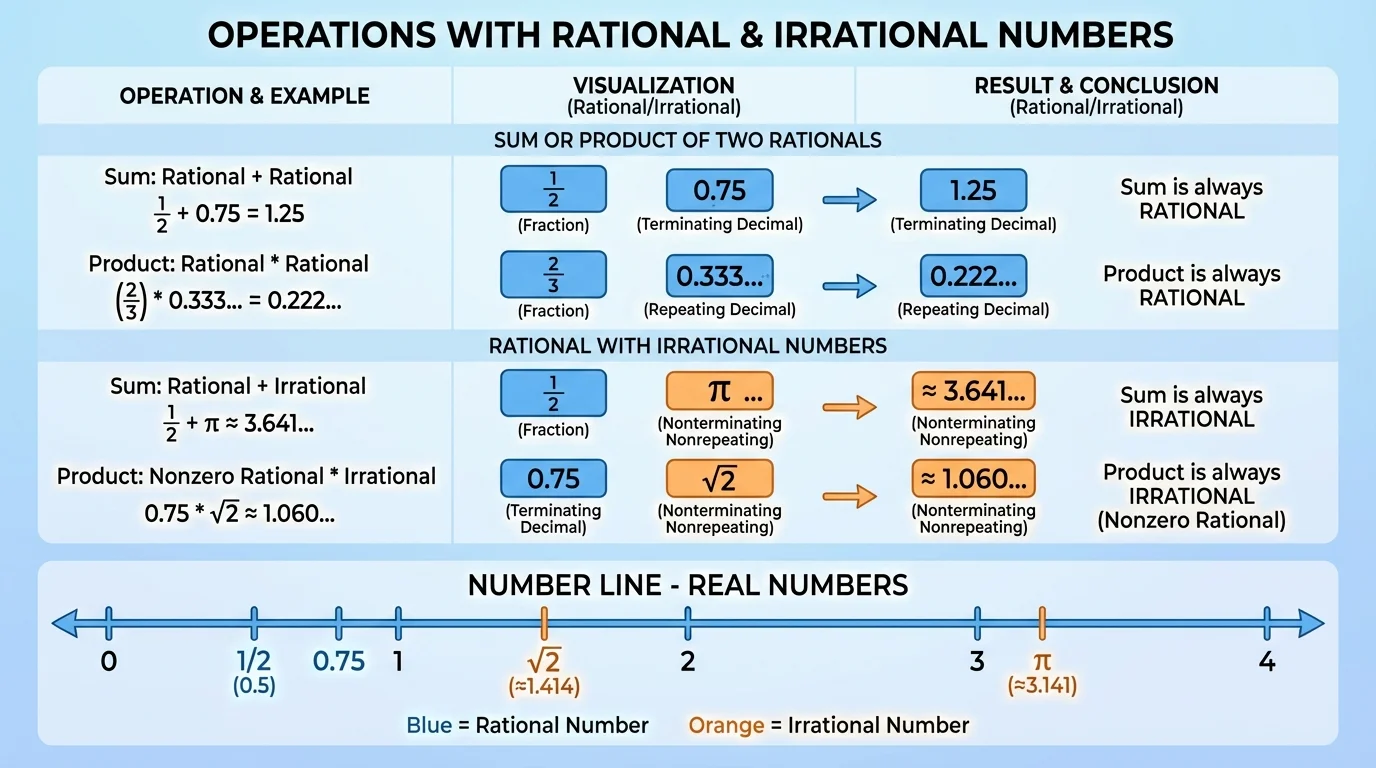
Rational number: a number of the form \(\dfrac{a}{b}\), where \(a\) and \(b\) are integers and \(b \neq 0\).
Irrational number: a real number that cannot be written as \(\dfrac{a}{b}\) for integers \(a\) and \(b\) with \(b \neq 0\).
One of the biggest goals in this topic is to understand how these two sets of numbers behave under addition and multiplication.
Take any two rational numbers. Because they are rational, we can write them as \(\dfrac{a}{b}\) and \(\dfrac{c}{d}\), where \(a\), \(b\), \(c\), and \(d\) are integers and \(b \neq 0\), \(d \neq 0\).
Now add them:
\[\frac{a}{b} + \frac{c}{d} = \frac{ad + bc}{bd}\]
The numerator \(ad + bc\) is an integer because integers are closed under multiplication and addition. The denominator \(bd\) is also an integer, and it is not zero because neither \(b\) nor \(d\) is zero. So the sum has the form \(\dfrac{m}{n}\), where \(m\) and \(n\) are integers and \(n \neq 0\), which means it is rational.
This argument is a proof. It does not depend on particular numbers. It works for all rational numbers.
For example, \(\dfrac{2}{3} + \dfrac{5}{6} = \dfrac{4}{6} + \dfrac{5}{6} = \dfrac{9}{6} = \dfrac{3}{2}\), which is rational. Also, \(-4 + \dfrac{7}{10} = -\dfrac{40}{10} + \dfrac{7}{10} = -\dfrac{33}{10}\), which is rational.
Now take the same two rational numbers, \(\dfrac{a}{b}\) and \(\dfrac{c}{d}\). Their product is
\[\frac{a}{b} \cdot \frac{c}{d} = \frac{ac}{bd}\]
Again, \(ac\) is an integer and \(bd\) is a nonzero integer. So the product is rational.
This means rational numbers are closed under multiplication. The word closure means that when you perform an operation on numbers in a set, the result stays in that set. Rational numbers have closure under addition, subtraction, and multiplication. They do not have closure under division by every rational number, because division by \(0\) is undefined.
Examples make the rule feel natural: \(\dfrac{3}{5} \cdot \dfrac{10}{9} = \dfrac{30}{45} = \dfrac{2}{3}\), and \((-2)\left(\dfrac{7}{8}\right) = -\dfrac{14}{8} = -\dfrac{7}{4}\). Both results are rational.
Why these proofs work
Both proofs depend on the fact that integers remain integers when you add or multiply them. Since rational numbers are built from integers in fraction form, the resulting numerator and denominator still fit the definition of a rational number.
That stability is what makes rational numbers so useful in algebraic manipulation.
A key change occurs when a rational number and an irrational number are added. A useful way to picture this is as a shift on the number line, as [Figure 2] illustrates: moving an irrational number left or right by a rational amount does not suddenly make its decimal pattern become terminating or repeating.
We can prove this with contradiction. Let \(r\) be rational and let \(x\) be irrational. Suppose, for the sake of argument, that \(r + x\) is rational.
If \(r + x\) is rational, then subtracting the rational number \(r\) from it should still give a rational number, because rational numbers are closed under subtraction. But
\[x = (r + x) - r\]
This would mean \(x\) is rational, which contradicts the fact that \(x\) is irrational. Therefore, our assumption was false, and \(r + x\) must be irrational.
This proof is elegant because it uses a fact we already know: rational numbers remain rational when added or subtracted.
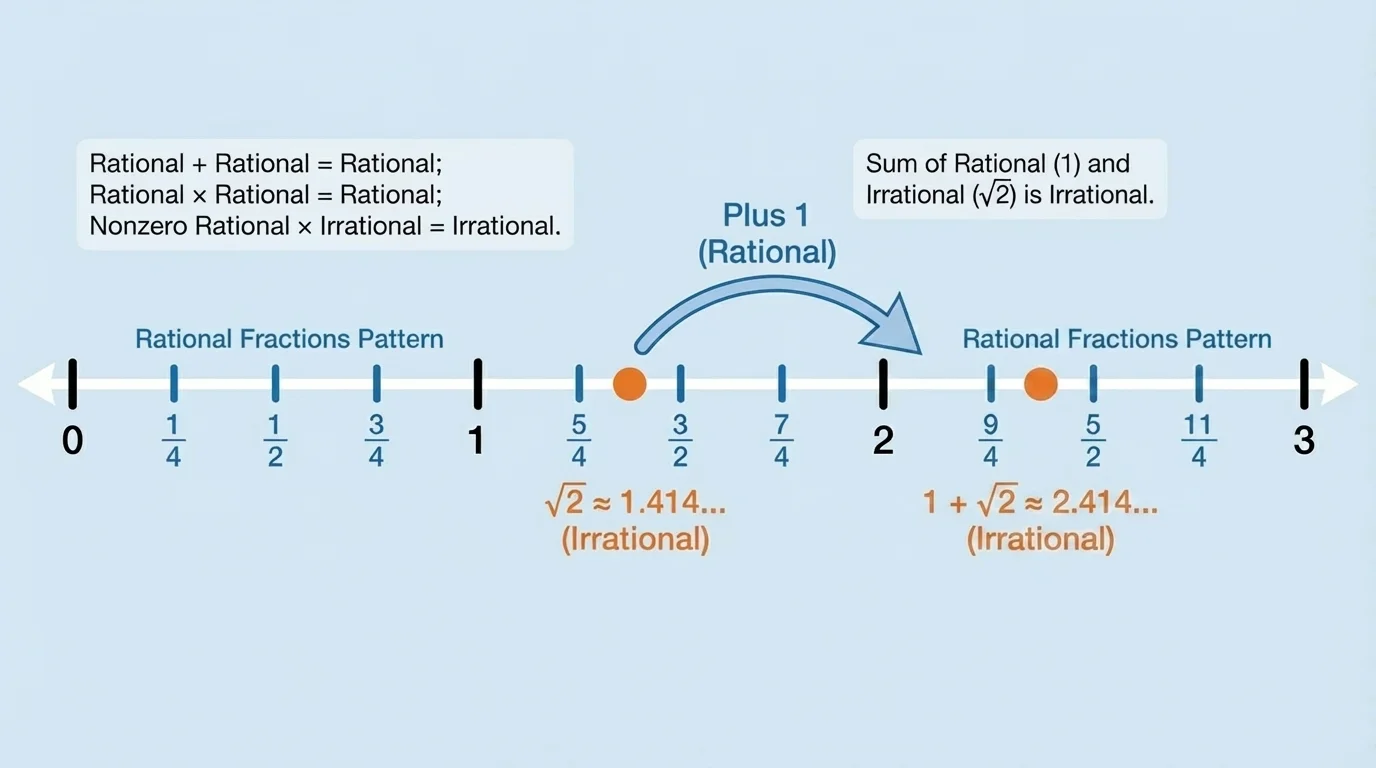
For instance, \(3 + \sqrt{2}\) is irrational. If it were rational, then subtracting \(3\) would make \(\sqrt{2}\) rational, which is impossible. The same reasoning works for \(-\dfrac{5}{4} + \pi\), \(10 + \sqrt{11}\), or any other rational-plus-irrational sum.
The decimal approximation of \(\sqrt{2}\) begins \(1.41421356\ldots\), but no matter how many decimal places you compute, it never turns into a repeating decimal. Adding \(1\) changes the location of the number, not its irrational nature.
As we saw earlier with decimal classifications in [Figure 1], rational numbers have decimal forms that terminate or repeat. Adding a rational number to an irrational number does not create that repeating structure.
Multiplication behaves similarly, but there is one important condition: the rational number must be nonzero. Geometrically, multiplication by a rational factor rescales a length, and [Figure 3] shows that scaling an irrational length like \(\sqrt{2}\) by a nonzero rational number still produces an irrational length.
Let \(r\) be a nonzero rational number and let \(x\) be irrational. Suppose that \(rx\) is rational.
Since \(r\) is rational and nonzero, the reciprocal \(\dfrac{1}{r}\) is also rational. Multiply both sides of \(rx\) by \(\dfrac{1}{r}\):
\[x = \frac{1}{r}(rx)\]
If \(rx\) were rational, then multiplying it by the rational number \(\dfrac{1}{r}\) would give another rational number. That would mean \(x\) is rational, contradicting the assumption that \(x\) is irrational. Therefore, \(rx\) must be irrational.
The phrase nonzero rational is essential. If \(r = 0\), then \(rx = 0\) for every real number \(x\), and \(0\) is rational. So the statement would be false without the nonzero condition.
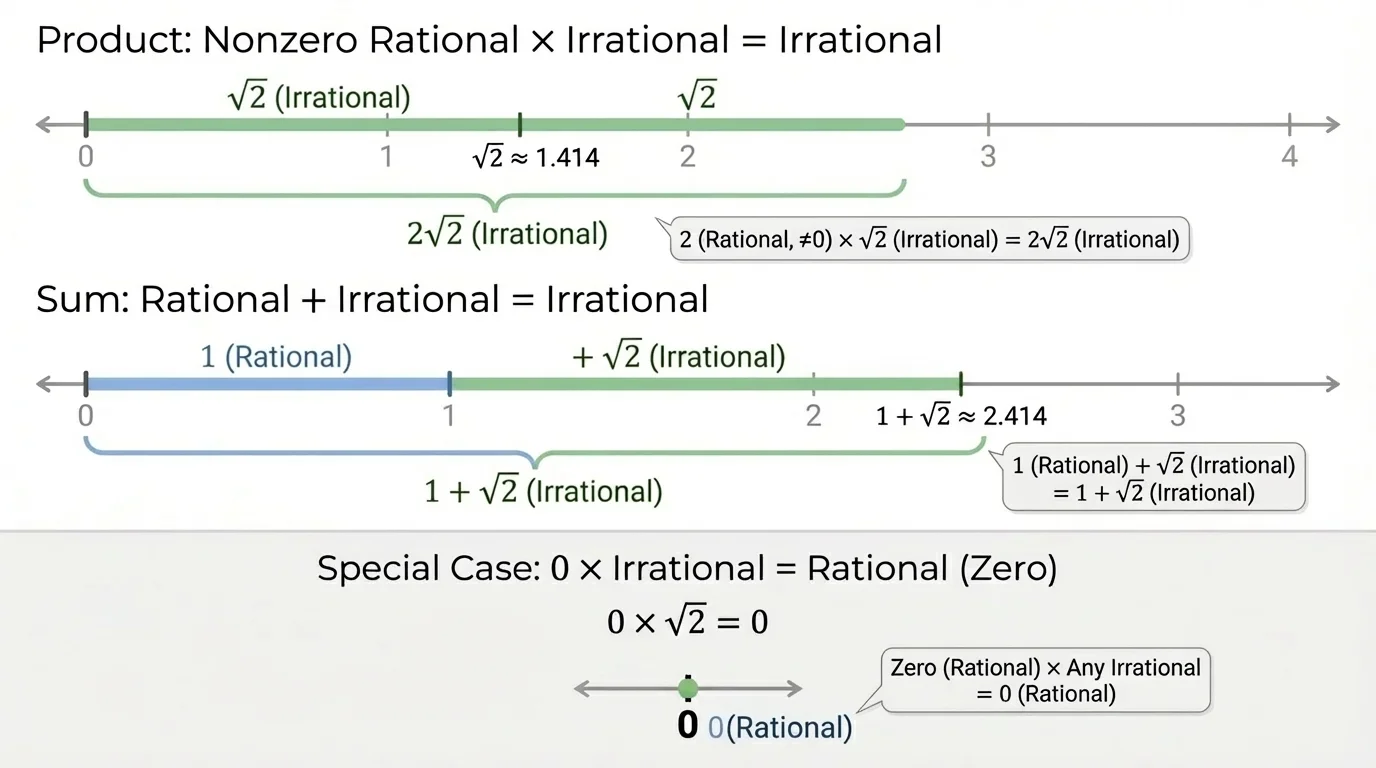
For example, \(2\sqrt{3}\) is irrational, and \(-\dfrac{3}{5}\pi\) is irrational. But \(0 \cdot \sqrt{3} = 0\), which is rational. That is exactly why the condition matters.
Students often try to extend these rules too far. Some patterns are guaranteed, and some are not.
Guaranteed: rational \(+\) rational \(=\) rational.
Guaranteed: rational \(\times\) rational \(=\) rational.
Guaranteed: rational \(+\) irrational \(=\) irrational.
Guaranteed: nonzero rational \(\times\) irrational \(=\) irrational.
But these are not guaranteed:
| Expression type | Always rational? | Always irrational? | Example |
|---|---|---|---|
| Irrational \(+\) irrational | No | No | \(\sqrt{2} + (-\sqrt{2}) = 0\), but \(\sqrt{2} + \sqrt{3}\) is irrational |
| Irrational \(\times\) irrational | No | No | \(\sqrt{2} \cdot \sqrt{2} = 2\), but \(\sqrt{2}\pi\) is irrational |
Table 1. Comparison of outcomes that are guaranteed and outcomes that depend on the particular irrational numbers involved.
This is a key mathematical habit: do not assume a pattern is universal unless you can justify it with a proof or a valid counterexample.
"A single counterexample is enough to show that a statement is not always true."
So although irrational numbers often "stay irrational," the exact operation and the exact numbers matter.
The best way to strengthen these ideas is to see the reasoning carried out carefully.
Worked example 1
Show that \(\dfrac{7}{12} + \dfrac{5}{18}\) is rational.
Step 1: Find a common denominator.
The least common multiple of \(12\) and \(18\) is \(36\).
Step 2: Rewrite each fraction.
\(\dfrac{7}{12} = \dfrac{21}{36}\) and \(\dfrac{5}{18} = \dfrac{10}{36}\).
Step 3: Add.
\(\dfrac{21}{36} + \dfrac{10}{36} = \dfrac{31}{36}\).
The result is \(\dfrac{31}{36}\), and it is rational because it is a ratio of two integers with a nonzero denominator.
This example matches the general proof: the sum of two rational numbers remains rational.
Worked example 2
Explain why \(4 + \sqrt{5}\) is irrational.
Step 1: Identify the types of numbers.
\(4\) is rational because \(4 = \dfrac{4}{1}\). The number \(\sqrt{5}\) is irrational.
Step 2: Assume the opposite of what you want to prove.
Suppose \(4 + \sqrt{5}\) is rational.
Step 3: Subtract the rational number \(4\).
Then \(\sqrt{5} = (4 + \sqrt{5}) - 4\) would be rational.
Step 4: State the contradiction.
This contradicts the fact that \(\sqrt{5}\) is irrational.
Therefore, \(4 + \sqrt{5}\) is irrational. This uses the same shift idea discussed earlier.
Notice that the proof did not depend on the number \(4\). Any rational number would work.
Worked example 3
Explain why \(-\dfrac{3}{2}\pi\) is irrational.
Step 1: Identify the types of numbers.
\(-\dfrac{3}{2}\) is rational and nonzero. The number \(\pi\) is irrational.
Step 2: Assume the product is rational.
Suppose \(-\dfrac{3}{2}\pi\) is rational.
Step 3: Multiply by the reciprocal.
The reciprocal of \(-\dfrac{3}{2}\) is \(-\dfrac{2}{3}\), which is rational. Then \(\pi = \left(-\dfrac{2}{3}\right)\left(-\dfrac{3}{2}\pi\right)\) would be rational.
Step 4: State the contradiction.
This contradicts the fact that \(\pi\) is irrational.
Therefore, \(-\dfrac{3}{2}\pi\) is irrational. This matches the scaling idea discussed earlier.
Here is one more useful variation.
Worked example 4
Determine whether \((\sqrt{2} + 3) - 3\) is rational or irrational.
Step 1: Simplify the expression.
\((\sqrt{2} + 3) - 3 = \sqrt{2}\).
Step 2: Classify the result.
\(\sqrt{2}\) is irrational.
The final answer is \(\sqrt{2}\), which is irrational. This example shows that adding and then subtracting the same rational number does not change the irrational nature of the original number.
Examples like these show that proof and computation support each other. A calculation gives one case; a proof explains every case.
These ideas appear whenever exact measurements matter. In geometry, the diagonal of a unit square is \(\sqrt{2}\). If an engineer adds a rational trim length such as \(\dfrac{1}{4}\) meter, the total length becomes \(\sqrt{2} + \dfrac{1}{4}\), which is still irrational. If the design is scaled by \(3\), the new length is \(3\sqrt{2}\), still irrational. Exact forms matter because rounded decimals can introduce error.
In computer graphics and physics, distances often come from formulas like \(\sqrt{x^2 + y^2}\). Even when coordinates are rational, the resulting distance may be irrational. Translating an object by a rational amount changes its position but does not automatically make such lengths rational. This connects directly to the shift model from [Figure 2].
In architecture and manufacturing, scale drawings use rational scale factors such as \(\dfrac{1}{2}\), \(2\), or \(5\). If an original measurement is irrational, multiplying by one of these nonzero rational scale factors keeps it irrational, exactly as shown conceptually in [Figure 3].
Exact value versus approximation
When a calculator gives \(\sqrt{2} \approx 1.414\), that decimal is only an approximation. The exact number is still irrational. Adding or multiplying approximations can make results look rational on a screen, but the exact mathematical value follows the rules proved in this lesson.
This distinction is especially important in higher mathematics, where exact forms preserve structure that rounded forms can hide.
The most important idea is not just the outcomes, but the logic behind them. Rational numbers stay rational when added or multiplied because their fraction form survives those operations. A rational number cannot "cancel out" the irrational nature of another number by simple addition, and a nonzero rational scale factor cannot turn an irrational number into a rational one.
At the same time, mathematics rewards precision. Some combinations involving two irrational numbers are rational, and some are irrational. So the correct statement must match the evidence and the proof exactly.
