A number can be more than a point on a line. As soon as mathematicians accepted numbers involving \(i=\sqrt{-1}\), they needed a whole new picture: not a number line, but a plane. That shift is powerful because a complex number has two parts, and the complex plane lets us see them at once. Even better, the same complex number can be described in two different ways: by its horizontal and vertical position, or by its distance and direction from the origin.
A complex number has the form \(a+bi\), where \(a\) and \(b\) are real numbers. The number \(a\) is called the real part, and \(b\) is called the imaginary part. Since there are two values to keep track of, one axis is not enough. We use a two-dimensional coordinate system called the complex plane.
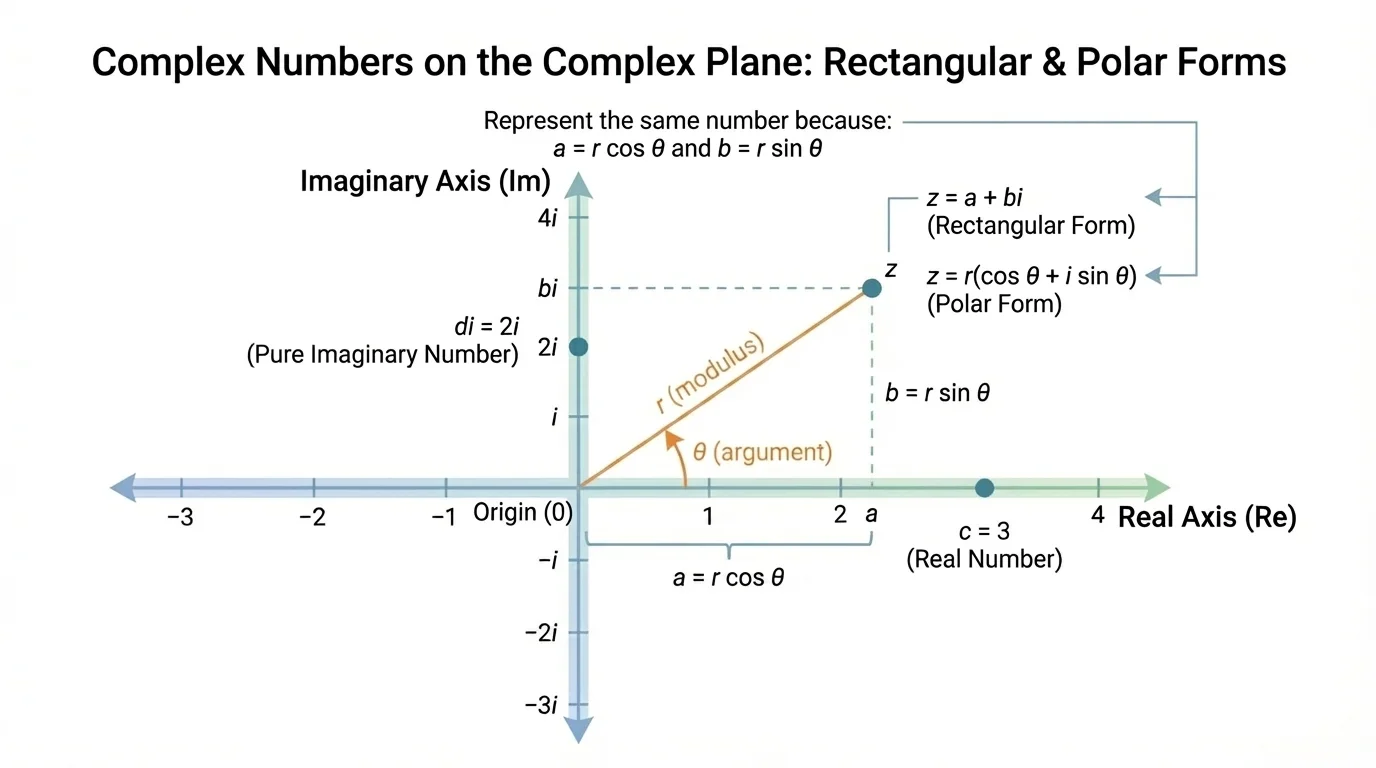
Complex plane means a coordinate plane used for complex numbers. The horizontal axis is the real axis, and the vertical axis is the imaginary axis.
Rectangular form is the form \(a+bi\).
Polar form describes a complex number using its distance from the origin and its angle from the positive real axis.
On this plane, the complex number \(a+bi\) is represented by the point \((a,b)\). That means the real part indicates how far left or right the point is, and the imaginary part indicates how far up or down it is. This makes complex numbers behave visually like vectors or points in a coordinate plane.
This picture also helps explain special cases. If \(b=0\), then the number is just a real number, and it lies on the real axis. If \(a=0\), then the number is a pure imaginary number, and it lies on the imaginary axis.
The rectangular form of a complex number is \(a+bi\). On the complex plane, as shown in [Figure 1], this number is plotted at the point \((a,b)\). You can think of this exactly like plotting coordinates, except the vertical coordinate represents the imaginary part instead of the usual \(y\)-coordinate in the Cartesian plane.
The horizontal axis is the real axis, and the vertical axis is the imaginary axis. For example, the complex number \(3+4i\) is plotted at \((3,4)\). The complex number \(-2+i\) is plotted at \((-2,1)\). The complex number \(5\) can be written as \(5+0i\), so it is plotted at \((5,0)\). The complex number \(-3i\) can be written as \(0-3i\), so it is plotted at \((0,-3)\).
This coordinate view makes addition and subtraction of complex numbers easier to understand, because adding real parts and imaginary parts separately matches horizontal and vertical movement on the plane. Even though this lesson focuses on representation, the geometry already hints that complex numbers are deeply connected to movement and rotation.
Recall that a point \((x,y)\) on the coordinate plane can also be described by its distance from the origin and the angle it makes with the positive \(x\)-axis. Complex numbers use the same geometric idea.
A useful habit is to rewrite every complex number so both parts are visible. For instance, write \(-7\) as \(-7+0i\) and write \(6i\) as \(0+6i\). That makes plotting straightforward and prevents mistakes about which axis to use.
There is another way to describe the same point. Instead of giving its horizontal and vertical coordinates, we can give its distance from the origin and its angle from the positive real axis. This is the polar form of a complex number. As shown in [Figure 2], one point can be reached by moving out a distance \(r\) from the origin at an angle \(\theta\).
The distance from the origin to the point is called the modulus and is usually written as \(r\) or \(|z|\). If the complex number is \(z=a+bi\), then the modulus is
\[r=|z|=\sqrt{a^2+b^2}\]
The angle is called the argument of the complex number. It is usually denoted by \(\theta\). The angle is measured from the positive real axis to the line segment connecting the origin to the point.
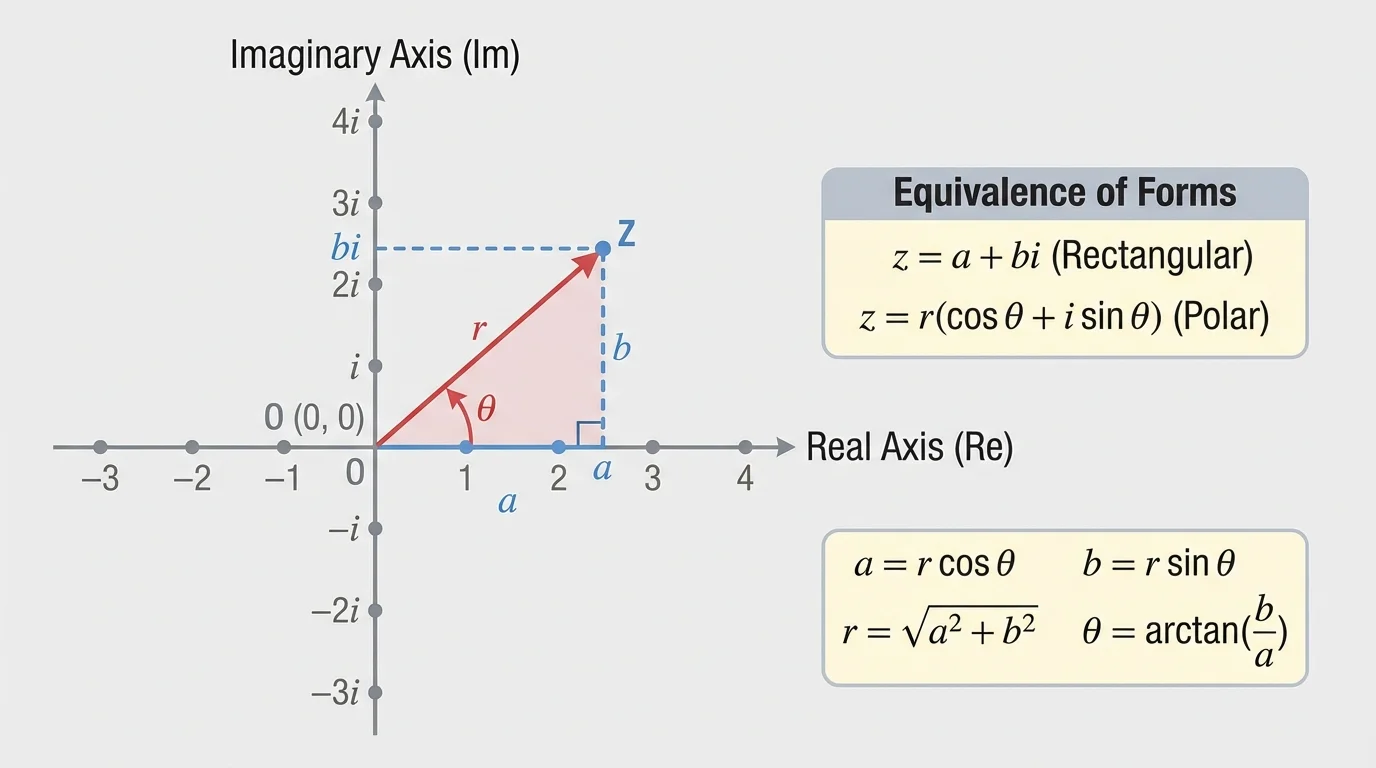
Using trigonometry, the horizontal coordinate is \(r\cos\theta\), and the vertical coordinate is \(r\sin\theta\). So if \(z=a+bi\), then
\[a=r\cos\theta \quad \textrm{and} \quad b=r\sin\theta\]
This leads to a common polar representation:
\[z=r(\cos\theta+i\sin\theta)\]
Some courses also use the shorthand \(z=r\operatorname{cis}\theta\), where \(\operatorname{cis}\theta=\cos\theta+i\sin\theta\). Whether written as \(r(\cos\theta+i\sin\theta)\) or with the shorthand, the idea is the same: the number is described by radius and angle instead of separate horizontal and vertical parts.
Why polar form matters
Rectangular form tells where a point is by using left-right and up-down information. Polar form tells where the same point is by using distance and direction. In problems involving rotation, waves, or repeated multiplication, distance-and-angle descriptions are often more natural and efficient.
For real numbers and pure imaginary numbers, polar form still works. A positive real number lies on the positive real axis, so its angle is \(0\). A negative real number lies on the negative real axis, so its angle can be taken as \(\pi\). A positive pure imaginary number lies on the positive imaginary axis, so its angle is \(\dfrac{\pi}{2}\), and a negative pure imaginary number lies on the negative imaginary axis, so its angle is \(\dfrac{3\pi}{2}\) or \(-\dfrac{\pi}{2}\).
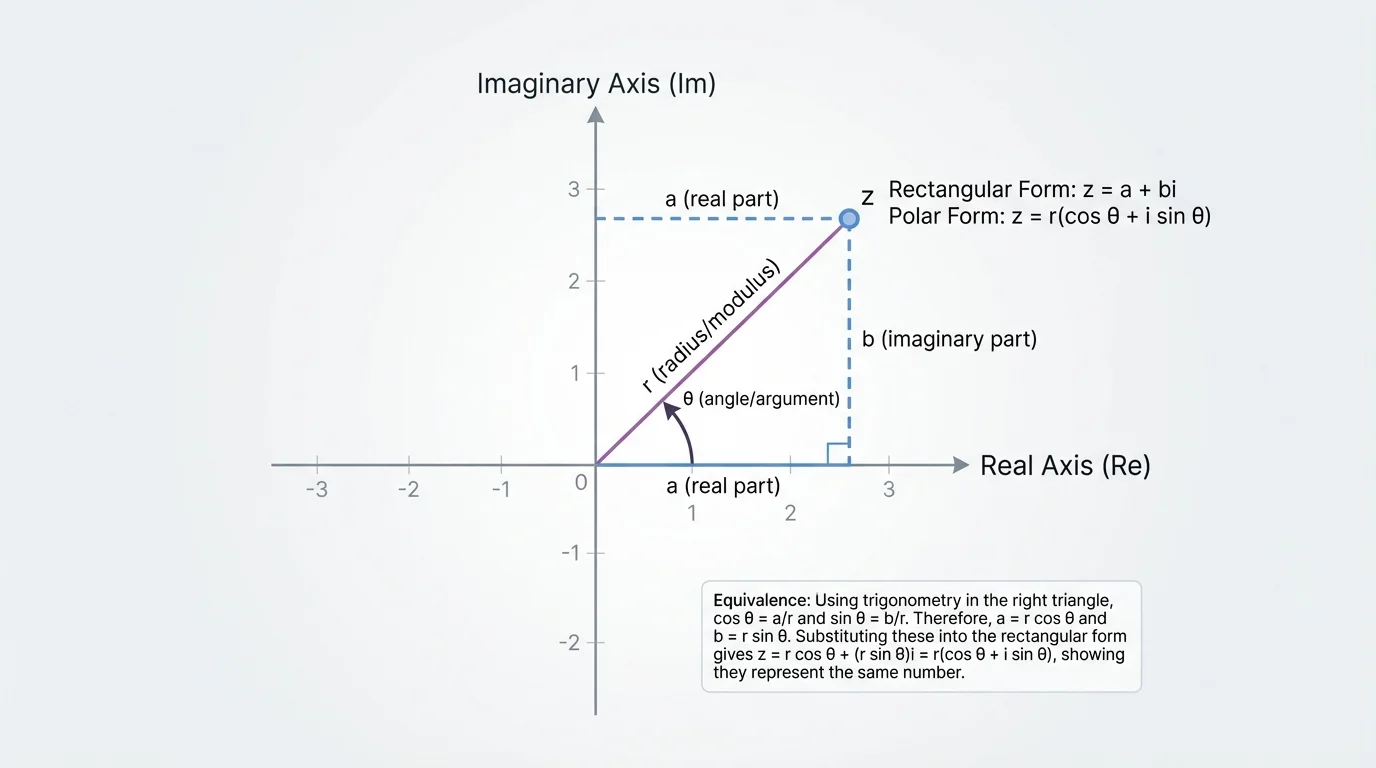
The two forms are not different numbers. As [Figure 3] illustrates, they are different descriptions of the same point. In rectangular form, we name the point by its coordinates \((a,b)\). In polar form, we name the same point by its distance \(r\) from the origin and its angle \(\theta\).
If you start with rectangular form \(a+bi\), use the Pythagorean Theorem to find the modulus:
\[r=\sqrt{a^2+b^2}\]
Then find the angle using trigonometry. Since \(\tan\theta=\dfrac{b}{a}\) when \(a\neq 0\), a first estimate is
\[\tan\theta=\frac{b}{a}\]
But you must pay attention to the quadrant, because different angles can have the same tangent value. The signs of \(a\) and \(b\) tell you which quadrant the point is in.
If you start with polar form \(r(\cos\theta+i\sin\theta)\), convert back by computing
\[a=r\cos\theta \quad \textrm{and} \quad b=r\sin\theta\]
Then the rectangular form is \(a+bi\).
The reason these forms represent the same complex number is geometric. The point has horizontal coordinate \(a\) and vertical coordinate \(b\). But by right-triangle trigonometry, those same coordinates are equal to \(r\cos\theta\) and \(r\sin\theta\). So
\[a+bi=(r\cos\theta)+(r\sin\theta)i=r(\cos\theta+i\sin\theta)\]
This is not a coincidence. It is simply two coordinate systems describing one point on one plane.
Example 1: Plot a complex number in rectangular form
Represent \(z=-4+3i\) on the complex plane.
Step 1: Identify the real and imaginary parts.
The real part is \(-4\), and the imaginary part is \(3\).
Step 2: Convert the number into a point.
The complex number \(-4+3i\) corresponds to the point \((-4,3)\).
Step 3: Describe the location.
Move \(4\) units left and \(3\) units up. The point lies in Quadrant II.
The number is represented by the point \((-4,3)\).
Notice that the sign of each part matters. A negative real part means left of the origin, and a positive imaginary part means above the origin. This agrees with the axis layout seen earlier in [Figure 1].
Example 2: Convert rectangular form to polar form
Write \(z=3+4i\) in polar form.
Step 1: Find the modulus.
Use \(r=\sqrt{a^2+b^2}\): \(r=\sqrt{3^2+4^2}=\sqrt{9+16}=\sqrt{25}=5\).
Step 2: Find the angle.
\(\tan\theta=\dfrac{4}{3}\). Since \((3,4)\) is in Quadrant I, \(\theta\) is a first-quadrant angle. Thus \(\theta=\tan^{-1}\left(\dfrac{4}{3}\right)\).
Step 3: Write the polar form.
Substitute into \(z=r(\cos\theta+i\sin\theta)\).
\[z=5\left(\cos\left(\tan^{-1}\left(\frac{4}{3}\right)\right)+i\sin\left(\tan^{-1}\left(\frac{4}{3}\right)\right)\right)\]
An approximate angle is \(\theta\approx 53.13^\circ\), so an approximate polar form is \(5(\cos 53.13^\circ+i\sin 53.13^\circ)\).
This example is especially important because \(3+4i\) creates a familiar \(3\)-\(4\)-\(5\) triangle. The geometry in [Figure 2] makes the relationships \(a=r\cos\theta\) and \(b=r\sin\theta\) feel natural rather than memorized.
Example 3: Convert polar form to rectangular form
Write \(z=10\left(\cos 30^\circ+i\sin 30^\circ\right)\) in rectangular form.
Step 1: Use \(a=r\cos\theta\).
\(a=10\cos 30^\circ=10\cdot \dfrac{\sqrt{3}}{2}=5\sqrt{3}\).
Step 2: Use \(b=r\sin\theta\).
\(b=10\sin 30^\circ=10\cdot \dfrac{1}{2}=5\).
Step 3: Write the complex number.
The rectangular form is \(a+bi\).
\[z=5\sqrt{3}+5i\]
Here the polar information gives the same point as rectangular coordinates. The radius is \(10\), and the angle is \(30^\circ\), but the horizontal and vertical coordinates are \(5\sqrt{3}\) and \(5\). That is exactly the equivalence shown by [Figure 3].
Example 4: Real and imaginary numbers in both forms
Express \(z=-6i\) in rectangular and polar form.
Step 1: Identify rectangular form.
Since there is no real part, \(z=0-6i\).
Step 2: Plot the point mentally.
The point is \((0,-6)\), which lies on the negative imaginary axis.
Step 3: Find the modulus.
\(r=\sqrt{0^2+(-6)^2}=6\).
Step 4: Find an angle.
The point lies straight down from the origin, so one angle is \(-90^\circ\). Another is \(270^\circ\).
Step 5: Write polar form.
Using \(-90^\circ\), the polar form is \(6(\cos(-90^\circ)+i\sin(-90^\circ))\).
\[z=-6i=6(\cos(-90^\circ)+i\sin(-90^\circ))\]
This example shows that even a pure imaginary number fits naturally into both systems. In rectangular form, it is a vertical coordinate. In polar form, it is a distance and a direction.
Angles in polar form are not unique. For example, \(45^\circ\), \(405^\circ\), and \(-315^\circ\) all point in the same direction. So one complex number has many valid angle descriptions. In general, if \(\theta\) is an argument of a complex number, then \(\theta+360^\circ k\) is also an argument for any integer \(k\). In radians, that becomes \(\theta+2\pi k\).
The modulus, however, is usually taken to be nonnegative. A negative radius is not the standard choice in basic polar form for complex numbers. We usually write \(r\ge 0\).
Electrical engineers often treat alternating current using complex numbers because magnitude and phase are easier to manage together than as separate sine and cosine calculations.
The number \(0\) is a special case. Its rectangular form is \(0+0i\), so it is at the origin. Its modulus is \(0\), but its angle is undefined because every direction from the origin is possible when the distance is zero.
Quadrant checking matters. If you only compute \(\tan^{-1}\left(\dfrac{b}{a}\right)\), you may get the wrong angle. For example, if \(z=-1+\sqrt{3}i\), then \(\tan\theta=-\sqrt{3}\), but the point is in Quadrant II, so the correct angle is \(120^\circ\), not \(-60^\circ\).
| Type of complex number | Rectangular form | Location on plane | One possible angle |
|---|---|---|---|
| Positive real | \(a+0i\), with \(a>0\) | Positive real axis | \(0\) |
| Negative real | \(a+0i\), with \(a<0\) | Negative real axis | \(\pi\) |
| Positive pure imaginary | \(0+bi\), with \(b>0\) | Positive imaginary axis | \(\dfrac{\pi}{2}\) |
| Negative pure imaginary | \(0+bi\), with \(b<0\) | Negative imaginary axis | \(-\dfrac{\pi}{2}\) |
Table 1. Common special cases of complex numbers and their locations on the complex plane.
Complex numbers may seem abstract, but their two-form representation is extremely practical. In wave motion, sound, and light, a signal has both magnitude and phase. Rectangular form is useful when combining components, while polar form is useful when describing amplitude and phase shift.
In electricity, alternating current circuits involve voltages and currents that oscillate. Engineers often model these with complex numbers because multiplication and rotation are easier in polar form. A change in phase is naturally described by changing the angle, while a change in strength is naturally described by changing the modulus.
In computer graphics and robotics, rotation in a plane can also be connected to the geometry of complex numbers. A point can be stored in coordinate form, but a rotation is often easier to understand through angle. That same idea mirrors the switch between rectangular and polar representations.
Whenever a problem depends on position in two perpendicular directions, rectangular form is often convenient. Whenever a problem depends on distance and direction, polar form is often more revealing. Choosing the right form can make a hard problem much easier.
"Mathematics is the art of giving the same name to different things."
— Henri Poincaré
That idea fits complex numbers beautifully: \(a+bi\) and \(r(\cos\theta+i\sin\theta)\) look different, but they can describe exactly the same point.
