For a long time, it may have seemed that an expression like \(x^2 + 4\) could not be factored: it does not factor over the real numbers, and the equation \(x^2 + 4 = 0\) appears to have no solution.
Sometimes a number system turns out to be too limited for the equations we want to solve. The complex numbers were introduced partly for exactly this reason. Once complex numbers enter the picture, expressions that looked unfactorable suddenly open up.
Over the real numbers, the equation \(x^2 = -4\) has no solution because the square of any real number is never negative. That is why \(x^2 + 4\) cannot be factored into real linear factors. But mathematicians defined a new number, called the imaginary unit, so that equations like this could be solved in a consistent way.
In the real number system, you already know identities such as \(x^2 - 9 = (x - 3)(x + 3)\). The question is: can similar identities still work when the numbers involved are not real? The answer is yes. In fact, the same algebra rules continue to work in the complex number system.
Recall the difference of squares identity:
\[a^2 - b^2 = (a-b)(a+b)\]
This identity is still true even when \(a\) and \(b\) are complex numbers.
The big idea is not that algebra changes. The big idea is that the number system expands. When the allowed numbers get bigger, more polynomials can be factored completely.
The imaginary unit is written as \(i\), and it is defined by
\(i^2 = -1\)
A complex number is any number of the form \(a + bi\), where \(a\) and \(b\) are real numbers. The number \(a\) is called the real part, and \(b\) is called the imaginary part.
Imaginary unit: \(i\) is the number defined so that \(i^2 = -1\).
Complex number: any number of the form \(a + bi\), where \(a\) and \(b\) are real numbers.
Complex conjugate: for \(a+bi\), the conjugate is \(a-bi\).
Because \(i^2 = -1\), we can take square roots of negative numbers in the complex system. For example, \(\sqrt{-4} = 2i\), since \((2i)^2 = 4i^2 = 4(-1) = -4\). Similarly, \(\sqrt{-25} = 5i\).
This means the equation \(x^2 = -4\) does have solutions in the complex numbers: \(x = 2i\) and \(x = -2i\). Once we know the solutions, we can factor the polynomial.
Familiar identities still hold in the complex system, and [Figure 1] illustrates one of the most important examples: instead of roots staying on the real number line, they can appear on the imaginary axis. That is exactly what happens for \(x^2 + 4\).
Notice that \(x^2 + 4 = x^2 - (-4)\). Since \(-4 = (2i)^2\), we can rewrite the expression as
\[x^2 + 4 = x^2 - (2i)^2\]
Now apply the difference of squares identity:
\[x^2 + 4 = (x + 2i)(x - 2i)\]
You can check by expanding:
\[(x + 2i)(x - 2i) = x^2 - 2ix + 2ix - 4i^2 = x^2 - 4(-1) = x^2 + 4\]
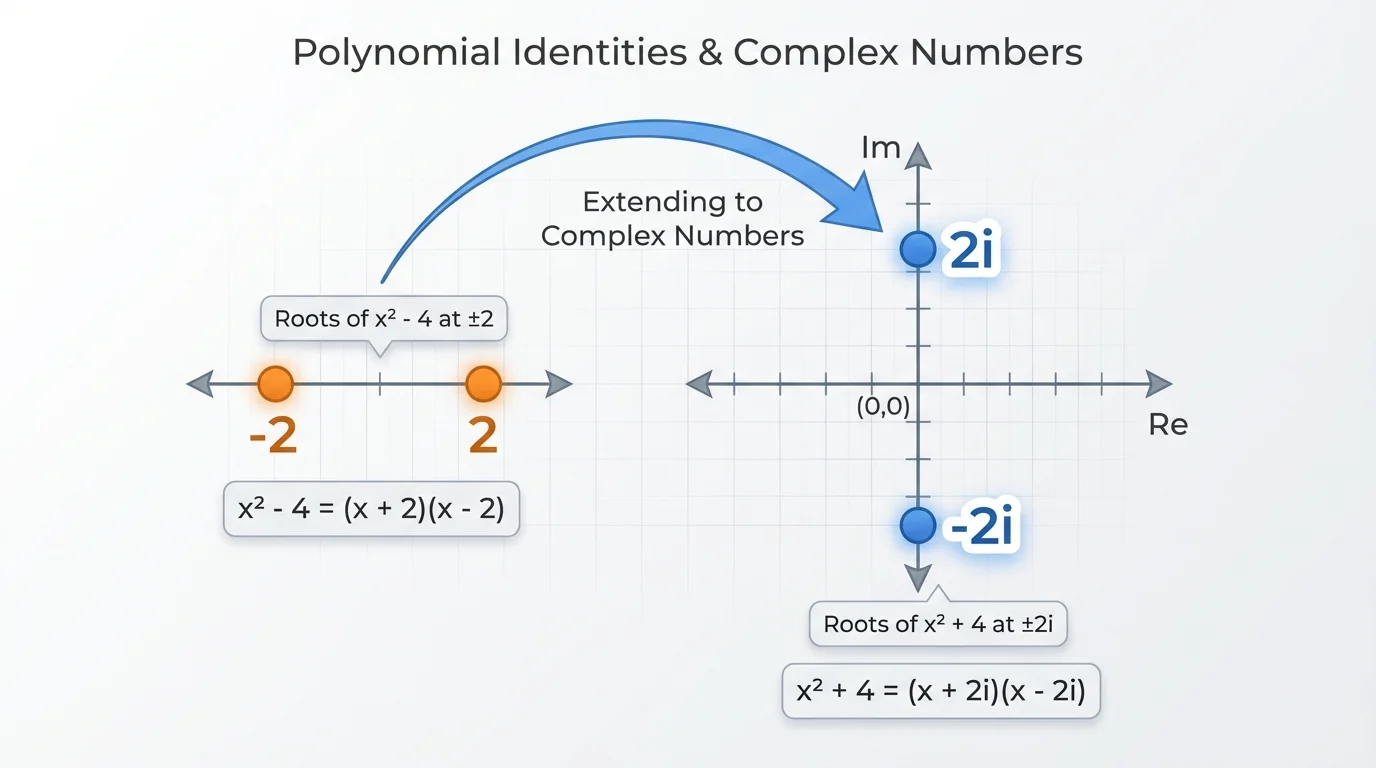
This is a powerful pattern. Any expression of the form \(x^2 + a^2\), where \(a\) is a positive real number, can be factored over the complex numbers as
\[x^2 + a^2 = (x + ai)(x - ai)\]
For example, \(x^2 + 49 = (x + 7i)(x - 7i)\), and \(x^2 + 1 = (x + i)(x - i)\).
What changes and what stays the same
The algebraic identities do not change when we move from real numbers to complex numbers. What changes is the set of numbers we are allowed to use. A polynomial that is irreducible over the real numbers may factor completely over the complex numbers.
This idea helps explain an important theme in algebra: factoring depends on the number system you are working in. Over the integers, \(x^2 - 2\) does not factor. Over the real numbers, it becomes \((x - \sqrt{2})(x + \sqrt{2})\). Over the complex numbers, even more expressions factor completely.
To factor a quadratic over the complex numbers, one useful strategy is to find its solutions first. If the solutions are \(r_1\) and \(r_2\), then the polynomial factors as
\[x^2 + bx + c = (x-r_1)(x-r_2)\]
Sometimes the roots are purely imaginary, like \(\pm 3i\). Sometimes they have both real and imaginary parts, like \(2 \pm 5i\).
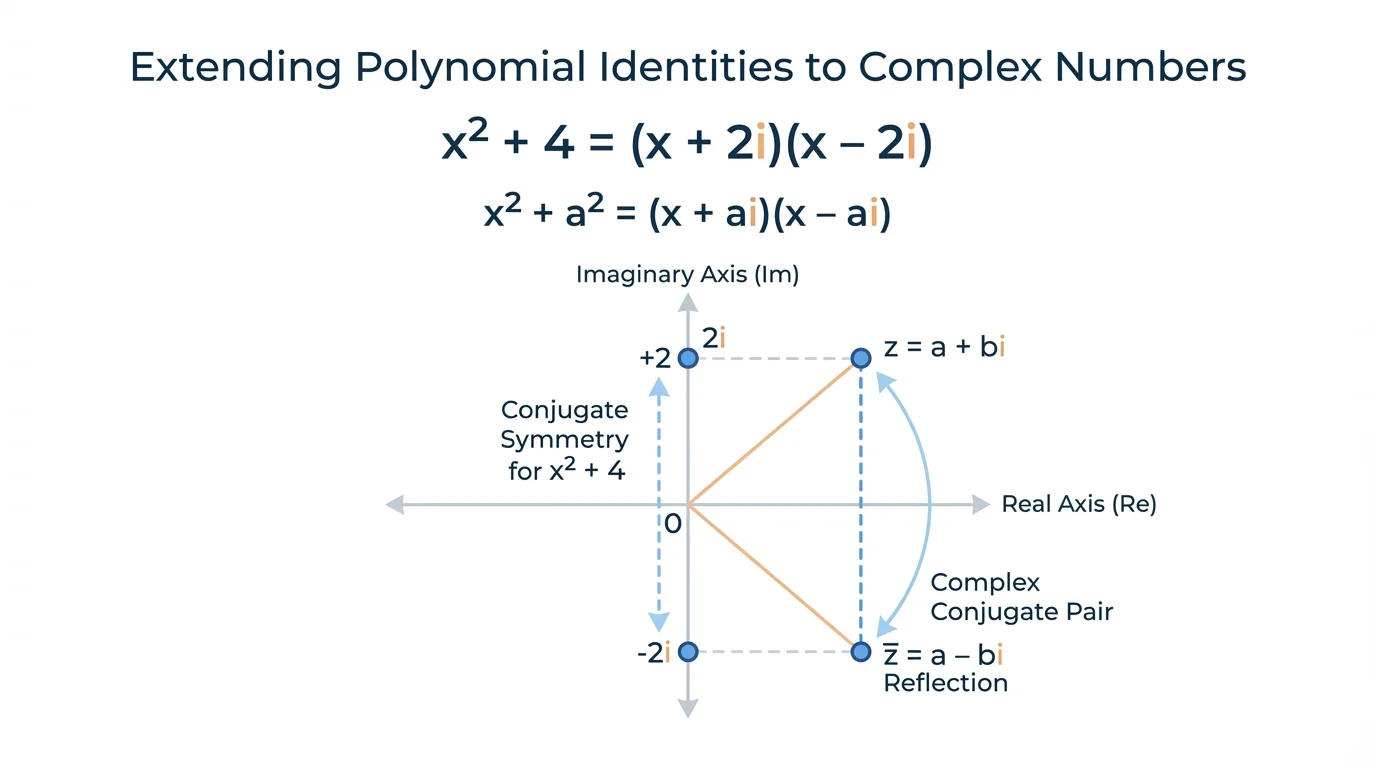
For a quadratic with real coefficients, nonreal roots always come in conjugate pairs. That means if \(a + bi\) is a root, then \(a - bi\) is also a root. This is why the factors often appear as conjugates.
Worked example 1
Factor \(x^2 + 16\) over the complex numbers.
Step 1: Rewrite the constant term using \(i\).
Since \((4i)^2 = -16\), we have \(16 = -(4i)^2\) in the form needed for a difference of squares.
Step 2: Rewrite the expression.
\(x^2 + 16 = x^2 - (4i)^2\)
Step 3: Apply the difference of squares identity.
\(x^2 - (4i)^2 = (x + 4i)(x - 4i)\)
The factorization is
\[x^2 + 16 = (x + 4i)(x - 4i)\]
A similar process works even when the quadratic is not just \(x^2 + a^2\). If a quadratic equation has complex solutions, those solutions give the factors directly.
Factoring and solving are closely connected. If a polynomial is written as a product, the solutions of the equation come from setting each factor equal to zero. This is the same zero-product principle you already use with real roots.
For instance, if \((x + 2i)(x - 2i) = 0\), then either \(x + 2i = 0\) or \(x - 2i = 0\). So the solutions are \(x = -2i\) and \(x = 2i\).
Worked example 2
Solve \(x^2 + 9 = 0\).
Step 1: Isolate the square term.
\(x^2 = -9\)
Step 2: Take square roots in the complex number system.
\(x = \pm \sqrt{-9} = \pm 3i\)
Step 3: Write the related factorization.
Since the solutions are \(3i\) and \(-3i\), the polynomial factors as \((x - 3i)(x + 3i)\).
The solutions are
\(x = \pm 3i\)
The same connection works for higher-degree polynomials too. Over the complex numbers, every polynomial of degree at least \(1\) has at least one complex root, and in fact can be factored completely into linear factors. This is one of the deepest reasons complex numbers matter in algebra.
[Figure 2] A complex conjugate changes the sign of the imaginary part: the conjugate of \(a+bi\) is \(a-bi\). These two numbers are mirror images across the real axis in the complex plane.
Conjugates are important because when you multiply them, the imaginary parts cancel:
\[(a+bi)(a-bi) = a^2 - (bi)^2 = a^2 + b^2\]
The result is real. This cancellation is exactly why quadratics with real coefficients can have complex factors and still expand back to a polynomial with no imaginary terms.
For example,
\[(x - (2+3i))(x - (2-3i)) = ((x-2)-3i)((x-2)+3i)\]
Using the difference of squares idea, this becomes
\[(x-2)^2 + 9 = x^2 - 4x + 13\]
So if \(2+3i\) is a root of a quadratic with real coefficients, then \(2-3i\) must also be a root.
Complex numbers first seemed strange and even suspicious to many mathematicians. Today they are essential in physics, electrical engineering, quantum mechanics, and computer graphics.
The conjugate pattern also helps you move backward. If you know the roots are \(a \pm bi\), then the quadratic with those roots is
\[(x-(a+bi))(x-(a-bi))\]
which simplifies to a quadratic with real coefficients.
Worked example 3
Write a quadratic with real coefficients whose roots are \(1+2i\) and \(1-2i\).
Step 1: Write the factors from the roots.
\((x-(1+2i))(x-(1-2i))\)
Step 2: Rewrite to show conjugates clearly.
\(((x-1)-2i)((x-1)+2i)\)
Step 3: Use the difference of squares pattern.
\(((x-1)-2i)((x-1)+2i) = (x-1)^2 - (2i)^2\)
Since \((2i)^2 = -4\), this becomes \((x-1)^2 + 4\).
Step 4: Expand.
\((x-1)^2 + 4 = x^2 - 2x + 1 + 4 = x^2 - 2x + 5\)
A quadratic with those roots is
\[x^2 - 2x + 5\]
Looking back at [Figure 1], notice that the roots \(2i\) and \(-2i\) are also a conjugate pair. Their symmetry explains why the product \((x+2i)(x-2i)\) has real coefficients even though the factors involve imaginary numbers.
Let's build fluency with a few more examples. The goal is not just to memorize patterns, but to see how the same reasoning appears in different forms.
Worked example 4
Factor \(x^2 - 6x + 13\) over the complex numbers.
Step 1: Use the quadratic formula.
For \(x^2 - 6x + 13 = 0\), \(a=1\), \(b=-6\), and \(c=13\).
\(x = \dfrac{-b \pm \sqrt{b^2 - 4ac}}{2a} = \dfrac{6 \pm \sqrt{36 - 52}}{2} = \dfrac{6 \pm \sqrt{-16}}{2}\)
Step 2: Simplify the square root.
\(\sqrt{-16} = 4i\), so \(x = \dfrac{6 \pm 4i}{2} = 3 \pm 2i\).
Step 3: Write the factors.
\((x-(3+2i))(x-(3-2i))\)
The factorization is
\[x^2 - 6x + 13 = (x-(3+2i))(x-(3-2i))\]
When the discriminant of a quadratic is negative, the solutions are complex. That is not a sign that something went wrong. It is a sign that the equation belongs naturally in the complex number system.
Worked example 5
Verify by expansion that \((x-5i)(x+5i) = x^2 + 25\).
Step 1: Multiply the binomials.
\((x-5i)(x+5i) = x^2 + 5ix - 5ix - 25i^2\)
Step 2: Combine like terms.
The middle terms cancel, leaving \(x^2 - 25i^2\).
Step 3: Use \(i^2 = -1\).
\(x^2 - 25(-1) = x^2 + 25\)
The identity is confirmed:
\[ (x-5i)(x+5i) = x^2 + 25 \]
One common pattern is easy to memorize:
\[x^2 + a^2 = (x + ai)(x - ai)\]
Another useful pattern comes from conjugate roots:
\[(x-(a+bi))(x-(a-bi)) = (x-a)^2 + b^2\]
But students often make a few predictable mistakes.
| Common mistake | Why it is wrong | Correct idea |
|---|---|---|
| Writing \(x^2 + 4 = (x+2)(x+2)\) | Expanding gives \(x^2 + 4x + 4\), not \(x^2 + 4\). | Use imaginary factors: \((x+2i)(x-2i)\). |
| Forgetting that \(i^2 = -1\) | This changes signs in calculations. | Always replace \(i^2\) with \(-1\). |
| Using only one complex root | Quadratics with real coefficients need both conjugates. | If \(a+bi\) is a root, include \(a-bi\) too. |
| Thinking complex factoring is a different kind of algebra | The identities are the same as before. | The number system changes, not the algebra rules. |
Table 1. Common mistakes students make when factoring polynomials over the complex numbers and the correct ideas that fix them.
As [Figure 2] shows, conjugate roots are paired by symmetry. That geometric picture can help you remember why real-coefficient polynomials do not usually have just one nonreal root by itself.
[Figure 3] Complex numbers may sound abstract, but they connect to real systems such as alternating current, sound waves, and signal processing. Engineers use complex numbers because they make oscillations and repeated patterns much easier to describe and combine.
In electrical engineering, voltages and currents often vary like waves. Complex numbers help represent both the size of a wave and its timing. In physics, they appear in models of vibration and quantum behavior. In digital technology, they help analyze audio, images, and communication signals.
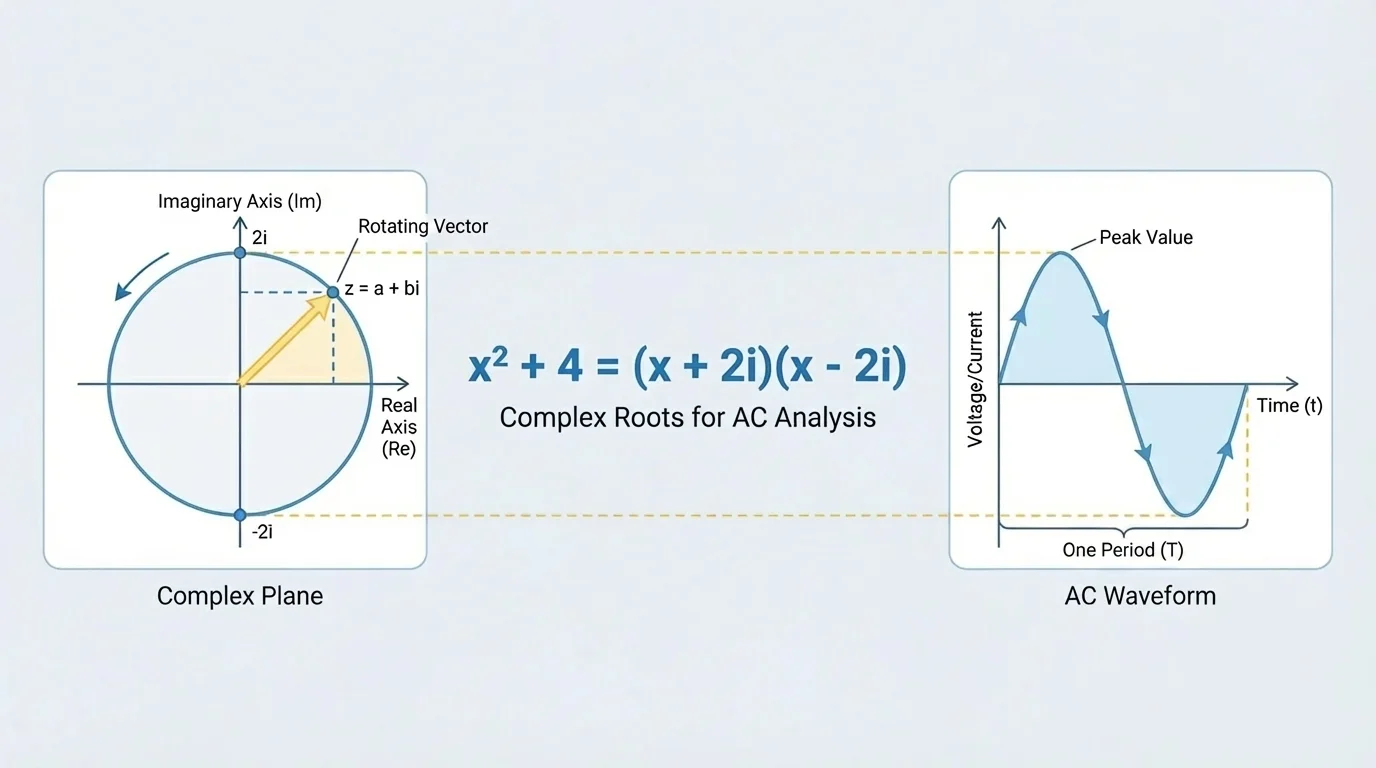
Why does this connect to polynomial identities? Because many of the equations behind wave behavior lead to expressions involving squares, roots, and factors that are most naturally handled in the complex number system. Factoring over the complex numbers is not just a classroom trick; it is part of a mathematical language used in science and engineering.
Even when the final measurable quantity is real, the intermediate calculations may be much cleaner with complex numbers. That is a recurring theme in mathematics: using a richer system can make difficult problems more manageable.
"The imaginary numbers are a fine and wonderful refuge of the divine spirit, almost an amphibian between being and non-being."
— Gottfried Wilhelm Leibniz
Once you accept complex numbers, polynomial identities become more complete. Expressions that seemed impossible to factor now fit into the same algebraic patterns you already know. The system becomes broader, but also more unified.
