A pilot changes speed, a game designer resizes motion on a screen, and an engineer reverses a force direction in a model. All of these situations can be described with one elegant idea: multiplying a vector by a number. That number can make the vector longer, shorter, or even reverse its direction completely. Scalar multiplication is one of the simplest vector operations, but it is also one of the most powerful because it connects algebra, geometry, and real-world motion.
A vector describes both magnitude and direction. If someone says a car moves at \(60\) kilometers per hour east, that information has two parts: how fast and in which direction. If the same car speeds up to twice that rate while still moving east, the new motion is a scaled version of the original vector. If it turns around and goes west at the same speed, the direction changes too. Scalar multiplication lets us describe these changes clearly and precisely.
In algebra, multiplying by a number often means "scale this quantity." With vectors, the same idea applies, but direction matters. A positive scalar keeps the direction the same, a negative scalar reverses it, and a scalar between \(0\) and \(1\) shrinks the vector.
Before going further, recall two important ideas. A scalar is a quantity described by a number alone, such as mass, temperature, or time. A vector is a quantity with both magnitude and direction, such as velocity, force, or displacement.
On the coordinate plane, a vector is often written in component form as \((v_x, v_y)\), where \(v_x\) is the horizontal component and \(v_y\) is the vertical component.
For example, the vector \((3, 2)\) means \(3\) units to the right and \(2\) units up.
Vectors can be drawn as arrows. The arrow starts at one point and ends at another. The arrow's length represents magnitude, and the arrow's direction represents direction. If a vector starts at the origin and ends at \((3,2)\), then its component form is \((3,2)\).
When we multiply a vector by a scalar, we multiply each component of the vector by that scalar. If \(c\) is a scalar and \((v_x, v_y)\) is a vector, then
\[c(v_x, v_y) = (cv_x, cv_y)\]
Scalar multiplication means multiplying a vector by a real number so that each component is multiplied by that number.
Component form is a way of writing a vector using its horizontal and vertical parts, such as \((v_x, v_y)\).
This rule is simple, but it captures several geometric changes at once. The scalar changes the vector's length by a factor of \(|c|\). If \(c > 0\), the vector keeps its direction. If \(c < 0\), the vector points in the opposite direction. If \(c = 0\), the result is the zero vector, written as \((0,0)\).
For example, if \(\vec{v} = (4, -1)\), then \(3\vec{v} = (12, -3)\). If we multiply by \(-2\), then \(-2\vec{v} = (-8, 2)\). Notice that every component is multiplied by the same scalar.
[Figure 1] On a graph, scalar multiplication changes a vector in a very visual way. If a vector is multiplied by \(2\), the new vector lies on the same line from the origin but has twice the length. If it is multiplied by \(-1\), the new vector has the same length but points exactly the opposite way.
Suppose \(\vec{v} = (2,1)\). Draw it from the origin to \((2,1)\). Then \(2\vec{v} = (4,2)\), so the arrow points in the same direction but reaches farther. Also, \(-\vec{v} = (-2,-1)\), which points in the opposite direction. Graphically, these vectors are all on the same line through the origin.
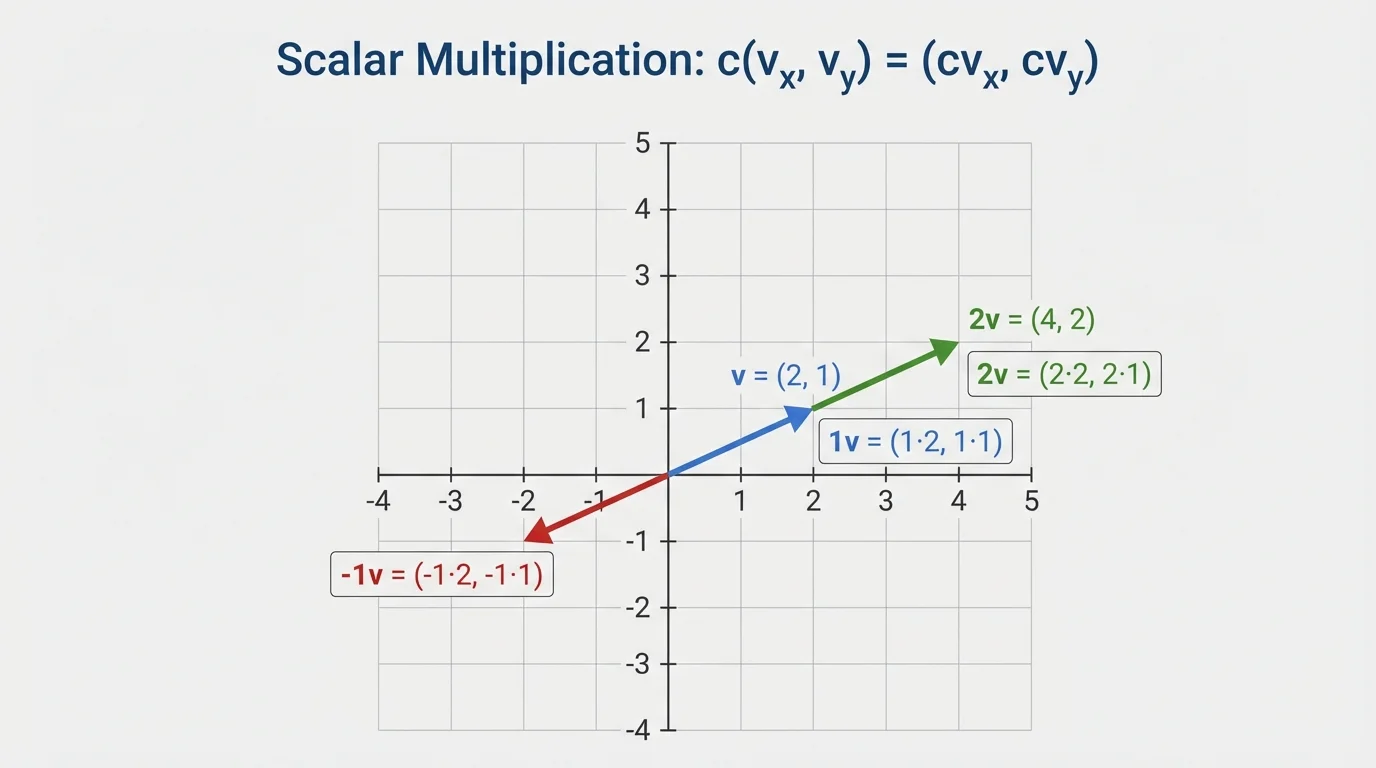
This idea of "same line, different length" is extremely important. Scalar multiplication does not tilt a vector into a new direction unless the scalar is negative, in which case the direction flips by \(180^\circ\). So scalar multiplication changes size and possibly orientation, but not the underlying line of action.
If the scalar is a fraction, the vector shrinks. For instance, \(\dfrac{1}{2}(2,1) = (1, \dfrac{1}{2})\). On the graph, that vector points the same way as \((2,1)\) but reaches only halfway as far from the origin.
[Figure 2] Different scalar values produce different effects, and this comparison makes these cases easy to distinguish. You should recognize these patterns quickly because they appear often in vector problems.
Case 1: \(c > 1\). The vector stretches and keeps the same direction. For example, \(3(1,2) = (3,6)\).
Case 2: \(0 < c < 1\). The vector shrinks and keeps the same direction. For example, \(\dfrac{1}{2}(6,4) = (3,2)\).
Case 3: \(c < 0\). The vector is scaled by \(|c|\) and reverses direction. For example, \(-2(3,-1) = (-6,2)\).
Case 4: \(c = 0\). The result is the zero vector. For example, \(0(5,-7) = (0,0)\). The zero vector has no direction and zero magnitude.
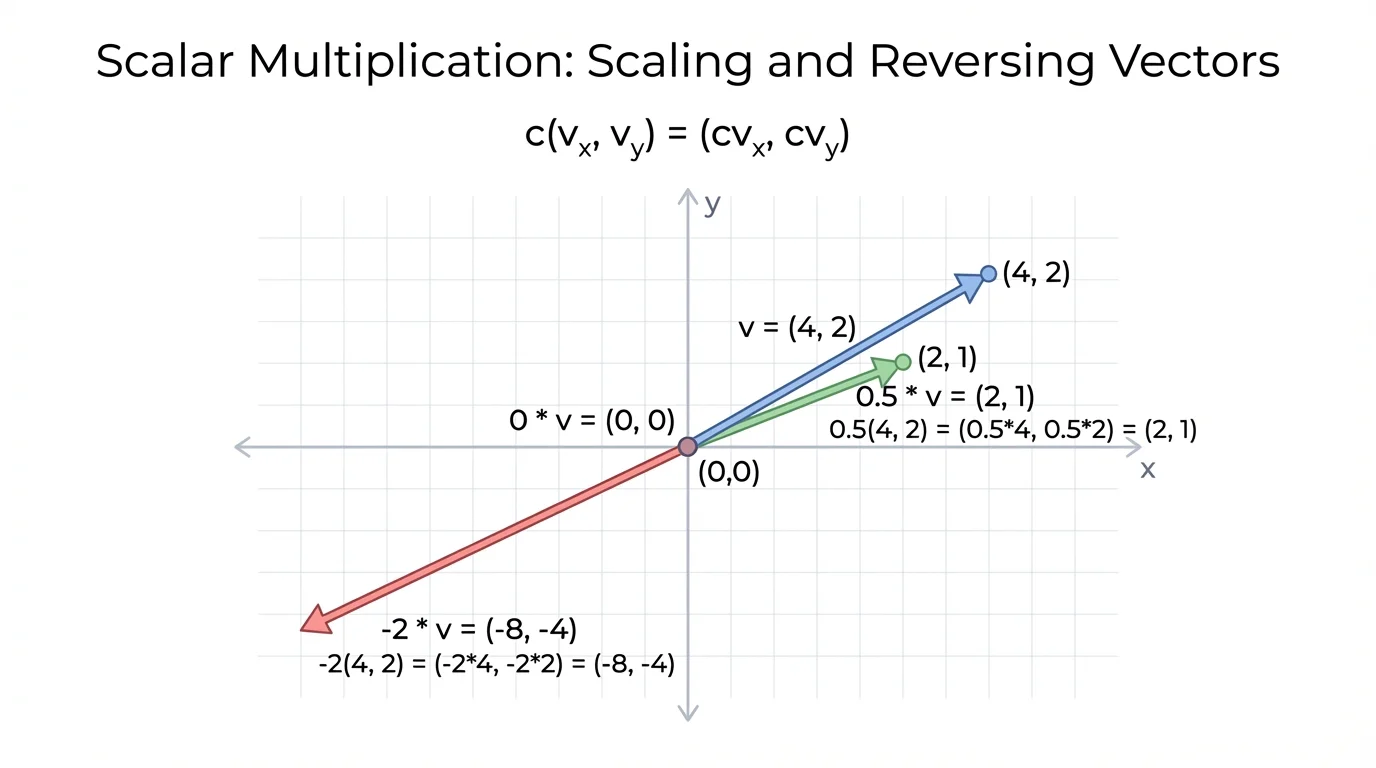
Notice that all of these changes come from one component-wise rule. No matter how large or small the scalar is, each coordinate gets multiplied by the same number. This is why algebra and geometry match perfectly in vector scaling.
The best way to master scalar multiplication is to connect the algebra to the picture in your head: multiply each component, then interpret what happened to the vector's length and direction.
Worked Example 1
Find \(3(2,-5)\) and describe the result graphically.
Step 1: Multiply each component by \(3\).
Start with \((2,-5)\). Then \(3(2,-5) = (3 \cdot 2, 3 \cdot (-5))\).
Step 2: Simplify the components.
\(3 \cdot 2 = 6\) and \(3 \cdot (-5) = -15\), so the result is \((6,-15)\).
Step 3: Interpret graphically.
Because \(3\) is positive and greater than \(1\), the vector keeps its direction and becomes three times as long.
\[3(2,-5) = (6,-15)\]
This example shows the most direct case: a positive scalar greater than \(1\) stretches the vector.
Worked Example 2
Find \(-2(4,3)\) and explain the direction change.
Step 1: Multiply each component by \(-2\).
\(-2(4,3) = (-2 \cdot 4, -2 \cdot 3)\).
Step 2: Compute the new components.
\(-2 \cdot 4 = -8\) and \(-2 \cdot 3 = -6\), so the new vector is \((-8,-6)\).
Step 3: Interpret the result.
The magnitude is doubled because \(|-2| = 2\), but the negative sign reverses the direction. So the vector points opposite to \((4,3)\).
\[-2(4,3) = (-8,-6)\]
The reversal in this example is exactly the same idea shown earlier with [Figure 1]: a negative scalar sends the vector to the opposite side of the origin along the same line.
Worked Example 3
A vector is \(\vec{u} = (-6,8)\). Find \(\dfrac{1}{2}\vec{u}\) and describe what happens.
Step 1: Multiply each component by \(\dfrac{1}{2}\).
\(\dfrac{1}{2}(-6,8) = \left(\dfrac{1}{2} \cdot (-6), \dfrac{1}{2} \cdot 8\right)\).
Step 2: Simplify.
\(\dfrac{1}{2} \cdot (-6) = -3\) and \(\dfrac{1}{2} \cdot 8 = 4\).
Step 3: Interpret graphically.
Because the scalar is positive and between \(0\) and \(1\), the vector keeps its direction but shrinks to half its original length.
\[\frac{1}{2}(-6,8) = (-3,4)\]
Fractions are especially useful because they let us create vectors that point in the same direction but with reduced magnitude.
Worked Example 4
The vector \(\vec{w}\) goes from the origin to \((5,-2)\). What vector represents motion in the opposite direction with the same magnitude?
Step 1: Identify the needed scalar.
To reverse direction without changing length, multiply by \(-1\).
Step 2: Apply scalar multiplication.
\(-1(5,-2) = (-5,2)\).
Step 3: Interpret.
The new vector points exactly opposite the original vector and has the same magnitude.
\[-\vec{w} = (-5,2)\]
That last example is important because multiplying by \(-1\) is the simplest way to reverse a vector.
Scalar multiplication has several key properties that help you reason about vectors efficiently.
Important properties
If \(\vec{v} = (v_x, v_y)\), then multiplying by a scalar \(c\) gives \(c\vec{v} = (cv_x, cv_y)\). The new vector stays on the same line as \(\vec{v}\), unless the result is the zero vector. Its magnitude becomes \(|c|\) times the original magnitude. A positive scalar keeps the direction, and a negative scalar reverses it.
There are also useful algebraic patterns. For example, \(1\vec{v} = \vec{v}\), which means multiplying by \(1\) changes nothing. Also, \((-1)\vec{v} = -\vec{v}\), which produces the opposite vector. And \(0\vec{v} = \vec{0}\), the zero vector.
If two vectors are scalar multiples of each other, then they are parallel, provided neither is the zero vector. For instance, \((2,3)\) and \((4,6)\) are parallel because \((4,6) = 2(2,3)\).
| Scalar \(c\) | Effect on magnitude | Effect on direction | Example |
|---|---|---|---|
| \(c > 1\) | Increases | Same | \(2(1,3) = (2,6)\) |
| \(0 < c < 1\) | Decreases | Same | \(\dfrac{1}{2}(4,2) = (2,1)\) |
| \(c < 0\) | Changes by \(|c|\) | Opposite | \(-3(1,-2) = (-3,6)\) |
| \(c = 0\) | Becomes \(0\) | No direction | \(0(7,5) = (0,0)\) |
Table 1. How different scalar values affect a vector's magnitude and direction.
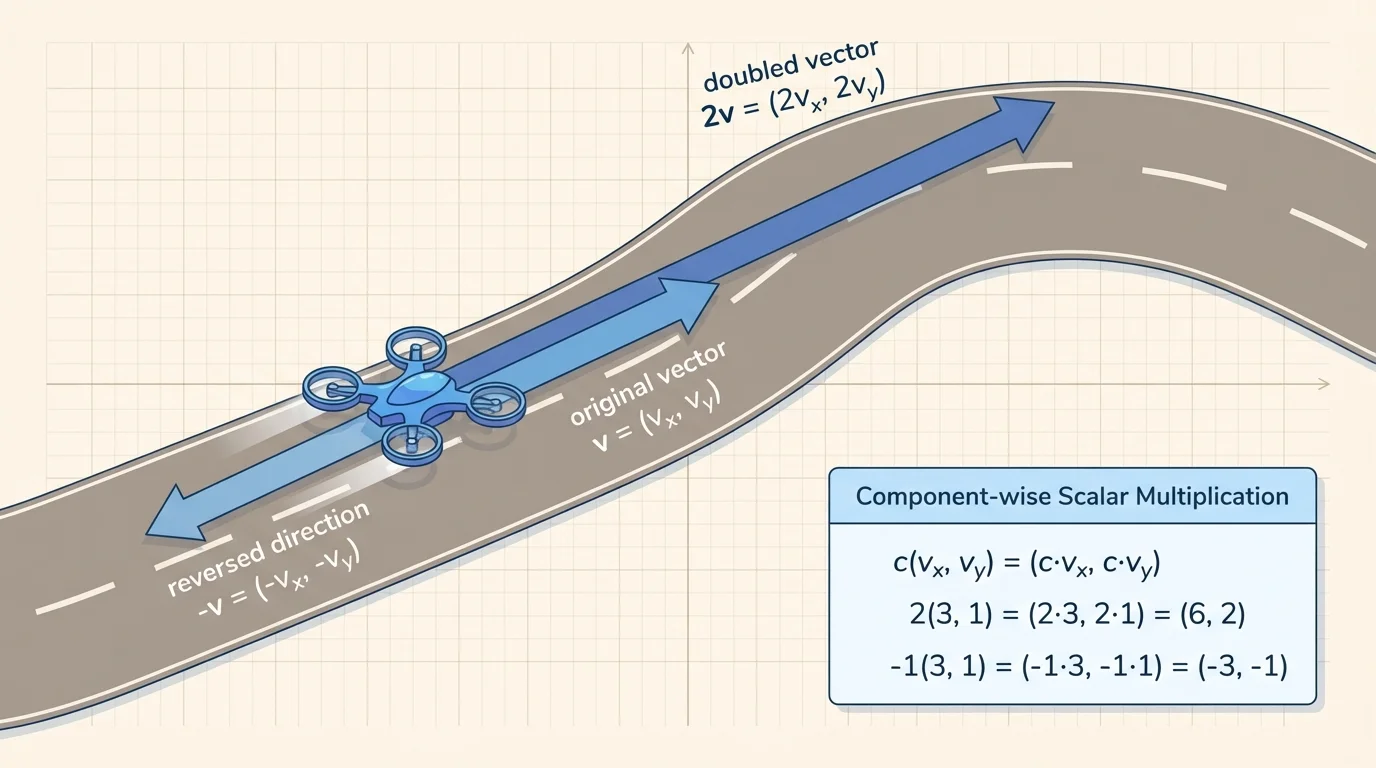
[Figure 3] Scalar multiplication is not just a classroom rule. In science, engineering, animation, and navigation, scaled vectors are used constantly. If a velocity vector describes an object's motion, multiplying that vector by \(2\) means the object moves in the same direction at twice the speed.
Suppose a drone has velocity vector \((3,4)\) meters per second. If the controller doubles the speed while keeping the same direction, the new velocity is \(2(3,4) = (6,8)\). If the drone must return directly backward at the same speed, the new velocity is \(-1(3,4) = (-3,-4)\).
Forces also behave this way. If a force vector is \((10,0)\), then applying half as much force in the same direction gives \(\dfrac{1}{2}(10,0) = (5,0)\). Applying twice the force in the opposite direction gives \(-2(10,0) = (-20,0)\).
Computer graphics uses vector scaling whenever images or motions are resized. A game character moving according to vector \((2,1)\) may be programmed to sprint by scaling the vector to \(3(2,1) = (6,3)\). The same mathematical rule appears in robotics, physics simulations, and even digital mapping.
Modern animation and video games rely heavily on vectors. A smooth change in speed often comes from repeatedly scaling motion vectors by carefully chosen numbers.
The same comparison of shrinking, stretching, and reversing seen in [Figure 2] appears in these applications. Whether the vector represents motion, force, or position change, scalar multiplication changes size in a predictable way.
One common mistake is multiplying only one component of the vector. For example, some students incorrectly turn \(3(2,5)\) into \((6,5)\). That is wrong because scalar multiplication must be applied to every component. The correct result is \((6,15)\).
Another common mistake is forgetting that a negative scalar reverses direction. For instance, \(-2(1,-4) = (-2,8)\), not \((2,-8)\). Each component must be multiplied by \(-2\), including the signs.
Students also sometimes confuse scalar multiplication with vector addition. The expression \(2(3,1)\) means multiply both components by \(2\), giving \((6,2)\). It does not mean add \(2\) to each component.
Finally, remember that multiplying by \(0\) produces the zero vector. This is not just a shorter vector. It has no direction at all because both components become \(0\).
Whenever you see a scalar multiplying a vector, ask two questions: What happens to the length? What happens to the direction? If the scalar is positive, direction stays the same. If it is negative, direction reverses. If its absolute value is greater than \(1\), the vector stretches. If it is between \(0\) and \(1\), the vector shrinks.
Then switch to component form and do the algebra carefully. Multiply each coordinate by the scalar. That single rule produces every graphical effect you have studied.
