Integers have a powerful feature: when you add, subtract, or multiply them, you stay within the world of integers. Polynomials work in a strikingly similar way. If you add two polynomials, subtract one polynomial from another, or multiply polynomials together, the result is still a polynomial. That simple idea gives algebra a stable structure and makes it possible to build everything from function models to equations of motion.
A polynomial is an expression made from variables, coefficients, and whole-number exponents, combined using addition, subtraction, and multiplication. Examples include \(4x^3 - 2x + 7\), \(9y^2 + y - 5\), and \(3\). A constant such as \(6\) is also a polynomial.
The parts of a polynomial matter. In \(5x^2 - 3x + 8\), the numbers \(5\), \(-3\), and \(8\) are coefficients, the variable is \(x\), and the terms are \(5x^2\), \(-3x\), and \(8\). The exponent tells the power of the variable. The degree of a term is the exponent on its variable, and the degree of the whole polynomial is the greatest degree among its terms. So the degree of \(5x^2 - 3x + 8\) is \(2\).
Polynomial: an algebraic expression whose variable exponents are whole numbers \(0, 1, 2, 3, ...\).
Term: a single part of an expression, such as \(7x^2\) or \(-4x\).
Coefficient: the numerical factor of a term.
Degree: the exponent of a variable in a term, or the highest exponent in the polynomial.
Not every algebraic expression is a polynomial. For example, \(x^{-1} + 2\) is not a polynomial because it has a negative exponent, and \(\sqrt{x} + 1\) is not a polynomial because \(\sqrt{x} = x^{1/2}\) has a fractional exponent. Polynomials use only whole-number exponents.
Integers are closed under addition, subtraction, and multiplication. For instance, \(4 + 7 = 11\), \(9 - 13 = -4\), and \(6 \cdot (-2) = -12\); each result is still an integer. Polynomials have the same kind of closure. If \(P(x)\) and \(Q(x)\) are polynomials, then \(P(x) + Q(x)\), \(P(x) - Q(x)\), and \(P(x)Q(x)\) are also polynomials.
This matters because it means polynomial expressions are dependable. You can manipulate them without suddenly leaving the system. Algebra would be much messier if multiplying two polynomial expressions produced something entirely different every time.
Closure under operations means that when you perform an operation on members of a set, the result stays in that set. For polynomials, closure under addition, subtraction, and multiplication is one reason they are such a central object in algebra. Their structure mirrors the arithmetic of integers, but with variables included.
There is one major arithmetic operation that behaves differently: division is not always closed for polynomials. For example, dividing one polynomial by another does not necessarily produce a polynomial. That is why this topic focuses especially on addition, subtraction, and multiplication.
Adding and subtracting polynomials is really about identifying like terms. Terms are like terms when they have exactly the same variable part, including the same exponents. For example, \(3x^2\) and \(-5x^2\) are like terms, but \(3x^2\) and \(3x\) are not. Writing polynomials in standard form makes these matches easier to see.
[Figure 1] To add polynomials, combine coefficients of like terms. To subtract polynomials, distribute the subtraction across every term in the second polynomial, then combine like terms. The structure is the same as combining items of the same kind: you can add \(5\) apples and \(2\) apples, but not \(5\) apples and \(2\) oranges as if they were the same item.
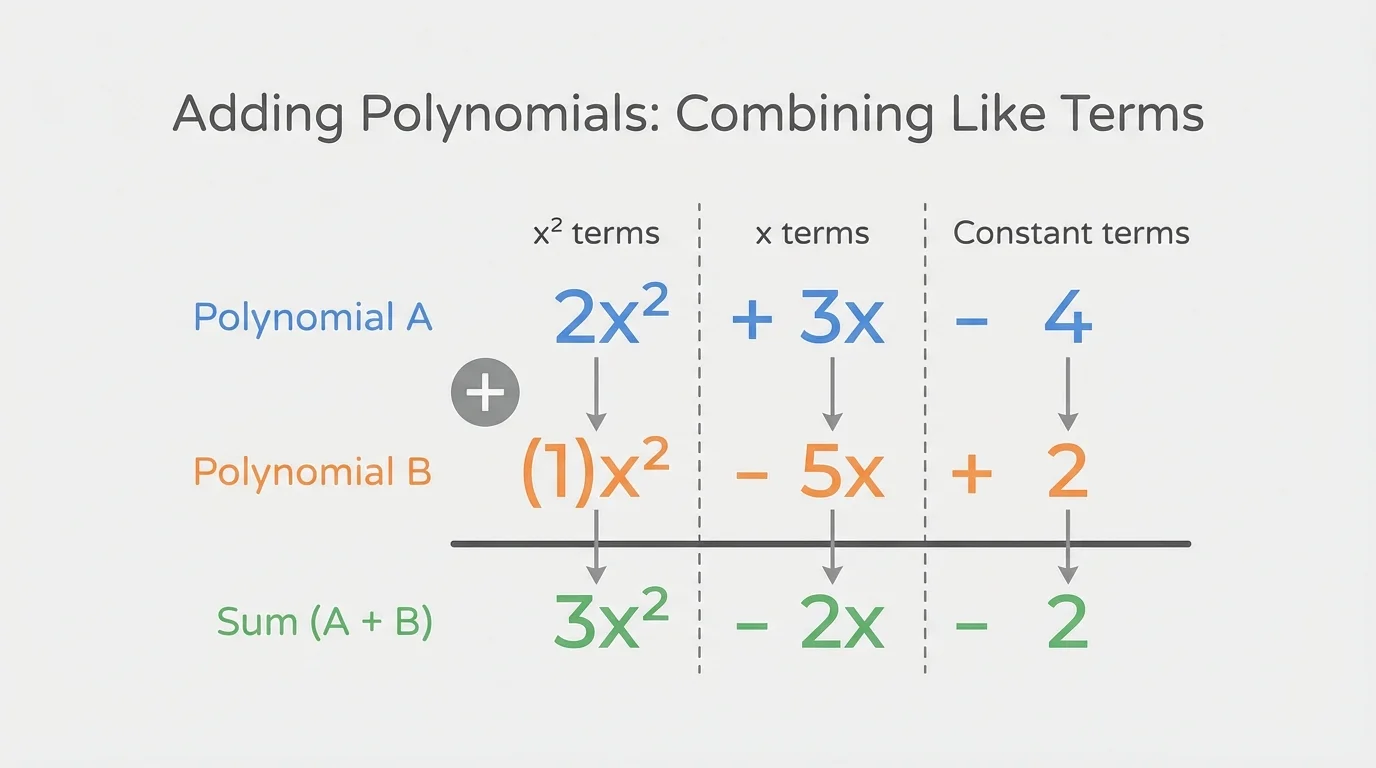
For example, when adding \(2x^2 + 3x - 4\) and \(5x^2 - x + 6\), group the matching powers:
\[ (2x^2 + 3x - 4) + (5x^2 - x + 6) = 7x^2 + 2x + 2 \]
Each part combines separately: \(2x^2 + 5x^2 = 7x^2\), \(3x + (-x) = 2x\), and \(-4 + 6 = 2\).
Solved example 1: Adding polynomials
Simplify \((4x^3 - 2x^2 + 7x - 5) + (x^3 + 6x^2 - 3x + 9)\).
Step 1: Group like terms.
\(4x^3 + x^3\), \(-2x^2 + 6x^2\), \(7x - 3x\), and \(-5 + 9\)
Step 2: Combine coefficients.
\(4x^3 + x^3 = 5x^3\)
\(-2x^2 + 6x^2 = 4x^2\)
\(7x - 3x = 4x\)
\(-5 + 9 = 4\)
Step 3: Write the result in standard form.
\[ (4x^3 - 2x^2 + 7x - 5) + (x^3 + 6x^2 - 3x + 9) = 5x^3 + 4x^2 + 4x + 4 \]
Subtraction looks similar, but signs become especially important. If you subtract \((3x^2 - 4x + 1)\) from \((6x^2 + 2x - 5)\), you must subtract every term in the second expression.
Solved example 2: Subtracting polynomials
Simplify \((6x^2 + 2x - 5) - (3x^2 - 4x + 1)\).
Step 1: Distribute the minus sign.
\(6x^2 + 2x - 5 - 3x^2 + 4x - 1\)
Step 2: Combine like terms.
\(6x^2 - 3x^2 = 3x^2\)
\(2x + 4x = 6x\)
\(-5 - 1 = -6\)
Step 3: State the simplified polynomial.
\[ (6x^2 + 2x - 5) - (3x^2 - 4x + 1) = 3x^2 + 6x - 6 \]
A vertical arrangement can help keep terms organized, especially when some powers are missing. As in [Figure 1], writing terms in descending powers reduces mistakes and makes subtraction more reliable.
For instance, if a polynomial has no \(x\)-term, you can still leave space for that degree mentally or on paper. This is similar to lining up place values when adding large integers.
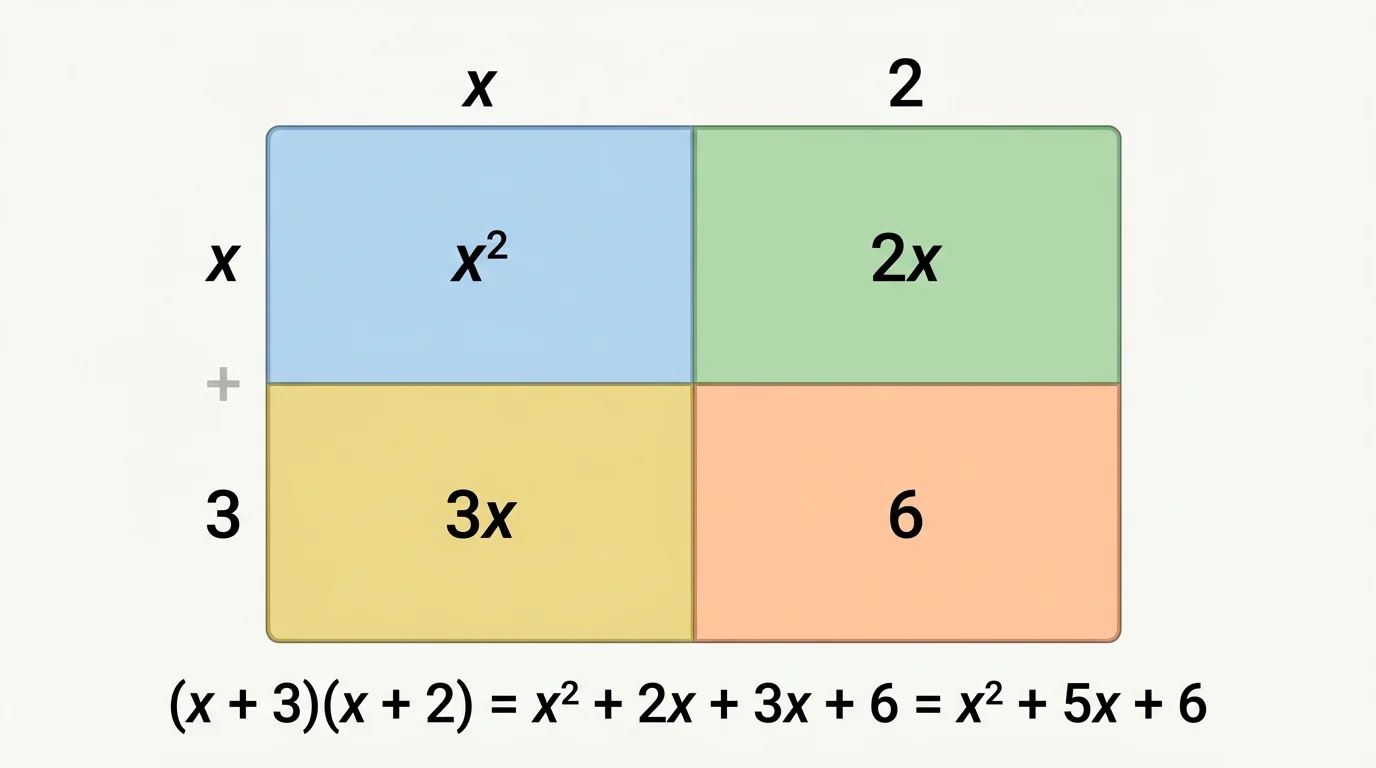
[Figure 2] Polynomial multiplication is built on the distributive property. Every term in one polynomial must multiply every term in the other. An area model can help organize this idea by splitting a rectangle into smaller regions whose areas represent partial products.
Start with the simplest case: multiplying a monomial by a polynomial. Multiply the monomial by each term in the polynomial.
For example, \(3x(2x^2 - 5x + 4)\) becomes \(6x^3 - 15x^2 + 12x\). Each product follows the exponent rule \(x^m \cdot x^n = x^{m+n}\).
When multiplying powers with the same base, add exponents: \(x^2 \cdot x^3 = x^5\). When adding terms, however, exponents do not combine unless the terms are like terms. That is why \(x^2 + x^3\) does not become \(x^5\).
Now consider multiplying two binomials. You may know methods such as FOIL, but FOIL is really just a special case of the distributive property. The deeper idea is that each term in the first polynomial multiplies each term in the second polynomial.
Solved example 3: Multiplying a monomial and a polynomial
Simplify \(-2x^2(3x^3 - 4x + 5)\).
Step 1: Multiply the monomial by each term.
\(-2x^2 \cdot 3x^3 = -6x^5\)
\(-2x^2 \cdot (-4x) = 8x^3\)
\(-2x^2 \cdot 5 = -10x^2\)
Step 2: Write the result in standard form.
\[ -2x^2(3x^3 - 4x + 5) = -6x^5 + 8x^3 - 10x^2 \]
For binomials, one organized approach is to multiply row by row. Consider \((x + 3)(x + 2)\). Multiply \(x\) by both terms in the second binomial, then multiply \(3\) by both terms.
Solved example 4: Multiplying two binomials
Simplify \((x + 3)(x + 2)\).
Step 1: Distribute \(x\) across the second binomial.
\(x(x + 2) = x^2 + 2x\)
Step 2: Distribute \(3\) across the second binomial.
\(3(x + 2) = 3x + 6\)
Step 3: Add the partial products and combine like terms.
\(x^2 + 2x + 3x + 6 = x^2 + 5x + 6\)
\[ (x + 3)(x + 2) = x^2 + 5x + 6 \]
This same method works for larger polynomials. If you multiply a trinomial by a binomial, every term in the trinomial must still multiply every term in the binomial. The number of partial products increases, but the principle never changes.
Solved example 5: Multiplying larger polynomials
Simplify \((2x^2 + x - 1)(x - 4)\).
Step 1: Distribute \(x\) across the first polynomial.
\(x(2x^2 + x - 1) = 2x^3 + x^2 - x\)
Step 2: Distribute \(-4\) across the first polynomial.
\(-4(2x^2 + x - 1) = -8x^2 - 4x + 4\)
Step 3: Combine like terms.
\(2x^3 + x^2 - x - 8x^2 - 4x + 4 = 2x^3 - 7x^2 - 5x + 4\)
\[ (2x^2 + x - 1)(x - 4) = 2x^3 - 7x^2 - 5x + 4 \]
Notice what happens to degree during multiplication. If one polynomial has degree \(m\) and another has degree \(n\), their product has degree \(m+n\), unless special cancellation occurs. That makes sense because the highest-power terms multiply together to produce the highest-power term in the product.
Some products appear so often that they are worth recognizing instantly. These are not new rules; they are shortcuts that come from ordinary polynomial multiplication.
One pattern is the square of a binomial:
\[ (a + b)^2 = a^2 + 2ab + b^2 \]
Similarly,
\[ (a - b)^2 = a^2 - 2ab + b^2 \]
Another important pattern is the difference of squares:
\[ (a + b)(a - b) = a^2 - b^2 \]
For example, \((x + 5)(x - 5) = x^2 - 25\). The middle terms cancel because \(5x - 5x = 0\). This is one of the cleanest examples of how structure can simplify multiplication.
The same multiplication rules used for classroom algebra are used by computer algebra systems when they expand and simplify expressions. Software can perform thousands of polynomial operations quickly, but it is still following the same distributive property you use by hand.
Recognizing patterns saves time, but it is important not to force them where they do not belong. For example, \((x + 2)^2\) is \(x^2 + 4x + 4\), not \(x^2 + 4\). Squaring a binomial means multiplying the entire binomial by itself.
One frequent mistake is combining unlike terms. For instance, \(3x^2 + 4x\) cannot become \(7x^2\) or \(7x\). The terms have different variable parts, so they remain separate.
Another common mistake appears in subtraction. In \((5x^2 - 3x + 1) - (2x^2 + x - 4)\), the minus sign must affect every term in the second polynomial. The correct rewrite is \(5x^2 - 3x + 1 - 2x^2 - x + 4\), leading to \(3x^2 - 4x + 5\).
A third error happens in multiplication when students forget one of the partial products. In a product like \((x + 2)(x + 7)\), there are four products: \(x \cdot x\), \(x \cdot 7\), \(2 \cdot x\), and \(2 \cdot 7\). Missing even one changes the answer completely. The area model in [Figure 2] helps prevent that by making every partial product visible.
It also helps to keep standard form throughout your work. Writing terms in descending powers, such as \(4x^3 + x^2 - 6x + 9\), makes it easier to spot errors and compare answers.
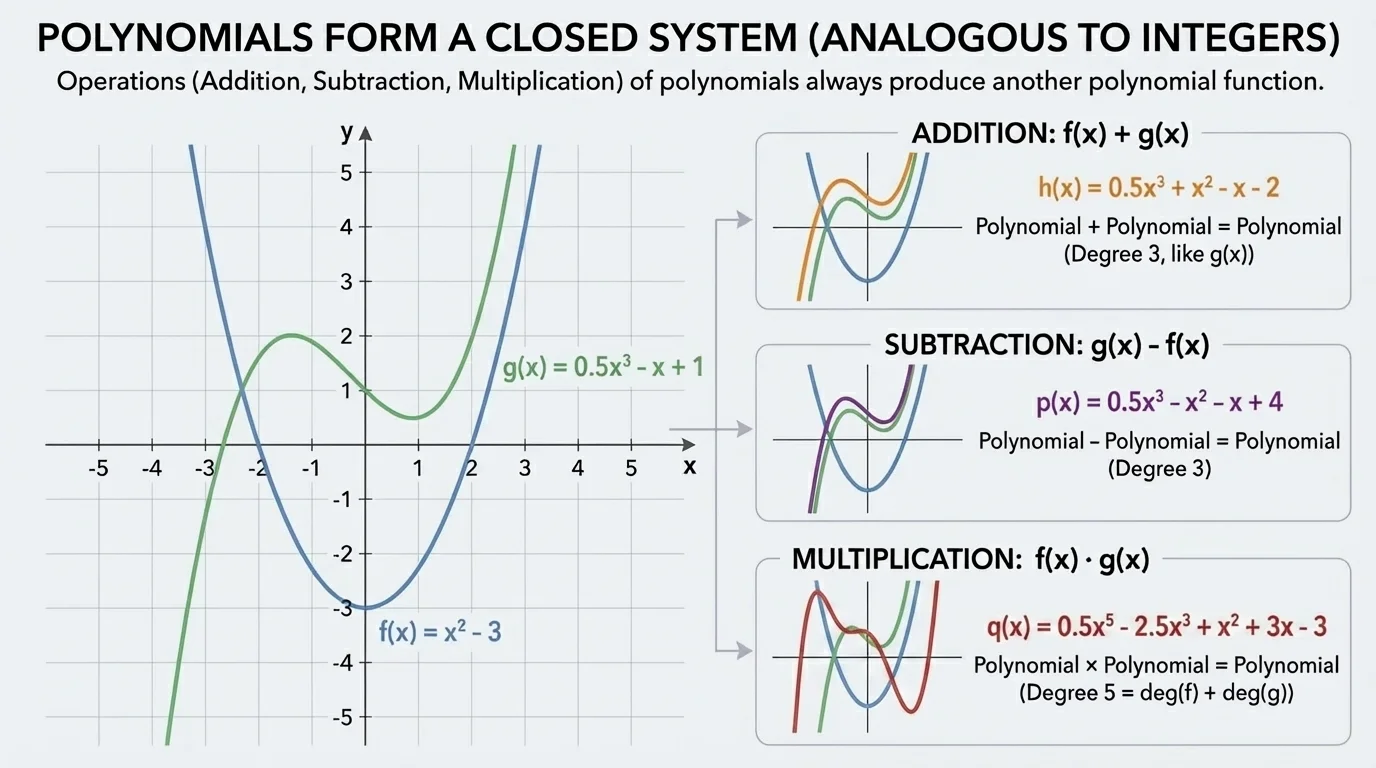
[Figure 3] Polynomials are not just symbolic exercises. They are used to model area, revenue, physical motion, and changing rates. When engineers or scientists multiply expressions, they often create new polynomial models whose shapes and degrees reveal important behavior, as polynomial graphs of different degrees show.
Area is a classic application. If a rectangle has side lengths \((x + 4)\) meters and \((x + 1)\) meters, then its area is the product of those expressions:
\[ A = (x + 4)(x + 1) = x^2 + 5x + 4 \]
This tells you how the area changes as \(x\) changes. The area model for multiplication is not just a classroom trick; it reflects an actual geometric interpretation.
In business, a profit or revenue model may be written as a polynomial. Adding or subtracting polynomials can combine categories such as production costs and marketing costs. Multiplying polynomials can appear when one changing quantity depends on another changing quantity.
In physics, expressions involving time often lead to polynomial models. For example, the height of an object under constant acceleration may be modeled by a quadratic polynomial in time. Operations with polynomials let scientists compare models, combine effects, and predict outcomes.
Graphs also connect naturally to arithmetic. A linear polynomial such as \(2x + 1\) gives a straight line, a quadratic polynomial such as \(x^2 - 4x + 3\) gives a parabola, and multiplying factors can create higher-degree expressions with more complex behavior, as seen again in [Figure 3]. The arithmetic of polynomials directly shapes the geometry of their graphs.
| Operation | Example | Result | Still a polynomial? |
|---|---|---|---|
| Addition | \((x^2 + 3x) + (2x^2 - x + 4)\) | \(3x^2 + 2x + 4\) | Yes |
| Subtraction | \((5x^2 - 2) - (x^2 + 7x)\) | \(4x^2 - 7x - 2\) | Yes |
| Multiplication | \((x + 1)(x - 3)\) | \(x^2 - 2x - 3\) | Yes |
Table 1. Examples showing that addition, subtraction, and multiplication of polynomials produce polynomials.
That closure is the main reason polynomial arithmetic is so useful. Just as integers remain integers after basic arithmetic, polynomials remain polynomials after these operations. This consistency is what allows algebra to scale from simple expressions to powerful models.
