A single algebraic expression can describe a phone plan, the area of a garden, the motion of a car, or the growth of a savings account. That is what makes algebra powerful: a short string of symbols can tell a whole story. But to read that story, you need to understand how the expression is built. Just as a sentence has words and phrases with different jobs, an expression has parts that each contribute meaning.
An expression is a mathematical phrase made of numbers, variables, and operations. When you look at an expression, you should not only ask, "Can I simplify it?" You should also ask, "What does each part mean?" In many situations, the structure of the expression tells you how quantities are related.
[Figure 1] For example, in the expression \(5x + 12\), the \(5x\) and the \(12\) are not just random pieces. The \(5x\) often represents a changing amount that depends on \(x\), while the \(12\) often represents a fixed amount. If \(x\) is the number of months in a streaming plan, then \(5x\) could mean a charge of \(\$5\) per month, and \(12\) could mean a one-time setup fee of \(\$12\).
From earlier algebra, you already know that expressions are not equations. An expression such as \(3x + 7\) names a quantity. An equation such as \(3x + 7 = 19\) states that two quantities are equal.
Seeing structure means recognizing how parts are grouped and how those parts relate to the situation being modeled. This is especially important when expressions become longer, such as \(4(x + 3) - 2\) or \(\dfrac{1}{2}ab + 7\).
One of the most important skills in algebra is identifying the terms, factors, and coefficients of an expression. These parts help you understand both the arithmetic structure and the meaning of the quantity, as a labeled expression shows.
Terms are the parts of an expression that are separated by addition or subtraction. In \(7x^2 - 3x + 9\), the terms are \(7x^2\), \(-3x\), and \(9\). It is important to include the sign with each term after the first when naming them. So the second term is \(-3x\), not just \(3x\).
Factors are numbers or variables being multiplied together. In \(6x\), the factors are \(6\) and \(x\). In \(2ab\), the factors are \(2\), \(a\), and \(b\). In \(5(x + 4)\), the factors are \(5\) and \((x + 4)\). A factor can be a grouped expression, not just a single number or variable.
Coefficients are the numerical factors of terms with variables. In \(8y\), the coefficient is \(8\). In \(-\dfrac{3}{4}m^2\), the coefficient is \(-\dfrac{3}{4}\). If a variable appears alone, as in \(x\), its coefficient is \(1\). If it appears as \(-x\), its coefficient is \(-1\).
A constant is a term with no variable. In \(4n + 11\), the constant is \(11\). Constants often represent fixed quantities in context, such as an entry fee, starting value, or initial amount.
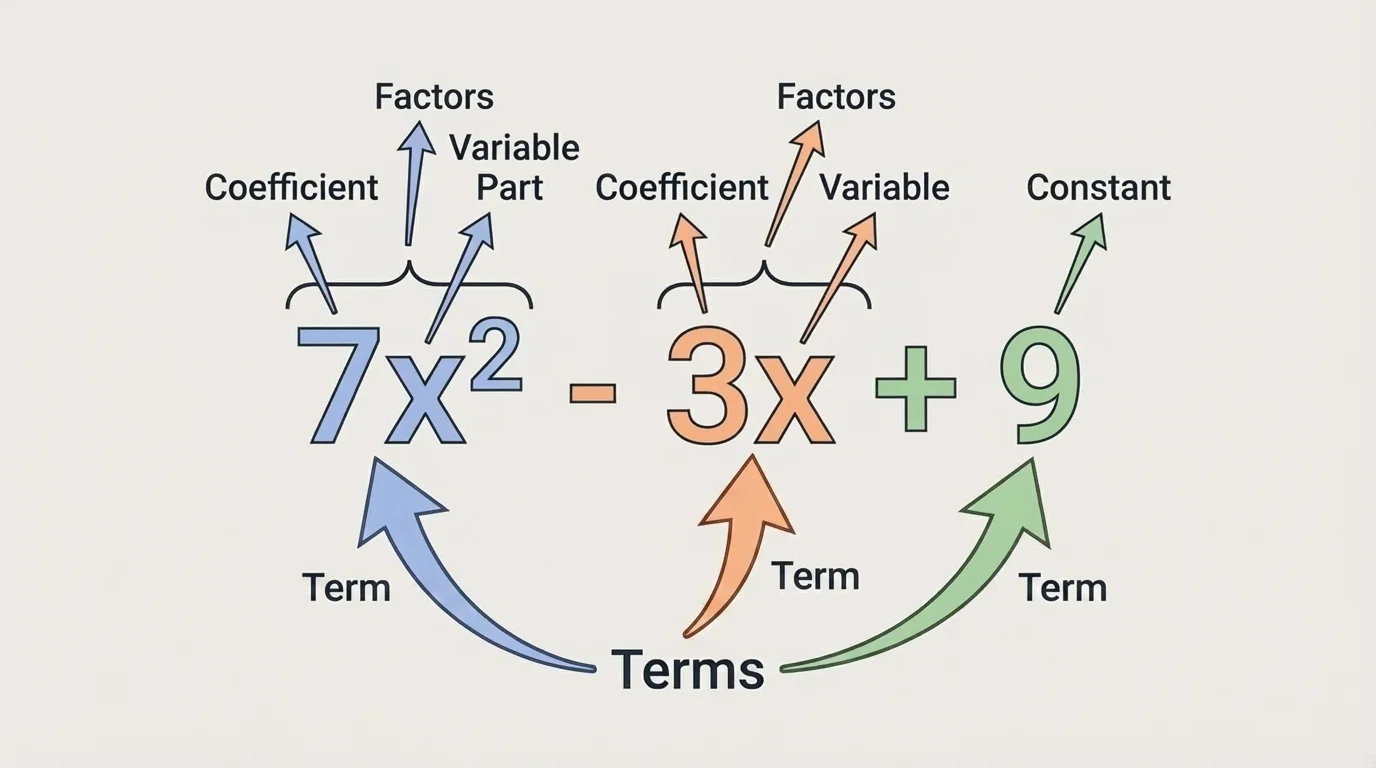
Essential parts of an expression: A term is a part separated by addition or subtraction. A factor is a quantity being multiplied. A coefficient is the numerical factor multiplying the variable part of a term. A constant is a term with no variable.
These ideas connect. In the term \(-5ab\), the coefficient is \(-5\), and the factors are \(-5\), \(a\), and \(b\). In the expression \(-5ab + 2\), there are two terms: \(-5ab\) and \(2\).
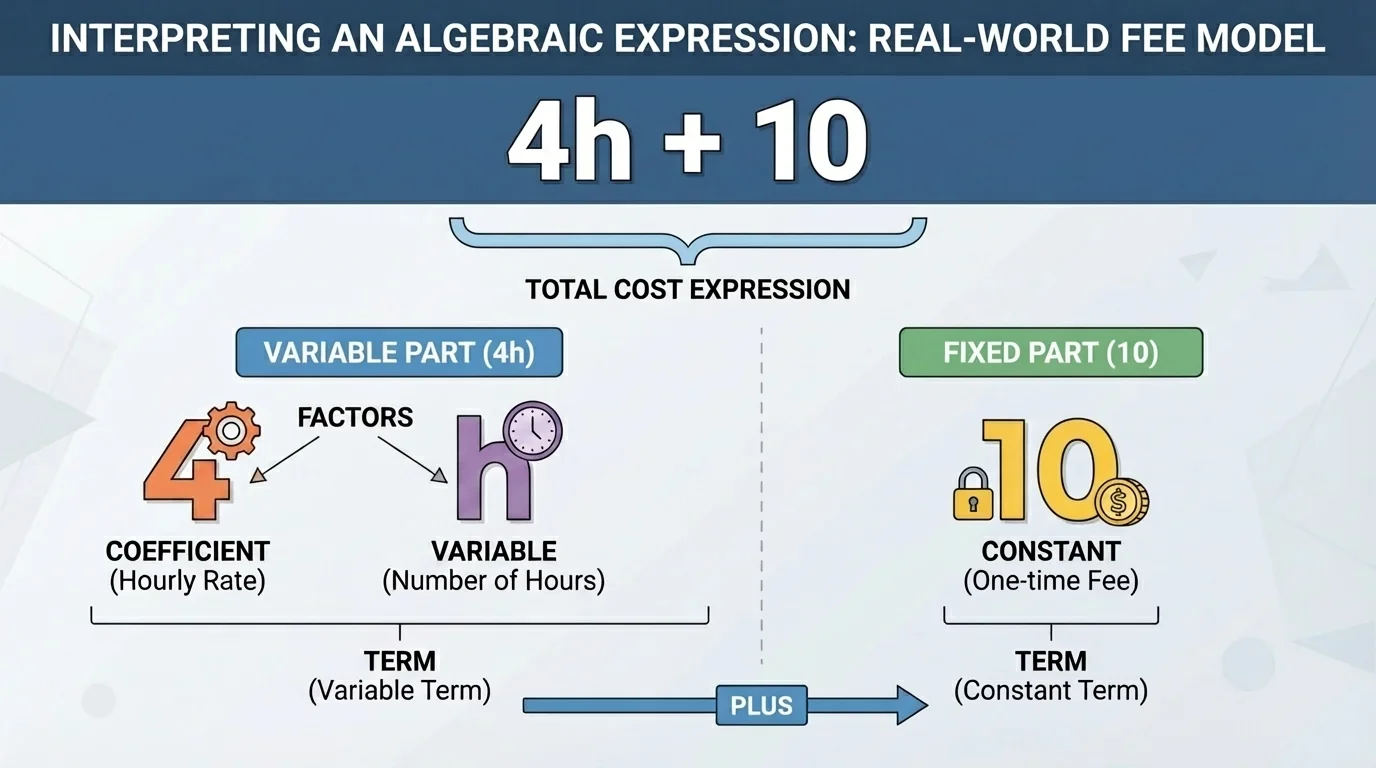
Algebra becomes more meaningful when you connect each symbol to a situation. A mathematical model is useful only if you can explain what its pieces represent. In contextual expressions, every term, factor, and coefficient should be interpreted in words, as [Figure 2] illustrates with a fee-and-rate situation.
Suppose a bike rental company charges a fixed fee of \(\$10\) plus \(\$4\) per hour. If \(h\) is the number of hours, the total cost is \(4h + 10\). Here, \(4h\) is the part that changes with time, and \(10\) is the fixed starting fee. The coefficient \(4\) tells the cost for each hour. The variable \(h\) tells how many hours are rented.
Now consider \(3(s - 2)\), where \(s\) is the number of students at a museum event and each group receives \(3\) brochures after excluding \(2\) staff leaders. The grouped expression \((s - 2)\) means the number of students only, not counting the staff leaders. The factor \(3\) means each student receives \(3\) brochures. Parentheses often signal that a whole quantity is being treated as one unit.
Expressions can also describe repeated growth or area. In \(l(w + 2)\), if \(l\) is the length of a rectangle and \(w + 2\) is the width after increasing it by \(2\) units, then the product tells the rectangle's area. Interpreting the factors explains the geometric meaning.
Context changes interpretation
The same expression can mean different things in different situations. For example, \(2x + 5\) could represent a taxi fare with a base fee of \(\$5\) and \(\$2\) per mile, or it could represent the perimeter of a rectangle with width \(x\) and fixed side lengths totaling \(5\). The algebraic structure stays the same, but the meaning comes from the context.
This is why good interpretation uses both mathematics and language. You should be able to point to a part of the expression and say what quantity it represents, not just name it.
Expressions can be written in several common forms, and each form highlights different structure.
Sum or difference form: In \(2x + 7\) or \(9 - 3p\), the terms are added or subtracted. This form often highlights separate contributions to a total.
Product form: In \(5n\) or \(3(x + 1)\), the expression is built from multiplication. This form often shows rate times quantity, dimension times dimension, or repeated equal groups.
Power form: In \(x^2\) or \(4r^3\), the exponent shows repeated multiplication. For instance, \(x^2\) means \(x \cdot x\). In geometry, squared quantities often relate to area, while cubed quantities often relate to volume.
Grouped form: Parentheses show that several symbols act as one quantity. In \(2(x + 5)\), the entire quantity \((x + 5)\) is multiplied by \(2\). This is different from \(2x + 5\), where only \(x\) is multiplied by \(2\).
A tiny pair of parentheses can completely change meaning. The expressions \(3x + 6\) and \(3(x + 6)\) look similar, but the first means "three times \(x\), then add \(6\)," while the second means "three times the entire quantity \(x + 6\)."
Recognizing these forms helps you read an expression more intelligently. Instead of seeing a blur of symbols, you begin to notice a fixed amount, a rate, a repeated factor, or a quantity treated as a single unit.
Suppose a concert ticket website charges a service fee of \(\$8\) for every ticket plus a one-time order fee of \(\$5\). If \(t\) is the number of tickets, the total extra cost is \(8t + 5\). Interpret the parts of the expression.
Worked example
Step 1: Identify the terms.
The expression \(8t + 5\) has two terms: \(8t\) and \(5\).
Step 2: Identify the coefficient and variable.
In the term \(8t\), the coefficient is \(8\) and the variable is \(t\).
Step 3: Interpret each part in context.
The term \(8t\) represents the service fee for all tickets because each ticket adds \(\$8\). The constant term \(5\) represents the one-time order fee.
Step 4: State the meaning of the whole expression.
The whole expression gives the total extra cost for buying \(t\) tickets.
The interpretation is that \(8\) is the cost per ticket, \(t\) is the number of tickets, and \(5\) is the fixed fee.
This kind of expression appears often in online shopping, delivery charges, and event pricing. A coefficient often acts like a rate, and a constant often acts like a fixed fee.
A rectangle has length \(x + 3\) and width \(x\). Its area is \(x(x + 3)\). Interpret the factors and connect them to geometry.
Worked example
Step 1: Identify the overall operation.
The expression \(x(x + 3)\) is a product. It multiplies two factors.
Step 2: Name the factors.
The factors are \(x\) and \((x + 3)\).
Step 3: Interpret the factors in context.
One factor, \(x\), represents the width. The other factor, \((x + 3)\), represents the length, which is \(3\) units longer than \(x\).
Step 4: Explain the meaning of the whole expression.
Because area is found by multiplying length and width, \(x(x + 3)\) represents the area of the rectangle.
If the expression is expanded, it becomes \(x^2 + 3x\). This expanded form shows the area as the sum of two smaller regions.
Geometry gives a useful way to interpret algebraic structure. A product can represent dimensions, while an expanded sum can represent pieces of the total area.
A fish population in a pond begins at \(120\) fish and increases by \(15\) fish per month. After \(m\) months, the population is modeled by \(120 + 15m\). Interpret the structure.
Worked example
Step 1: Identify the terms.
The terms are \(120\) and \(15m\).
Step 2: Identify the coefficient.
In \(15m\), the coefficient is \(15\).
Step 3: Interpret the constant.
The constant \(120\) represents the starting population before any months pass.
Step 4: Interpret the variable term.
The term \(15m\) represents the total increase after \(m\) months because the pond gains \(15\) fish each month.
The full expression represents the total number of fish after \(m\) months.
Many linear models have this same structure: starting amount plus rate times time. In science, economics, and data analysis, recognizing that structure helps you read models quickly.
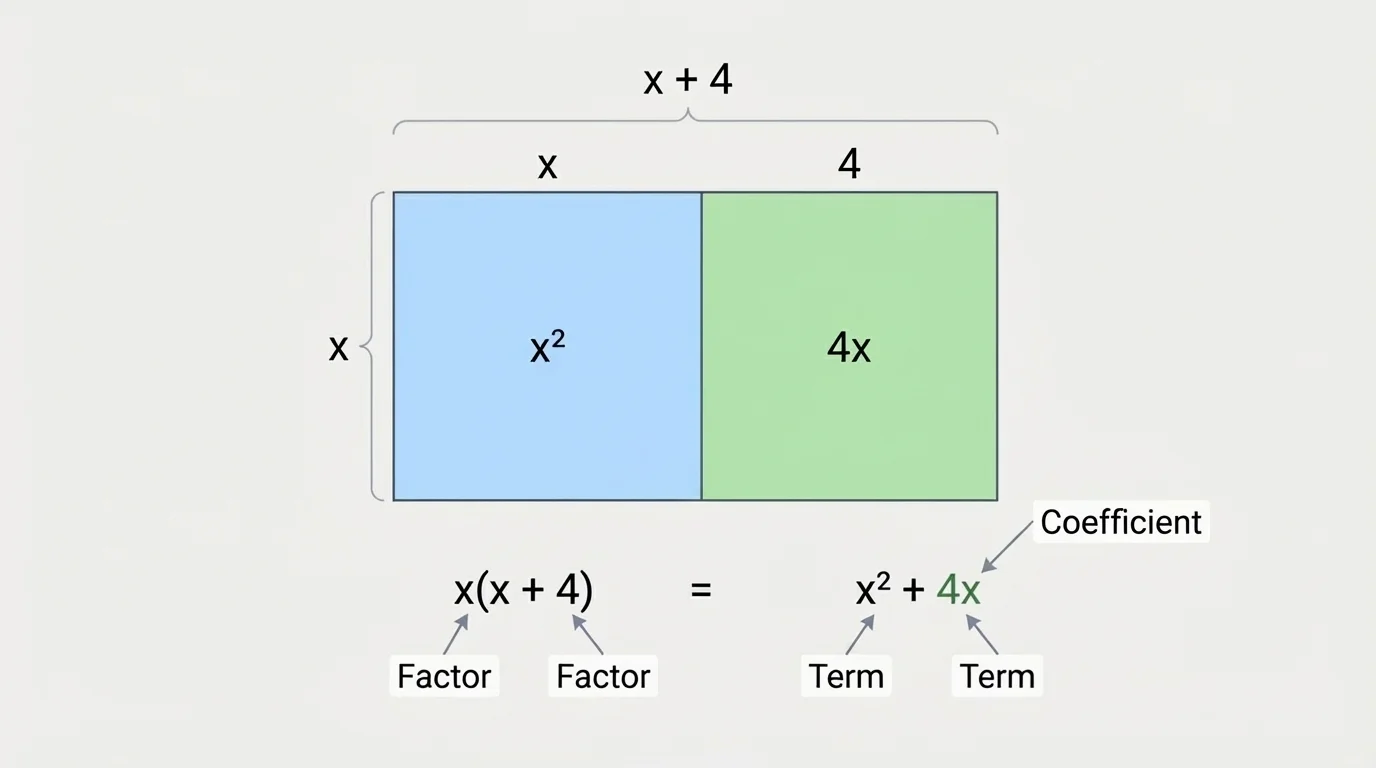
Two expressions can be equivalent expressions, meaning they always have the same value, yet they can reveal different information. This matters because structure is not only about what an expression equals; it is also about what the form helps you notice, as [Figure 3] shows with an area model.
Consider \(x(x + 4)\) and \(x^2 + 4x\). These are equivalent because distributing gives \(x(x + 4) = x^2 + 4x\). But the factored form \(x(x + 4)\) highlights multiplication of dimensions, while the expanded form \(x^2 + 4x\) highlights two area pieces.
Another example is \(5n + 5\) and \(5(n + 1)\). Both are equivalent, but \(5(n + 1)\) emphasizes that the entire quantity \((n + 1)\) is multiplied by \(5\). This can suggest equal groups or a common factor. The form \(5n + 5\) emphasizes two separate terms being added.
Choosing a form depends on what you want to understand. In a context problem, one form may better reveal the meaning of the quantities involved. Later, when solving equations or simplifying, a different form may be more useful. Algebraic structure can be viewed in more than one valid way.
Equivalent does not mean identical in appearance
Expressions can look different but represent the same quantity for every value of the variable. Interpreting structure means asking what each form highlights. One form may show a sum of parts, while another may show a common factor or a geometric relationship.
This idea is one of the most important habits in algebra: do not just manipulate expressions mechanically. Read them.
A common error is confusing terms and factors. In \(3x + 2\), the terms are \(3x\) and \(2\). But in the term \(3x\), the factors are \(3\) and \(x\). Terms are separated by addition or subtraction; factors are connected by multiplication.
Another error is forgetting the sign of a term. In \(6y - 4\), the second term is \(-4\), not \(4\). The sign matters because it affects the value and the meaning. In context, a negative term may represent a loss, discount, or decrease.
Students also sometimes say the coefficient of \(x\) in \(-x\) is missing. It is not missing; it is \(-1\). Likewise, the coefficient of \(x\) in \(x\) is \(1\).
Parentheses can also cause confusion. The expression \(2(x + 7)\) has factors \(2\) and \((x + 7)\). The expression \(2x + 7\) has terms \(2x\) and \(7\). These are not the same structure, and they usually do not mean the same thing.
| Expression | Terms | Factors in a Variable Term | Constant |
|---|---|---|---|
| \(4x + 9\) | \(4x\), \(9\) | \(4\), \(x\) | \(9\) |
| \(-3ab + 2\) | \(-3ab\), \(2\) | \(-3\), \(a\), \(b\) | \(2\) |
| \(5(x - 1)\) | one term if viewed as a product | \(5\), \((x - 1)\) | none written separately |
| \(x^2 + 6x + 8\) | \(x^2\), \(6x\), \(8\) | for \(6x\): \(6\), \(x\) | \(8\) |
Table 1. Examples comparing terms, factors, and constants in different expressions.
Interpreting expressions is not just a classroom exercise. In physics, an expression like \(d = vt\) tells you that distance is the product of speed and time. In finance, an expression such as \(50 + 12m\) might describe the total cost of a membership with a sign-up fee and a monthly charge. In engineering, \(lw\) immediately signals area because it is a product of dimensions. In data science, a model like \(200 - 3t\) can represent a quantity decreasing steadily over time.
Medical dosage can also be described with expressions. If a medicine is prescribed at \(2m\) milligrams per day for a patient with mass \(m\) kilograms, the coefficient \(2\) gives the number of milligrams per kilogram. Understanding that coefficient correctly is important because it carries the rate information.
Sports statistics use the same structure. If a basketball player scores \(2p + 3q + f\), where \(p\) is the number of two-point shots, \(q\) is the number of three-point shots, and \(f\) is the number of free throws, each coefficient reveals the point value of a shot type. The terms show how different scoring methods contribute to the total.
"Symbols are powerful because they compress meaning."
— A central idea of algebra
When you interpret an expression well, you move beyond symbol-pushing. You understand what changes, what stays fixed, what is multiplied, what is added, and what the whole expression tells you about the situation.
