Suppose you had to expand \((x+y)^{10}\) by multiplying \((x+y)\) by itself ten times. You could do it directly, but it would be long, messy, and very easy to get wrong. Mathematics becomes powerful when it replaces repeated work with a pattern, and the Binomial Theorem is one of the clearest examples of that idea. It turns a huge multiplication problem into an organized formula.
In algebra, expressions like \((x+y)^n\) appear everywhere: in polynomial identities, probability, statistics, physics, and even computer science. The Binomial Theorem gives a direct way to expand them without multiplying step by step. That makes it useful not only for writing polynomials in standard form, but also for finding specific coefficients, evaluating expressions, and solving more complex problems efficiently.
A binomial is a polynomial with exactly two terms, such as \(x+y\), \(a-b\), or \(2m+5\). The theorem applies to powers of these two-term expressions when the exponent is a positive integer.
Before studying the theorem, recall two important ideas: first, exponents tell how many times a factor is multiplied by itself; second, when multiplying powers of the same base, you add exponents. For example, \(x^3 \cdot x^2 = x^5\).
You may already know some common identities. For example, \((x+y)^2 = x^2 + 2xy + y^2\). The Binomial Theorem extends this pattern to any positive integer power.
Let us look at the first few powers of \((x+y)\):
\[(x+y)^1 = x+y\]
\[(x+y)^2 = x^2 + 2xy + y^2\]
\[(x+y)^3 = x^3 + 3x^2y + 3xy^2 + y^3\]
\[(x+y)^4 = x^4 + 4x^3y + 6x^2y^2 + 4xy^3 + y^4\]
Several patterns appear immediately. The powers of \(x\) start high and decrease by \(1\) in each term. The powers of \(y\) start at \(0\) and increase by \(1\). In every term, the exponents add up to the original power. For example, in \(6x^2y^2\), the exponents satisfy \(2+2=4\).
The coefficients also follow a pattern: \(1\), then \(1,2,1\), then \(1,3,3,1\), then \(1,4,6,4,1\). These are not random. They come from a famous triangular arrangement of numbers.
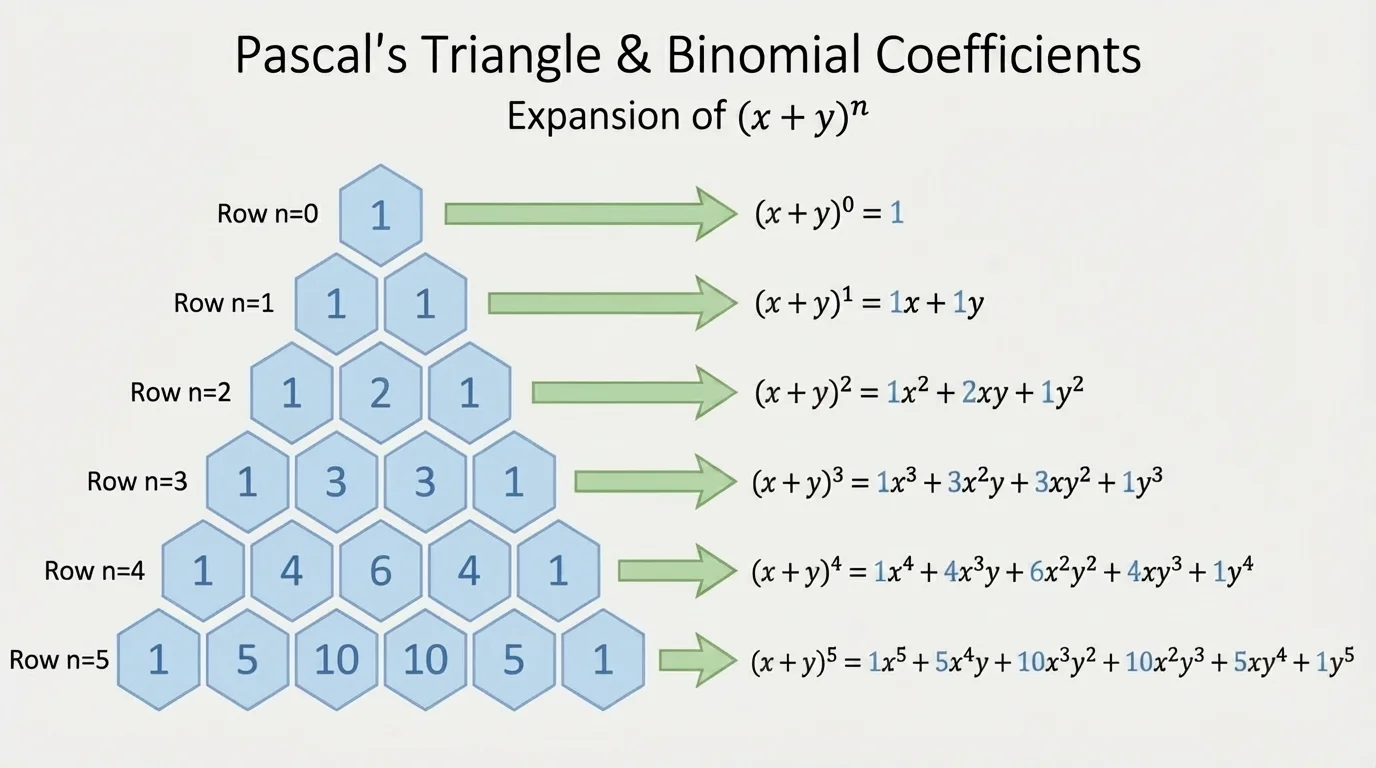
The pattern of coefficients becomes much easier to see with Pascal's Triangle. As [Figure 1] shows, each row begins and ends with \(1\), and each interior number is the sum of the two numbers directly above it.
The first few rows are:
\[\begin{array}{ccccccc} &&&&1\\&&&1&&1\\&&1&&2&&1\\&1&&3&&3&&1\\1&&4&&6&&4&&1\end{array}\]
These rows match the coefficients of \((x+y)^0\), \((x+y)^1\), \((x+y)^2\), \((x+y)^3\), and \((x+y)^4\). So the coefficients of \((x+y)^5\) are the next row: \(1,5,10,10,5,1\).
That means
\[(x+y)^5 = x^5 + 5x^4y + 10x^3y^2 + 10x^2y^3 + 5xy^4 + y^5\]
Pascal's Triangle is a very useful tool when the binomial has the form \((x+y)^n\). However, when the terms involve coefficients, such as \((2x-3)^5\), the same coefficient pattern still appears, but each term must also include the powers of \(2x\) and \(-3\).
The Binomial Theorem gives a formula for expanding \((x+y)^n\), where \(n\) is a positive integer.
A binomial coefficient is the numerical coefficient in a term of the expansion, often written as \(\binom{n}{k}\).
Pascal's Triangle is really a visual way of organizing these binomial coefficients. For larger powers, writing coefficients with symbols is more efficient than building row after row of the triangle.
The Binomial Theorem states that
\[(x+y)^n = \sum_{k=0}^{n} \binom{n}{k}x^{n-k}y^k\]
This formula may look compact, but it contains a lot of structure. The symbol \(\sum\) means "add all the terms." The index \(k\) starts at \(0\) and goes up to \(n\). For each value of \(k\), you get one term in the expansion.
The expression \(\binom{n}{k}\) is called a binomial coefficient. It can be found from Pascal's Triangle or by the formula
\[\binom{n}{k} = \frac{n!}{k!(n-k)!}\]
Here, \(n!\) means factorial, which is the product of all positive integers from \(1\) to \(n\). For example, \(5! = 5\cdot4\cdot3\cdot2\cdot1 = 120\).
So, for example, \(\binom{5}{2} = \dfrac{5!}{2!3!} = \dfrac{120}{2\cdot6} = 10\).
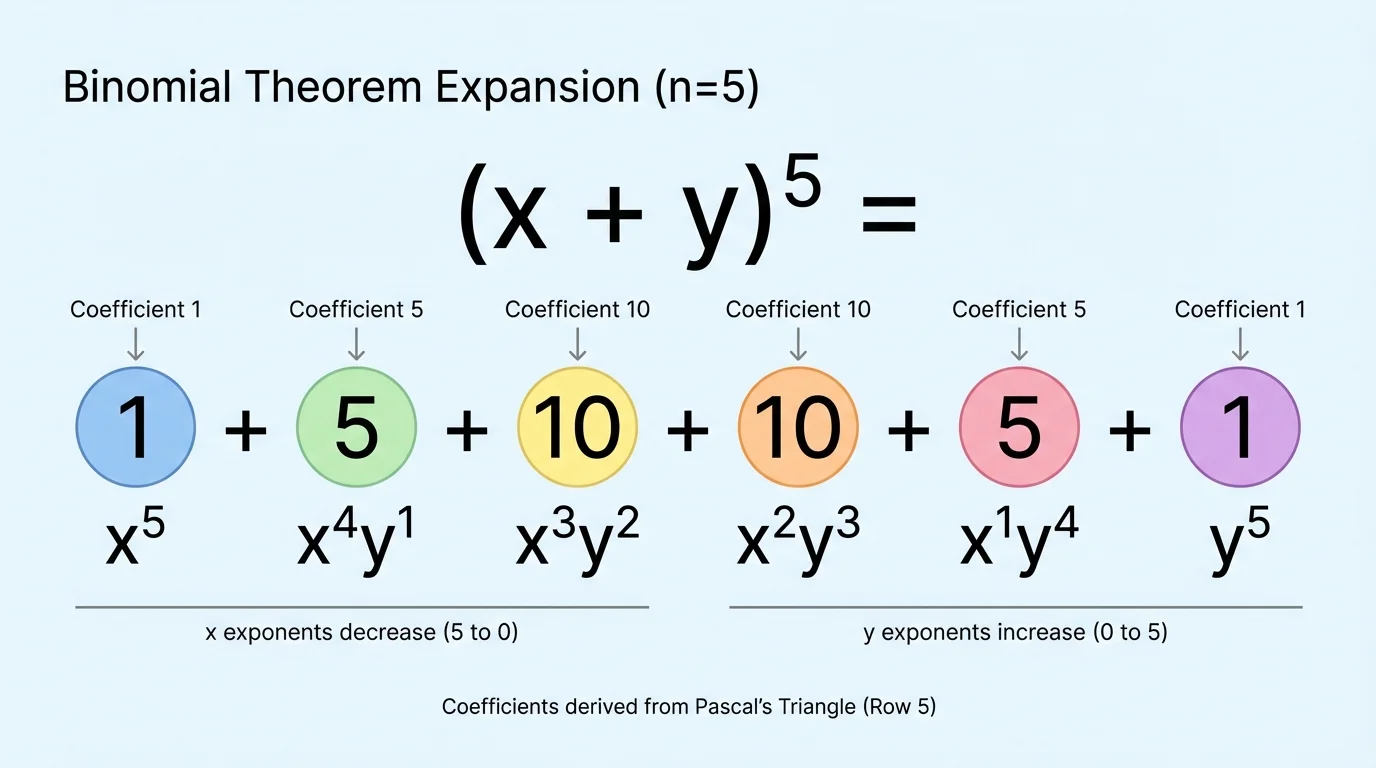
One of the most important ideas is the general term of the expansion. The powers shift in opposite directions: the exponent of \(x\) decreases while the exponent of \(y\) increases.
As [Figure 2] illustrates, the general term is
\[T_{k+1} = \binom{n}{k}x^{n-k}y^k\]
This means the \((k+1)\)-st term has coefficient \(\binom{n}{k}\), power \(n-k\) on \(x\), and power \(k\) on \(y\). The exponents always add to \(n\):
\((n-k)+k=n\)
That fact helps you check whether a term is correct. If you are expanding \((x+y)^8\), every term must have total degree \(8\).
This pattern is still true if the binomial is not exactly \((x+y)\). For \((2a-b)^4\), each term still follows the coefficient pattern from row \(4\) of Pascal's Triangle, but powers are applied to \(2a\) and \(-b\), not just to \(a\) and \(b\).
Why signs matter
If the binomial contains subtraction, like \((x-y)^n\), then terms with odd powers of \(y\) become negative because \((-y)^1\), \((-y)^3\), and other odd powers are negative. Terms with even powers of \(y\) remain positive because \((-y)^2\), \((-y)^4\), and other even powers are positive.
This is why \((x-y)^4 = x^4 - 4x^3y + 6x^2y^2 - 4xy^3 + y^4\). The coefficients match Pascal's Triangle, but the signs alternate.
The theorem becomes clearer when you use it in complete expansions and term-finding problems.
Worked example 1: Expand \((x+2)^5\)
Step 1: Write the coefficient pattern.
For power \(5\), the coefficients are \(1,5,10,10,5,1\).
Step 2: Write the powers of \(x\) and \(2\).
\((x+2)^5 = 1\cdot x^5 + 5\cdot x^4(2) + 10\cdot x^3(2^2) + 10\cdot x^2(2^3) + 5\cdot x(2^4) + 1\cdot 2^5\)
Step 3: Simplify each term.
\(5\cdot2 = 10\), \(10\cdot4 = 40\), \(10\cdot8 = 80\), \(5\cdot16 = 80\), and \(2^5 = 32\).
So,
\[(x+2)^5 = x^5 + 10x^4 + 40x^3 + 80x^2 + 80x + 32\]
Notice that the theorem avoids repeated multiplication and keeps the structure organized from the start.
Worked example 2: Expand \((2a-b)^4\)
Step 1: Use the coefficients from row \(4\).
The coefficients are \(1,4,6,4,1\).
Step 2: Write the pattern of terms.
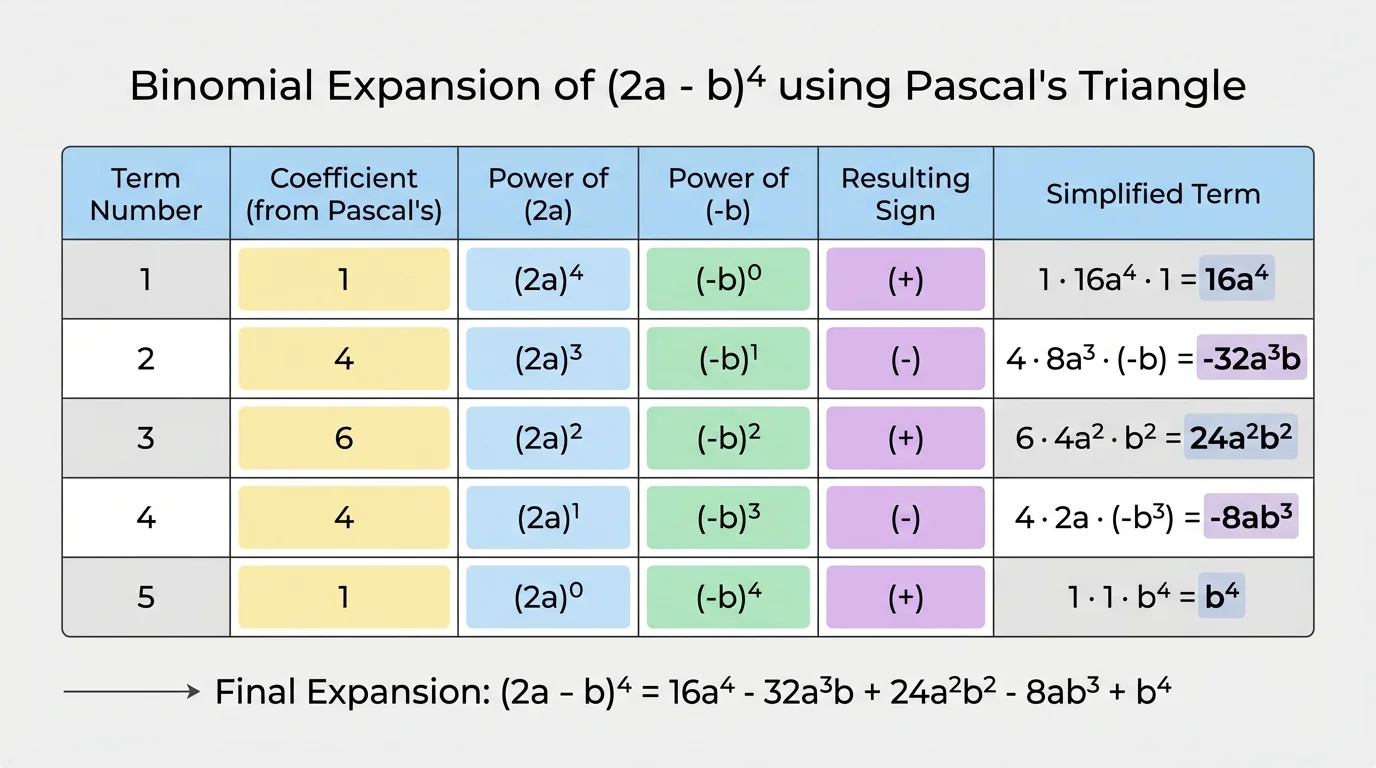
\((2a-b)^4 = (2a)^4 + 4(2a)^3(-b) + 6(2a)^2(-b)^2 + 4(2a)(-b)^3 + (-b)^4\)
Step 3: Simplify term by term.
\((2a)^4 = 16a^4\)
\(4(2a)^3(-b) = 4(8a^3)(-b) = -32a^3b\)
\(6(2a)^2(-b)^2 = 6(4a^2)(b^2) = 24a^2b^2\)
\(4(2a)(-b)^3 = 8a(-b^3) = -8ab^3\)
\((-b)^4 = b^4\)
Therefore,
\[(2a-b)^4 = 16a^4 - 32a^3b + 24a^2b^2 - 8ab^3 + b^4\]
This example shows why careful attention to powers and signs matters. A common mistake is to forget that \((-b)^3 = -b^3\).
Worked example 3: Find the fourth term of \((3x+y)^6\)
Step 1: Use the general term.
The \((k+1)\)-st term is \(T_{k+1} = \binom{6}{k}(3x)^{6-k}y^k\).
Step 2: Identify \(k\) for the fourth term.
If \(k+1=4\), then \(k=3\).
Step 3: Substitute \(k=3\).
\(T_4 = \binom{6}{3}(3x)^3y^3 = 20\cdot27x^3y^3\)
Step 4: Simplify.
\(20\cdot27=540\).
The fourth term is
\(540x^3y^3\)
Finding a specific term is often more efficient than expanding the whole expression. This is especially useful when the exponent is large.
As [Figure 3] demonstrates for a subtraction example, it helps to organize the coefficient, variable powers, and sign pattern systematically when solving algebra problems. This prevents dropped factors and exponent mistakes.
For example, suppose you want the coefficient of \(x^2\) in \((x+3)^5\). You do not need the full expansion if you recognize which term contains \(x^2\).
Using the general term, the power of \(x\) is \(5-k\). To get \(x^2\), solve \(5-k=2\), so \(k=3\). Then the term is \(\binom{5}{3}x^2(3^3) = 10\cdot27x^2 = 270x^2\). So the coefficient of \(x^2\) is \(270\).
This idea is a direct example of using polynomial identities to solve problems. Instead of multiplying everything out, you use the theorem as a structure for extracting exactly the information you need.
You can also use the theorem to evaluate expressions mentally and efficiently. For instance,
\[(101)^3 = (100+1)^3 = 100^3 + 3(100)^2(1) + 3(100)(1)^2 + 1^3\]
So,
\[(101)^3 = 1{,}000{,}000 + 30{,}000 + 300 + 1 = 1{,}030{,}301\]
That is much faster than multiplying \(101\cdot101\cdot101\) directly.
Binomial coefficients also appear in probability. For example, they count how many different ways a certain number of successes can occur in repeated yes-or-no experiments, such as flipping a coin multiple times.
The same coefficients that build algebraic expansions also count combinations. That connection is one reason the Binomial Theorem is important beyond pure algebra.
Students often make predictable errors when using the theorem. Knowing them in advance can save a lot of time.
Forgetting the coefficient: In \((x+y)^5\), the middle term is not just \(x^3y^2\); it is \(10x^3y^2\).
Incorrect exponents: In any expansion of \((x+y)^n\), the exponents in each term must add to \(n\). If they do not, something went wrong.
Sign errors with subtraction: In \((x-y)^n\), odd powers of \(y\) produce negative terms.
Applying the power to only one factor: For example, \((2x+1)^3\) is not \(8x^3+1\). You must include all terms of the expansion.
Another good check comes from substitution. If you expand \((x+y)^4\) and then let \(x=1\) and \(y=1\), the result should equal \((1+1)^4=16\). The sum of the coefficients in the expansion must therefore be \(16\). In general, the sum of coefficients of \((x+y)^n\) is \(2^n\).
The Binomial Theorem appears in many settings that involve repeated combinations of two quantities. In algebra, it helps rewrite and compare polynomial expressions. In probability, coefficients such as \(\binom{n}{k}\) count the number of ways an event can happen. In numerical estimation, expansions like \((a+b)^n\) help approximate values efficiently.
For example, engineers and scientists often use expansions to model small changes. If one quantity is a large base value plus a small adjustment, then a binomial expansion can reveal the leading terms quickly. Even in computer algorithms, coefficient patterns help organize calculations efficiently.
Returning to [Figure 1], the same rows that help with algebra also encode counting patterns. And as seen earlier in [Figure 2], the shifting exponents make it possible to predict the structure of a term before doing any arithmetic.
| Idea | What stays true | Example |
|---|---|---|
| Number of terms | Expansion of \((x+y)^n\) has \(n+1\) terms | \((x+y)^4\) has \(5\) terms |
| Coefficient pattern | Comes from row \(n\) of Pascal's Triangle | Row \(5\): \(1,5,10,10,5,1\) |
| Powers of first term | Decrease from \(n\) to \(0\) | \(x^5,x^4,x^3,x^2,x,1\) |
| Powers of second term | Increase from \(0\) to \(n\) | \(1,y,y^2,y^3,y^4,y^5\) |
| Total degree | Exponents in each term add to \(n\) | \(x^3y^2\) in the expansion of a fifth power |
Table 1. Core patterns that remain true in every binomial expansion.
Once these patterns become familiar, the theorem feels less like a formula to memorize and more like a structure you can read almost automatically.
