A single algebraic expression can reveal two useful perspectives at once. For example, \(\dfrac{x^2+5x+6}{x+2}\) looks like a fraction, but it can also be rewritten as a simpler expression plus a leftover piece. That idea is powerful: instead of seeing one complicated object, you learn to split it into a quotient and a remainder. This is the same basic idea used in division of whole numbers, except now you are dividing polynomials.
Rewriting rational expressions matters in algebra because it helps you simplify work, compare expressions, analyze graphs, and understand how one polynomial is built from another. It also appears in higher mathematics, physics, and engineering, where expressions are often easier to interpret once they are broken into cleaner parts.
A rational expression is a quotient of two polynomials, such as \(\dfrac{2x^2+3x-1}{x-4}\) or \(\dfrac{x^3-8}{x^2+1}\). Sometimes the numerator has degree greater than or equal to the degree of the denominator. In that case, the fraction can often be rewritten as a polynomial plus a smaller fraction.
This is useful for several reasons. First, the rewritten form often makes calculations easier. Second, it reveals the expression's overall behavior. Third, when you graph a rational function, the quotient often tells you the trend the graph follows for large values of \(x\). In more advanced settings, this kind of rewriting is a gateway to partial fractions and other algebraic techniques.
Recall ordinary division with whole numbers: when you divide \(17\) by \(5\), you get \(3\) with remainder \(2\). That means \(17 = 5 \cdot 3 + 2\), so \(\dfrac{17}{5} = 3 + \dfrac{2}{5}\). Polynomial division follows the same pattern.
The key difference is that instead of dividing integers, you are dividing polynomials. The same structure remains, but now the quotient and remainder can involve variables.
Polynomial means an expression built from terms like \(4x^3\), \(-2x\), and \(7\), where exponents of the variable are whole numbers.
Degree is the highest exponent of the variable in a polynomial with a nonzero coefficient.
Quotient is the result of division.
Remainder is what is left after division is complete.
Proper rational expression is a rational expression whose numerator has lower degree than its denominator.
For example, \(3x^2-4x+1\) has degree \(2\), and \(x^3+5\) has degree \(3\). The expression \(\dfrac{x+1}{x^2-9}\) is proper because the degree of the numerator is \(1\) and the degree of the denominator is \(2\). But \(\dfrac{x^2+1}{x-3}\) is not proper, because the numerator's degree is greater than the denominator's degree.
When an expression is not proper, it can be rewritten by division. This gives the standard form that is the focus of this lesson.
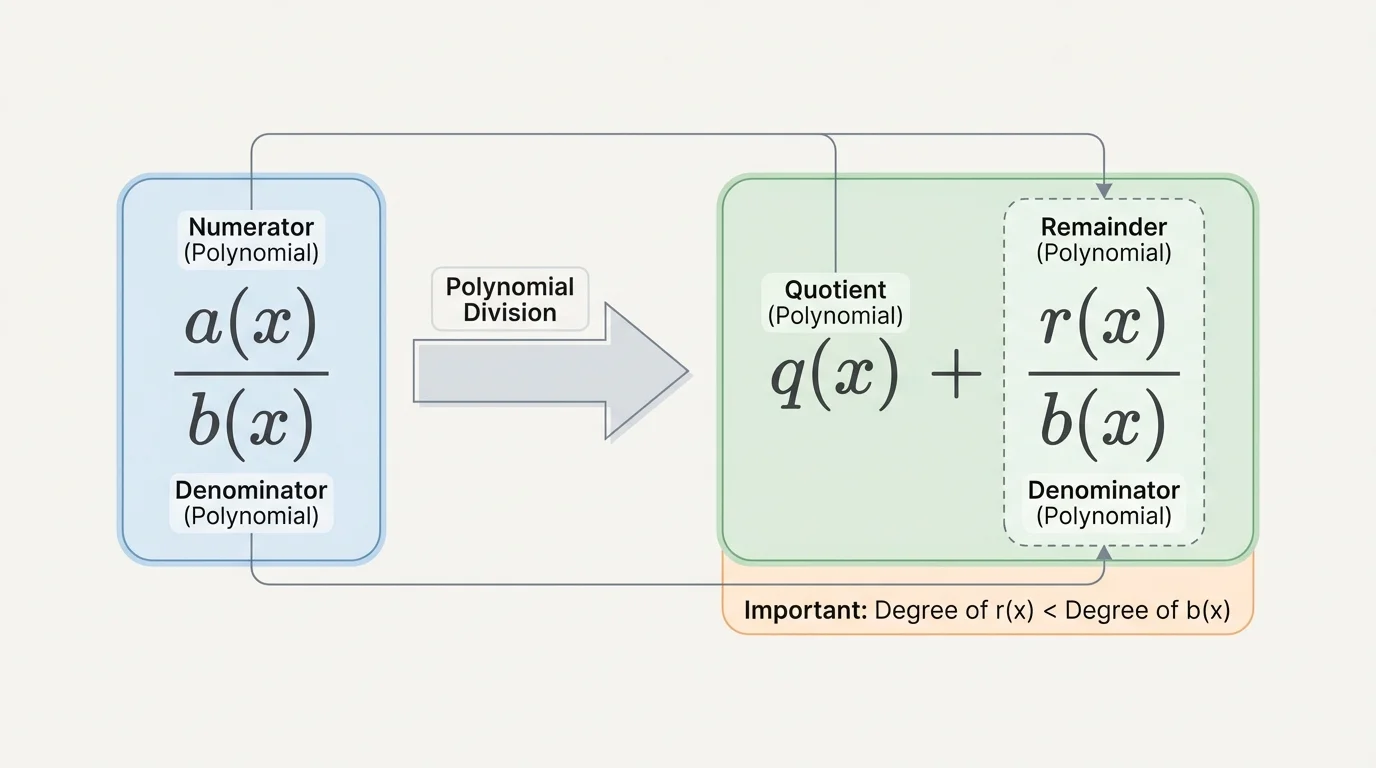
Every time one polynomial \(a(x)\) is divided by a nonzero polynomial \(b(x)\), the result can be written in the form shown conceptually in [Figure 1]: a quotient polynomial plus a remainder over the original divisor. In symbols,
\[\frac{a(x)}{b(x)} = q(x) + \frac{r(x)}{b(x)}\]
where \(a(x)\), \(b(x)\), \(q(x)\), and \(r(x)\) are polynomials, and the degree of \(r(x)\) is less than the degree of \(b(x)\).
That degree condition is essential. If the remainder had degree equal to or greater than the divisor, then division would not really be finished yet. A finished remainder must be "smaller" than the divisor in degree.
You can also write the relationship in multiplication form:
\[a(x) = b(x)q(x) + r(x)\]
This is often the easiest way to check your answer. Multiply the divisor by the quotient, add the remainder, and see whether you recover the original numerator.
For instance, if \(a(x) = x^2+5x+6\) and \(b(x)=x+2\), then one possible rewrite is \(\dfrac{x^2+5x+6}{x+2}=x+3\), because in that case the remainder is \(0\). That means the numerator factors exactly as \((x+2)(x+3)\).
Sometimes you can rewrite an expression quickly by recognizing a factor pattern or by mentally matching terms. This method is called inspection. It works best when the divisor is simple and the numerator is easy to compare with a product.
For example, with \(\dfrac{x^2+5x+6}{x+2}\), you may notice that \(x^2+5x+6 = (x+2)(x+3)\). Therefore,
\[\frac{x^2+5x+6}{x+2}=x+3\]
In this case, the remainder is \(0\).
Solved example 1: using inspection with a nonzero remainder
Rewrite \(\dfrac{x^2+4x+7}{x+2}\) in the form \(q(x)+\dfrac{r(x)}{b(x)}\).
Step 1: Guess the main quotient term.
Since \(x^2 \div x = x\), the quotient should begin with \(x\).
Step 2: Test a simple quotient.
If the quotient were \(x+2\), then \((x+2)(x+2)=x^2+4x+4\).
Step 3: Compare with the original numerator.
The original numerator is \(x^2+4x+7\), which is \(3\) more than \(x^2+4x+4\). So the remainder is \(3\).
Step 4: Write the result.
\[\frac{x^2+4x+7}{x+2}=x+2+\frac{3}{x+2}\]
Here, \(q(x)=x+2\) and \(r(x)=3\).
Inspection is fast, but it does not always work cleanly. As polynomials become more complicated, long division is usually the safer method.
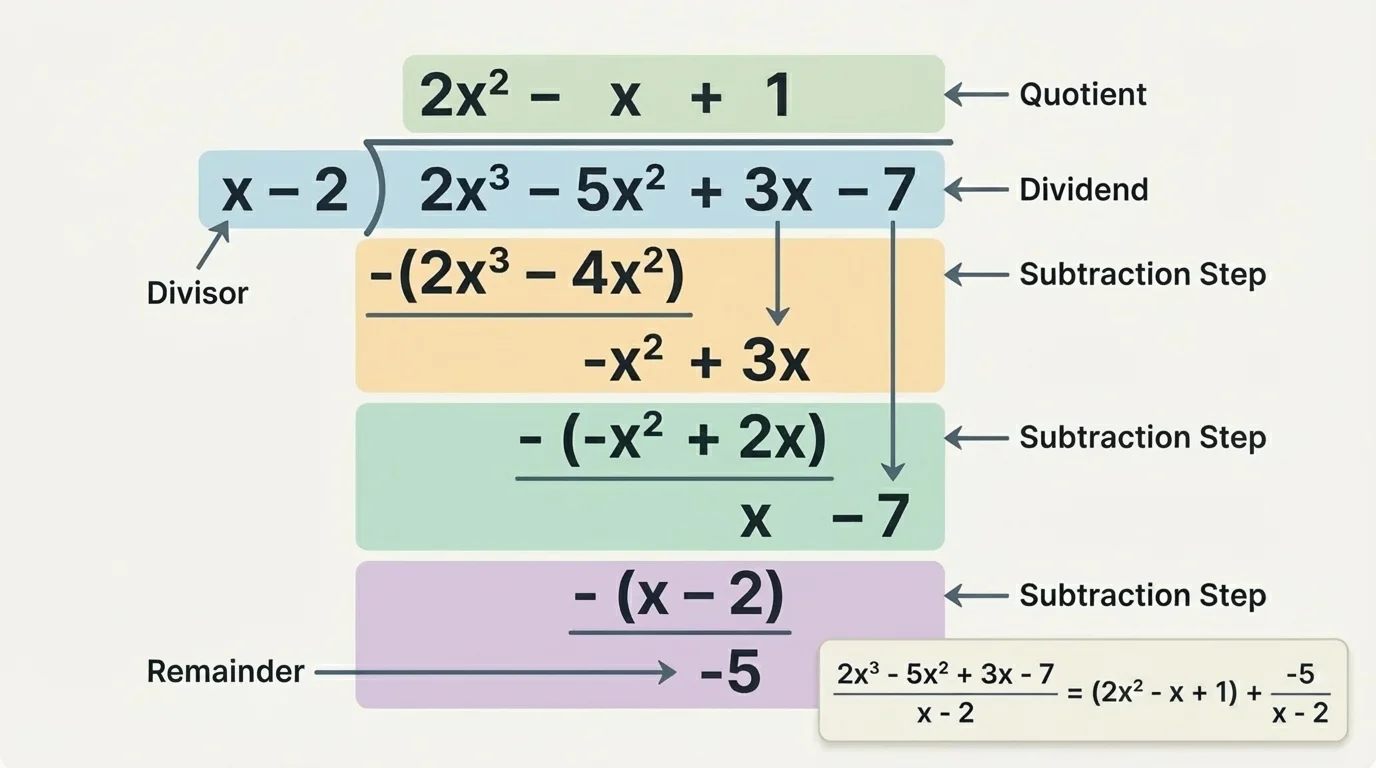
Polynomial long division is the standard algorithm for rewriting expressions, and the setup shown in [Figure 2] is especially important: arrange both polynomials in descending powers, and include any missing terms using zero coefficients when needed. This keeps the subtraction steps organized and prevents errors.
The process mirrors numerical long division: divide the leading term, place that result in the quotient, multiply back, subtract, and repeat.
Solved example 2: long division with a linear divisor
Rewrite \(\dfrac{2x^2+7x+3}{x+2}\).
Step 1: Divide the leading terms.
\(2x^2 \div x = 2x\). Put \(2x\) in the quotient.
Step 2: Multiply and subtract.
Multiply \(2x(x+2)=2x^2+4x\).
Subtract: \((2x^2+7x+3)-(2x^2+4x)=3x+3\).
Step 3: Repeat with the new leading term.
\(3x \div x = 3\). Put \(+3\) in the quotient.
Step 4: Multiply and subtract again.
Multiply \(3(x+2)=3x+6\).
Subtract: \((3x+3)-(3x+6)=-3\).
Step 5: Write the final form.
The quotient is \(2x+3\) and the remainder is \(-3\).
\[\frac{2x^2+7x+3}{x+2}=2x+3-\frac{3}{x+2}\]
You can check by multiplying: \((x+2)(2x+3)-3 = 2x^2+7x+3\).
Notice that the remainder is a constant, which has degree \(0\). Since the divisor \(x+2\) has degree \(1\), the remainder degree is smaller, so the answer is complete.
Long division also works when the divisor has degree greater than \(1\).
Solved example 3: long division with a quadratic divisor
Rewrite \(\dfrac{x^3+2x^2+5}{x^2+1}\).
Step 1: Arrange the numerator carefully.
Write the numerator as \(x^3+2x^2+0x+5\) so no degree is skipped during subtraction.
Step 2: Divide leading terms.
\(x^3 \div x^2 = x\). Put \(x\) in the quotient.
Step 3: Multiply and subtract.
Multiply \(x(x^2+1)=x^3+x\).
Subtract: \((x^3+2x^2+0x+5)-(x^3+0x^2+x+0)=2x^2-x+5\).
Step 4: Repeat.
\(2x^2 \div x^2 = 2\). Put \(+2\) in the quotient.
Step 5: Multiply and subtract again.
Multiply \(2(x^2+1)=2x^2+2\).
Subtract: \((2x^2-x+5)-(2x^2+2)=-x+3\).
Step 6: Check the remainder degree.
The remainder is \(-x+3\), which has degree \(1\). The divisor has degree \(2\), so the division is complete.
\[\frac{x^3+2x^2+5}{x^2+1}=x+2+\frac{-x+3}{x^2+1}\]
A cleaner final form is \(x+2+\dfrac{3-x}{x^2+1}\).
As we saw earlier in [Figure 1], every completed division produces a quotient polynomial and a proper rational remainder. Long division is simply the systematic way to find them.
A computer algebra system, or CAS, is software that can manipulate algebraic expressions symbolically rather than just numerically. For complicated examples, a CAS can perform polynomial division quickly and accurately.
However, using technology does not replace understanding. You still need to interpret the output. If a CAS says
\[\frac{3x^4-2x^3+x-7}{x^2-1}=3x^2-2x+3+\frac{-x-4}{x^2-1}\]
you should still recognize which part is the quotient, which part is the remainder, and why the remainder degree is less than the divisor degree.
Many graphing tools and symbolic calculators internally use polynomial division when they simplify rational expressions or analyze asymptotes. What looks like a single command often depends on the same algebra you are learning here.
A good habit is to verify a CAS result by multiplying back:
\[a(x)=b(x)q(x)+r(x)\]
If the original numerator is recovered, the rewrite is correct.
One frequent mistake is stopping too early. If the remainder still has degree greater than or equal to the divisor, division is not finished.
Another common error is forgetting missing terms. For example, when dividing \(x^3+5\) by \(x-1\), you should write the numerator as \(x^3+0x^2+0x+5\). Those zero terms keep all subtraction lined up correctly, just as the layout in [Figure 2] emphasizes.
Students also sometimes divide every term of the numerator by every term of the denominator separately. That is not a valid general method for rational expressions. For example,
\[\frac{x^2+4x+7}{x+2} \ne \frac{x^2}{x} + \frac{4x}{2} + \frac{7}{x}\]
Fractions with sums in the numerator or denominator do not split that way.
A final mistake is not checking the answer. Even a correct-looking quotient can hide a sign error in the remainder. Multiplying back is one of the fastest ways to catch that.
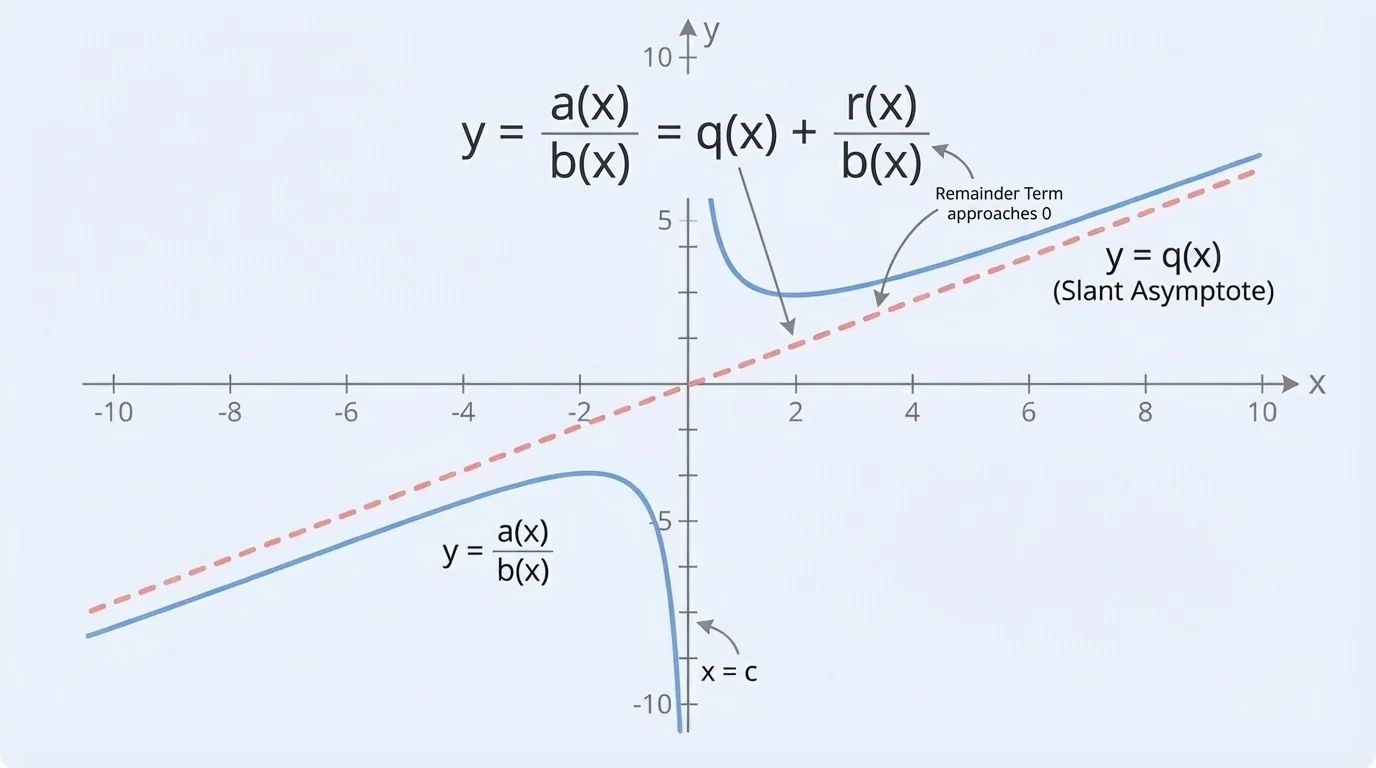
The rewritten form is useful for graphing because the quotient tells you the main trend of the rational function, as [Figure 3] shows. If \(\dfrac{a(x)}{b(x)}=q(x)+\dfrac{r(x)}{b(x)}\), then for large values of \(x\), the term \(\dfrac{r(x)}{b(x)}\) often becomes relatively small. That means the graph of the rational function stays close to the graph of \(y=q(x)\).
When \(q(x)\) is a constant, the function has a horizontal asymptote. When \(q(x)\) is linear, the function has a slant asymptote. Rewriting the expression helps you identify this behavior much more easily than staring at the original fraction.
For example, from solved example 2,
\[\frac{2x^2+7x+3}{x+2}=2x+3-\frac{3}{x+2}\]
The graph behaves like the line \(y=2x+3\) for large \(|x|\), except near \(x=-2\), where the denominator is zero and the function is undefined.
This idea appears in applied settings too. In engineering or economics, a model may involve one polynomial expression divided by another. Rewriting can separate the main long-term trend from the smaller correction term. The quotient captures the dominant behavior, while the remainder explains the adjustment.
Different expressions lead to different kinds of quotients and remainders, but the same structure always holds.
Solved example 4: exact division
Rewrite \(\dfrac{x^3-8}{x-2}\).
Step 1: Recognize a factor pattern.
\(x^3-8\) is a difference of cubes: \(x^3-2^3=(x-2)(x^2+2x+4)\).
Step 2: Simplify.
\[\frac{x^3-8}{x-2}=x^2+2x+4\]
The remainder is \(0\), so the rational expression is actually a polynomial except at \(x=2\), where the original expression is undefined.
That last detail matters. Even when division gives a polynomial, the original rational expression may still exclude values that make the denominator zero.
Solved example 5: long division with a missing term
Rewrite \(\dfrac{x^3+4x-1}{x-2}\).
Step 1: Insert the missing term.
Write the numerator as \(x^3+0x^2+4x-1\).
Step 2: Divide leading terms.
\(x^3 \div x = x^2\). Put \(x^2\) in the quotient.
Step 3: Multiply and subtract.
Multiply \(x^2(x-2)=x^3-2x^2\).
Subtract: \((x^3+0x^2+4x-1)-(x^3-2x^2)=2x^2+4x-1\).
Step 4: Continue the process.
\(2x^2 \div x = 2x\). Put \(+2x\) in the quotient.
Multiply \(2x(x-2)=2x^2-4x\).
Subtract: \((2x^2+4x-1)-(2x^2-4x)=8x-1\).
Step 5: Finish.
\(8x \div x = 8\). Put \(+8\) in the quotient.
Multiply \(8(x-2)=8x-16\).
Subtract: \((8x-1)-(8x-16)=15\).
Step 6: Write the result.
\[\frac{x^3+4x-1}{x-2}=x^2+2x+8+\frac{15}{x-2}\]
Check: \((x-2)(x^2+2x+8)+15=x^3+4x-1\).
Notice how important the zero coefficient was. Without the \(0x^2\) term, the subtraction would be much easier to misalign.
There are two main checks. First, confirm that the remainder has lower degree than the divisor. Second, multiply back:
\[b(x)\left(q(x)+\frac{r(x)}{b(x)}\right)=b(x)q(x)+r(x)=a(x)\]
If both checks work, the rewrite is correct.
This check is especially useful after using inspection, since quick mental recognition can sometimes miss a sign or constant.
"A good algebraic rewrite does not change the expression's value; it changes how clearly you can see it."
That is exactly the point here: the original fraction and the rewritten form are equivalent wherever the denominator is not zero, but the rewritten form often reveals structure that was hidden before.
