Fractions are everywhere: speed is distance divided by time, density is mass divided by volume, and many formulas in science and engineering are built from ratios. Now replace ordinary numbers with polynomials, and you get a much more powerful idea: rational expressions that can still be added, subtracted, multiplied, and divided. These expressions follow consistent algebraic rules. They form a system with rules that closely mirror the rules for rational numbers, but with one extra challenge: variables can make a denominator equal to \(0\), so every expression comes with conditions.
A rational expression is a quotient of two polynomials, written in the form \(\dfrac{P(x)}{Q(x)}\), where \(Q(x) \ne 0\). This is directly analogous to a rational number, which is any number of the form \(\dfrac{a}{b}\), where \(a\) and \(b\) are integers and \(b \ne 0\).
For example, \(\dfrac{3}{5}\), \(-\dfrac{7}{2}\), and \(\dfrac{11}{1}\) are rational numbers. Similarly, \(\dfrac{x+2}{x-3}\), \(\dfrac{2x^2-8}{x^2+1}\), and \(\dfrac{5}{x}\) are rational expressions.
Rational expression means a fraction whose numerator and denominator are polynomials, with the denominator not equal to zero.
Domain restriction means a value of the variable that is not allowed because it would make the denominator equal to zero.
Equivalent rational expressions are expressions that have the same value for every allowable input, even if they look different.
Just as \(\dfrac{2}{4}\) and \(\dfrac{1}{2}\) are equivalent rational numbers, \(\dfrac{2x}{4}\) and \(\dfrac{x}{2}\) are equivalent rational expressions for all values of \(x\) that keep the original denominator nonzero. This distinction matters: equivalent does not mean "identical in every detail." It means "same value wherever both are defined."
Before doing arithmetic with a rational expression, always ask: which values of the variable are forbidden? This is the algebra version of the basic arithmetic rule that you can never divide by \(0\).
To find restrictions, set the denominator equal to \(0\) and solve. For \(\dfrac{x+1}{x-4}\), the denominator is \(x-4\), so \(x-4=0\) gives \(x=4\). Therefore, the expression is defined for all real \(x\) except \(4\).
If the denominator is more complicated, factor first. For \(\dfrac{x^2-1}{x^2-5x+6}\), factor the denominator: \(x^2-5x+6=(x-2)(x-3)\). The restricted values are \(x=2\) and \(x=3\).
From earlier algebra, remember that factoring is essential. You often need to factor quadratics, difference of squares, or greatest common factors before you can simplify or find excluded values.
Restrictions remain important even after simplification. For instance, \(\dfrac{x-3}{(x-3)(x+1)}\) simplifies to \(\dfrac{1}{x+1}\), but \(x=3\) is still excluded because it made the original denominator zero. Simplifying changes the appearance, not the original domain.
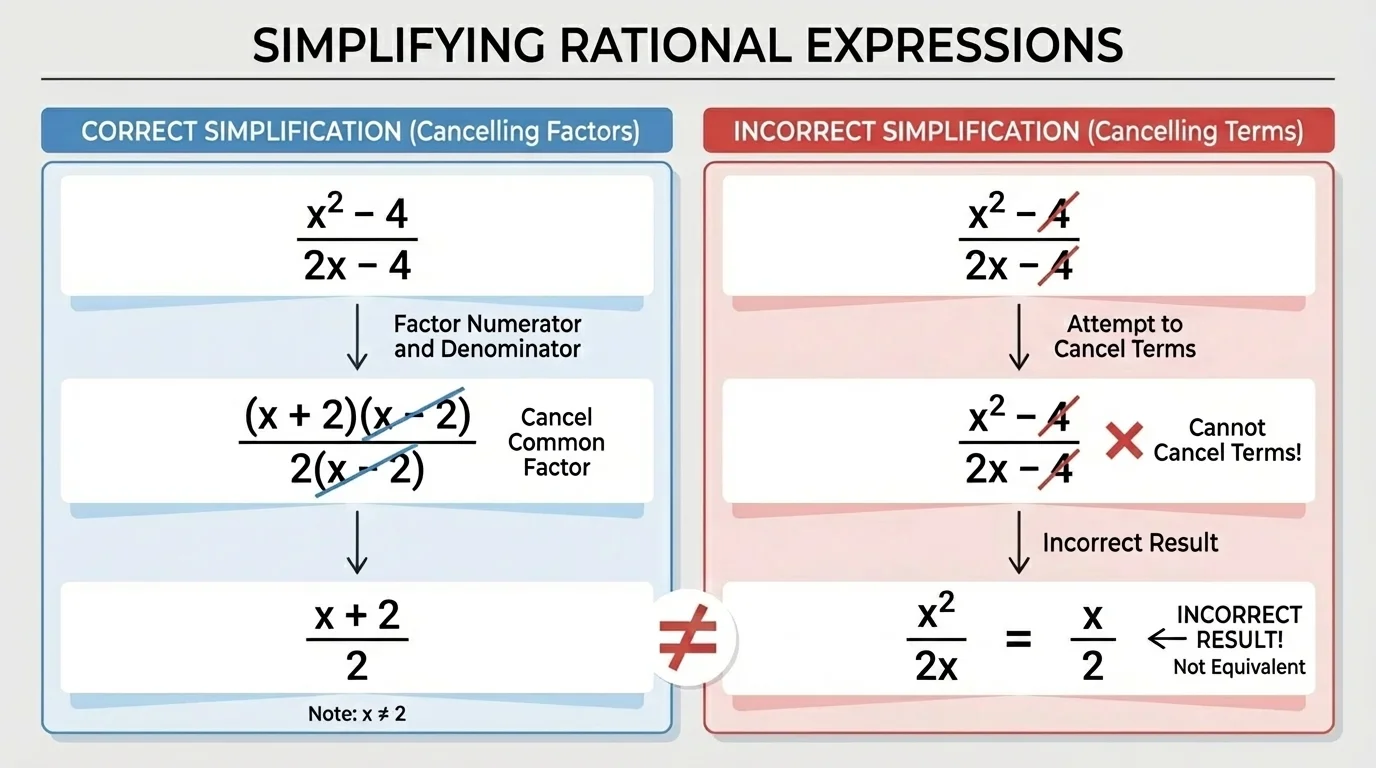
Simplifying a rational expression means rewriting it in an equivalent form with no common factors in the numerator and denominator. The key word is factor. You may cancel only common factors, not pieces of terms. This idea is central because valid factor cancellation differs from invalid term cancellation.
For example, in \(\dfrac{x^2-9}{x^2+5x+6}\), as shown in [Figure 1], you do not "cancel the \(x^2\)." Instead, factor each polynomial: \(x^2-9=(x-3)(x+3)\) and \(x^2+5x+6=(x+2)(x+3)\). Now the common factor \((x+3)\) can be canceled.
Solved example 1
Simplify \(\dfrac{x^2-9}{x^2+5x+6}\) and state the restrictions.
Step 1: Factor the numerator and denominator.
\(x^2-9=(x-3)(x+3)\)
\(x^2+5x+6=(x+2)(x+3)\)
Step 2: Identify restrictions from the original denominator.
\((x+2)(x+3)=0\) when \(x=-2\) or \(x=-3\).
Step 3: Cancel the common factor.
\(\dfrac{(x-3)(x+3)}{(x+2)(x+3)}=\dfrac{x-3}{x+2}\)
The simplified form is \[\frac{x-3}{x+2}\] with restrictions \(x \ne -2\) and \(x \ne -3\).
A classic mistake is trying to simplify \(\dfrac{x+3}{x+5}\) by "canceling the \(x\)." That is not allowed because \(x+3\) and \(x+5\) are sums, not products. You can cancel in \(\dfrac{x(x+3)}{x(x+5)}\), but not in \(\dfrac{x+3}{x+5}\).
Another example is \(\dfrac{3x^2y}{9xy^3}\). Treat the numerator and denominator as products: \(3x^2y\) and \(9xy^3\). Then simplify coefficients and variable factors: \(\dfrac{3}{9}=\dfrac{1}{3}\), \(\dfrac{x^2}{x}=x\), and \(\dfrac{y}{y^3}=\dfrac{1}{y^2}\). So the result is \(\dfrac{x}{3y^2}\), with restrictions \(x \ne 0\) and \(y \ne 0\).
The difference between terms and factors decides whether cancellation is legal. If an expression is added or subtracted, factor first before looking for anything to cancel.
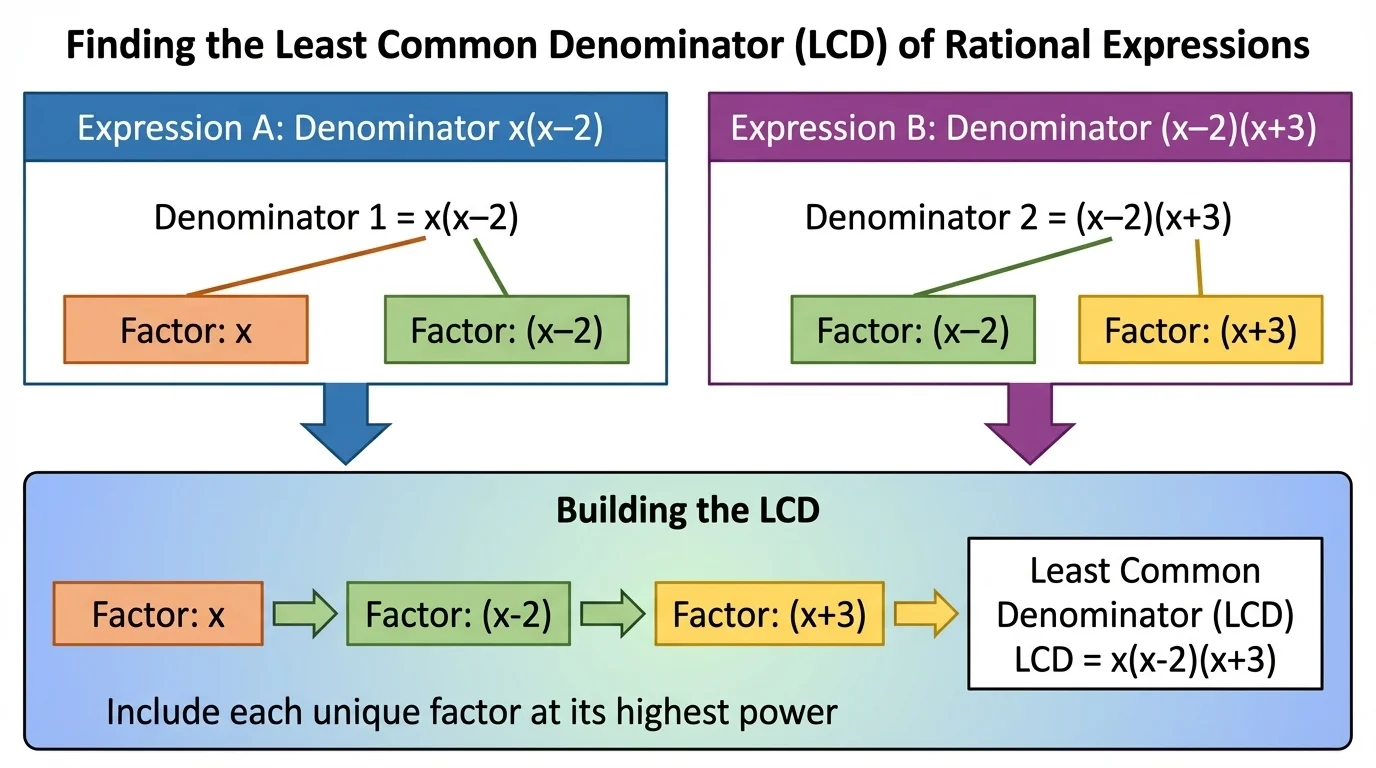
Adding rational expressions works like adding numerical fractions. If the denominators match, add the numerators and keep the denominator. If they do not match, find a least common denominator, often called the LCD. The LCD must include every factor needed from each denominator, and if a factor appears more than once, include it to the greatest power needed.
For like denominators, the process is quick. For example, \(\dfrac{3}{x} + \dfrac{5}{x} = \dfrac{8}{x}\), where \(x \ne 0\). Similarly, \(\dfrac{x+1}{x-2} - \dfrac{4}{x-2} = \dfrac{x-3}{x-2}\), where \(x \ne 2\).
When denominators are unlike, as shown in [Figure 2], factor them if possible. Then build the LCD, rewrite each fraction with that denominator, combine numerators, and simplify if possible.
Solved example 2
Add \(\dfrac{2}{x} + \dfrac{3}{x+1}\).
Step 1: Find the LCD.
The denominators are \(x\) and \(x+1\), so the LCD is \(x(x+1)\).
Step 2: Rewrite each fraction.
\(\dfrac{2}{x}=\dfrac{2(x+1)}{x(x+1)}\)
\(\dfrac{3}{x+1}=\dfrac{3x}{x(x+1)}\)
Step 3: Add the numerators.
\(\dfrac{2(x+1)}{x(x+1)}+\dfrac{3x}{x(x+1)}=\dfrac{2x+2+3x}{x(x+1)}\)
\(=\dfrac{5x+2}{x(x+1)}\)
The result is \[\frac{5x+2}{x(x+1)}\] with restrictions \(x \ne 0\) and \(x \ne -1\).
Subtraction follows the same pattern, but signs become especially important. A missing negative sign can change the entire answer.
Solved example 3
Subtract \(\dfrac{5}{x-2} - \dfrac{1}{x+3}\).
Step 1: Find the LCD.
The denominators are \(x-2\) and \(x+3\), so the LCD is \((x-2)(x+3)\).
Step 2: Rewrite each fraction.
\(\dfrac{5}{x-2}=\dfrac{5(x+3)}{(x-2)(x+3)}\)
\(\dfrac{1}{x+3}=\dfrac{x-2}{(x-2)(x+3)}\)
Step 3: Subtract carefully.
\(\dfrac{5(x+3)}{(x-2)(x+3)}-\dfrac{x-2}{(x-2)(x+3)}=\dfrac{5x+15-(x-2)}{(x-2)(x+3)}\)
\(=\dfrac{5x+15-x+2}{(x-2)(x+3)}=\dfrac{4x+17}{(x-2)(x+3)}\)
The simplified result is \[\frac{4x+17}{(x-2)(x+3)}\] with restrictions \(x \ne 2\) and \(x \ne -3\).
The denominator-building strategy is especially useful when denominators are already factored, because it prevents unnecessary multiplication and keeps expressions simpler.
Multiplying rational expressions is often easier than adding them. Multiply numerators together and denominators together, but simplify first whenever possible. This is sometimes called cross-canceling, though what you are really doing is canceling common factors in a product.
For example, consider \(\dfrac{x^2-4}{x^2+3x+2} \cdot \dfrac{x+2}{x-2}\). First factor: \(x^2-4=(x-2)(x+2)\) and \(x^2+3x+2=(x+1)(x+2)\). Then
\(\dfrac{(x-2)(x+2)}{(x+1)(x+2)} \cdot \dfrac{x+2}{x-2}\).
Now cancel \((x-2)\) and one \((x+2)\). The result is \(\dfrac{x+2}{x+1}\), with restrictions \(x \ne -1\), \(x \ne -2\), and \(x \ne 2\).
Why multiplication stays inside the system
If one rational expression is \(\dfrac{P(x)}{Q(x)}\) and another is \(\dfrac{R(x)}{S(x)}\), then their product is \(\dfrac{P(x)R(x)}{Q(x)S(x)}\). Since products of polynomials are still polynomials, the result is again a rational expression, provided the denominator is not zero.
This is the same closure idea you know from rational numbers: multiplying two fractions still gives a fraction.
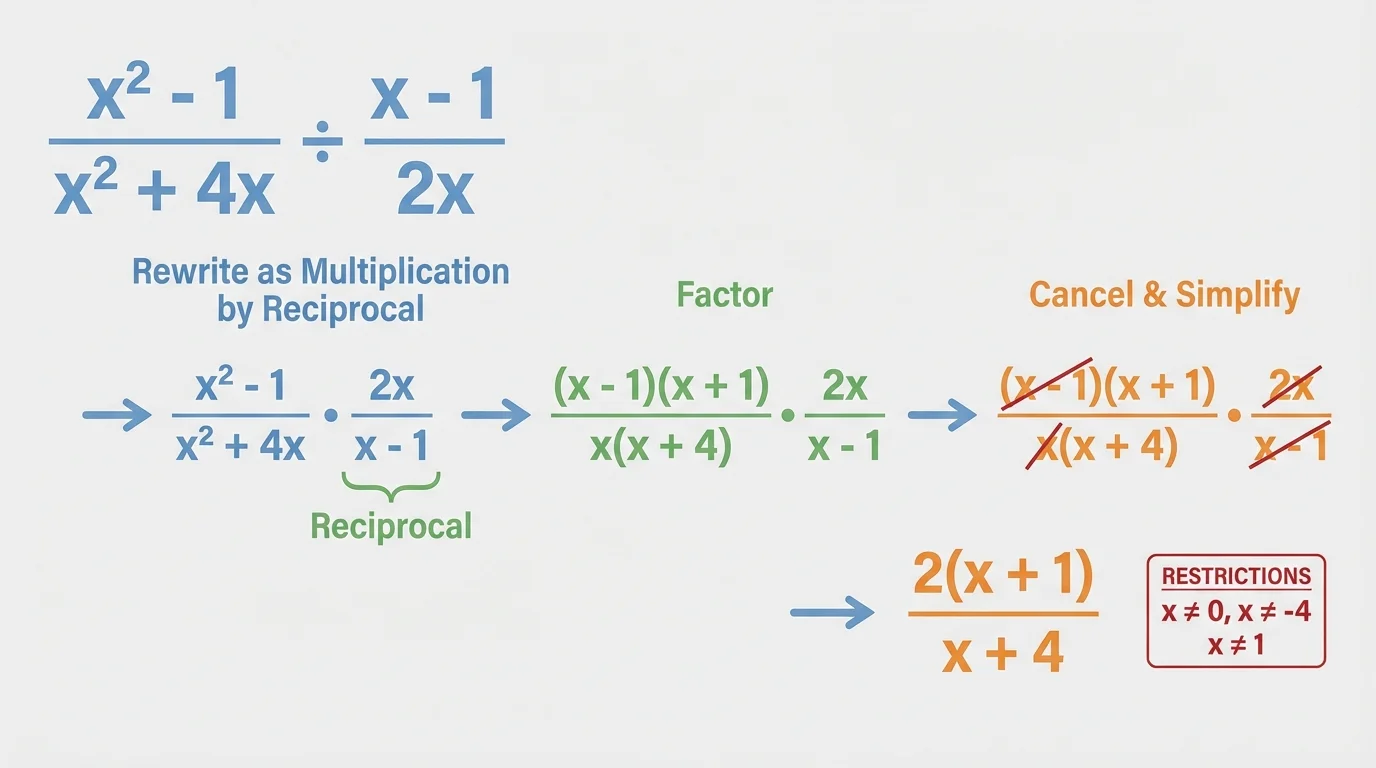
Division has one extra twist. To divide by a rational expression, multiply by its reciprocal. But just as you cannot divide by the number \(0\), you also cannot divide by a rational expression that equals \(0\).
So if you have \(\dfrac{P(x)}{Q(x)} \div \dfrac{R(x)}{S(x)}\), as shown in [Figure 3], rewrite it as \(\dfrac{P(x)}{Q(x)} \cdot \dfrac{S(x)}{R(x)}\). That means the divisor \(\dfrac{R(x)}{S(x)}\) must be nonzero, so in addition to denominator restrictions, you must avoid values that make the divisor itself equal to \(0\).
Solved example 4
Divide \(\dfrac{x^2-1}{x^2-x} \div \dfrac{x+1}{x}\).
Step 1: Rewrite as multiplication by the reciprocal.
\(\dfrac{x^2-1}{x^2-x} \div \dfrac{x+1}{x}=\dfrac{x^2-1}{x^2-x} \cdot \dfrac{x}{x+1}\)
Step 2: Factor where possible.
\(x^2-1=(x-1)(x+1)\)
\(x^2-x=x(x-1)\)
Step 3: Substitute the factors and cancel common factors.
\(\dfrac{(x-1)(x+1)}{x(x-1)} \cdot \dfrac{x}{x+1}=1\)
Step 4: State all restrictions from the original problem.
From \(x^2-x=x(x-1)\), we need \(x \ne 0\) and \(x \ne 1\).
Also, the divisor \(\dfrac{x+1}{x}\) cannot equal \(0\), so \(x+1 \ne 0\), giving \(x \ne -1\).
The quotient is \(1\) with restrictions \(x \ne -1\), \(x \ne 0\), and \(x \ne 1\).
The reciprocal process makes division manageable, but it only works if you keep all restrictions from the original expressions and the nonzero divisor requirement.
Rational expressions are analogous to rational numbers because they are built from division, and they obey the same basic operation patterns. If you add, subtract, or multiply two rational expressions, the result is still a rational expression. If you divide one rational expression by another nonzero rational expression, the result is also a rational expression.
This property is called closure. A set is closed under an operation if performing that operation on members of the set gives another member of the same set. Rational numbers are closed under addition, subtraction, multiplication, and division by a nonzero number. Rational expressions follow the same pattern, with the added attention to domain restrictions.
For instance, if \(f(x)=\dfrac{x}{x-1}\) and \(g(x)=\dfrac{2}{x+3}\), then:
The structure is powerful because it lets rational expressions behave predictably, which is exactly what makes them useful in advanced algebra, calculus, physics, economics, and engineering.
One common error is canceling terms instead of factors. For example, \(\dfrac{x+4}{x}\) cannot simplify by "canceling \(x\)." But \(\dfrac{x(x+4)}{x}\) does simplify to \(x+4\), with \(x \ne 0\).
Another common error is forgetting to distribute a negative sign in subtraction. In \(\dfrac{3}{x} - \dfrac{x+2}{x}\), the numerator becomes \(3-(x+2)=3-x-2=1-x\), not \(3-x+2\).
A third error is losing restrictions after simplification. If \(\dfrac{(x-5)(x+1)}{x-5}\) simplifies to \(x+1\), the value \(x=5\) is still excluded from the original expression.
Many famous formulas in science are rational expressions in disguise. Average speed, electrical resistance relationships, and concentration formulas often become easier to analyze when they are rewritten and simplified as rational expressions.
Rational expressions appear whenever one changing quantity is divided by another. Suppose a car travels \(d\) miles in \(t\) hours. Its average speed is \(\dfrac{d}{t}\). If both distance and time depend on another variable, such as engine setting or traffic conditions, the speed can become a rational expression.
In geometry, the area of a rectangle with width \(x\) and fixed perimeter can lead to expressions like \(\dfrac{P-2x}{2}\) for the length. Combining formulas may produce rational expressions that must be simplified to understand how area changes.
In physics, formulas for combined rates and resistances often involve fractions of algebraic expressions. In economics, average cost may be written as total cost divided by number of items, and if the total cost is polynomial, the result is a rational expression. Being able to simplify and combine these expressions helps reveal trends, restrictions, and meaningful interpretations.
That is one reason rational expressions matter: they are not just algebra exercises. They are the language of relationships where one varying quantity depends on another through division.
