A straight line and a parabola can meet in three important ways: they can intersect at two points, touch at exactly one point, or fail to meet at all. That simple idea appears in physics when a moving object follows a curved path and a rule or boundary is linear, in economics when one model is linear and another is nonlinear, and in design when a straight edge meets a curved surface. Solving such a system means finding the point or points that satisfy both equations at the same time.
In a system with two variables, a solution is an ordered pair \(x, y\) that makes every equation in the system true. When one equation is linear and the other is quadratic, the graph usually involves a line and a parabola. The coordinates where they intersect are the solutions.
That is the key idea behind a system of equations: you are not solving each equation separately. You are looking for values that work for both at once. This shared solution can often be found exactly with algebra and visualized with a graph.
Linear equation: an equation whose graph is a straight line, such as \(y = 2x - 5\).
Quadratic equation: an equation involving a squared variable, such as \(y = x^2 - 4x + 1\), whose graph is usually a parabola.
Solution of a system: an ordered pair \((x, y)\) that satisfies both equations in the system.
One reason this topic is important is that it combines several big algebra ideas: rewriting equations, substituting expressions, solving quadratic equations, and interpreting graphs. It also shows how algebra and geometry support each other. An exact algebraic answer and a graphical picture should tell the same story.
[Figure 1] A linear-quadratic system contains one linear equation and one quadratic equation. For example, \(y = x + 1\) and \(y = x^2 - 3\) form such a system. Each solution is an intersection point because the same ordered pair lies on both the line and the parabola.
If the graphs intersect twice, the system has two real solutions. If the line just touches the parabola at one point, the system has one real solution. If the graphs do not meet at all, the system has no real solutions.
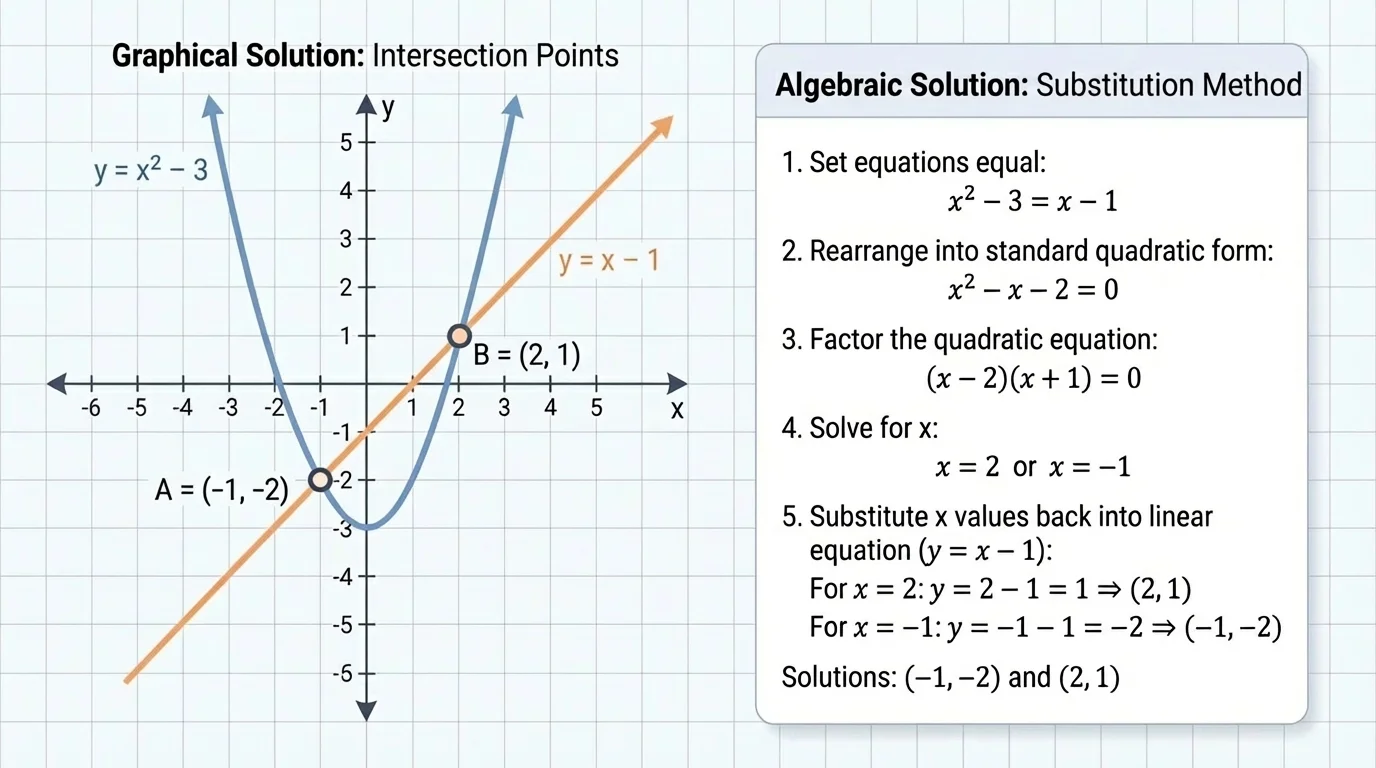
The graphical picture is useful, but algebra gives exact values. In high school algebra, the most common method is substitution. You solve one equation for one variable, then replace that variable in the other equation. This reduces the system to a single equation in one variable.
To solve these systems successfully, you should already be comfortable solving linear equations, expanding expressions, factoring when possible, and using the quadratic formula if factoring does not work.
In many cases, the linear equation is already written as \(y = mx + b\). That makes substitution especially efficient because you can replace \(y\) in the quadratic equation with the linear expression.
The main algebraic strategy is usually this:
Step 1: Solve the linear equation for either \(y\) or \(x\), whichever is easier.
Step 2: Substitute that expression into the quadratic equation.
Step 3: Solve the resulting quadratic equation.
Step 4: Use the value or values you found to get the corresponding other coordinate.
Step 5: Check each ordered pair in both original equations.
Why substitution works
If one equation tells you that \(y = 2x + 3\), then everywhere \(y\) appears in the other equation, you can replace it with \(2x + 3\). Since both expressions represent the same quantity, the replacement keeps the system equivalent while reducing the number of variables in the equation you solve next.
After substitution, you often get a quadratic equation such as \(x^2 - x - 2 = 0\). That equation may factor, or you may need the quadratic formula:
\[x = \frac{-b \pm \sqrt{b^2 - 4ac}}{2a}\]
Once you find the \(x\)-values, substitute back to find \(y\)-values. Each \(x\)-value must be paired with the correct \(y\)-value from the system.
The number of real solutions depends on how the line and parabola interact. This is where algebra and graphing connect beautifully.
If substitution produces a quadratic equation with two distinct real roots, the system has two real solutions. If the quadratic has one repeated root, the line is tangent to the parabola and there is one real solution. If the quadratic equation has no real roots, then the graphs do not intersect in the real coordinate plane.
| After substitution | Graphical meaning | Number of real solutions |
|---|---|---|
| Two real roots | Line crosses parabola at two points | \(2\) |
| One repeated real root | Line touches parabola once | \(1\) |
| No real roots | Line and parabola do not meet | \(0\) |
Table 1. Relationship between the algebraic result after substitution and the graphical number of solutions.
A powerful clue comes from the discriminant, the expression \(b^2 - 4ac\) in a quadratic equation \(ax^2 + bx + c = 0\). If it is positive, there are two real roots. If it is zero, there is one repeated real root. If it is negative, there are no real roots.
The system \(y = x + 1\) and \(y = x^2 - 3\) is a classic example with two solutions. The algebraic work should match the two intersections.
Solve the system algebraically:
\[\begin{cases} y = x + 1 \\ y = x^2 - 3 \end{cases}\]
Step 1: Set the expressions for \(y\) equal to each other.
Since both equal \(y\), write \(x + 1 = x^2 - 3\).
Step 2: Rearrange into quadratic form.
\(x + 1 = x^2 - 3\) becomes \(0 = x^2 - x - 4\), or \(x^2 - x - 4 = 0\).
Step 3: Solve the quadratic.
This does not factor nicely over the integers, so use the quadratic formula with \(a = 1\), \(b = -1\), and \(c = -4\):
\[x = \frac{-(-1) \pm \sqrt{(-1)^2 - 4(1)(-4)}}{2(1)} = \frac{1 \pm \sqrt{17}}{2}\]
Step 4: Find the corresponding \(y\)-values.
Use \(y = x + 1\).
If \(x = \dfrac{1 + \sqrt{17}}{2}\), then \(y = \dfrac{3 + \sqrt{17}}{2}\).
If \(x = \dfrac{1 - \sqrt{17}}{2}\), then \(y = \dfrac{3 - \sqrt{17}}{2}\).
The solutions are
\[\left(\frac{1 + \sqrt{17}}{2}, \frac{3 + \sqrt{17}}{2}\right), \left(\frac{1 - \sqrt{17}}{2}, \frac{3 - \sqrt{17}}{2}\right)\]
[Figure 2] These are exact answers. A graph gives approximate coordinates, but algebra gives the precise values. Later, when you graph the system, the intersections should appear near these coordinates.
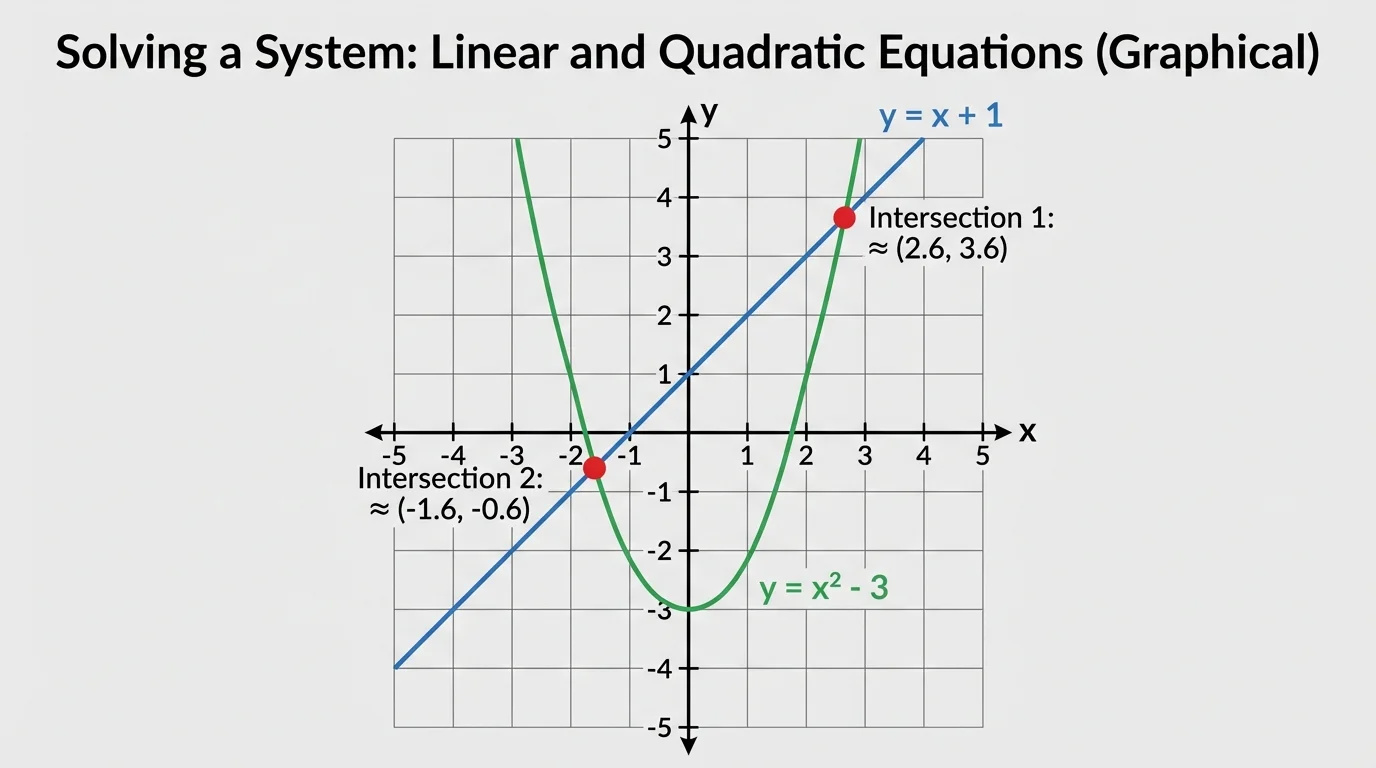
Notice something important: even though the first equation is linear and easy to read, the actual coordinates are not always integers. Real systems often produce irrational solutions, which is one reason exact algebra is so valuable.
A system can also have exactly one real solution if the line only touches the parabola. A repeated root means the line is tangent.
Solve the system algebraically:
\[\begin{cases} y = 2x + 1 \\ y = x^2 + 2 \end{cases}\]
Step 1: Set the equations equal.
\(2x + 1 = x^2 + 2\)
Step 2: Rearrange.
\(0 = x^2 - 2x + 1\), so \(x^2 - 2x + 1 = 0\).
Step 3: Factor.
\(x^2 - 2x + 1 = (x - 1)^2\)
So \((x - 1)^2 = 0\), which gives \(x = 1\).
Step 4: Find \(y\).
Substitute into \(y = 2x + 1\): \(y = 2(1) + 1 = 3\).
The solution is
\((1, 3)\)
[Figure 3] This system has one real solution, not because one equation disappeared, but because both equations meet at exactly one point in the plane.
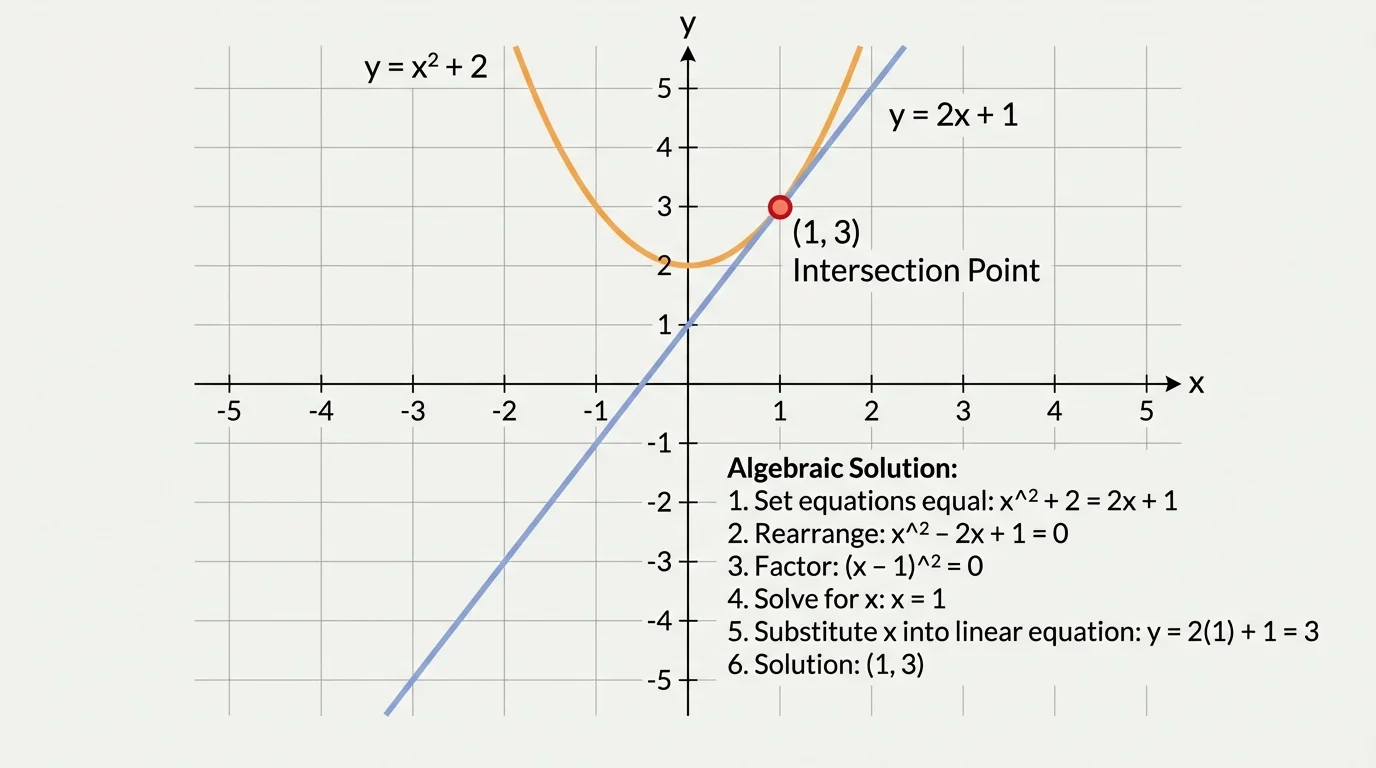
When the quadratic equation after substitution becomes a perfect square, that is often a sign of a tangent situation. It is an algebraic way of detecting a single point of contact.
Some systems have no real solution. That means there is no ordered pair \((x, y)\) that makes both equations true at once.
Solve the system algebraically:
\[\begin{cases} y = x - 5 \ y = x^2 + 2 \end{cases}\]
Step 1: Set the equations equal.
\(x - 5 = x^2 + 2\)
Step 2: Rearrange.
\(0 = x^2 - x + 7\), so \(x^2 - x + 7 = 0\).
Step 3: Check the discriminant.
Here, \(a = 1\), \(b = -1\), and \(c = 7\).
\(b^2 - 4ac = (-1)^2 - 4(1)(7) = 1 - 28 = -27\)
Step 4: Interpret the result.
Since the discriminant is negative, the quadratic equation has no real roots.
Therefore, the system has no real solutions.
Solve the system algebraically:
\[\begin{cases} y = x + 5 \\ y = x^2 + 2 \end{cases}\]
Step 1: Set the equations equal.
\(x + 5 = x^2 + 2\)
Step 2: Rearrange.
\(0 = x^2 - x - 3\), so \(x^2 - x - 3 = 0\).
Step 3: Check the discriminant.
Here, \(a = 1\), \(b = -1\), and \(c = -3\).
\(b^2 - 4ac = (-1)^2 - 4(1)(-3) = 1 + 12 = 13\)
Step 4: Solve.
Since the discriminant is positive, this actually gives two real solutions:
\[x = \frac{1 \pm \sqrt{13}}{2}\]
Then use \(y = x + 5\) to get the matching \(y\)-values:
\[\left(\frac{1 + \sqrt{13}}{2}, \frac{11 + \sqrt{13}}{2}\right), \left(\frac{1 - \sqrt{13}}{2}, \frac{11 - \sqrt{13}}{2}\right)\]
These calculations show how the discriminant helps confirm the number of real intersection points. Even if both equations are easy to write down, algebra reveals whether the line and parabola meet twice, touch once, or do not meet in the real coordinate plane.
A parabola opens forever, so students sometimes assume every line must eventually cross it. That is false. Depending on the line's slope and position, the line may cross twice, touch once, or miss the parabola completely.
This is one of the most useful habits in algebra: trust structure, not guesswork. The discriminant gives a fast and reliable answer about the number of real intersection points.
Not every system is easiest to handle by solving for \(y\). Sometimes the linear equation is easier to rewrite in the form \(x = \) an expression, especially if the quadratic equation is written in terms of \(x\) awkwardly.
Solve the system:
\[\begin{cases} x = y + 2 \\ y = x^2 - 4x + 7 \end{cases}\]
Step 1: Substitute \(x = y + 2\) into the quadratic equation.
\(y = (y + 2)^2 - 4(y + 2) + 7\)
Step 2: Simplify.
\(y = y^2 + 4y + 4 - 4y - 8 + 7\)
\(y = y^2 + 3\)
Step 3: Rearrange.
\(0 = y^2 - y + 3\), so \(y^2 - y + 3 = 0\).
Step 4: Use the discriminant.
\(b^2 - 4ac = (-1)^2 - 4(1)(3) = 1 - 12 = -11\)
Because the discriminant is negative, there are no real solutions.
The lesson here is not just computational. Choose the variable that makes the substitution cleaner. Efficient algebra often starts with noticing which equation is easiest to rewrite.
Graphing reveals the big picture immediately: zero, one, or two solutions appear as the number of intersection points. A graph may not give exact coordinates unless the intersections land neatly on grid points, but it is excellent for estimating and checking.
To solve graphically, graph the line and graph the parabola on the same coordinate plane. Then identify the intersection point or points. Their coordinates are the solutions of the system.
For example, in the system \(y = 2x + 1\) and \(y = x^2 + 2\), the graph shows a single point where the line touches the parabola. That confirms the algebraic result \((1, 3)\).
[Figure 4] In the first worked example, the graph supports the exact algebraic answers by showing two intersections with approximate decimal coordinates. This is where a graph is especially helpful: it lets you see whether your symbolic work makes sense.
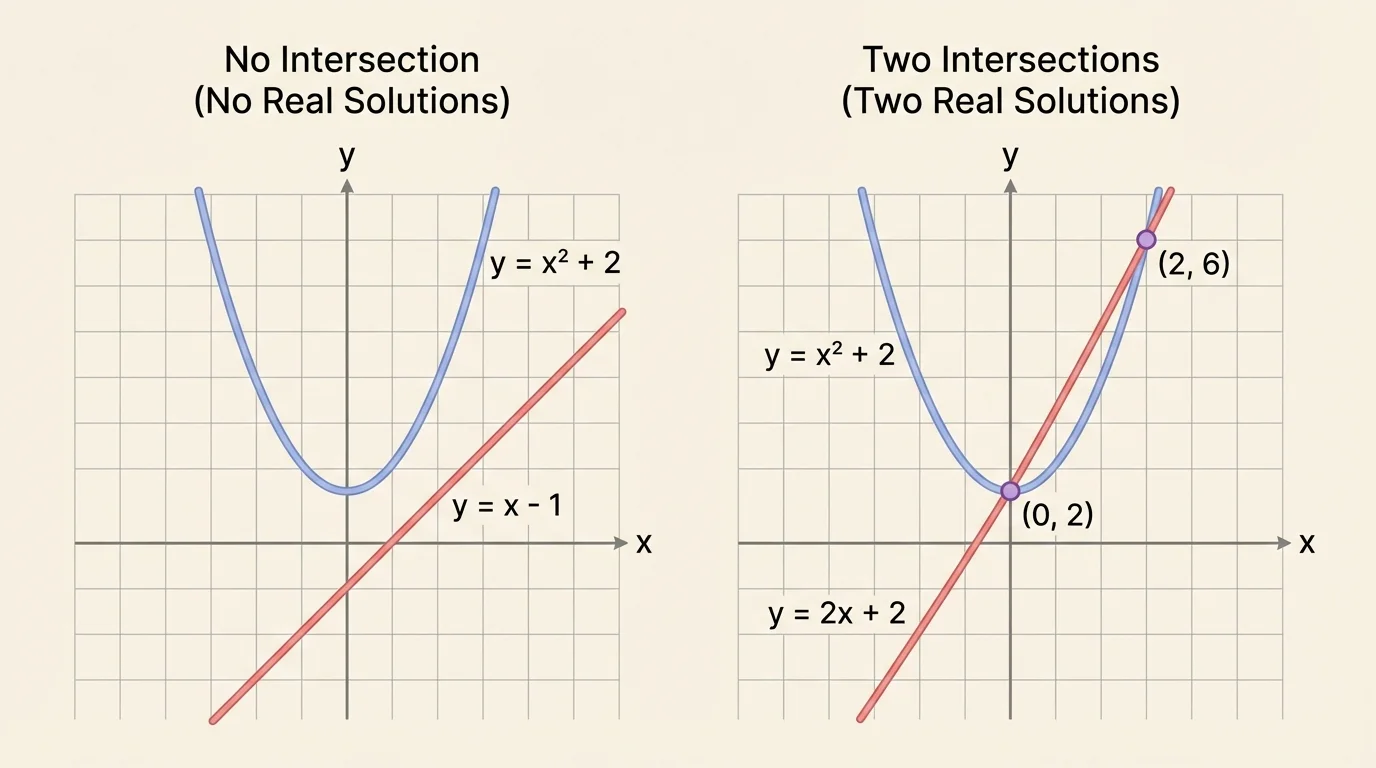
Graphing also helps you detect errors. If your algebra says there are two solutions but the graph seems to show only one, you should recheck your work or your graphing window. Scale matters. A poor graphing window can hide intersections.
Later, when comparing methods, we return to this comparison because it makes an important point: graphs are excellent for understanding structure, while algebra is better for exact answers.
Both methods matter, but they serve different purposes.
| Method | Strength | Limitation |
|---|---|---|
| Algebraic | Gives exact solutions such as radicals or integers | Can involve lengthy manipulation |
| Graphical | Shows the number and approximate location of solutions quickly | Usually gives only approximate coordinates |
Table 2. Comparison of algebraic and graphical approaches to linear-quadratic systems.
In practice, strong problem-solvers often use both. They graph to predict the number of solutions and estimate their locations, then use algebra to compute exact coordinates. After that, they use the graph again as a check.
This is also why the earlier graph remains useful even after learning substitution: it keeps the central meaning in view. A solution is not just a number coming out of a formula. It is a point where two relations agree.
One major application appears in motion. Suppose the height of a launched object is modeled by a quadratic function, while a sensor line or safety limit is modeled by a linear function. Solving the system tells you when and where the object reaches that line.
Another application appears in business. A company might model one quantity with a linear rule and another with a quadratic rule. The intersections can represent break-even points or points where two models predict the same outcome.
Architecture and engineering also use line-curve intersections. A straight beam meeting a curved support can be modeled by a linear equation and a quadratic equation. The intersection points matter in design and measurement.
Why exact solutions matter in applications
In many real settings, a graphical estimate is not enough. If an engineer needs the exact coordinate where a support beam meets a curved structure, or if a scientist needs precise timing from a motion model, algebraic solutions provide the needed accuracy.
Even when technology does the graphing, understanding the algebra is still essential. Software can produce coordinates, but you need algebraic reasoning to know whether the answers are reasonable and what they mean.
One common mistake is substituting incorrectly. If \(y = 3x - 2\), then every occurrence of \(y\) in the other equation must be replaced by \(3x - 2\), including the parentheses when necessary.
Another mistake is solving the quadratic correctly but forgetting to find the matching second coordinate. A system's solution is an ordered pair, not just an \(x\)-value or a \(y\)-value.
Students also sometimes lose solutions by factoring carelessly or assume that a negative discriminant means they made an arithmetic mistake. In fact, a negative discriminant can simply mean the system has no real intersection.
"Algebra finds the coordinates; graphing explains the picture."
Always check your final ordered pairs in both original equations. A correct-looking quadratic answer can still become an incorrect system solution if you pair it with the wrong second coordinate.
As seen earlier in [Figure 2] and [Figure 3], the graph gives a quick sanity check: two intersections suggest two ordered pairs, one touch suggests one ordered pair, and no crossing suggests no real solution.
When one equation is linear and the other is quadratic, substitution usually turns the system into a quadratic equation in one variable. Solving that quadratic gives the possible coordinates of intersection.
The graph tells you what those answers mean geometrically: two crossings, one tangent point, or no meeting at all. By keeping both views in mind, you are not just performing steps—you are understanding a relationship between algebraic structure and geometric behavior.
