Your phone battery might drop by about the same number of percentage points each hour during one kind of use, while money in an investment account can grow by the same percentage each year. Those two patterns look similar at first because they both change over time, but mathematically they behave very differently. One changes by adding or subtracting the same amount; the other changes by multiplying by the same factor. Sequences help us describe both patterns clearly.
Sequences are a major idea in algebra because they connect patterns, formulas, tables, and real-world models. They also show an important difference between additive change and multiplicative change. Understanding that difference lets you decide whether a situation is better modeled by an arithmetic sequence or a geometric sequence.
A sequence is useful when values are listed in order and each value depends on its position. For example, the amount saved in a jar at the end of each week, the number of views on a video after each day, or the height of a bouncing ball after each bounce can all be modeled with sequences. These are not continuous changes measured at every possible moment; they are changes tracked at specific steps.
That idea of step-by-step change matters in many fields. Engineers track repeated gains or losses in efficiency, economists model regular deposits and percentage growth, and scientists study populations generation by generation. Sequences are one of the cleanest ways to build a function that relates a term number to a quantity.
A sequence is an ordered list of numbers. Each number is called a term. We often label terms with subscripts such as \(a_1, a_2, a_3, \dots\), where \(a_1\) is the first term, \(a_2\) is the second term, and so on.
The number that tells the position of a term is called its index. In many formulas, the index is written as \(n\). So \(a_n\) means "the term at position \(n\)." This is why a sequence can be viewed as a function whose inputs are positive integers.
Recursive form is a formula that defines a term using one or more earlier terms.
Explicit form gives a formula for the \(n\)th term directly, without needing previous terms.
Arithmetic sequence changes by a constant difference.
Geometric sequence changes by a constant ratio.
For example, the sequence \(5, 8, 11, 14, \dots\) has first term \(a_1 = 5\). The term \(14\) is \(a_4\) because it is the fourth term. A sequence can also start with a different index, but in most algebra courses the first term is labeled \(a_1\).
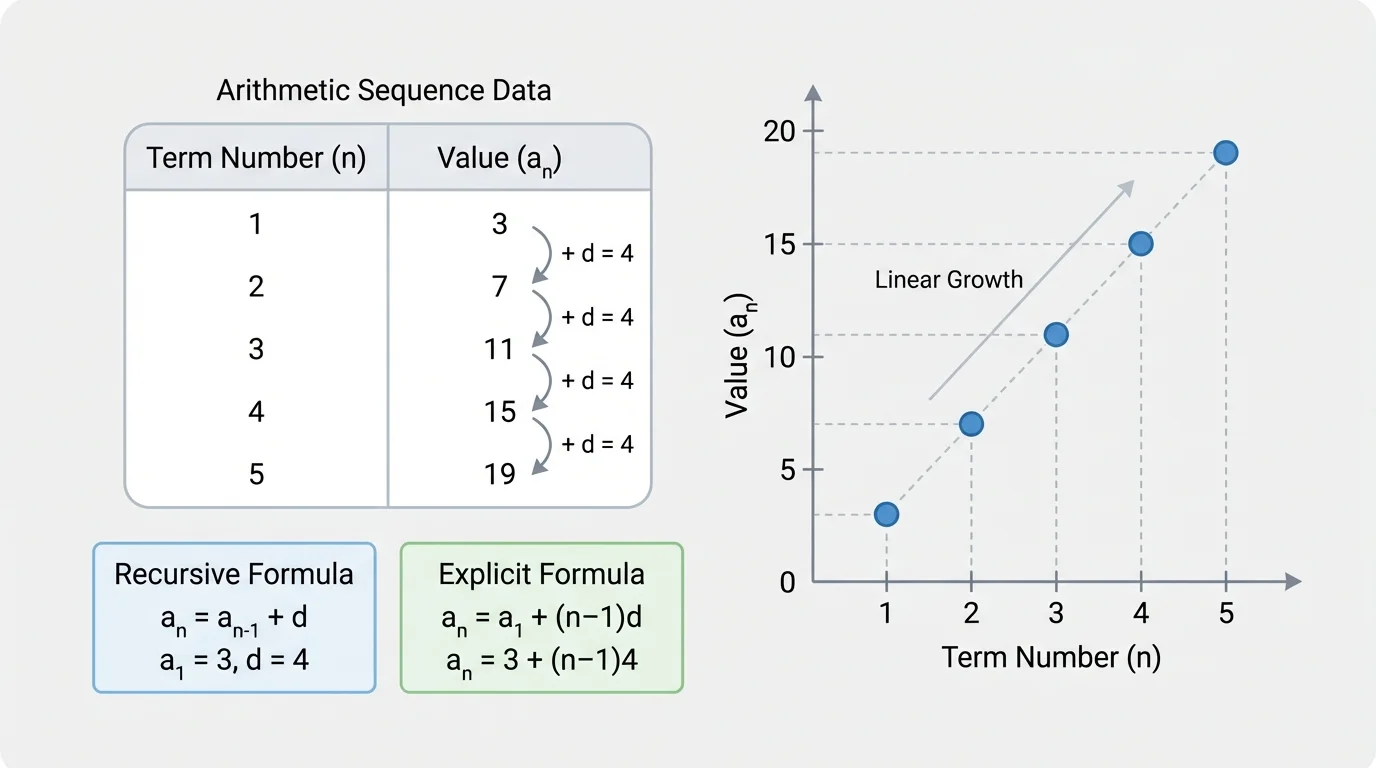
An arithmetic sequence changes by adding the same number each time. That constant amount is called the common difference. If a sequence adds \(4\) every step, then the difference between consecutive terms is always \(4\). This constant additive pattern, shown visually in [Figure 1], is what makes arithmetic sequences predictable.
Suppose the sequence is \(7, 11, 15, 19, \dots\). The common difference is \(d = 4\). To write it recursively, state the first term and then describe how each new term is created from the previous one:
\(a_1 = 7\)
\[a_n = a_{n-1} + 4 \quad \textrm{for } n \geq 2\]
The explicit formula for an arithmetic sequence uses the first term and the common difference:
\[a_n = a_1 + (n-1)d\]
For this sequence, substitute \(a_1 = 7\) and \(d = 4\):
\[a_n = 7 + 4(n-1)\]
This can also be simplified to \(a_n = 4n + 3\).
An arithmetic sequence may increase or decrease. If the common difference is positive, the terms increase. If the common difference is negative, the terms decrease. For example, \(20, 17, 14, 11, \dots\) is arithmetic with \(d = -3\).
To identify an arithmetic sequence from a table or list, subtract consecutive terms. If the differences are always equal, the sequence is arithmetic. This works even when the terms are negative or fractional.
| Sequence | Consecutive difference | Arithmetic? |
|---|---|---|
| \(3, 8, 13, 18, \dots\) | \(+5, +5, +5\) | Yes |
| \(10, 6, 2, -2, \dots\) | \(-4, -4, -4\) | Yes |
| \(2, 6, 18, 54, \dots\) | \(+4, +12, +36\) | No |
Table 1. Examples showing how constant difference identifies arithmetic sequences.
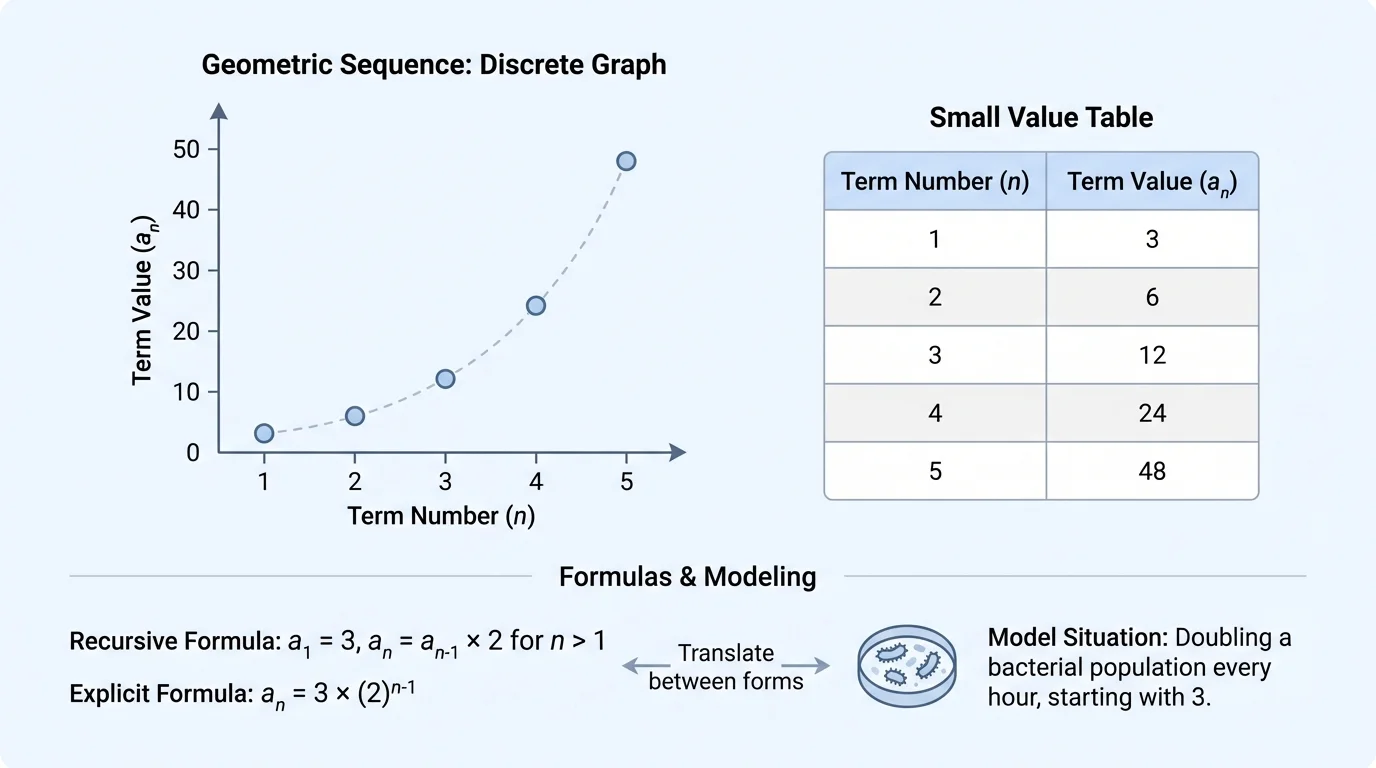
A geometric sequence changes by multiplying by the same number each time. That constant multiplier is called the common ratio. If each term is obtained by multiplying the previous term by \(3\), then the common ratio is \(r = 3\). This repeated multiplication creates growth or decay that can become dramatic very quickly.
[Figure 2] Suppose the sequence is \(5, 15, 45, 135, \dots\). Each term is multiplied by \(3\), so \(r = 3\). The recursive form is
\(a_1 = 5\)
\[a_n = 3a_{n-1} \quad \textrm{for } n \geq 2\]
The explicit formula for a geometric sequence is
\[a_n = a_1r^{n-1}\]
Substituting \(a_1 = 5\) and \(r = 3\) gives
\[a_n = 5 \cdot 3^{n-1}\]
Geometric sequences can also decrease. For example, \(81, 27, 9, 3, \dots\) has common ratio \(r = \dfrac{1}{3}\). Because each term is multiplied by a number between \(0\) and \(1\), the sequence gets smaller. This is often called geometric decay.
To identify a geometric sequence from a list, divide consecutive terms. If the ratios are equal, the sequence is geometric. Be careful: dividing by \(0\) is undefined, so sequences with zero terms need extra thought.
| Sequence | Consecutive ratio | Geometric? |
|---|---|---|
| \(4, 12, 36, 108, \dots\) | \(3, 3, 3\) | Yes |
| \(64, 32, 16, 8, \dots\) | \(\dfrac{1}{2}, \dfrac{1}{2}, \dfrac{1}{2}\) | Yes |
| \(2, 5, 8, 11, \dots\) | \(\dfrac{5}{2}, \dfrac{8}{5}, \dfrac{11}{8}\) | No |
Table 2. Examples showing how constant ratio identifies geometric sequences.
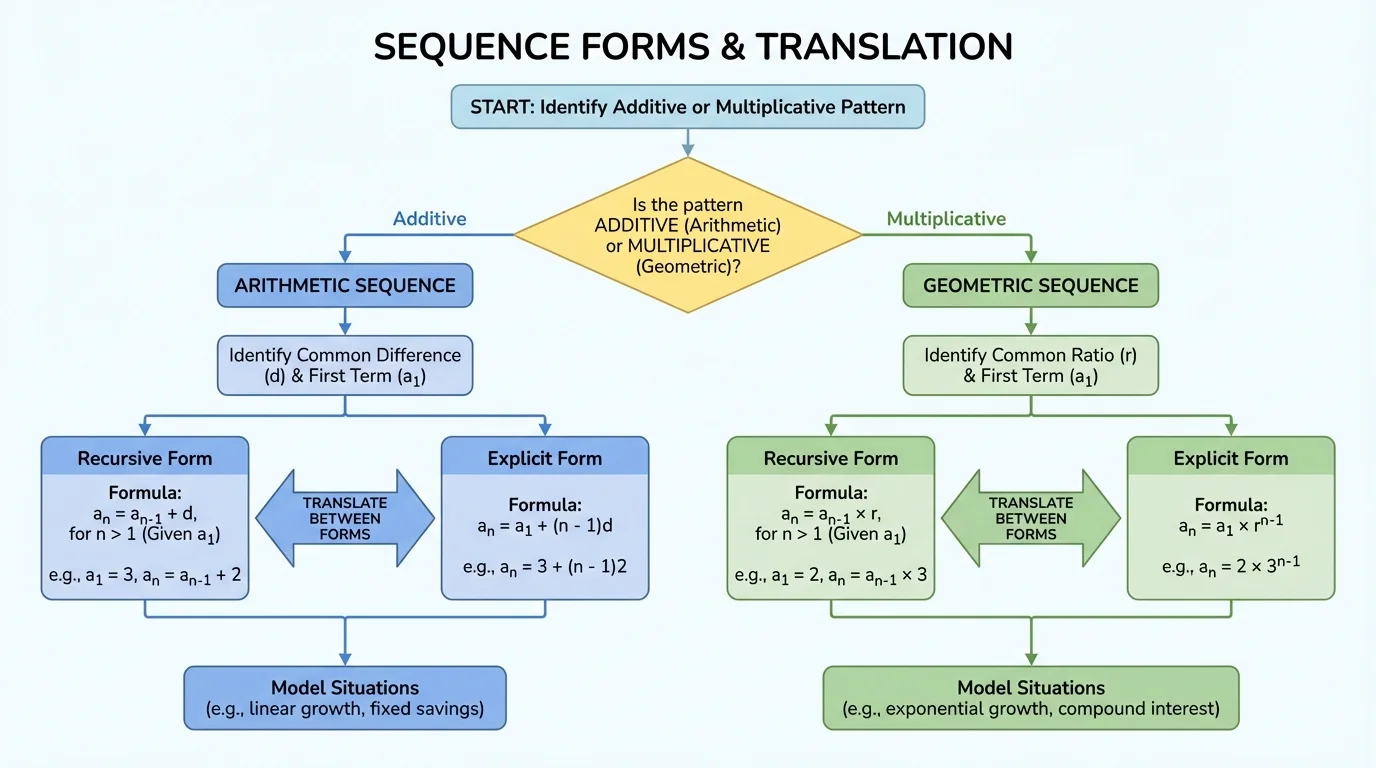
One of the most important skills is moving between recursive and explicit rules. A recursive rule focuses on how a term comes from the previous term. An explicit rule focuses on the direct relationship between \(n\) and \(a_n\). The overall translation process, outlined in [Figure 3], begins by deciding whether the pattern is additive or multiplicative.
For an arithmetic sequence, start with the recursive rule \(a_1\) and \(a_n = a_{n-1} + d\). The explicit form becomes \(a_n = a_1 + (n-1)d\). If you begin with the explicit form, identify \(a_1\) by substituting \(n = 1\), then identify the common difference from the coefficient or from consecutive terms.
For a geometric sequence, start with the recursive rule \(a_1\) and \(a_n = ra_{n-1}\). The explicit form becomes \(a_n = a_1r^{n-1}\). If you begin with an explicit formula, plug in \(n = 1\) to find the first term, and then identify the common ratio from the base of the exponent.
Notice how the exponent \(n-1\) in a geometric formula plays the same structural role that \((n-1)d\) plays in an arithmetic formula. In both cases, \(n-1\) measures how many steps away the term is from the first term.
Why recursive and explicit forms both matter
A recursive rule matches situations where each stage grows out of the stage before it, such as balances updated year by year or populations reproducing generation by generation. An explicit rule is better when you want a specific term quickly, such as the \(50\)th value, without calculating all earlier terms.
Later, when you compare models, this flowchart remains useful because it shows that the first question is always the same: is the pattern based on repeated addition or repeated multiplication?
Arithmetic sequences represent linear step-by-step growth. Geometric sequences represent exponential step-by-step growth or decay. This difference is huge in real applications. If a quantity increases by \(10\) each month, that is arithmetic. If it increases by \(10\%\) each month, that is geometric.
For example, compare these two sequences with the same first term \(100\):
Arithmetic: \(100, 110, 120, 130, \dots\)
Geometric: \(100, 110, 121, 133.1, \dots\)
At first, they seem close. But geometric growth pulls away because each increase is based on the latest value, not the original value. That is why compound interest grows faster than simply adding the same dollar amount each period.
A sheet of paper folded repeatedly doubles in thickness each time, which is a geometric pattern. Repeated doubling grows so fast that after surprisingly few folds, the thickness becomes enormous compared with the starting value.
Negative values and fractions can appear in both kinds of sequences. For example, \(-2, 1, 4, 7, \dots\) is arithmetic with \(d = 3\). The sequence \(8, -4, 2, -1, \dots\) is geometric with \(r = -\dfrac{1}{2}\). A negative ratio causes the signs to alternate.
Worked example 1
Write the sequence \(12, 17, 22, 27, \dots\) in recursive and explicit form.
Step 1: Identify the type of sequence.
Subtract consecutive terms: \(17 - 12 = 5\), \(22 - 17 = 5\), and \(27 - 22 = 5\). The common difference is \(d = 5\), so the sequence is arithmetic.
Step 2: Write the recursive rule.
The first term is \(a_1 = 12\). Each term is \(5\) more than the previous term, so \(a_n = a_{n-1} + 5\) for \(n \geq 2\).
Step 3: Write the explicit formula.
Use \(a_n = a_1 + (n-1)d\). Substitute \(a_1 = 12\) and \(d = 5\): \(a_n = 12 + 5(n-1)\).
So the sequence can be written as \[a_1 = 12, \quad a_n = a_{n-1} + 5\] and \[a_n = 12 + 5(n-1)\]
In arithmetic examples like this one, the constant difference creates the equal-step pattern that was shown earlier in [Figure 1].
Worked example 2
A bacterial culture triples every hour. At hour \(1\), there are \(200\) bacteria. Write recursive and explicit formulas, then find the number of bacteria at hour \(5\).
Step 1: Identify the type of sequence.
"Triples every hour" means multiply by \(3\), so this is geometric with \(r = 3\).
Step 2: Write the recursive rule.
The first term is \(a_1 = 200\). Each new term is \(3\) times the previous one, so \(a_n = 3a_{n-1}\) for \(n \geq 2\).
Step 3: Write the explicit formula.
Use \(a_n = a_1r^{n-1}\). Substitute \(a_1 = 200\) and \(r = 3\): \(a_n = 200 \cdot 3^{n-1}\).
Step 4: Find the fifth term.
Substitute \(n = 5\): \(a_5 = 200 \cdot 3^{4} = 200 \cdot 81 = 16{,}200\).
The formulas are \[a_1 = 200, \quad a_n = 3a_{n-1}\] and \[a_n = 200 \cdot 3^{n-1}\]. The number of bacteria at hour \(5\) is \[a_5 = 16{,}200\]
This kind of rapid multiplication is exactly the behavior represented by the discrete growth pattern in [Figure 2].
Worked example 3
The explicit formula for a sequence is \(a_n = 50 - 4(n-1)\). Write the recursive formula and find \(a_6\).
Step 1: Identify the sequence type.
The formula matches the arithmetic form \(a_n = a_1 + (n-1)d\). So \(a_1 = 50\) and \(d = -4\).
Step 2: Write the recursive rule.
Since the common difference is \(-4\), each term is \(4\) less than the previous term: \(a_n = a_{n-1} - 4\) for \(n \geq 2\).
Step 3: Find the sixth term.
Use the explicit formula: \(a_6 = 50 - 4(6-1) = 50 - 20 = 30\).
The recursive form is \[a_1 = 50, \quad a_n = a_{n-1} - 4\], and the sixth term is \(a_6 = 30\).
This example shows how moving from explicit to recursive form depends on recognizing the structure first, just as the decision path in [Figure 3] indicates.
Worked example 4
A car loses \(15\%\) of its value each year. Its value is \(\$24{,}000\) after the first year. Write a sequence model for the car's value.
Step 1: Determine the ratio.
Losing \(15\%\) means keeping \(85\%\) of the previous value. The common ratio is \(r = 0.85\).
Step 2: Write the recursive rule.
If \(a_n\) is the value after \(n\) years and \(a_1 = 24{,}000\), then \(a_n = 0.85a_{n-1}\) for \(n \geq 2\).
Step 3: Write the explicit formula.
Use the geometric formula: \(a_n = 24{,}000(0.85)^{n-1}\).
The model is \[a_1 = 24{,}000, \quad a_n = 0.85a_{n-1}\] and \[a_n = 24{,}000(0.85)^{n-1}\]
Sequences model situations where change happens in regular steps. If a gym membership reward program gives you \(25\) points every visit, your points after each visit form an arithmetic sequence. If an account balance increases by \(2\%\) each month, the balances form a geometric sequence.
In the function-building view of algebra, the term number \(n\) is the input and the quantity is the output. For example, if a student saves \(\$15\) each week starting with \(\$40\) in week \(1\), the total savings are modeled by
\[a_n = 40 + 15(n-1)\]
This formula directly relates two quantities: week number and total savings.
If a medicine in the bloodstream decreases to \(70\%\) of its previous amount each hour, then a geometric model is appropriate:
\[a_n = a_1(0.7)^{n-1}\]
That type of model appears in pharmacology, environmental science, and finance. Repeated percentage change is almost always a sign that a geometric sequence is the right choice.
When choosing a model, look at the wording. Phrases like "adds \(5\) each time," "drops by \(2\) per step," or "increases by a fixed amount" suggest arithmetic change. Phrases like "doubles," "triples," "grows by \(8\%\)," or "retains \(90\%\)" suggest geometric change.
Some situations are not modeled well by either type. If the difference is not constant and the ratio is not constant, then the sequence may belong to another pattern entirely. Good modeling is not just about writing a formula; it is about checking whether the pattern actually matches the situation.
One common mistake is confusing the first term with the term at index \(0\). If your formula uses \(a_1\), then the standard explicit forms are \(a_n = a_1 + (n-1)d\) and \(a_n = a_1r^{n-1}\). The \(n-1\) is there because the first term is zero steps away from itself.
Another mistake is checking differences when you should check ratios, or checking ratios when you should check differences. Arithmetic means constant subtraction. Geometric means constant division.
Students also sometimes use the wrong first term in a real-world model. If a problem says "after the first year," that value may already be \(a_1\), not the starting value before any change. Read the wording carefully.
Finally, be careful with negative ratios and fractional ratios. A common ratio of \(-2\) makes signs alternate while absolute values grow. A common ratio of \(\dfrac{1}{2}\) creates decay, not growth.
"The pattern tells you the formula, and the formula tells you the future."
Once you can recognize the pattern, write both forms, and connect them to a context, sequences become much more than lists of numbers. They become functions that describe how quantities change over time, step by step.
