A triangle can be measured even when its height is hidden. That is one of the elegant surprises of trigonometry: if you know two sides and the angle between them, you can still find area without ever being given a height directly. This is especially useful in surveying, engineering, and navigation, where distances and angles are often easier to measure than heights.
You already know the familiar area formula for a triangle:
\[A = \frac{1}{2}(\textrm{base})(\textrm{height})\]
This formula always works, but sometimes the height is not given. In many triangles, especially non-right triangles, the height is not one of the sides. You may know two side lengths and an angle, but not the perpendicular distance needed for the usual formula.
That is where trigonometry helps. By drawing an extra line and using the sine ratio in a right triangle, we can express the missing height in terms of a known side and a known angle. Then the standard area formula becomes a new and very powerful result.
In a right triangle, if \(\theta\) is an acute angle, then \(\sin(\theta) = \dfrac{\textrm{opposite}}{\textrm{hypotenuse}}\). Rearranging gives \(\textrm{opposite} = (\textrm{hypotenuse})\sin(\theta)\).
That single idea drives the derivation.
As shown in [Figure 1], consider a triangle with side lengths \(a\), \(b\), and \(c\), where angle \(C\) is the angle formed by sides \(a\) and \(b\). In other words, \(a\) and \(b\) meet at angle \(C\). We want to find the area using those two sides and that included angle.
Choose side \(a\) as the base. Now draw an auxiliary line from the vertex opposite side \(a\) to side \(a\) so that it is perpendicular to side \(a\). This perpendicular segment is the altitude, or height, of the triangle.
Let that height be \(h\). Once we know \(h\), the area is simply \(A = \dfrac{1}{2}ah\).
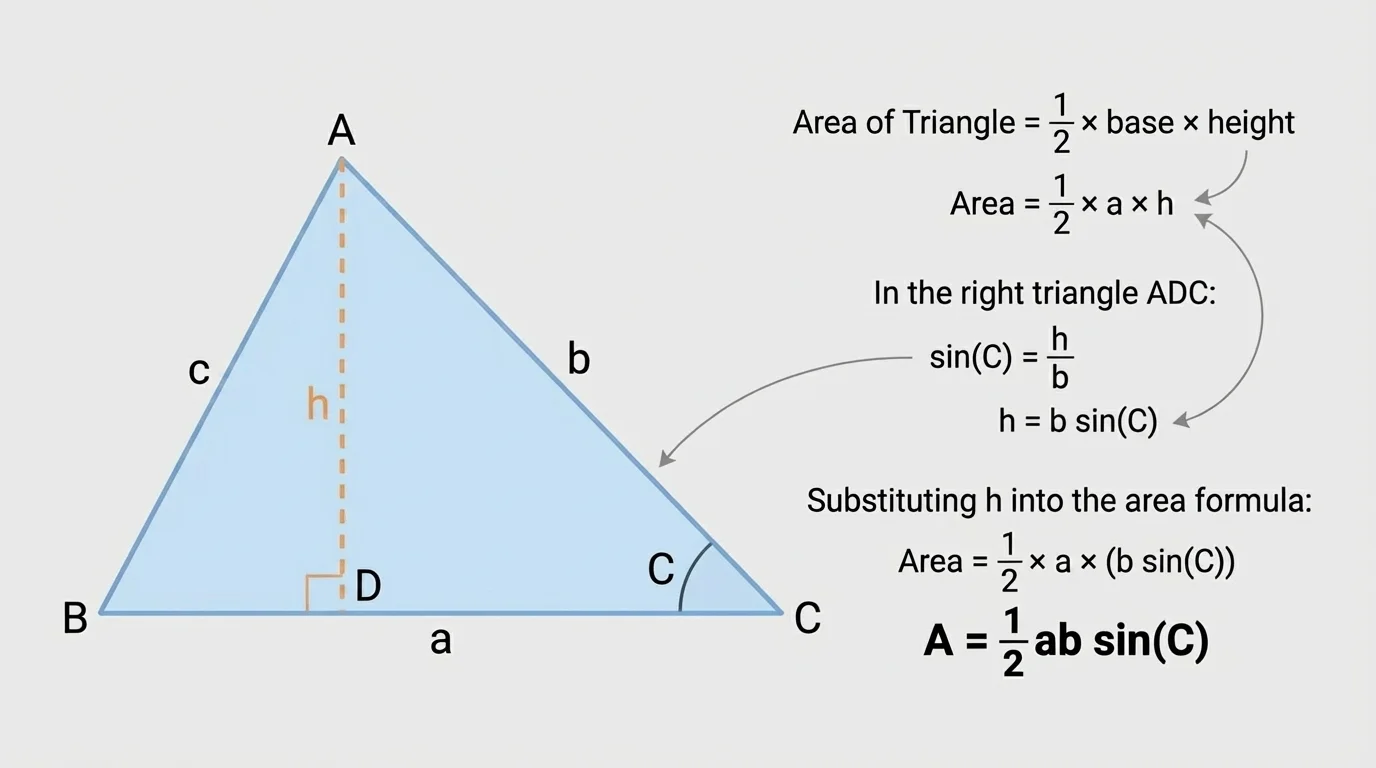
The key question is now: how can we write \(h\) using side \(b\) and angle \(C\)? The altitude creates a right triangle inside the original triangle, and that smaller right triangle lets trigonometry do the work.
Included angle is the angle formed by the two sides being used in a formula. In \(A = \dfrac{1}{2}ab\sin(C)\), the angle \(C\) is the angle between sides \(a\) and \(b\).
If you use two sides, the angle in the formula must be the angle between those two sides. That detail matters; using the wrong angle gives the wrong area.
As shown in [Figure 2], the altitude creates a right triangle, and in that right triangle, side \(b\) acts as the hypotenuse while the height \(h\) is opposite angle \(C\). This is exactly the situation where the sine ratio applies.
Using the definition of sine,
\[\sin(C) = \frac{h}{b}\]
Multiply both sides by \(b\):
\[h = b\sin(C)\]
Now substitute this expression for height into the standard triangle area formula \(A = \dfrac{1}{2}ah\):
\[A = \frac{1}{2}a(b\sin(C))\]
Simplifying gives
\[A = \frac{1}{2}ab\sin(C)\]
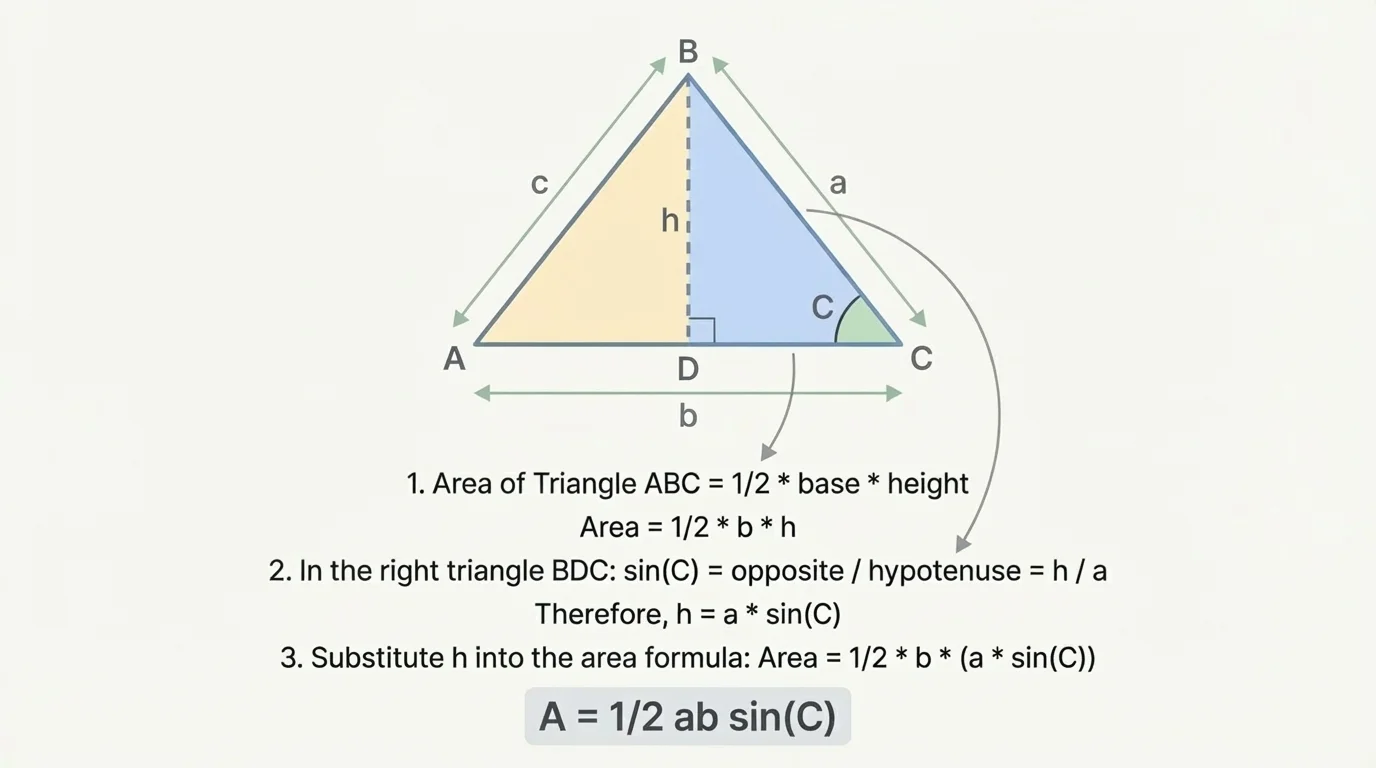
This is the desired formula. It is not an arbitrary rule; it comes directly from the standard base-height area formula and the fact that \(h = b\sin(C)\).
Notice the structure: one side plays the role of the base, and the other side contributes the vertical part through the sine of the included angle. As we saw in [Figure 1], the perpendicular line converts the general triangle into a right-triangle problem.
Why sine appears
Sine measures the part of a side that acts perpendicular to another side. In this derivation, \(b\sin(C)\) is the vertical component of side \(b\) relative to base \(a\). Since area depends on perpendicular height, sine naturally appears in the formula.
This also explains an important fact: if angle \(C\) is very small, then \(\sin(C)\) is small, so the area is small. That matches the picture because the triangle becomes flatter.
The formula
\[A = \frac{1}{2}ab\sin(C)\]
uses two sides and the included angle. The angle must be between the two sides named in the formula. If you know sides \(a\) and \(b\), then the correct angle is \(C\). If you know sides \(b\) and \(c\), then the correct angle is \(A\). If you know sides \(c\) and \(a\), then the correct angle is \(B\).
In a triangle, the area does not change depending on which side you choose as the base. That means there are three equivalent versions of the formula:
\[A = \frac{1}{2}ab\sin(C)\]
\[A = \frac{1}{2}bc\sin(A)\]
\[A = \frac{1}{2}ca\sin(B)\]
Each one comes from the same reasoning: choose a base, draw a perpendicular from the opposite vertex, write the height using sine, and substitute into \(A = \dfrac{1}{2}(\textrm{base})(\textrm{height})\).
Two different triangles can have the same two side lengths but different areas if the included angle changes. The factor \(\sin(C)\) captures exactly how the opening of the triangle affects the area.
This is one reason the formula is so useful: it shows how both size and shape matter.
As shown in [Figure 3], students sometimes wonder whether the formula still works if angle \(C\) is obtuse. It does. In an obtuse triangle, the perpendicular from the opposite vertex may land outside the segment used as the base, on the extension of that side.
The geometry changes slightly, but the trigonometric idea does not. The altitude still creates a right triangle involving side \(b\), and the height is still the perpendicular component of side \(b\). Because \(\sin(C)\) is positive for angles between \(0^\circ\) and \(180^\circ\), the formula continues to give a positive area.
So for any triangle with included angle \(C\), whether acute or obtuse, the same formula applies:
\[A = \frac{1}{2}ab\sin(C)\]
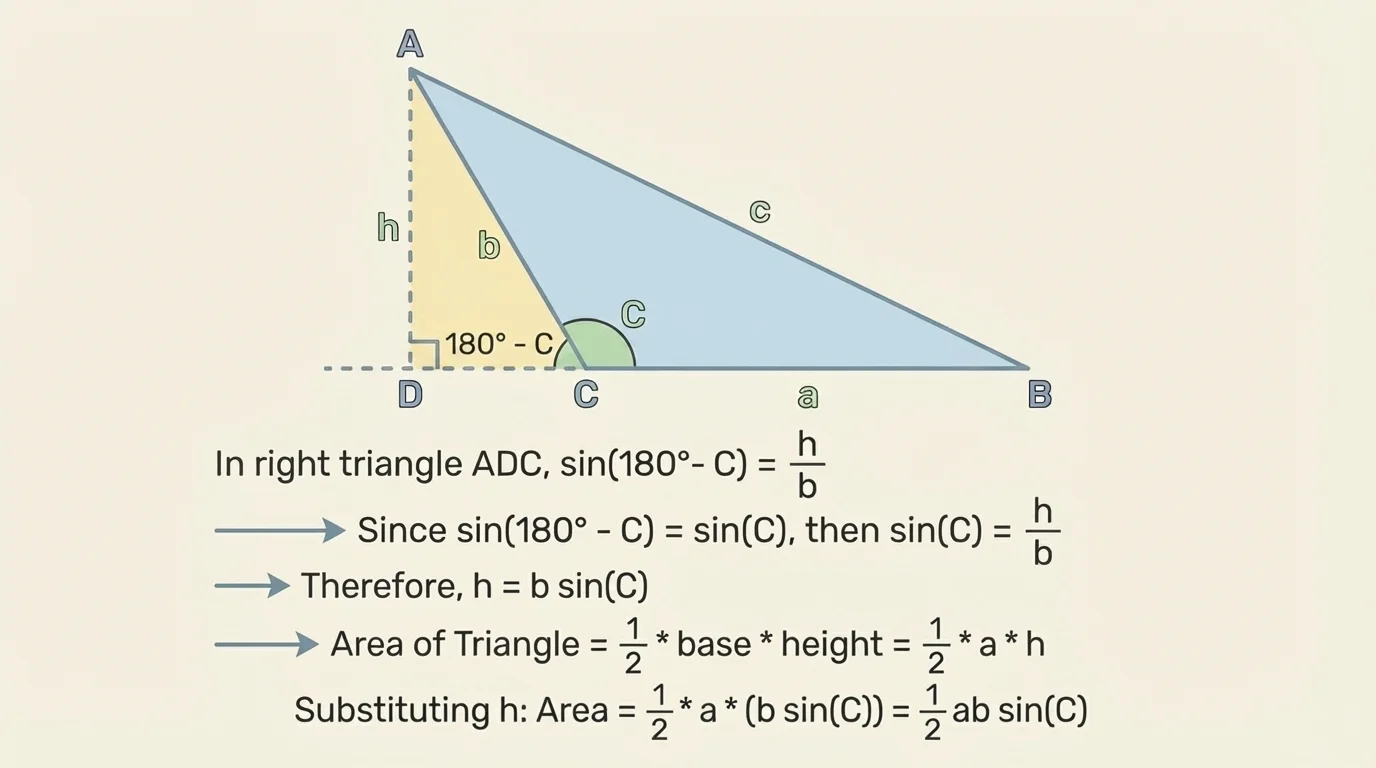
This is a good example of how right-triangle trigonometry extends to general triangles. Even when the whole triangle is not right, drawing one perpendicular lets us use right-triangle relationships inside it.
Later, when studying the Law of Sines and Law of Cosines, this same idea of dropping an altitude will appear again and again. The triangle area formula is one of the first major successes of that approach.
Now let us apply the formula in several situations.
Example 1
A triangle has side lengths \(a = 10\), \(b = 7\), and included angle \(C = 30^\circ\). Find the area.
Step 1: Write the formula.
Use \(A = \dfrac{1}{2}ab\sin(C)\).
Step 2: Substitute the known values.
\(A = \dfrac{1}{2}(10)(7)\sin(30^\circ)\).
Step 3: Evaluate the sine.
Since \(\sin(30^\circ) = \dfrac{1}{2}\), we get \(A = \dfrac{1}{2}(10)(7)\left(\dfrac{1}{2}\right)\).
Step 4: Simplify.
\(A = 35 \cdot \dfrac{1}{2} = 17.5\).
So the area is \(A = 17.5\) square units.
This result makes sense. If the angle were larger, the triangle would open wider and the area would increase.
Example 2
A triangle has side lengths \(b = 12\), \(c = 9\), and included angle \(A = 68^\circ\). Find the area.
Step 1: Choose the matching form of the formula.
Because the known sides are \(b\) and \(c\), use \(A = \dfrac{1}{2}bc\sin(A)\).
Step 2: Substitute.
\(A = \dfrac{1}{2}(12)(9)\sin(68^\circ)\).
Step 3: Compute.
\(\dfrac{1}{2}(12)(9) = 54\), so \(A = 54\sin(68^\circ)\).
Step 4: Approximate.
Using \(\sin(68^\circ) \approx 0.927\), we get \(A \approx 54(0.927) = 50.058\).
The area is approximately \(A \approx 50.1\) square units.
Notice that no height was given, yet the area is still easy to compute because the sine function supplies the needed perpendicular component.
Example 3
A triangle has side lengths \(a = 15\), \(b = 11\), and included angle \(C = 120^\circ\). Find the area.
Step 1: Use the formula for two sides and their included angle.
\(A = \dfrac{1}{2}ab\sin(C)\).
Step 2: Substitute.
\(A = \dfrac{1}{2}(15)(11)\sin(120^\circ)\).
Step 3: Evaluate the sine.
Since \(\sin(120^\circ) = \sin(60^\circ) = \dfrac{\sqrt{3}}{2}\), we have \(A = \dfrac{1}{2}(15)(11)\left(\dfrac{\sqrt{3}}{2}\right)\).
Step 4: Simplify.
\(\dfrac{1}{2}(15)(11) = 82.5\), so \(A = 82.5\left(\dfrac{\sqrt{3}}{2}\right) = 41.25\sqrt{3}\).
The exact area is \(A = 41.25\sqrt{3}\) square units, and the approximate area is \(A \approx 71.4\) square units.
This example confirms what we discussed earlier: the formula still works for an obtuse triangle.
Example 4
A triangle has area \(24\) square centimeters, side lengths \(a = 8\) centimeters and \(b = 6\) centimeters. Find \(\sin(C)\).
Step 1: Start with the formula.
\(24 = \dfrac{1}{2}(8)(6)\sin(C)\).
Step 2: Simplify the constant part.
\(\dfrac{1}{2}(8)(6) = 24\), so \(24 = 24\sin(C)\).
Step 3: Solve for \(\sin(C)\).
Divide both sides by \(24\): \(\sin(C) = 1\).
Step 4: Interpret the result.
If \(\sin(C) = 1\), then \(C = 90^\circ\).
The triangle is a right triangle with \(C = 90^\circ\).
That makes sense because the maximum possible value of sine is \(1\), so the largest possible area for fixed sides \(a\) and \(b\) occurs when the included angle is a right angle.
One common mistake is using an angle that is not between the two listed sides. For example, if you write \(A = \dfrac{1}{2}ab\sin(A)\), that is usually incorrect because angle \(A\) is not between sides \(a\) and \(b\).
Another common mistake is using cosine instead of sine. Cosine gives the adjacent component of a side, but area depends on the perpendicular component, so sine is the correct function here.
A quick reasonableness check can help. Since \(0 < \sin(C) \leq 1\) for any interior angle \(C\) of a triangle, the area must satisfy
\[A \leq \frac{1}{2}ab\]
The largest area for fixed sides \(a\) and \(b\) happens when \(C = 90^\circ\). If your computed area is greater than \(\dfrac{1}{2}ab\), something went wrong.
| Situation | Correct area form |
|---|---|
| Known \(a\), \(b\), and included angle \(C\) | \(A = \dfrac{1}{2}ab\sin(C)\) |
| Known \(b\), \(c\), and included angle \(A\) | \(A = \dfrac{1}{2}bc\sin(A)\) |
| Known \(c\), \(a\), and included angle \(B\) | \(A = \dfrac{1}{2}ca\sin(B)\) |
Table 1. Matching each pair of known sides with its correct included angle in the triangle area formula.
It is also important to keep angle mode consistent on a calculator. If the angle is given in degrees, your calculator must be in degree mode.
Surveyors often measure two sides of a triangular region and the angle between them rather than climbing through rough terrain to find a height. A land survey setup like this uses exactly the same mathematics as our derivation: measured side lengths and an included angle determine the area.
Suppose two boundary lines of a triangular plot measure \(80\) meters and \(65\) meters, with an included angle of \(42^\circ\). Then
\[A = \frac{1}{2}(80)(65)\sin(42^\circ)\]
Using \(\sin(42^\circ) \approx 0.669\),
\[A \approx 2600(0.669) = 1739.4\]
So the area is about \(1739.4\) square meters.
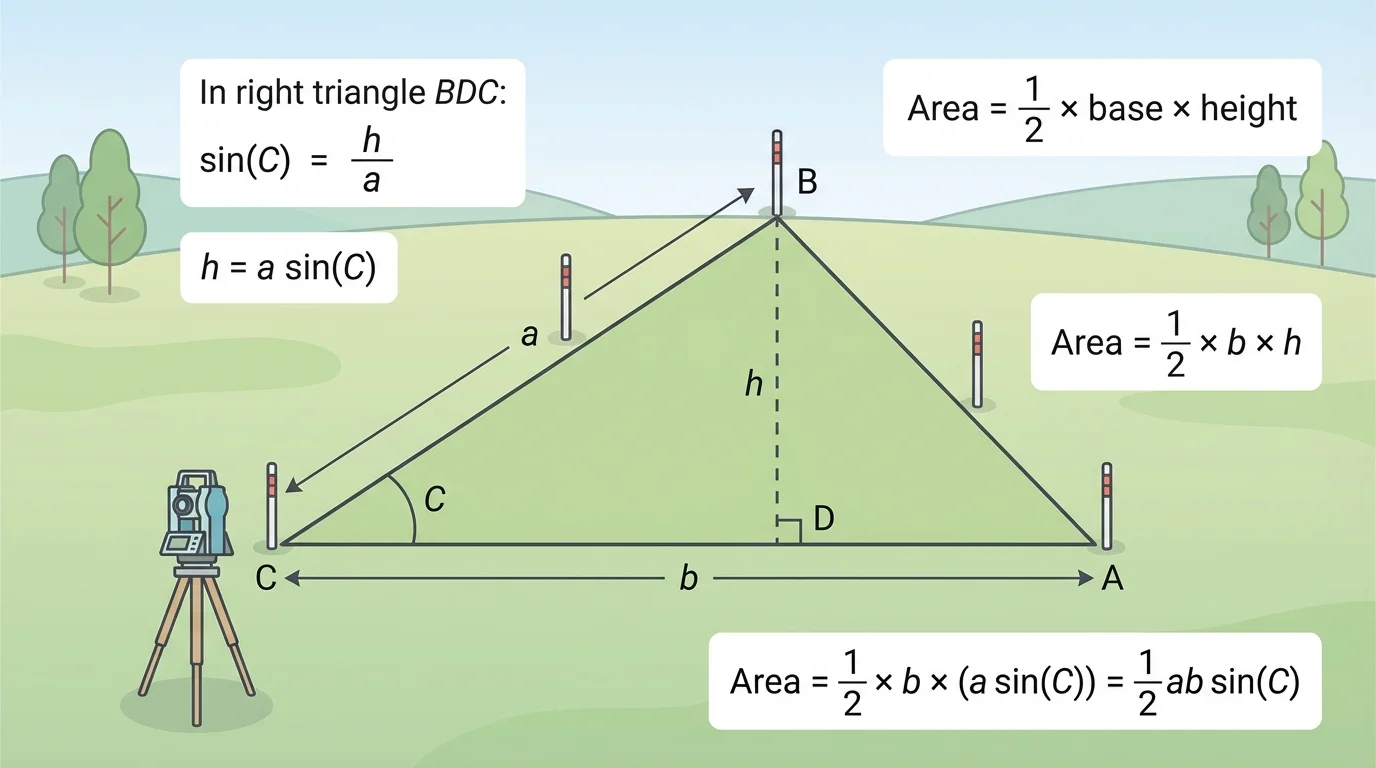
Engineers use the same idea when analyzing triangular supports in bridges or roof trusses. A triangular frame can be described by its side lengths and angles, and area may be needed for material estimates or load analysis.
In physics, the formula connects to the idea of components. The term \(b\sin(C)\) is the component of side \(b\) perpendicular to side \(a\). That same decomposition appears in vector problems, force analysis, and motion in two dimensions.
Navigation also uses this idea. If two travel paths and the angle between them form a triangle on a map, the area can represent a region enclosed by routes or the geometry of a triangulation system. The same perpendicular-component reasoning from [Figure 2] appears in those settings too.
The formula \(A = \dfrac{1}{2}ab\sin(C)\) is really a bridge between geometry and trigonometry. Geometry gives the area idea \(\dfrac{1}{2}(\textrm{base})(\textrm{height})\), and trigonometry supplies the missing height through \(\sin(C)\).
What makes the result powerful is that it works for general triangles, not just right triangles. By drawing one perpendicular line, a non-right triangle becomes manageable because part of it is now a right triangle. That is a major theme in trigonometry: create a right triangle, then use its ratios.
Once this derivation is understood, the formula is much easier to remember. You are not memorizing an isolated rule. You are remembering that the height equals a side times the sine of the included angle, and the rest comes from the familiar area formula.
