Two teams can play equally hard, two students can both deserve a turn, and two applicants can be equally qualified. But if only one can be chosen, how do we decide fairly? In many real situations, fairness does not mean arguing longer or choosing the loudest voice. It means giving each valid option the same chance. Probability gives us a precise way to test whether a decision process really does that.
People often say "leave it to chance," but chance is only fair when the probabilities are distributed correctly. A coin flip is fair for choosing between two people because each person can be assigned one side of the coin, and each side has probability \(\dfrac{1}{2}\). But not every random-looking method is fair. If a spinner has unequal sections, or if a random number generator is used carelessly, some outcomes may be more likely than others.
This topic is about using probability not just to describe uncertainty, but to make decisions responsibly. When you can evaluate the probabilities of outcomes, you can judge whether a method is fair, redesign it if it is not, and explain your reasoning clearly.
A decision rule is fair when the people or options that are meant to have equal chances actually have equal probabilities. If three students are competing for one presentation slot and the class agrees that each should have the same chance, then a fair process gives each student probability \(\dfrac{1}{3}\).
Fairness matters in school, sports, law, science, and public policy. Schools may use lotteries when there are more applicants than spaces. Clinical trials may randomly assign patients to treatment groups. Officials may randomly select names for audits or jury pools. In each case, the method matters because even small biases can affect real people.
Probability is the measure of how likely an event is, from \(0\) to \(1\). A probability of \(0\) means impossible, a probability of \(1\) means certain, and values in between show different levels of likelihood.
Fair decision method is a rule in which each person or outcome that should be treated equally has the same probability.
Sample space is the complete set of all possible outcomes of a random process.
Sometimes fairness means equal probability for all individuals. Sometimes it means probabilities are proportional to something agreed upon in advance. For example, if a committee decides that one school gets \(2\) representatives and another gets \(1\), equal treatment does not mean all schools get the same probability; it means the selection rule matches the agreed structure. Probability helps separate these situations clearly.
When outcomes are equally likely, probability is often calculated by dividing the number of favorable outcomes by the total number of outcomes. In symbols, if all outcomes in the sample space are equally likely, then fairness can be checked using \(P(\textrm{event}) = \dfrac{\textrm{number of favorable outcomes}}{\textrm{total number of outcomes}}\).
[Figure 1] For example, if a spinner has \(4\) equal sections labeled \(A\), \(B\), \(C\), and \(D\), then each label has probability \(\dfrac{1}{4}\). If each of four students is assigned one section, the method is fair because each student has the same chance.
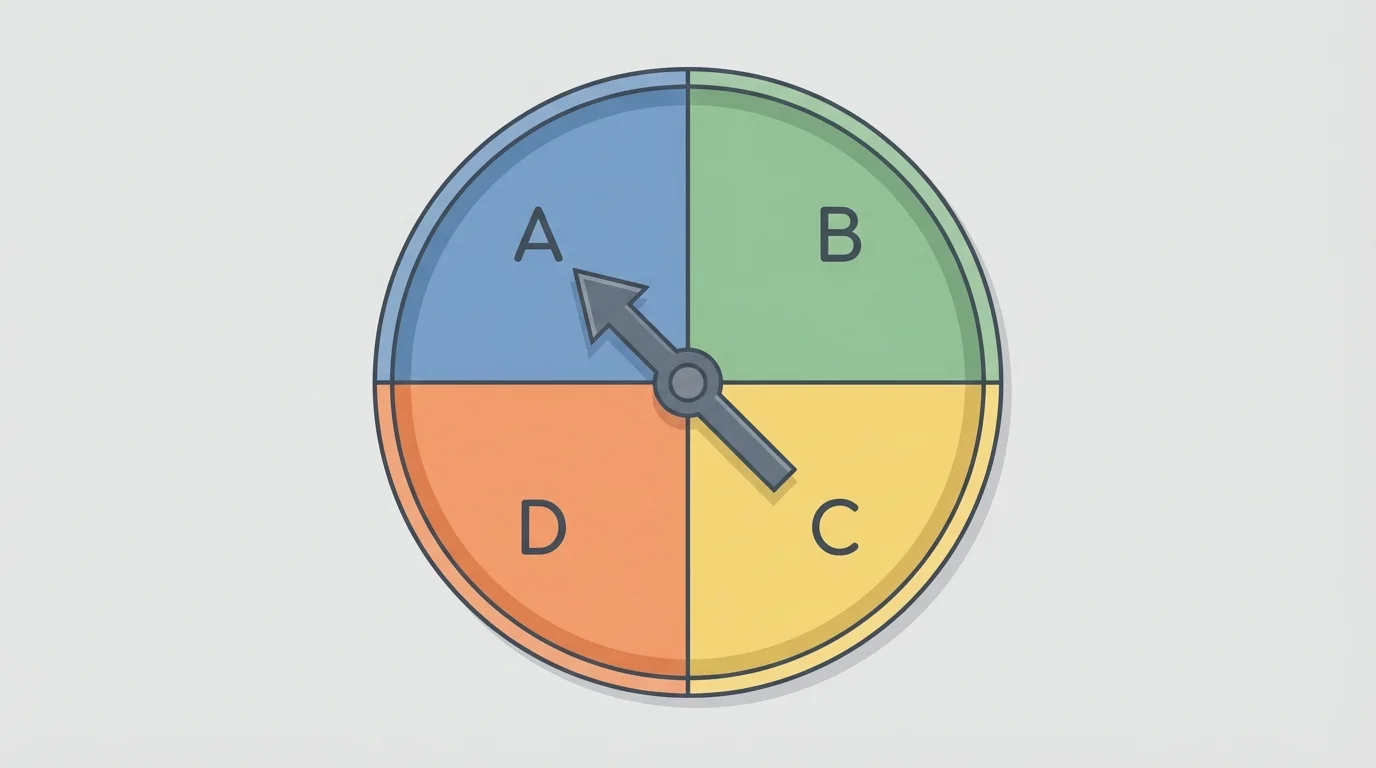
If the sections are not equal, then the labels are not equally likely. A label covering half the circle has probability \(\dfrac{1}{2}\), while a label covering one quarter has probability \(\dfrac{1}{4}\). A spinner may look random because it spins unpredictably, but the underlying probabilities can still be unequal.
The same idea applies to drawing names. If one name is written on one slip and another name is written on three slips, the second person is three times as likely to be chosen. Randomness alone does not guarantee fairness; the probabilities must match the intended rule.
Another key idea is that probabilities for all outcomes in a complete sample space add to \(1\). If a decision method assigns probabilities \(\dfrac{1}{3}\), \(\dfrac{1}{3}\), and \(\dfrac{1}{3}\) to three students, then \(\dfrac{1}{3}+\dfrac{1}{3}+\dfrac{1}{3}=1\). If the probabilities add to \(1\) but are unequal, the method may still be valid mathematically, but it is not fair if equal treatment was intended.
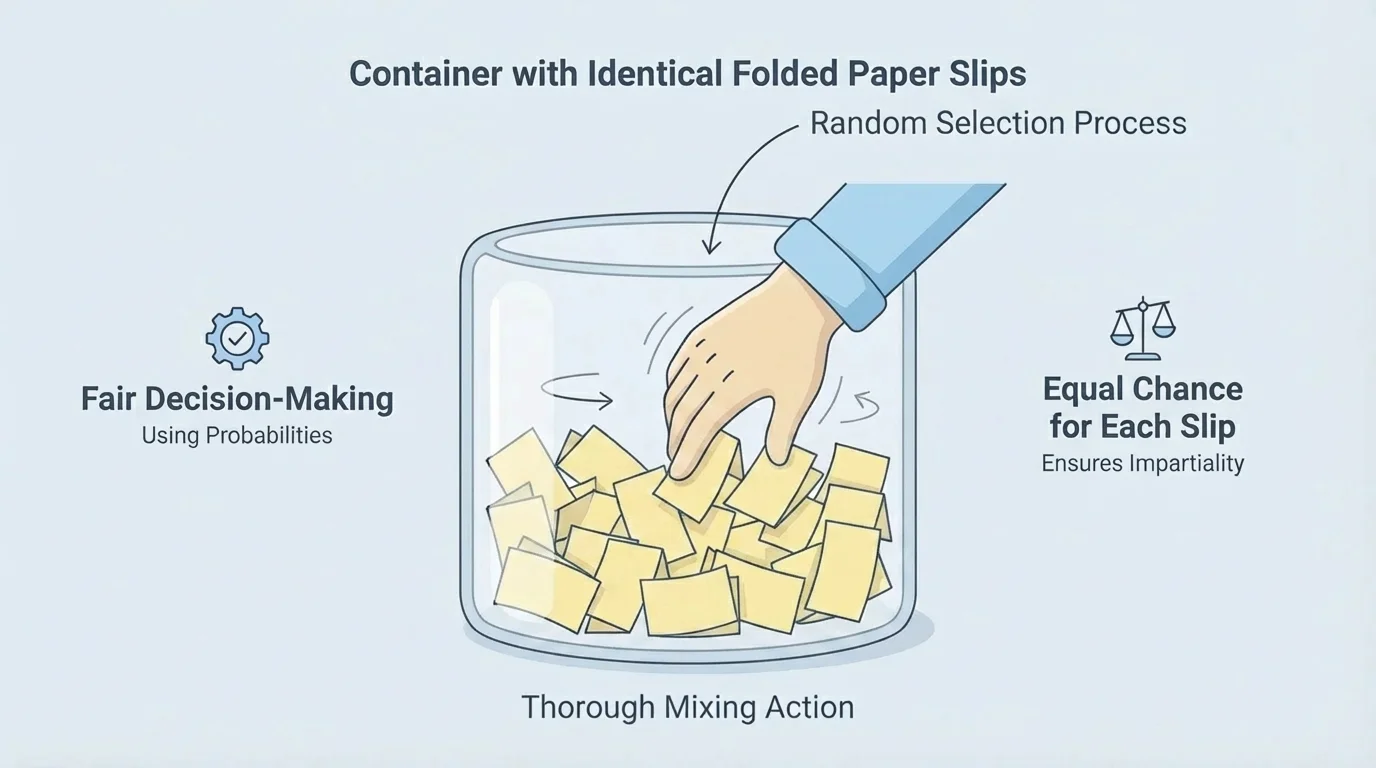
[Figure 2] Common physical and digital random methods are useful only when they are matched carefully to the decision. Physical methods include drawing by lots from identical slips, flipping coins, rolling dice, or spinning a balanced spinner. Digital methods include random number generators in apps, calculators, and computer programs that produce random integers.
Drawing by lots is fair when every slip is identical in size, shape, folding, and texture, and the slips are mixed thoroughly. If one slip is larger, stiffer, or easier to grab, the process can become biased.
Coin flips work well for two outcomes. Assign one person to heads and one to tails. If the coin is fair, each has probability \(\dfrac{1}{2}\).
Dice work well for up to \(6\) outcomes if one outcome is assigned to each face. For four students, a number cube can be used by assigning \(1\) through \(4\) and re-rolling on \(5\) or \(6\), or by using another method with exactly four equally likely outcomes.
Random number generators are especially useful when there are many choices. For instance, a generator that outputs an integer from \(1\) to \(100\) can be used fairly if the numbers are assigned evenly. But if \(100\) numbers are split among \(3\) students as \(34\), \(33\), and \(33\), one student has a slightly larger probability unless extra rules are added.
That is why probability is so powerful: it lets you test a procedure instead of trusting appearances. The slips are fair only because they are physically identical and mixed well; if not, drawing by lots becomes less reliable than it seems.
Modern computers often use pseudo-random numbers, which are generated by algorithms. They are usually random enough for classroom decisions, but in high-stakes settings such as cryptography or major lotteries, much stricter methods are used.
A fair method must be both mathematically sound and practically well carried out. A perfectly fair rule on paper can become unfair if people do not follow it carefully.
[Figure 3] The easiest cases are when the number of possible random outcomes matches the number of choices. A coin for \(2\) choices, a spinner with \(3\) equal sectors for \(3\) choices, or a die for \(6\) choices are natural matches.
Harder cases happen when the number of available random outcomes does not divide evenly by the number of choices. Suppose you want to choose fairly among \(3\) students using random digits \(0\) through \(9\). Because \(10\) is not divisible by \(3\), you cannot assign exactly the same number of digits to each student without handling one extra digit. A fair fix is to assign \(3\) digits to each student and treat the extra digit as "generate again."
For example, assign digits \(0,1,2\) to Student A, digits \(3,4,5\) to Student B, and digits \(6,7,8\) to Student C. If the generator produces \(9\), ignore it and generate a new digit. Conditional on getting one of the accepted digits, each student has probability \(\dfrac{3}{9}=\dfrac{1}{3}\).
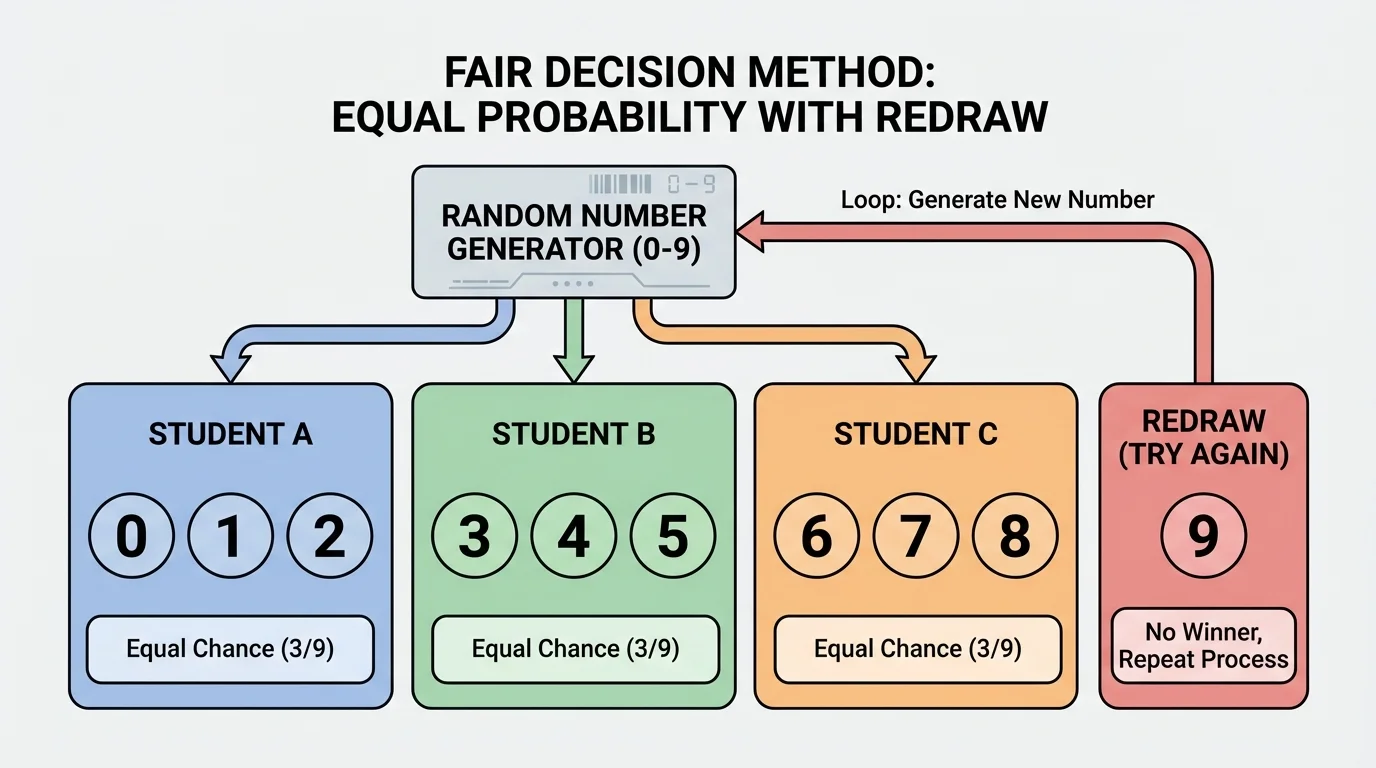
This "reject and redraw" idea is important. It prevents hidden bias when the number of random outcomes and the number of desired choices do not line up neatly. The goal is not to use every possible outcome. The goal is to make the final accepted outcomes fair.
Another situation involves unequal group sizes. Suppose \(12\) tickets are distributed among \(3\) clubs in proportion to club membership: Club X has \(6\) tickets, Club Y has \(4\), and Club Z has \(2\). Then the probabilities are \(\dfrac{6}{12}=\dfrac{1}{2}\), \(\dfrac{4}{12}=\dfrac{1}{3}\), and \(\dfrac{2}{12}=\dfrac{1}{6}\). This is not equal probability, but it may still be fair if the agreed rule is proportional representation.
| Situation | Good random method | Why it is fair |
|---|---|---|
| \(2\) choices | Coin flip | Each outcome has probability \(\dfrac{1}{2}\) |
| \(4\) choices | Spinner with \(4\) equal sectors | Each outcome has probability \(\dfrac{1}{4}\) |
| \(3\) choices using digits \(0\) to \(9\) | Assign \(3\) digits each and redraw on \(1\) extra digit | Accepted outcomes become equal |
| Many choices | Random integer generator with even assignment | Each person receives the same number of integers |
Table 1. Examples of matching random methods to the number of choices.
To evaluate a method, identify the sample space, compute the probability of each decision outcome, and compare those probabilities with the intended rule. If the intended rule is equal treatment, all probabilities should be equal.
For instance, suppose a teacher says, "We will choose one of three groups by rolling a die: Group A wins on \(1,2,3\), Group B wins on \(4,5\), and Group C wins on \(6\)." The method is random, but it is not fair. The probabilities are \(P(A)=\dfrac{3}{6}=\dfrac{1}{2}\), \(P(B)=\dfrac{2}{6}=\dfrac{1}{3}\), and \(P(C)=\dfrac{1}{6}\).
Fairness as probability matching
A decision process is fair when the probabilities match the intended decision rule. If the goal is equal treatment, then every eligible person or option must have the same probability. If the goal is weighted treatment, then the probabilities must match the agreed weights. Probability turns fairness into something testable, not just something that feels right.
Sometimes a method is close to fair but not exactly fair. In low-stakes settings, a tiny difference may not matter much. In formal settings, even small probability differences can be unacceptable. This is why legal systems, scientific studies, and public lotteries usually require carefully defined procedures.
The redraw strategy from [Figure 3] is one of the cleanest ways to repair a nearly fair method. Instead of forcing every possible random output to count, it removes outputs that would create unequal chances.
The best way to understand fair decision methods is to analyze complete examples step by step.
Worked example 1: Is a spinner fair for four students?
A spinner has \(4\) equal sections labeled with the names of Students \(A\), \(B\), \(C\), and \(D\). Determine whether the decision method is fair.
Step 1: Identify the sample space
The possible outcomes are \(\{A,B,C,D\}\).
Step 2: Determine the probability of each outcome
Because the sections are equal, each outcome has probability \(\dfrac{1}{4}\).
Step 3: Compare the probabilities
All four students have the same probability: \(P(A)=P(B)=P(C)=P(D)=\dfrac{1}{4}\).
The method is fair.
Equal-sized regions are essential here. The equal sectors in [Figure 1] make the conclusion possible; if one region were larger, the method would no longer be fair.
Worked example 2: Fix an unfair die rule
A teacher chooses one of three debate teams using a fair die. Team \(A\) is assigned \(1,2\), Team \(B\) is assigned \(3,4\), and Team \(C\) is assigned \(5,6\). Is the method fair? Then compare it to the rule where Team \(A\) gets \(1,2,3\), Team \(B\) gets \(4,5\), and Team \(C\) gets \(6\).
Step 1: Analyze the first assignment
Each team is assigned \(2\) outcomes out of \(6\), so each probability is \(\dfrac{2}{6}=\dfrac{1}{3}\).
Step 2: Decide whether the first assignment is fair
Since all probabilities are equal, the first rule is fair.
Step 3: Analyze the second assignment
For the second rule, \(P(A)=\dfrac{3}{6}=\dfrac{1}{2}\), \(P(B)=\dfrac{2}{6}=\dfrac{1}{3}\), and \(P(C)=\dfrac{1}{6}\).
Step 4: Compare the probabilities
The probabilities are not equal, so the second rule is unfair if the teams are meant to have equal chances.
A fair revision is to give each team exactly two die outcomes.
This example shows that a process can be random without being fair. Randomness answers "which outcome occurs?" Fairness answers "does each intended outcome have the right chance?"
Worked example 3: Using a random number generator for three finalists
A random number generator produces integers from \(1\) to \(10\). Three finalists, \(X\), \(Y\), and \(Z\), need equal chances of being selected. Design a fair rule.
Step 1: Check whether \(10\) can be split equally among \(3\) finalists
Since \(10 \div 3\) is not an integer, the \(10\) outcomes cannot be divided equally with all outcomes used.
Step 2: Assign equal numbers of outcomes
Give \(1,2,3\) to \(X\), \(4,5,6\) to \(Y\), and \(7,8,9\) to \(Z\).
Step 3: Handle the extra outcome
If the generator outputs \(10\), ignore it and generate again.
Step 4: Compute the accepted probabilities
Among the accepted outcomes \(1\) through \(9\), each finalist has \(3\) favorable outcomes, so each probability is \(\dfrac{3}{9}=\dfrac{1}{3}\).
The rule is fair because each finalist has the same final probability.
Notice that the rejected outcome does not create unfairness. It simply means the process sometimes repeats. That is often better than forcing unequal probabilities.
Worked example 4: Drawing by lots with repeated names
A raffle-style selection is made by placing slips in a box. Maya has \(2\) slips, Jordan has \(2\) slips, and Elena has \(1\) slip. Find each probability and decide whether the method is fair for equal selection.
Step 1: Count the total number of slips
There are \(2+2+1=5\) slips in total.
Step 2: Compute each probability
\(P(\textrm{Maya})=\dfrac{2}{5}\), \(P(\textrm{Jordan})=\dfrac{2}{5}\), and \(P(\textrm{Elena})=\dfrac{1}{5}\).
Step 3: Evaluate fairness
If equal selection is intended, the method is unfair because Elena has a smaller probability.
Step 4: Revise the rule
Use one identical slip per person, so each probability becomes \(\dfrac{1}{3}\).
The original method is only fair if the class intentionally wants Maya and Jordan each to have twice Elena's chance.
lottery systems are used when demand exceeds supply, such as school admissions, housing programs, or ticket distribution. A lottery is only trustworthy if every eligible entry has the correct probability.
In medicine, random assignment helps researchers compare treatments without letting personal choice or bias distort the results. If patients are meant to be split evenly into two groups, then each patient should have probability \(\dfrac{1}{2}\) of entering each group.
Sports also use probability-based procedures. Tied teams may be seeded by random draw when other ranking rules do not separate them. Draft order lotteries attempt to reduce incentives for teams to lose intentionally, though some lotteries use intentionally unequal probabilities based on league rules.
In computing, programmers use random selection for simulations, testing, and security. But when fairness is required for people, the generator must be appropriate, the input range must be assigned carefully, and the method should be transparent enough that others can verify it.
Earlier probability ideas still matter here: probabilities must be between \(0\) and \(1\), the probabilities of all outcomes in a complete sample space add to \(1\), and equally likely outcomes let you use the ratio \(\dfrac{\textrm{favorable outcomes}}{\textrm{total outcomes}}\).
Public trust depends on clear procedures. When people understand the probabilities, they are more likely to accept the outcome, even if they are not selected.
One common mistake is assuming that "random" automatically means "fair." A biased spinner, uneven slips, or poorly assigned random numbers can all produce unequal probabilities.
Another mistake is using too few outcomes. For example, choosing among \(5\) people with a coin flip sequence can work, but only if the sequences are assigned carefully and some outcomes may require repeating the process. If the assignments are uneven, the method becomes unfair.
Good practice includes stating the rule before the random process begins, making the sample space clear, checking the probabilities, and using identical materials or trusted software. In higher-stakes decisions, documentation matters too: people should be able to inspect the method and confirm that it was followed correctly.
"A fair chance is not a feeling. It is a probability that can be justified."
Probability gives you a way to defend a decision method with evidence. Instead of saying "it seems fair," you can say exactly why each outcome has probability \(\dfrac{1}{2}\), \(\dfrac{1}{3}\), or whatever the agreed rule requires.
