A state lottery can advertise a giant jackpot, yet the average ticket buyer still loses money. That sounds contradictory until you look at the mathematics. The key idea is that a game of chance is not judged by its most exciting outcome, but by the average result you would expect over many plays. That average is called the expected payoff, and it helps answer a practical question: Is this game actually worth playing?
People encounter games of chance in more places than casinos. They appear in lottery tickets, online giveaways, school raffles, sports contests, and fast-food promotions. A game may offer prizes that seem generous, but what matters mathematically is how likely each prize is and how much it is worth. A rare large prize often gets balanced by a huge number of losing outcomes.
Expected payoff is a powerful tool because it turns uncertainty into a single number that can be compared. It does not predict what will happen on one attempt. Instead, it describes the average amount won or lost per play in the long run.
Probability values must be between \(0\) and \(1\), and the probabilities for all possible outcomes of a game must add up to \(1\). A probability written as \(25\%\) should be converted to \(0.25\) before it is used in a calculation.
If you buy one ticket, you might win a prize or get nothing. But if a very large number of people each buy one ticket, the average result per ticket will be close to the expected value. That is why governments, companies, and game designers pay close attention to expected payoff when creating games.
To analyze a game, break it into possible outcomes. In each outcome, there is a result, a probability, and a payoff. In a game of chance, the outcome is one possible result of the game. The payoff is the amount of money gained or lost from that result.
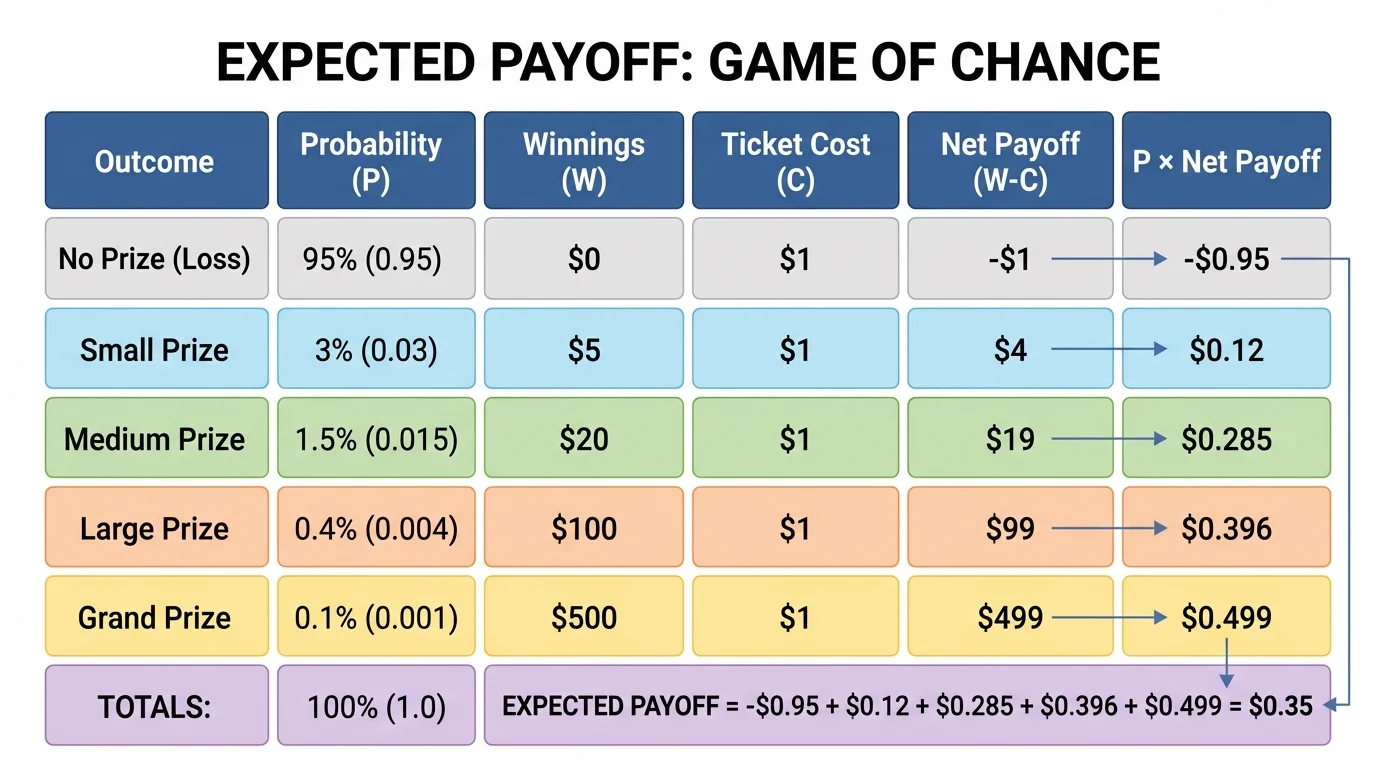
Every game can be organized into a list of outcomes with associated probabilities and payoff values, as [Figure 1] shows. This is the first step in finding expected value, because the math depends on matching each possible result with how likely it is to occur.
A very important detail is whether the payoff means winnings or net payoff. Winnings are the amount of the prize itself. Net payoff is what you actually gain or lose after subtracting the cost to play. If a ticket costs $2 and you win $5, your net payoff is $3, not $5. If you win nothing, your net payoff is negative $2.
In many decision problems, net payoff is the more useful quantity because it reflects your true financial result. Two games can have the same prizes but different ticket prices, so their net payoffs may be very different.
Expected value is the weighted average of all possible payoff values, where each payoff is weighted by its probability. In games of chance, expected value tells the average payoff per play over many plays.
You can think of expected value as a balance point. Large payoffs pull the average upward, but only according to their probabilities. A huge jackpot with a tiny probability contributes much less to the expected value than many students first expect.
The expected value of a game combines all payoffs into one probability-weighted average, as [Figure 2] illustrates. If the possible payoffs are \(x_1, x_2, x_3, ...\) with probabilities \(p_1, p_2, p_3, ...\), then the expected value is
\[E = p_1x_1 + p_2x_2 + p_3x_3 + \cdots\]
This formula says: multiply each payoff by its probability, then add the products. If you are working with net payoffs, the result is the expected net gain or expected net loss per play.
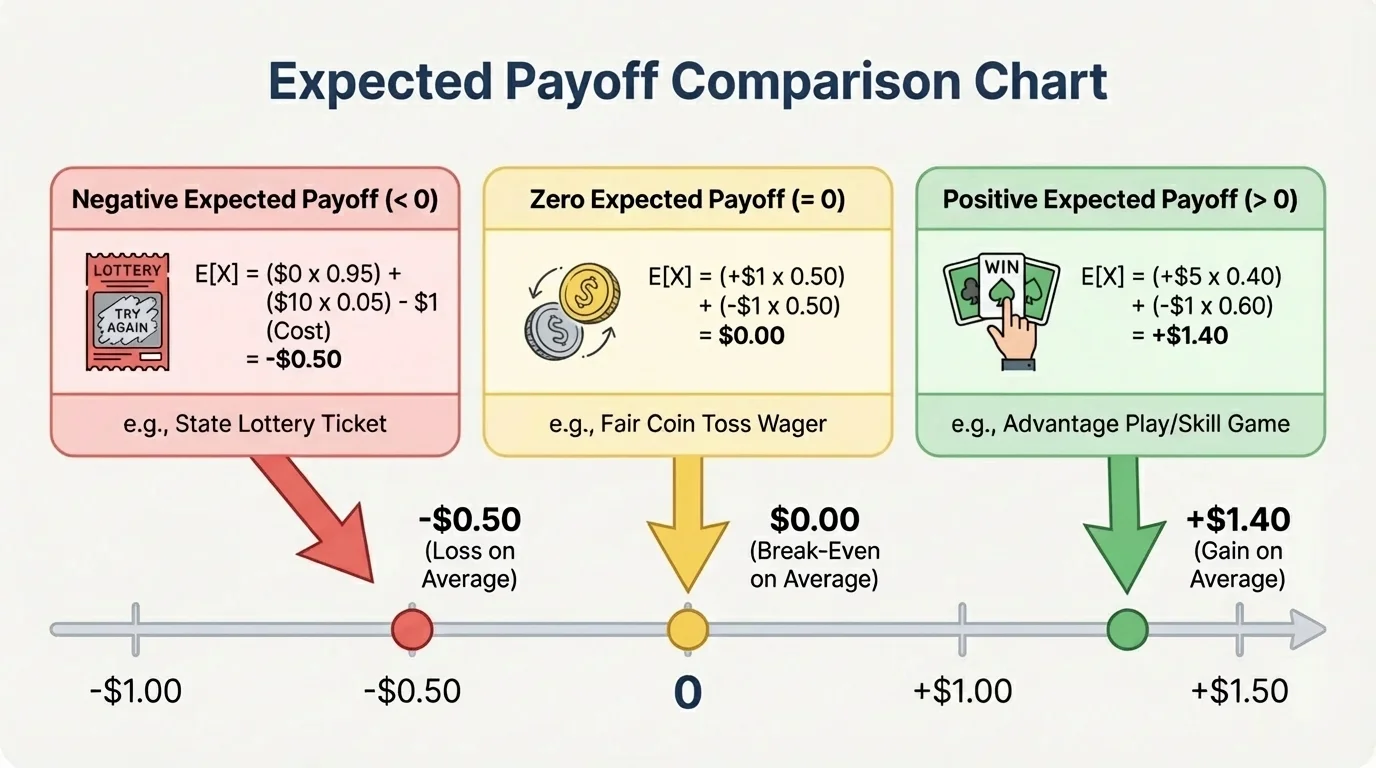
If the expected value is negative, the game is unfavorable to the player on average. If it is zero, the game is fair. If it is positive, the player has an advantage on average.
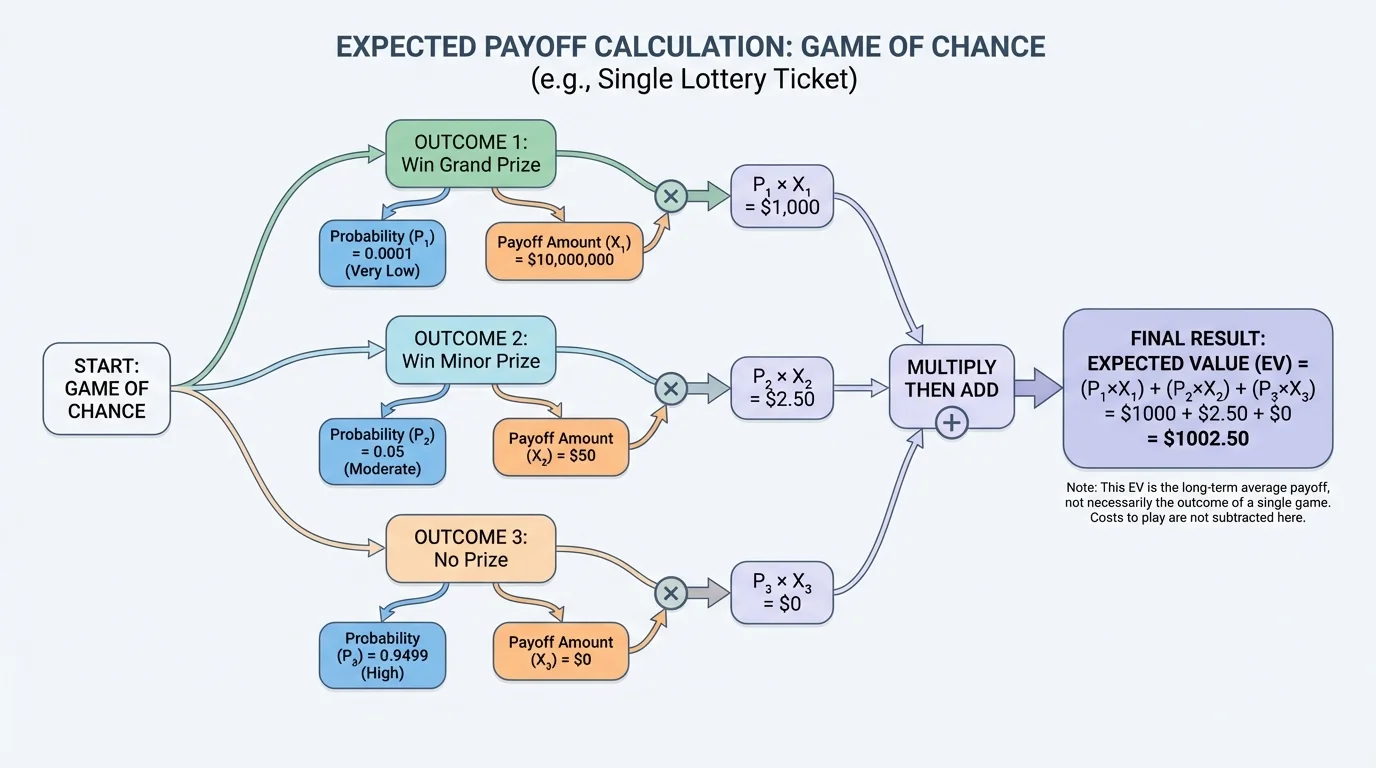
Notice that expected value can be a number that is not itself a possible outcome. For example, an expected payoff of $0.35 does not mean you will win exactly $0.35 in one play. It means that over many plays, the average payoff per play is about $0.35.
Start with a small game where the calculation is easy to see clearly. A prize wheel costs $4 to spin. The possible prizes are: $0 with probability \(0.5\), $5 with probability \(0.3\), and $20 with probability \(0.2\). Find the expected net payoff.
Worked example 1
Step 1: Convert prizes to net payoffs.
If the cost is $4, then the net payoffs are \(-4\), \(1\), and \(16\).
Step 2: Use the expected value formula.
\(E = 0.5(-4) + 0.3(1) + 0.2(16)\)
Step 3: Calculate each product and add.
\(0.5(-4) = -2\), \(0.3(1) = 0.3\), and \(0.2(16) = 3.2\).
So \(E = -2 + 0.3 + 3.2 = 1.5\).
The expected net payoff is \(\$1.50\), which means the player gains an average of $1.50 per spin over many spins.
This game is favorable to the player because the expected value is positive. Even though half the spins lose money, the larger prize has enough value to raise the average above zero.
A lottery ticket is a classic example of a game with many losing outcomes and a few winning outcomes. Suppose a $2 ticket has the following prize structure:
| Prize | Probability |
|---|---|
| $0 | \(0.94\) |
| $5 | \(0.05\) |
| $100 | \(0.009\) |
| $10,000 | \(0.001\) |
Table 1. Prize distribution for the sample lottery ticket.
We will first find the expected winnings, and then the expected net payoff.
Worked example 2
Step 1: Find the expected winnings.
\(E_w = 0.94(0) + 0.05(5) + 0.009(100) + 0.001(10000)\)
Step 2: Compute each part.
\(0.94(0) = 0\), \(0.05(5) = 0.25\), \(0.009(100) = 0.9\), and \(0.001(10000) = 10\).
Step 3: Add to get expected winnings.
\(E_w = 0 + 0.25 + 0.9 + 10 = 11.15\)
Step 4: Subtract the ticket cost for the expected net payoff.
\(E_n = 11.15 - 2 = 9.15\)
The expected net payoff is \(\$9.15\), so in this hypothetical example the ticket would be very favorable to the player.
This result is unusual for a real lottery. Actual lotteries are almost always designed to have a negative expected net payoff for players. That is how the lottery raises revenue. The example is useful because it shows the process clearly, but in real life the jackpot probability is usually much smaller than in this simplified model.
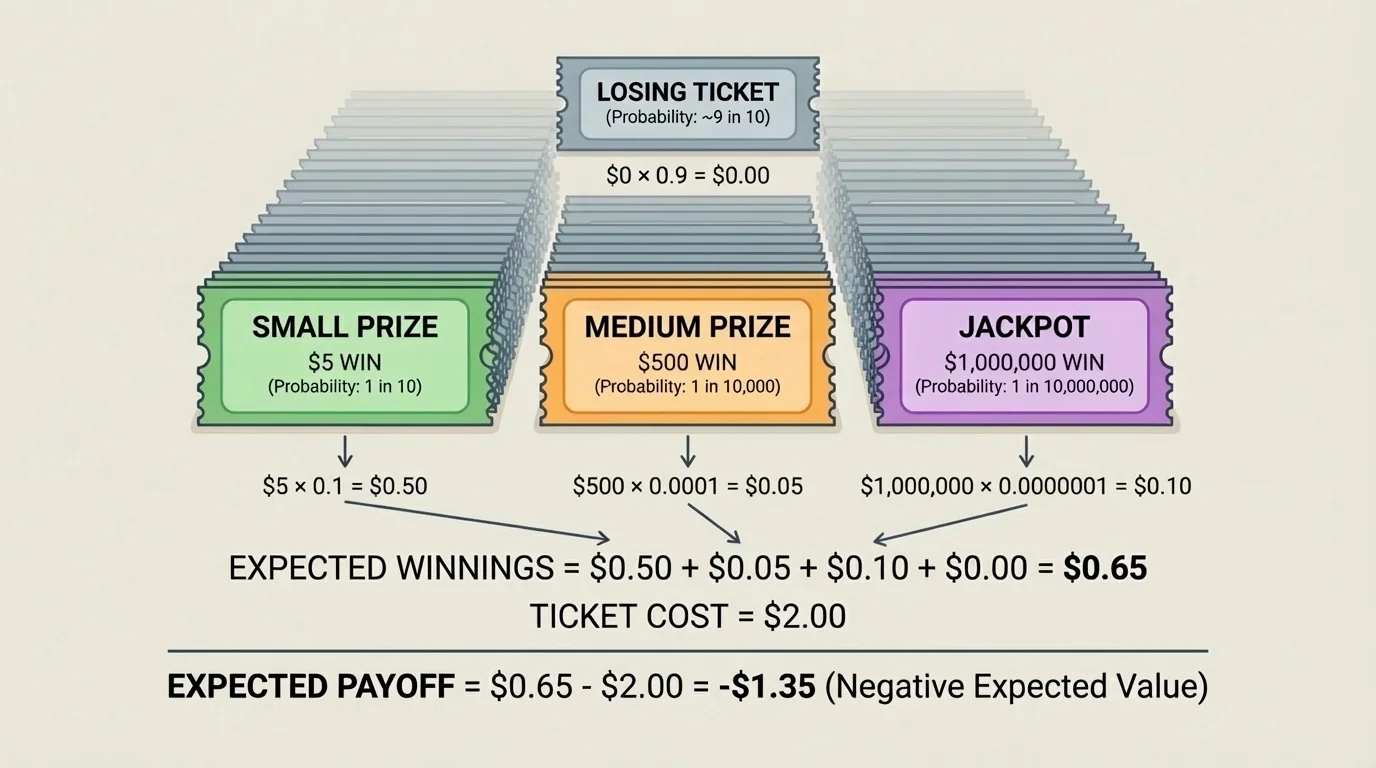
Notice how strongly the jackpot affects the expected value. Even a very small probability can contribute a lot if the prize is extremely large. Still, if that probability becomes tiny enough, the expected value can quickly drop. That is why realistic lottery calculations usually produce negative average returns despite impressive advertisements.
Now consider a restaurant promotion. A customer gets a game card with a meal purchase. The card has these possible prizes: free fries worth $3 with probability \(0.12\), free meal worth $9 with probability \(0.03\), gift card worth $50 with probability \(0.001\), and no prize with probability \(0.849\). Suppose the customer effectively pays $1 for the chance to play because the promotional meal costs $1 more than usual. Find the expected net payoff.
Worked example 3
Step 1: Write the net payoff for each outcome.
Free fries: \(3 - 1 = 2\)
Free meal: \(9 - 1 = 8\)
Gift card: \(50 - 1 = 49\)
No prize: \(0 - 1 = -1\)
Step 2: Multiply each net payoff by its probability.
\(0.12(2) = 0.24\)
\(0.03(8) = 0.24\)
\(0.001(49) = 0.049\)
\(0.849(-1) = -0.849\)
Step 3: Add the products.
\(E = 0.24 + 0.24 + 0.049 - 0.849 = -0.32\)
The expected net payoff is about \(-\$0.32\), so the customer loses an average of $0.32 per game card.
This does not mean every customer loses exactly $0.32. It means that if the promotion were repeated many times, the average net result per card would be about negative $0.32. Promotions can still attract customers because people enjoy the possibility of a prize, even when the average result is negative.
Many promotional games are designed so that the prizes are memorable, but the average cost to the company stays lower than the extra sales the promotion creates. Expected value helps businesses make those designs profitable.
As we saw in [Figure 1], organizing outcomes into a payoff table makes these calculations much easier. In more complicated games, a table prevents you from forgetting a losing outcome or using the wrong payoff amount.
A game is called fair game when the expected net payoff is \(0\). A player neither gains nor loses money on average. A game is unfavorable to the player when the expected net payoff is less than \(0\), and favorable when it is greater than \(0\).
Suppose a carnival game costs $3. You roll a die once. If you roll a \(6\), you win $18; otherwise you win nothing. The net payoff is \(15\) with probability \(\dfrac{1}{6}\), and \(-3\) with probability \(\dfrac{5}{6}\).
The expected net payoff is \(E = \dfrac{1}{6}(15) + \dfrac{5}{6}(-3) = 2.5 - 2.5 = 0\). So this game is fair.
Most real commercial games are not fair to players. A lottery, casino game, or store promotion usually has a negative expected value for the customer and a positive expected value for the organizer. Otherwise the organizer would not be able to stay in business.
Later, when you compare different games, [Figure 4] remains useful: negative expected payoff means average loss, zero means break-even, and positive means average gain. That simple comparison can guide smart decisions very quickly.
One common error is forgetting to include all outcomes. If a game has a "no prize" result, that outcome must be included. Another common error is using prize amounts instead of net payoffs when the question asks for actual gain or loss after the cost to play.
A third mistake is failing to check the probabilities. They should add to \(1\). For example, if the probabilities are \(0.2\), \(0.35\), and \(0.4\), their sum is \(0.95\), so something is missing or incorrect.
Students also sometimes confuse a high prize with a good game. But expected payoff depends on both size and probability. A $1,000 prize with probability \(0.0001\) contributes only \(0.1\) to the expected value, because \(1000(0.0001) = 0.1\).
Long-run average, not short-run promise
Expected value predicts what happens on average across many repetitions. In the short run, actual outcomes can differ a lot from the expected value. A player may win big once in a negative-expectation game, or lose several times in a positive-expectation game. The expected value describes the trend over repeated plays.
This distinction matters because people often judge games emotionally rather than statistically. A dramatic winner in an advertisement does not change the average value of the game. Mathematics focuses on the full distribution of outcomes, not just the most exciting story.
Expected payoff is not only about gambling. It appears in business, finance, economics, and everyday consumer choices. Companies use it to price promotions. Insurance companies use related ideas to estimate average payouts. Investors compare possible gains and losses with probabilities. Even choosing whether to pay extra for a warranty involves weighing probable outcomes and their financial effects.
Suppose a phone store offers a one-year protection plan for $80. If the probability of accidental damage is \(0.1\) and the repair would cost $500, then the expected repair cost without the plan is \(0.1(500) + 0.9(0) = 50\), or $50. Based only on expected monetary value, paying $80 for the plan is not favorable. However, some people still choose it because they want to avoid the risk of a large unexpected expense.
This shows an important extension: expected value is a mathematical tool, but real decisions can also include risk tolerance, budget limits, and personal preferences. Even so, expected payoff gives a clear starting point for comparing options.
"Chance favors the prepared mind."
— Louis Pasteur
In probability, being prepared means understanding the numbers behind uncertain outcomes. When a game or offer looks tempting, expected payoff helps you see past the headline prize and evaluate the real average result.
When you find the expected payoff for a game of chance, you are calculating a weighted average of all possible net results. The method stays the same whether the game is a simple spinner, a state lottery, or a fast-food scratch card: identify the outcomes, assign probabilities, determine the payoff for each one, and compute the sum of probability times payoff.
That process turns a flashy game into a clear mathematical decision. Instead of asking only, "What is the biggest prize?" you ask the deeper question: "What happens on average if this game is played many times?"
