What should \(5^{1/3}\) mean? At first glance, it looks strange: an exponent is supposed to count repeated multiplication, so how can multiplying something by itself one-third of a time make sense? The answer is one of the most elegant ideas in algebra: instead of inventing a totally new rule, mathematicians extend the patterns that already work for integer exponents. That choice leads directly to radicals, so cube roots, square roots, and expressions like \(16^{3/4}\) become part of one connected system.
To understand rational exponents, we begin with something familiar: powers such as \(2^3\), \(2^2\), and \(2^1\). The exponent rules are not random tricks. They describe patterns that stay consistent, as [Figure 1] shows, when exponents increase or decrease. If we want algebra to remain logical, those same patterns should still hold when exponents are fractions.
For positive integers, exponents mean repeated multiplication. For example, \(2^4 = 2 \cdot 2 \cdot 2 \cdot 2 = 16\). We also know the product rule: \(2^4 \cdot 2^3 = 2^{4+3} = 2^7\). This rule works smoothly for integer exponents, and it would be very inconvenient if it suddenly failed for other exponents.
Look at the pattern of powers of \(2\): \(2^4 = 16\), \(2^3 = 8\), \(2^2 = 4\), \(2^1 = 2\). Each time the exponent decreases by \(1\), the value is divided by \(2\). Continuing that pattern gives \(2^0 = 1\), then \(2^{-1} = \dfrac{1}{2}\), and \(2^{-2} = \dfrac{1}{4}\). Extending exponents already worked once, from positive integers to zero and negative integers, by preserving the same laws.
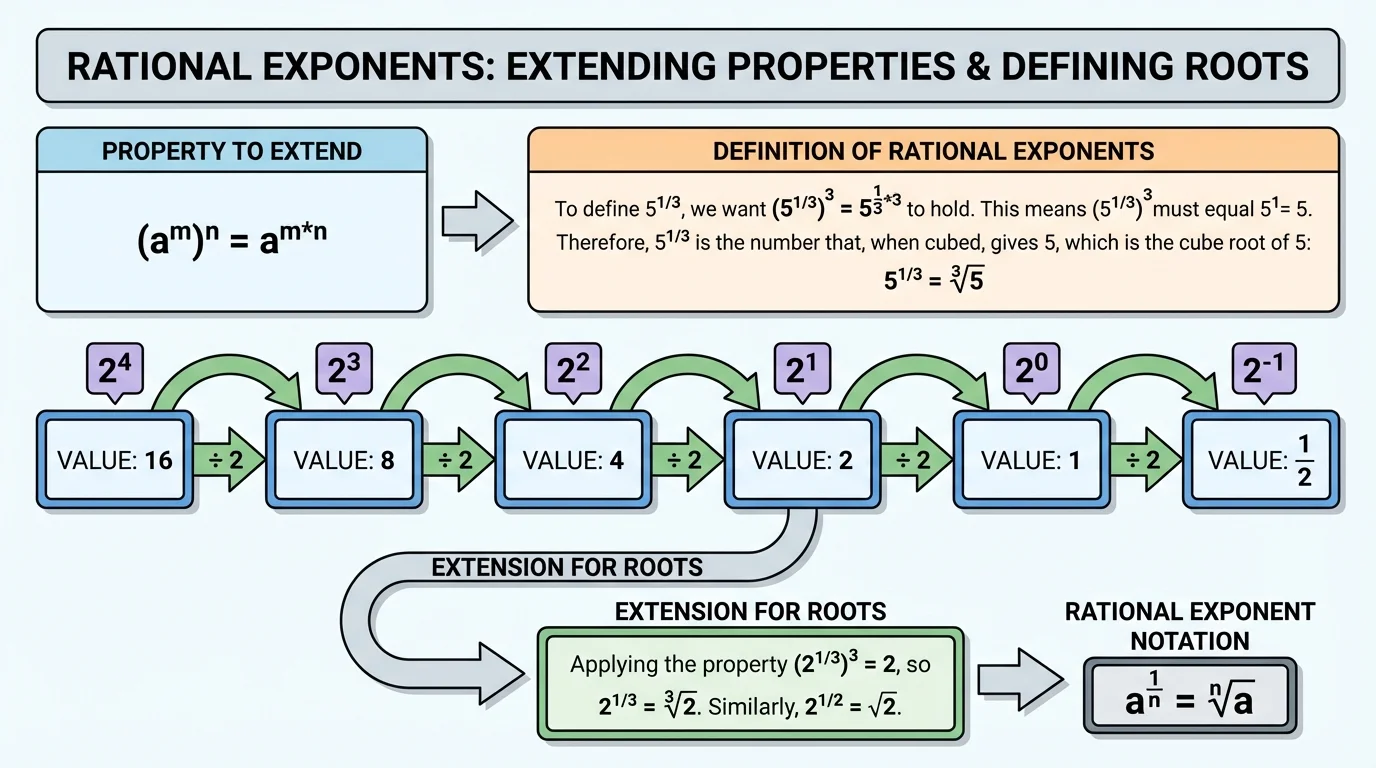
This same idea motivates fractional exponents. Suppose we want to define \(5^{1/3}\). The exponent law \((a^m)^n = a^{mn}\) should still hold. If it does, then \((5^{1/3})^3 = 5^{(1/3)\cdot 3} = 5^1 = 5\). That means \(5^{1/3}\) must be a number that, when cubed, equals \(5\). In other words, \(5^{1/3}\) must be the cube root of \(5\).
For integer exponents, several laws are already familiar: \(a^m \cdot a^n = a^{m+n}\), \(\dfrac{a^m}{a^n} = a^{m-n}\) when \(a \ne 0\), and \((a^m)^n = a^{mn}\). Rational exponents are defined so that these same relationships continue to work whenever the expressions are meaningful in the real numbers.
This is the central idea: rational exponents are not arbitrary. They are defined so the exponent rules remain consistent. Algebra becomes much more powerful when one notation system can represent both repeated multiplication and roots.
Let \(a\) be a positive real number and let \(n\) be a positive integer. We define
Rational exponent notation extends exponent rules to fractional powers. In particular, for appropriate real numbers, \(a^{1/n}\) means the number whose \(n\)th power is \(a\), and more generally \(a^{m/n}\) is built from that definition.
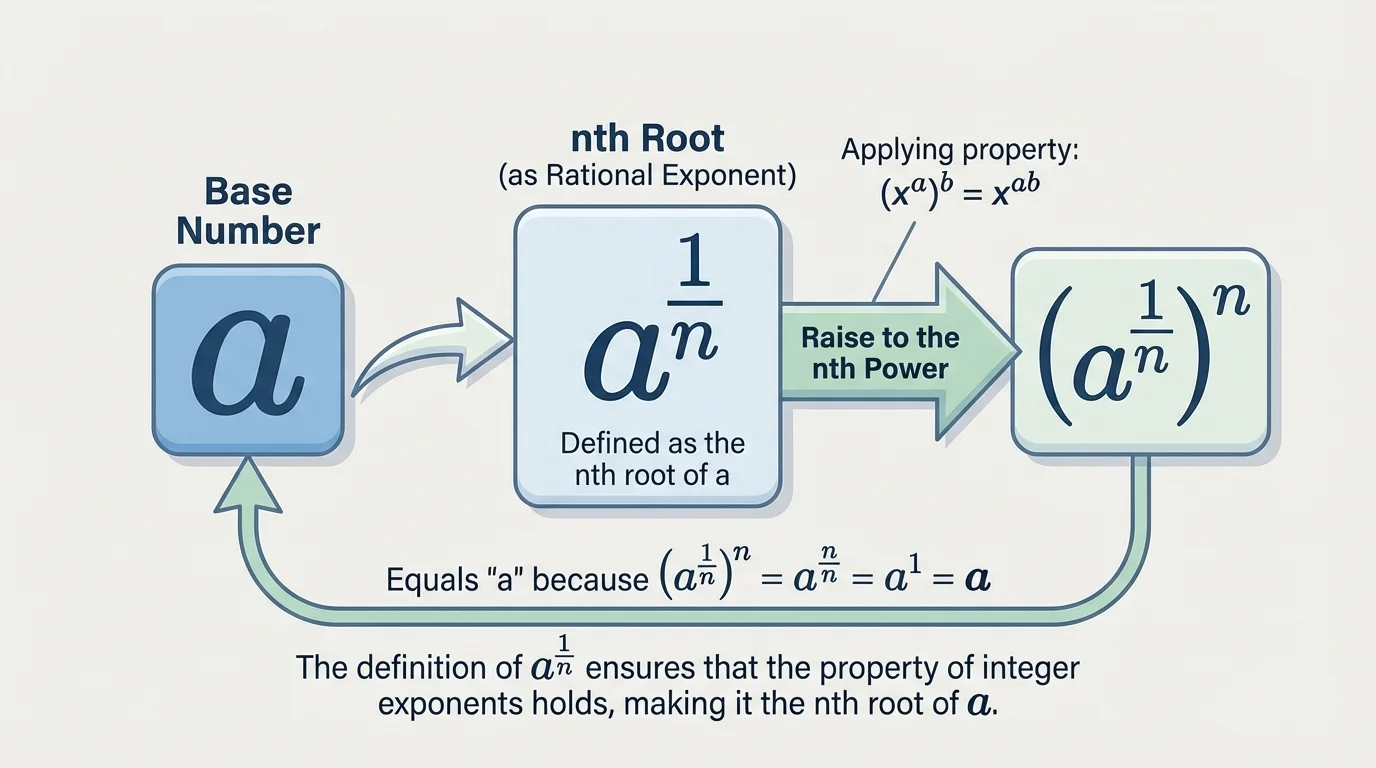
[Figure 2] The basic definition is
\[a^{1/n} = \sqrt[n]{a}\]
because we want
\[(a^{1/n})^n = a^{(1/n)\cdot n} = a\]
This shows that \(a^{1/n}\) is the nth root of \(a\): the number that gives \(a\) when raised to the \(n\)th power. The notation \(a^{1/n}\) and \(\sqrt[n]{a}\) describe the same quantity, just from two different viewpoints: one emphasizes exponents, and the other emphasizes roots.
For example, since \(2^3 = 8\), we have \(8^{1/3} = 2\). Since \(3^4 = 81\), we have \(81^{1/4} = 3\). Since \(7^2 = 49\), we have \(49^{1/2} = 7\), which is the same as \(\sqrt{49} = 7\).
Now consider a more general fractional exponent such as \(a^{m/n}\). We define it by combining powers and roots:
\[a^{m/n} = \left(a^{1/n}\right)^m = \left(\sqrt[n]{a}\right)^m = \sqrt[n]{a^m}\]
These expressions are equal when the quantities are defined in the real number system. This gives us a powerful translation rule between radicals and exponents.
For instance, \(8^{2/3} = (8^{1/3})^2 = 2^2 = 4\). It can also be written as \(\sqrt[3]{8^2} = \sqrt[3]{64} = 4\). Both routes give the same answer.
Why the definition works
The definition of \(a^{1/n}\) is chosen to preserve the power-of-a-power rule. If \((a^{1/n})^n\) did not equal \(a\), then exponent laws would break as soon as we used fractional exponents. Defining rational exponents through roots keeps algebra consistent across integer, negative, zero, and fractional exponents.
This is why the example \(5^{1/3}\) is not a guess. We define \(5^{1/3}\) to be \(\sqrt[3]{5}\) because we require \((5^{1/3})^3 = 5\). The notation follows from the law, not the other way around.
Once the basic definition is in place, you can move back and forth between rational exponents and radicals. This is especially useful when simplifying expressions. A radical such as \(\sqrt[4]{x^3}\) can be written as \(x^{3/4}\), and an expression like \(27^{2/3}\) can be written as \((\sqrt[3]{27})^2\).
Here are common translations:
| Radical form | Rational exponent form |
|---|---|
| \(\sqrt{a}\) | \(a^{1/2}\) |
| \(\sqrt[3]{a}\) | \(a^{1/3}\) |
| \(\sqrt[n]{a}\) | \(a^{1/n}\) |
| \(\sqrt[n]{a^m}\) | \(a^{m/n}\) |
Table 1. Equivalent forms for radicals and rational exponents.
It is often helpful to think of the denominator of the exponent as telling you the root, and the numerator as telling you the power. In \(a^{m/n}\), the \(n\) means "take the \(n\)th root," and the \(m\) means "raise to the \(m\)th power."
For example, \(16^{3/4}\) means "take the fourth root of \(16\), then cube the result," or "cube \(16\), then take the fourth root." Since \(16^{1/4} = 2\), we get \(16^{3/4} = 2^3 = 8\).
Not every rational exponent expression represents a real number. The real number system has rules about roots, and these rules matter. As [Figure 3] highlights, the key issue is whether the root index is even or odd.
If \(n\) is odd, then \(a^{1/n}\) exists for every real number \(a\). For example, \((-8)^{1/3} = -2\) because \((-2)^3 = -8\). Cube roots of negative numbers are real.
If \(n\) is even, then \(a^{1/n}\) is only a real number when \(a \ge 0\). For example, \(16^{1/2} = 4\), but \((-16)^{1/2}\) is not a real number. There is no real number whose square is \(-16\).
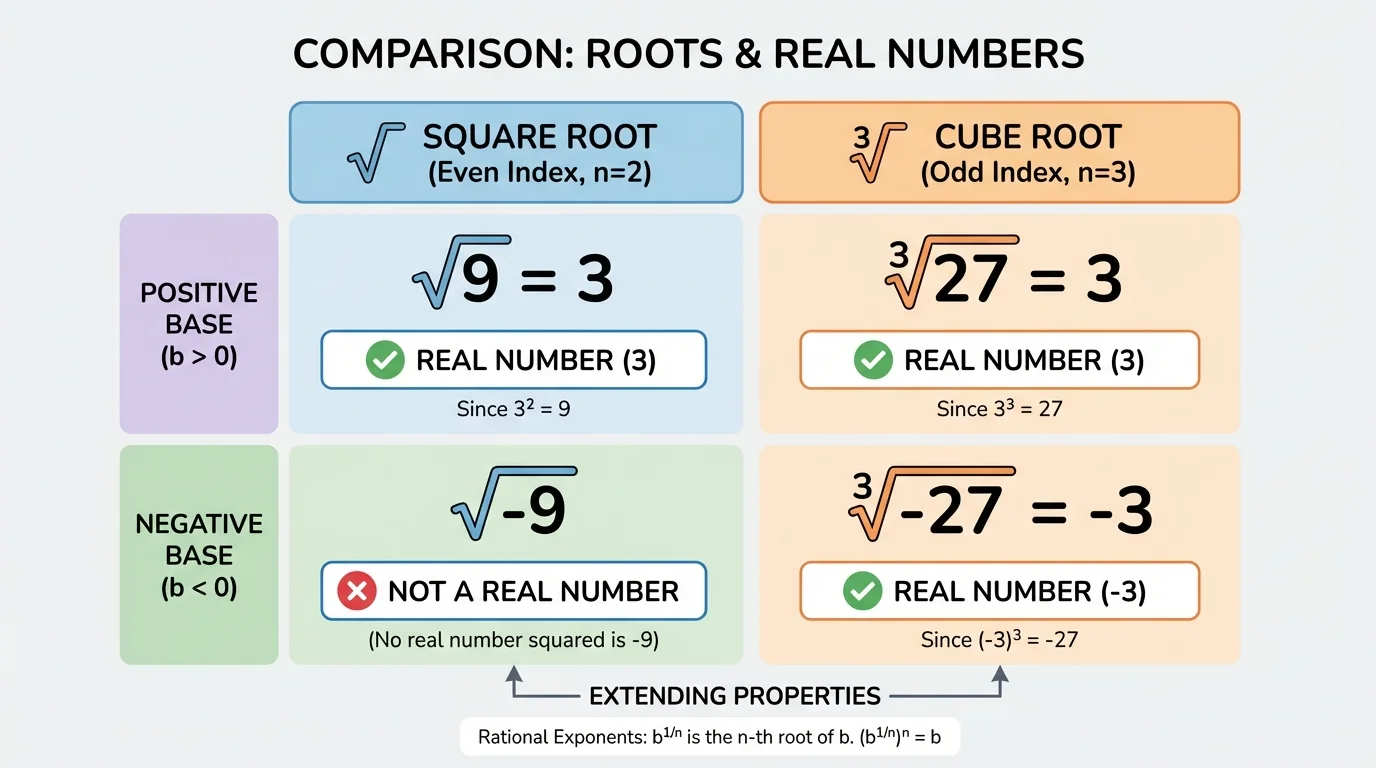
This means you must be careful with expressions like \((-32)^{2/5}\). Since the denominator \(5\) is odd, the fifth root of \(-32\) exists and equals \(-2\). Then \((-32)^{2/5} = \left((-32)^{1/5}\right)^2 = (-2)^2 = 4\).
But \((-16)^{3/4}\) is not a real number, because the fourth root of \(-16\) is not real. Even though the numerator is \(3\), the denominator \(4\) tells us we need a fourth root first.
Expressions with rational exponents often reveal whether a quantity makes sense in real life. A model might allow a cube root of a negative change, but a square root of a negative length or area usually signals that the situation is impossible in the real-number setting.
Another subtle point is principal roots. For example, \(16^{1/2} = 4\), not \(\pm 4\). The symbol \(\sqrt{16}\) refers to the principal square root, which is the nonnegative one. Although both \(4^2\) and \((-4)^2\) equal \(16\), the expression \(16^{1/2}\) means the principal root.
Because rational exponents are defined by extending exponent laws, many familiar properties still hold. For positive real numbers \(a\) and \(b\), and rational numbers \(r\) and \(s\), we use:
\[a^r \cdot a^s = a^{r+s}\]
\[\frac{a^r}{a^s} = a^{r-s} \quad \textrm{for } a \ne 0\]
\[(a^r)^s = a^{rs}\]
\[(ab)^r = a^r b^r\]
\[\left(\frac{a}{b}\right)^r = \frac{a^r}{b^r} \quad \textrm{for } b \ne 0\]
These properties are extremely useful, but they should be applied with attention to domain restrictions. For example, \((ab)^{1/2} = a^{1/2}b^{1/2}\) is safe in the real numbers when \(a \ge 0\) and \(b \ge 0\). If negative values are involved, the expression may not be real.
Returning to [Figure 1], the same idea drives everything here: exponent rules are preserved rather than replaced. Rational exponents fit into the same system as integer exponents.
Worked examples make the definitions concrete. Pay attention to how each step uses a rule or a definition.
Example 1: Evaluate \(27^{2/3}\).
Step 1: Interpret the exponent.
The denominator \(3\) means cube root, and the numerator \(2\) means square:
\(27^{2/3} = (27^{1/3})^2\).
Step 2: Find the cube root.
Since \(3^3 = 27\), we have \(27^{1/3} = 3\).
Step 3: Square the result.
\(3^2 = 9\).
So, \[27^{2/3} = 9\]
This example also works in radical form: \(\sqrt[3]{27^2} = \sqrt[3]{729} = 9\).
Example 2: Rewrite \(\sqrt[5]{x^3}\) using a rational exponent.
Step 1: Identify the root index and the power.
The fifth root gives denominator \(5\), and the exponent on \(x\) gives numerator \(3\).
Step 2: Write the equivalent exponent form.
\(\sqrt[5]{x^3} = x^{3/5}\).
Therefore, \[\sqrt[5]{x^3} = x^{3/5}\]
Being able to switch forms matters because one form may be easier to simplify than the other.
Example 3: Simplify \(16^{3/4}\).
Step 1: Use the denominator to find the root.
\(16^{1/4} = 2\) because \(2^4 = 16\).
Step 2: Apply the numerator.
\(16^{3/4} = (16^{1/4})^3 = 2^3 = 8\).
So, \[16^{3/4} = 8\]
Notice how much easier this is when you recognize \(16\) as a perfect fourth power.
Example 4: Determine whether \((-32)^{2/5}\) is a real number, and if so, evaluate it.
Step 1: Check the denominator.
The denominator is \(5\), which is odd, so the fifth root of a negative number is real.
Step 2: Find the fifth root.
\((-32)^{1/5} = -2\), because \((-2)^5 = -32\).
Step 3: Square the result.
\((-2)^2 = 4\).
Thus, \[(-32)^{2/5} = 4\]
This is a good reminder that negative bases are sometimes allowed with rational exponents, but not always. The denominator of the exponent is the key clue.
One common mistake is treating \(a^{1/2}\) as \(\pm\sqrt{a}\). In exponent notation, \(a^{1/2}\) means the principal square root, so for \(a \ge 0\), it is nonnegative.
Another mistake is ignoring parentheses. Compare \(-8^{1/3}\) with \((-8)^{1/3}\). The first means the negative of \(8^{1/3}\), which is \(-2\). The second means the cube root of \(-8\), which is also \(-2\). In this case they match, but with other exponents parentheses can change the meaning dramatically.
A third mistake is simplifying in the wrong order without checking whether the expression is real. For example, \((-16)^{1/2}\) is not a real number, so trying to use ordinary real-number exponent rules on it can lead to incorrect conclusions.
Looking back at [Figure 3], the even-root versus odd-root distinction helps prevent these errors. If the root index is even, negative radicands do not produce real numbers.
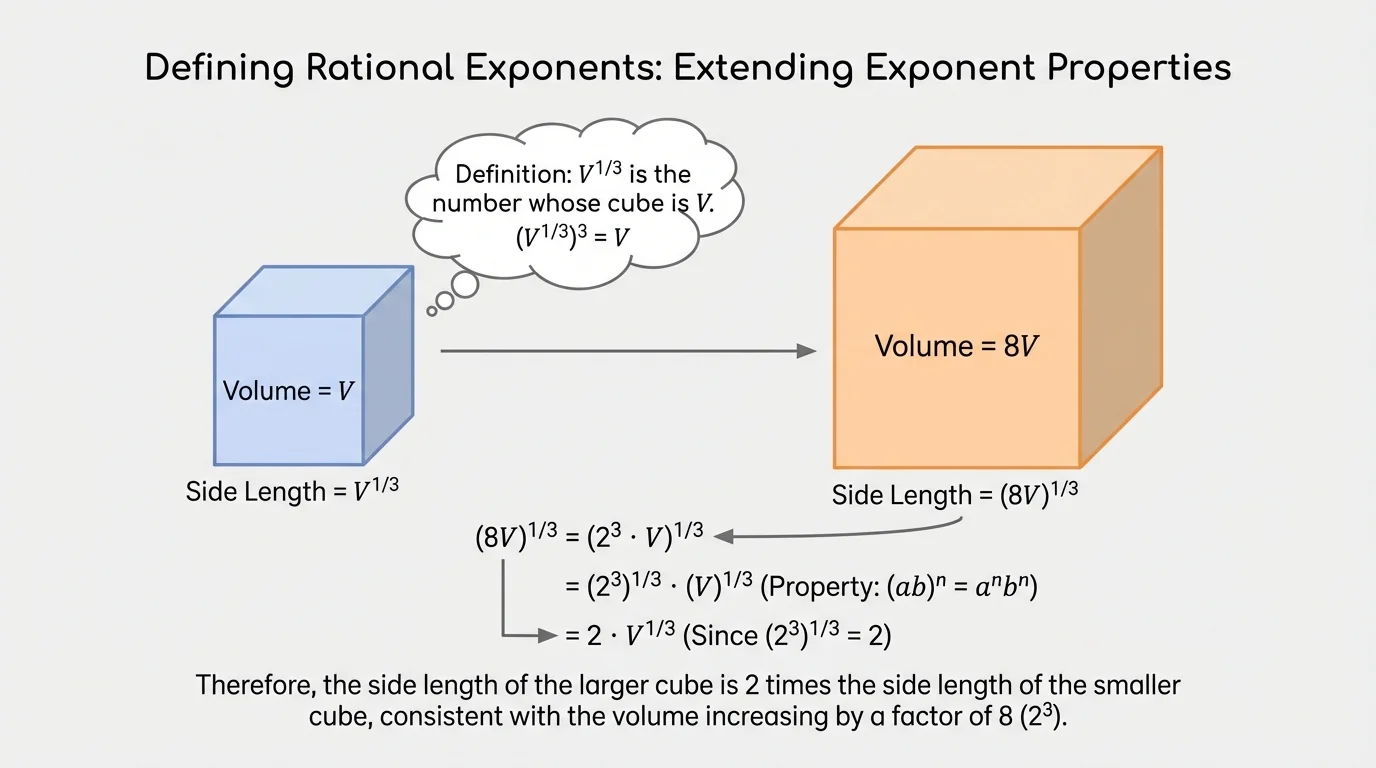
[Figure 4] shows how rational exponents appear in science, engineering, and geometry because many formulas involve roots. In measurement problems, for example, volume and side length are connected by cube roots. A cube with volume \(V\) has side length \(s = V^{1/3}\). This relationship is easier to analyze when written in exponent form.
If a cube-shaped container has volume \(64\) cubic units, then its side length is \(64^{1/3} = 4\). If the volume is multiplied by \(8\), the side length is multiplied by \(8^{1/3} = 2\). That is a compact and powerful use of rational exponents.
In chemistry and physics, formulas sometimes require square roots or cube roots when solving for an unknown quantity. In finance and population studies, fractional exponents can appear when reversing exponential growth. For example, if a quantity grows by the same factor each year, finding the yearly growth factor over several years may require taking an \(n\)th root.
In digital technology and engineering, scaling laws matter. If the volume of a 3D-printed object changes, its linear dimensions change according to cube roots, not in direct proportion. That difference affects design, material use, and performance.
So rational exponents are not just another algebra rule to memorize. They are the language used whenever a problem asks, in effect, "What number raised to this power gives the quantity I know?"
