A streaming service charges a sign-up fee, a delivery company adds the same amount per mile, and an investment account grows by a fixed percent each month. These may seem like completely different situations, but they share one powerful idea: each can be described by a function. The challenge is not only to find a rule, but to decide which kind of rule fits the context best. Sometimes you want a direct formula. Sometimes the situation naturally unfolds one step at a time. Sometimes the clearest model is a list of instructions for calculating an output from an input.
When you build a function from a real situation, you are turning words into mathematics. That means paying attention to what changes, what stays constant, what happens first, and whether each value depends directly on the input or on the previous value. This skill is central in algebra because real-world quantities rarely arrive labeled as equations. You have to extract the structure from the context.
A function describes how one quantity depends on another. If the input is the number of hours worked, the output might be total pay. If the input is the month number, the output might be the amount in a savings account. If the input is the number of tickets sold, the output might be total revenue.
Words such as "starts with," "increases by," "multiplied by," "every time," and "after each month" give important clues about the mathematical structure. A statement like "starts at \(50\) and increases by \(8\) each week" suggests linear change. A statement like "starts at \(50\) and increases by \(8\%\) each week" suggests exponential change. The difference between adding and multiplying is one of the biggest ideas in modeling.
Recall: A relationship is linear when equal changes in the input produce equal additive changes in the output. A relationship is exponential when equal changes in the input produce equal multiplicative changes in the output.
Context also tells you what the variables mean. If \(n\) is the number of months, then \(n = 0\) may represent the starting month. If \(n\) is the first, second, third, and fourth payment, then the sequence may begin at \(n = 1\). This matters because the formula changes depending on where counting begins.
There are three common ways to model a relationship from a context, as [Figure 1] shows when the same situation is written in different forms. Each form tells the same mathematical story, but from a different point of view.
An explicit expression gives the output directly from the input. For example, if a gym charges a $30 start-up fee and $12 per month, then the total cost after \(m\) months can be written as \(C(m) = 30 + 12m\). You can substitute any value of \(m\) and calculate the answer immediately.
A recursive process defines each output using the previous one. For the same gym situation, if the first month's total is \(42\), then later totals can be built by adding \(12\) each month: \(C_1 = 42\), and \(C_n = C_{n-1} + 12\) for \(n \ge 2\).
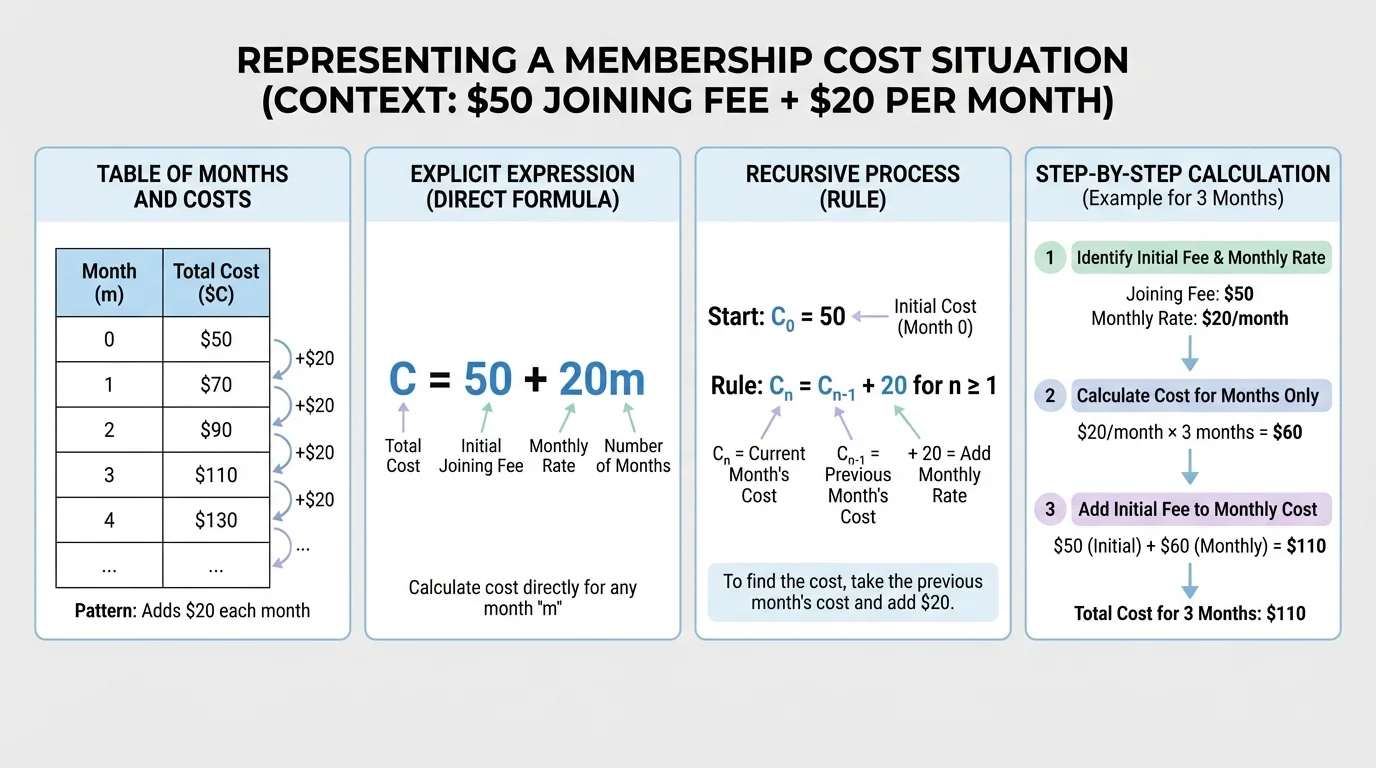
Steps for calculation are a verbal or procedural description of how to compute the output. For the gym example: first multiply the number of months by \(12\), then add \(30\). This can be especially useful before the symbolic formula is written, or when students are translating everyday language into algebra.
These are not competing methods. They are connected representations. In fact, strong mathematical modeling means being able to move among them. Later, when comparing forms again, [Figure 1] remains useful because it shows that one context can be represented in several valid ways.
Before writing any expression or process, identify the key parts of the situation.
First, find the input and output. Ask: what quantity is being chosen or counted, and what quantity depends on it? In a bike rental, the input may be hours rented, and the output may be total cost.
Second, find the initial value. This is the amount present before any change happens. Words like "starting amount," "initial fee," "when \(x = 0\)," or "already has" usually signal this quantity.
Third, find the pattern of change. Does the amount increase by a constant number, such as \(5\) each day? Or does it grow by a constant factor, such as multiplying by \(1.03\) each month?
Fourth, decide the most natural form. If the context asks for a direct value for any input, an explicit formula is often best. If the context unfolds over time and each stage builds from the one before, a recursive process may fit more naturally. If the relationship is described in operations, calculation steps may be the clearest starting point.
Explicit expression: a rule that gives the output directly from the input.
Recursive process: a rule that defines each value using one or more earlier values, together with a starting value.
Initial value: the starting amount before change occurs.
Rate of change: how much the output changes when the input increases by one unit, for linear situations.
One subtle but important point is that contexts may describe sequences or functions. If the input takes only counting numbers like \(1, 2, 3, ...\), you are often working with a sequence. If the input can be any real number in an interval, such as time in hours, you are often working with a continuous function. The modeling ideas are similar, but the notation may look slightly different.
An explicit expression is the most direct model because it lets you compute the output in one substitution. In many real-world problems, you can build it from two pieces: an initial value and a rule for change. For linear contexts, this often looks like \(y = mx + b\), where \(b\) is the starting amount and \(m\) is the rate of change.
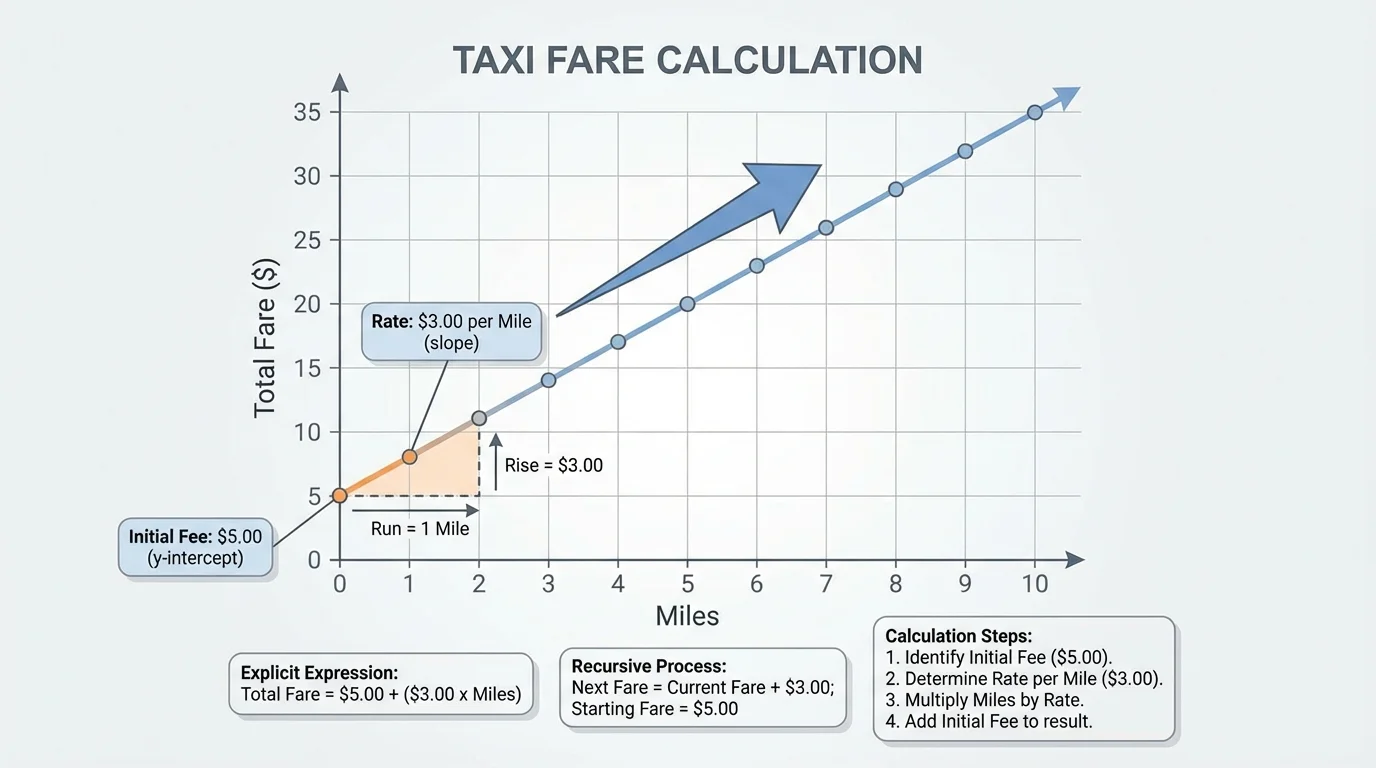
[Figure 2] helps illustrate a taxi fare model. If a taxi charges a $4 base fee and $2.50 per mile, then the total fare for \(m\) miles is \(F(m) = 4 + 2.5m\).
The graph helps connect the context to the formula. The starting fee is the y-intercept, and the cost per mile is the slope. Reading contexts this way is one of the most important habits in algebra.
Explicit expressions are also useful for exponential contexts. If a quantity starts at \(A_0\) and is multiplied by a factor of \(r\) each time period, then after \(n\) periods the amount is often written as \(A(n) = A_0 r^n\) when counting begins at \(n = 0\). For example, if a bacteria culture starts with \(500\) cells and doubles every hour, then \(B(t) = 500 \cdot 2^t\).
The phrase "doubles every hour" means multiply by \(2\), not add \(2\). The phrase "increases by \(20\%\)" means multiply by \(1.20\). The phrase "decreases by \(20\%\)" means multiply by \(0.80\). These conversions are essential when writing explicit expressions from context.
Worked example 1: Writing an explicit linear function
A concert venue charges a one-time service fee of $15 plus $28 per ticket. Write a function for the total cost of buying \(t\) tickets.
Step 1: Identify the starting amount and the rate.
The service fee is $15, so the initial value is \(15\). Each ticket adds $28, so the rate of change is \(28\) per ticket.
Step 2: Write the expression.
Total cost equals starting fee plus ticket cost: \(C(t) = 15 + 28t\).
Step 3: Interpret the function.
If \(t = 3\), then \(C(3) = 15 + 28(3) = 15 + 84 = 99\).
The explicit function is \[C(t) = 15 + 28t\]
Notice how naturally the words become algebra: "plus" suggests addition, and "per ticket" identifies the variable part.
[Figure 3] shows how a recursive process can model repeated monthly growth. Instead of jumping straight to the \(n\)th value, you define how to get the next value from the current one.
For linear sequences, recursion often means adding the same amount repeatedly. If a student saves $25 each week starting with $40, then one recursive model is \(S_0 = 40\), and \(S_n = S_{n-1} + 25\) for \(n \ge 1\).
For exponential growth, recursion means multiplying by the same factor repeatedly. If a social media account has \(800\) followers and gains \(10\%\) each week, then \(F_0 = 800\), and \(F_n = 1.10F_{n-1}\).
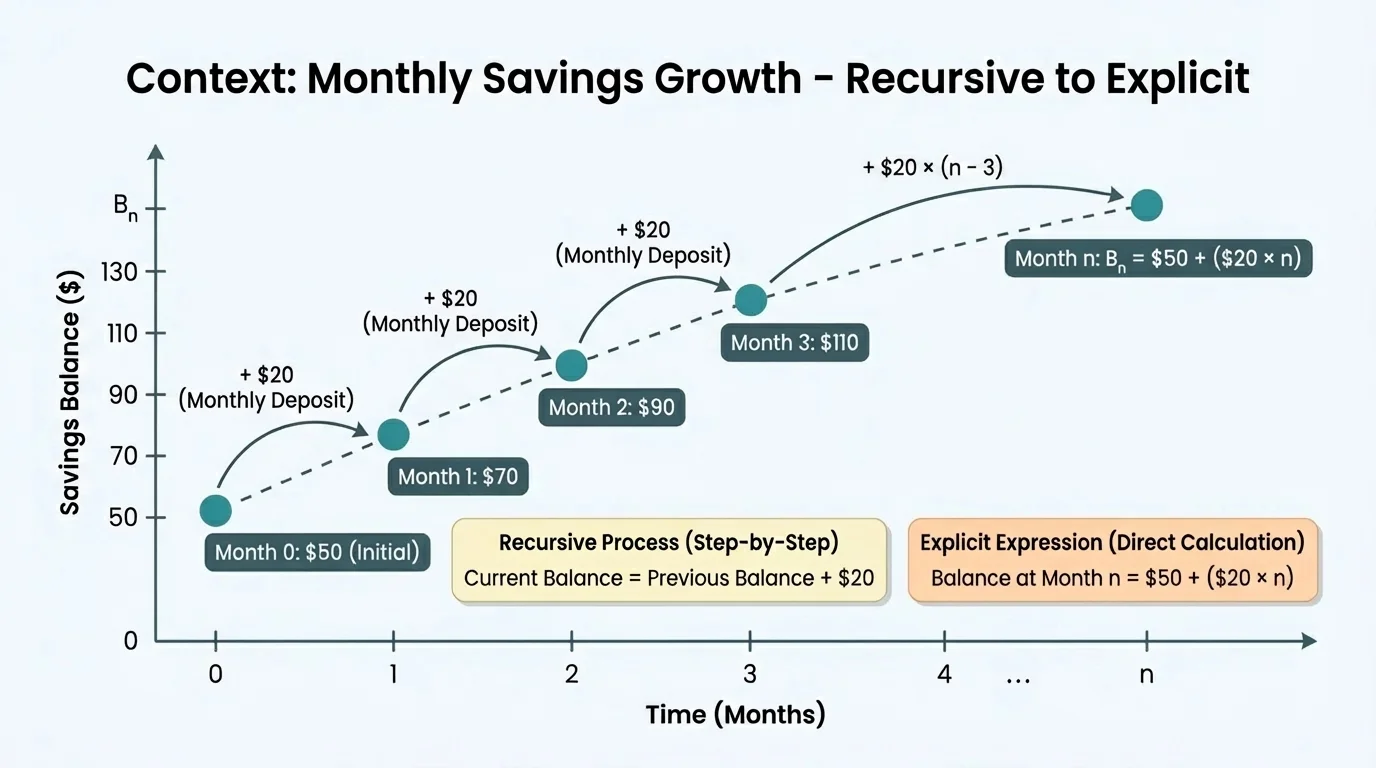
Recursive rules are common in finance, population growth, inventory, and computer algorithms because many systems update from one stage to the next. They are also useful when you actually compute values one at a time in a table.
However, recursion requires a starting value. Without that first term, the rule is incomplete. Saying "add \(7\) each time" does not tell you the sequence unless you also know where it begins.
When recursive form is more natural
If the context describes what happens next after each time period, recursive form is often the clearest first model. For example, "each month the balance becomes the old balance plus $50" or "each year the population becomes \(1.03\) times the previous population" both naturally describe recursion before they describe an explicit rule.
Later, some recursive relationships can be converted into explicit expressions. For arithmetic sequences, repeated addition becomes a linear formula. For geometric sequences, repeated multiplication becomes an exponential formula.
Worked example 2: Writing a recursive process
A town begins a tree-planting program with \(120\) trees. Each year, \(18\) more trees are planted. Write a recursive model for the total number of trees after \(n\) years.
Step 1: Find the starting value.
At year \(0\), there are \(120\) trees. So \(T_0 = 120\).
Step 2: Describe how one year leads to the next.
Each year adds \(18\) trees, so the next total is the previous total plus \(18\).
Step 3: Write the recursive rule.
\(T_n = T_{n-1} + 18\) for \(n \ge 1\).
The recursive model is \[T_0 = 120, \quad T_n = T_{n-1} + 18\]
If needed, you could then compute values one by one: \(T_1 = 138\), \(T_2 = 156\), and so on.
Sometimes a context is most understandable as a list of operations before it becomes a symbolic formula. A calculation process is still a function description if each input leads to exactly one output.
For example, suppose a website designer charges $250 as a setup fee and then $40 per page. A student might first write the steps: take the number of pages, multiply by \(40\), then add \(250\). This is perfectly valid as a way to describe the relationship. The symbolic function is \(C(p) = 40p + 250\).
Calculation steps are especially helpful in multistage contexts. For example, a salesperson earns an hourly wage and then receives a bonus if a target is reached. Or a package shipping cost may depend on weight, then taxes, then a handling fee. Clear steps help preserve the order of operations.
Worked example 3: Writing steps for calculation and then a formula
A custom notebook company charges $6 per notebook and then adds a shipping fee of $9 to the order. Describe the calculation steps and write a function for the total cost of \(n\) notebooks.
Step 1: Describe the procedure in words.
Multiply the number of notebooks by \(6\). Then add \(9\).
Step 2: Translate the steps into algebra.
Notebook cost is \(6n\). After adding shipping, total cost is \(6n + 9\).
Step 3: Test a value.
If \(n = 4\), then total cost is \(6(4) + 9 = 24 + 9 = 33\).
The function is \[C(n) = 6n + 9\]
Although this example becomes a simple explicit expression, the calculation steps are often the bridge between context and algebra.
Different forms emphasize different ideas, and [Figure 4] displays how a verbal context can move into a table, then into either an explicit or recursive rule. Skilled modelers choose the form that best matches the question being asked.
If you want the value for a large input right away, explicit form is efficient. To find the \(100\)th value, substituting into a formula is much faster than computing the first \(99\) values recursively.
If you want to simulate what happens over time, recursive form may be more natural. This is common in spreadsheets, coding, and finance because each new row or time step comes from the previous one.
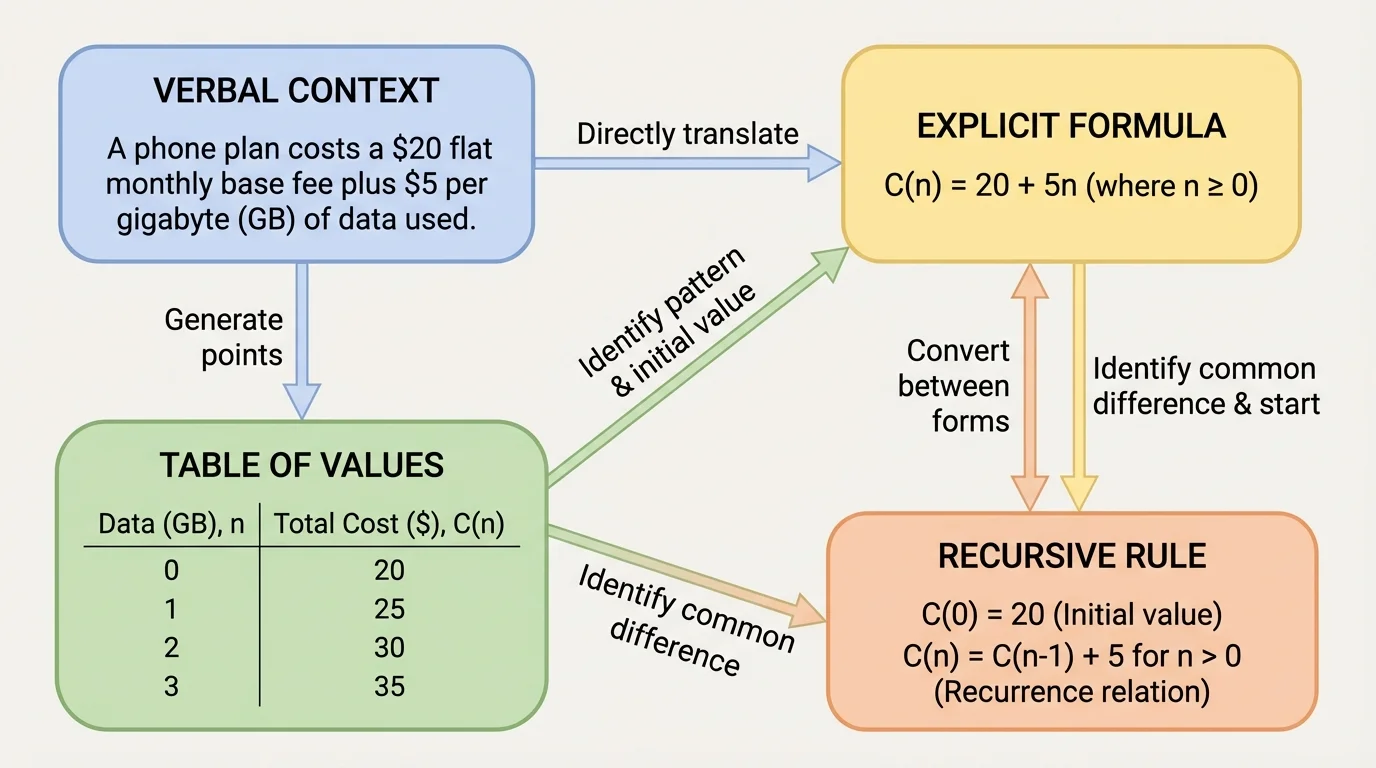
If you are first translating a real situation into mathematics, step-by-step calculation can help organize the reasoning. Later, you may compress the steps into a formula.
For instance, consider a phone plan with a $20 monthly fee and $5 per gigabyte used. A direct formula is \(C(g) = 20 + 5g\). A recursive form across increasing whole-number gigabytes could be \(C_0 = 20\), and \(C_n = C_{n-1} + 5\). A calculation process says: multiply gigabytes by \(5\), then add \(20\). These are all connected descriptions of the same relationship. As seen earlier in [Figure 1], changing the representation does not change the situation being modeled.
Worked example 4: Exponential explicit model
A laptop loses \(12\%\) of its value each year and is worth $900 when purchased. Write an explicit function for its value after \(n\) years.
Step 1: Identify the initial value.
The laptop starts at $900, so the initial value is \(900\).
Step 2: Convert the percent decrease to a multiplier.
A decrease of \(12\%\) means the laptop keeps \(88\%\) of its value each year, so the multiplier is \(0.88\).
Step 3: Write the exponential function.
\(V(n) = 900(0.88)^n\).
Step 4: Evaluate if needed.
After \(3\) years, \(V(3) = 900(0.88)^3 \approx 900(0.681472) \approx 613.32\).
The explicit model is \[V(n) = 900(0.88)^n\]
This kind of model appears in depreciation, medicine dosage, and radioactive decay. The key clue is repeated multiplication by the same factor.
Worked example 5: From recursive to explicit
A video channel has \(150\) subscribers at the start and gains \(25\) subscribers each week.
Step 1: Write the recursive model.
\(S_0 = 150\), and \(S_n = S_{n-1} + 25\).
Step 2: Recognize the pattern.
This is repeated addition of \(25\), so it is linear.
Step 3: Write the explicit model.
Starting value plus \(25\) for each week gives \(S(n) = 150 + 25n\).
Step 4: Check agreement.
For \(n = 4\), the explicit model gives \(150 + 25(4) = 250\). The recursive model also gives \(175, 200, 225, 250\).
The explicit model is \[S(n) = 150 + 25n\]
When the change is additive and constant, recursion and explicit form connect neatly through linear structure.
Function building is not just a classroom exercise. Businesses use explicit formulas to estimate revenue quickly. Banks and financial apps use recursive processes to update balances month by month. Engineers use calculation steps to design costing systems and material estimates. Public health researchers model population growth, disease spread, and treatment levels using explicit and recursive functions.
In coding and spreadsheets, recursion and step-by-step calculation are especially important. A spreadsheet may compute each row from the row above it, which mirrors a recursive process. A program may apply operations in sequence, which mirrors calculation steps. But if you need to predict a far-future value quickly, an explicit formula is often better.
Many smartphone battery predictions rely on function models. The device estimates future battery life from present charge, recent usage rate, and repeated updates over time, which is essentially a real-world mix of recursive and explicit reasoning.
Scientists also choose among forms depending on purpose. A recursive model may describe day-to-day data collection, while an explicit formula may summarize the long-term pattern.
One common mistake is confusing "increase by \(5\)" with "increase by \(5\%\)." The first means add \(5\). The second means multiply by \(1.05\). These produce very different models.
Another mistake is forgetting the initial value. A context such as "$18 per month plus a sign-up fee of $40" should not become just \(18m\). The fee matters, so the correct model is \(40 + 18m\).
A third mistake is starting the count incorrectly. If a recursive rule begins with \(a_1\), then your explicit expression may look different than if it begins with \(a_0\). Always ask what input value represents the beginning.
Students also sometimes write a recursive rule without the starting term. But a recursive process is incomplete unless it includes both the initial condition and the update rule.
| Clue from context | Likely operation | Typical model type |
|---|---|---|
| "Starts at \(b\), then adds \(m\) each time" | Addition | Linear explicit or recursive |
| "Starts at \(A_0\), then multiplies by \(r\) each time" | Multiplication | Exponential explicit or recursive |
| "First do this, then that" | Ordered operations | Calculation steps, then formula |
| "Depends on previous value" | Update from earlier term | Recursive process |
| "Find the output directly for any input" | Direct substitution | Explicit expression |
Table 1. Common wording clues that help identify the appropriate type of model.
As shown earlier in [Figure 2], linear contexts often combine a visible starting amount with a constant rate, while [Figure 3] reminds us that recursive thinking focuses on how one stage becomes the next.
"A formula is a compressed story about how quantities are related."
That idea is worth taking seriously. When you build a function from context, you are not just manipulating symbols. You are deciding which story the quantities are telling: direct, step-by-step, or one term after another.
